

Jett Battery Heated Vest for Motorcycling
Finally — nice warm heat without wires!
This must be the Year of the Heated Vest!
And just in time, because the frost is on the pumpkin, as they say, here in the Mid-Atlantic U.S.A. (translation: it’s October and it’s starting to get cold!).
The EXO2 StormRider heated vest (review) remains a big hit around here.
Just as I was thinking about dusting it off and installing the StormRider’s controller on the GT1000, along comes the Jett battery heated vest to save the day.
webBikeWorld visitors will remember that weren’t very pleased with some of the other heated vests we’ve reviewed for a variety of reasons.
These included hot spots caused by internal wiring to the amount of power that they draw to the pain of installing the wiring harness and having to mess with mounting the controllers.
Besides that, some of the manufacturers actually charge extra for a controller, believe it or not!
That’s like buying a motorcycle and having to pay extra for the handlebars and throttle.
Check out our Gerbing heated jacket liner review, the Chilli heated vest review and the aforementioned EXO2 StormRider heated vest review for more information.
I held out a hope that some day technology would come to the rescue, and that day has arrived, for the Jett battery heated vest is completely self contained, powered by the latest in rechargeable battery technology with a two-unit lithium-polymer battery pack.
Wireless Heat
Think about it — no more wires, no more wiring harness, no accessory controller, no mounting problems and no drain on the motorcycle battery!
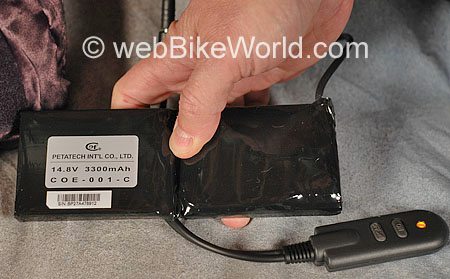
The four 3.7V lithium-polymer waterproof batteries are only 173 mm long by 55 mm wide and is a mere 11 mm thick ( 6-3/4″ by 2-3/8″ by 7/16″).
Yes, the battery pack does weigh 273 grams (9.63 oz.), but it fits nicely into a Velcro-covered pocket inside the right-hand bottom portion of the vest and the weight isn’t a problem.
(Note: We originally listed the Voltage for a single battery but in fact each battery is 3.7V and there are 4 of the slim 3.7V batteries in each vest battery pack for a total of 14.8V (4 x 3.7V). The dimensions and weight for the battery pack are correct.
See the comments section at the end of this page for more information on the batteries).
The battery pack has a single wire that attaches to a provided 120V (for the U.S. market) charger. The battery was almost completely charged when the vest arrived, but a full charge took about 2 hours or so.
The good news is that the battery lasts a long, long time and the vest puts out plenty of heat.
The heat seems to come on almost instantaneously, which is a real surprise. Switch on the vest and instant heat!
I’ve worn the vest for a measured 6 hours, alternating between the medium and high settings, and the battery was putting out warmth the entire time.
Jett claims that a single battery will last up to 4 hours on high, 5-6 hours on medium and up to 8 hours on low (Note: corrected from our original posting, which said the battery would last 4 hours), and of course your experience may vary.
Jett Heated Vest Controller
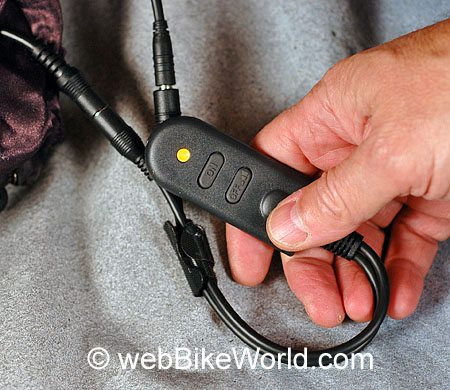
The Jett battery heated vest comes with a simple controller. The vest has a single wire routed right next to the battery pocket inside the right-hand bottom section of the vest; this is the wire that leads from the battery to power the vest. After the battery is charged, the battery wire and the vest wire are plugged into the controller and you’re good to go.
The controller hangs out the bottom of the right-hand side of the vest and it’s about the perfect length for any of the motorcycle jackets I’ve worn while evaluating the vest.
The controller wires are just long enough to let it hang out the bottom of a 3/4-length motorcycle jacket like the Tourmaster Advanced (review), the REV’IT! Cayenne (review) and others.
The controller has two push buttons; one turns the vest on and off and the other switches between the low, medium and high settings.
The low setting reaches 40 degrees Celsius (104F); the medium setting is 50C (122F) and the high setting is a hot 60C (140F).
Believe it or not, the high setting is almost too hot, if that can be possible in a motorcycle battery heated vest. I mostly keep the vest at the medium setting, with occasional forays into the red zone if I feel a chill.
Also, the vest seems to heat the back much hotter than the front, but the heat is in the right place, from the mid to lower back, down by the kidneys.
[UPDATE: Jett confirmed that the vest has heat elements only in the back. According to Jett, “this is the correct place to put heating as it is dangerous to have heating directly on your heart or too close, as experience has shown it can cause fainting. ]The rear elements will keep upper and lower back warm including kidneys.
These are vital, also being “FAR” infared heat (red heat), it is absorbed 90% into the body via the spine and will spread rapidly and safely though your whole body system. Here is a link which will explain the many benefits of far infrared heat.
The selection button cycles through the three heat settings and a small light cycles through green, orange and red to indicate the temperature.
The settings are changed by pressing the “off” button down for a split-second and the setting is changed at each press to the next level, starting over again at green.
And here’s one of the nicest features of the Jett battery heated vest: I can simply get off the bike and walk away without having to worry about forgetting to disconnect the wires to the bike’s wiring harness.
And, the vest keeps working — in fact, I’ve taken to wearing it around the house, outside, on hikes and other adventures… It works great for any type of outdoor event, and it’s a real freedom that pretty much makes all of the other wired motorcycle heated vests obsolete.
Another nice feature of the Jett battery heated vest is that it does not use wires to produce the heat. In fact, I’m not sure how it does it, but the vest heats via “Far Infrared Technology”, which is claimed to have all sorts of therapeutic benefits, including reduction of joint stiffness and back spasms, pain relief, increased blood flow, and more.
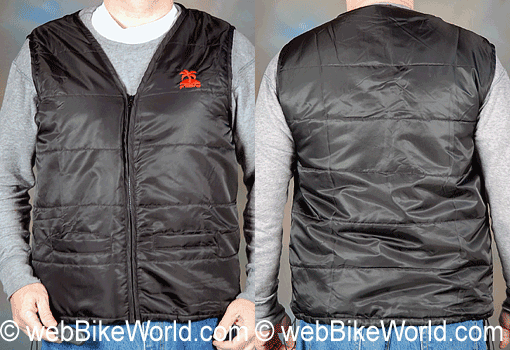
The Jett battery heated vest is available in a wide range of sizes from XXS to XXXXL.
Mine is a size large, and although Jett provides two elastic cinch adjusters, one around the chest and one down at the hem to help keep it snug, I’d probably order a size medium if I were to do it again.
The large seems just slightly too big for me — I have a U.S. men’s size 43 chest and I’d guess that the vest is maybe a 44 or 44.5.
Sizing Addendum
Read the paragraph directly above again and comments below and note that you may consider ordering one size smaller than normal for a snug fit; other owners have reported slightly larger than normal sizing after ordering the Jett vest.
I think it’s important to make sure any heated clothing fits slightly tight to keep the heat as close to the body as possible. Just remember that a heated garment should never be worn against bare skin.
I usually wear a thick cotton long-sleeve undershirt underneath and cover the vest with a stretchy turtleneck to keep the vest pressed against my core.
The Jett vest has a zipper up the front and a deep V-neck, so it shouldn’t interfere with a motorcycle jacket neck closure or zipper.
When the weather gets chilly, I usually wear the vest along with a 3/4-length motorcycle jacket and a neck wind block, like the EDZ MultiTube neck warmer (review), the Rukka neck warmer (review)or the Frank Thomas Antifreeze Neck Guard (review).
One of the nice things about wearing a heated vest is that you can usually get away with fewer layers under the motorcycle jacket, which provides greater freedom of movement and can actually be safer because you can move back and forth on the bike to check traffic.
The Jett battery heated vest is actually very reasonably priced at $275 Australian dollars, which equates to about $206.00 U.S. dollars.
Jett charges $30.00 Australian (about $22.00 USD) to ship worldwide. But wait, there’s more:
Conclusion
I’m really glad to be free of the wire, the controller installation, the battery harness and the charging problems associated with all of the other motorcycle heated vests we’ve tried.
The Jett battery heated vest has knocked all of our other heated vests out of contention and it has the added benefit of providing warmth during many other off-bike outdoor and indoor activities.
Add in the fact that the vest is reasonably priced and the free extra battery pack offer and you’ve got a real winner!
More on Battery Heated Vests
We recently purchased two more battery heated vests for evaluation; see the Brookstone heated vest review. One vest was from Brookstone, a popular catalog retailer, and the other was from Hammacher Schlemmer.
Our opinion is that the Jett vest provides the most reasonable solution for motorcycle riders in need of a battery heated vest.
More wBW Heated Clothing Reviews | Motorcycle Glove Reviews
| wBW Review: Jett Battery Heated Vest | |
|---|---|
| Manufacturer: Jett Performance Products Pty Ltd | List Price (2006): Contact Jett for latest pricing. |
| Colors: Black | Made In: Australia |
| Review Date: October 2006 | |
|
Note: Item was provided by a retailer, distributor or manufacturer with these Terms and Conditions.
|
|
Owner Comments and Feedback
See details on submitting comments.
From Jett Heated Vests (2007): “We use four 3.7 Volt, 3 Amp Lithium Polymer Batteries in series to make one battery pack, which gives us a 14.8 total Voltage.
The Wattage and power varies depending on which heat setting temperature is drawing the heat and cannot be compared to conventional means which use metal wires and also by implementing a Thermostat, gives us the ability to conserve battery power, similar to your central home heating.
Once the desired temperature has been reached the power cuts out and restarts as it drops to program level. Size of Batteries is always getting smaller and we will be replacing batteries with smaller types as they become available.
We hope to supply Batteries half the current size in the next 12 months.
Batteries are perfectly safe and also fitted with Overcharge Protection Circuit which protects from overcharging — you can leave on charger for months without any danger.
Also the polymer batteries do not explode like their hard cased counterparts –- they merely “puff up” like a soft pillow if damaged, even if dipped underwater. Hard cased batteries have been known to explode if exposed to water!”
From Ben B. (3/09): See this special report on modifying a Jett Battery Heated Vest to provide front heat for hyperthermia treatment for cancer.
From “D.J.”: “I have had the Jett vest for over a month, and I think it works very well. The batteries ability to power the vest for prolonged periods is phenomenal.
No doubt, riders winter riding needs are extremely idiosyncratic, varying with metabolism, circulation, cold sensitivity, the bike ridden and its unique pattern of wind blast, other garments, etc. I also have a Widder with arm chaps.
If I am looking at a longer ride below 40 degrees, its Widder Time. If I am looking for some comfort on a chilly day, on goes the Jett, if its not already on. I am 64, smoked 2 plus a day for 34 years, and don’t have the best circulation in the world.
I don’t have to be on the bike for my old bones to really appreciate the comfort that the Jett can provide, working outdoors, or even just around the house if the temp is in the teens. I wear it under an Aerostitch, well layered.
I ride both a BMW RT and a Honda VFR.
Skin out starts with a cotton tee, then Patagonia polycapilene long sleeve, then the electric vest, then a light fleece, then a $12 First Gear membrane liner, very thin, that is wind and waterproof, then the Stitch.
The layers are the same using either vest. If I were to loose a layer, it would definitely be the cotton tee. You know the hikers adage, cotton kills.
I would say that the $12 liner is a big key for me. I got the liner initially as a waterproof layer for under a mesh Sidi hot weather jacket. However, I have used the liner much more in cold weather.
The liner goes on before I need any electric or battery vest.
Even though MY Stitch is waterproof, it is not quite windproof. The liner is.
That liner makes a huge difference to my cold riding comfort, partly wind blast, and partly I suspect, vapor retention. Ask any physicist about the amount of energy that can be carried off by latent heat.
This is exactly what happens when vapor around your body is lost. A fellow named Stephenson, ex NASA engineer mfg’d some pretty exotic backpack gear as Warmlite, maybe still the best. He was nearly religious about preventing the loss of body moisture to conserve body heat.
I will admit that when I first received my Jett, I was disappointed, felt mislead when I discovered that there were only two 5″ square heated patches, and intended to return it. But after trying it, have certainly changed my mind.
Freedom from the umbilical to the bike is nice. The use off the bike, and when going from bike to bike, to maybe a bike without the right outlet are definite pluses. For me, esp on the RT, that little glow of heat in the small of my back is often just right.
On the VFR, I want more heat sooner. If I were smaller, rode more tucked in, and ran a hotter metabolism, maybe not.
I have tried to independently verify some of Jett’s info or claims regarding Far Infra Red (FIR) penetrating heat, being NASA derived, increasing blood flow being right over the kidneys, and having multiple health benefits, all without much success.
I did find one medical study that pretty much discounted all such medical claims (not just Jett) with the exception that arthritis sufferers find relief in the heat.
Just my taste, but I would be as happy not having read the extensive medical claims without authoritative data to back them up.
Regarding the arrangements, I think the battery should definitely not be in the back. Also, with the Velcro arrangement and quite a bit of cord, you can arrange the control fob about where you want it.
On the left would be OK, but what is overlooked, and not well explained, is that this vest has a built in thermostat.
When I run the Widder, I am constantly at the switch like every 2 to 4 minutes, too hot and off, now its cold and back on. The Widder definitely needs a thermostat too.
But with the Jett, just turn it on and let it do its thing. I have never used other than the first level of heat, level 2 is just too hot for me. You may not be able to select among heats 1, 2, or 3 by feel, but if you can’t turn it off and on by feel, maybe you shouldn’t be riding.
What might be nice would be a little stiffer fabric or something around the battery pocket. The battery has a little heft, and the battery pouch just feels a bit floppy.
Also a bit more massive Velcro tab to help hold the fob and cord in position would help.
All in all, I think this is a pretty amazing, if controversial product. Judging from your other battery vest reviews, Jett is obviously doing something right where others have failed.
One thing puzzles me however, is why after all the reviews of heated vests, some of which are obviously totally unacceptable, webBikeWorld has not reviewed Rider warehouse’ Kanetsu products, surely among the most innovative electric gear available today. Something’s going on. Is Andy not playing nice?
Whatever, I definitely appreciate what you guys are doing. I have bought a number of items that you have brought to my attention.
I am just about to the point that I buy absolutely nothing without an extensive professional review.
In the moto world, that is you guys, MCN, and motorcycle.com road tests. Keep it up, please.”
Editor’s Note: Thanks for the kind words! We just haven’t gotten around to the Kanetsu line, but I’ll add it to the shopping list.
From “J.A.”: “Thanks for testing the Jett vest. The concept of battery powered heat is interesting but for riders like myself it would be almost completely useless.
First, this vest has no heated collar. The carotid arteries are the perfect place to transfer external heat to your blood supply.
If you can’t proactively heat your neck you’re not going to be warm enough in extremely cold ambient temperatures. You’re not going to be very comfortable either.
Secondly it’s not difficult or complicated to wire a proper power socket for heated gear.
It’s not expensive either. I have to rely on my heated gear to work ALL the time. I can’t afford to have it crap out after 4 hours or 40 hours for that matter.
It must be capable of full power at all times period, no matter how far from home I ride or how long I’m gone.
I don’t need to fill my tank bag with spare batteries that may or may not work when I need them, nor do I want to be changing out vest batteries even if it’s only every 6 hours.
And no heat in the front of the vest? That’s just silly. That’s precisely where you’re being pounded by the cold air. Sure that helps the batteries last longer but who needs batteries?
Just plug in a proper piece of purpose-built motorcycle gear and you’re covered. You say this vest was not designed for specifically for motorcycle use. That’s pretty clear. The features (or the lack of features) are good reason to leave it for bird watchers, not riders.
And you don’t need a huge, high-capacity alternator to run a proper piece of heated gear.
Sure a full liner like Gerbings might draw 70 watts or more but a good vest, Widder to name one, is only pulling half of that. In addition to “big bikes” I’ve run my Widder very nicely on an 80cc Honda scooter.
I routinely use a Widder vest on my KLR 250cc and it gets nice and toasty with a simple on/off switch. Also even if you do have a serious electron shortage, just use a controller like the Heat Troller which is non-resistive.
Only take as little juice as you really need at any moment.
You might love the Jett vest but I’d give it thumbs down for motorcycle use at least here in the mountains of NH. It wouldn’t cut the mustard up here on the 45th parallel.”
Editor’s Reply: I’m not sure how to respond to your comments, because it’s not clear to me if you’ve actually worn a Jett vest and compared it to various electric vests?
We have — if you look through the webBikeWorld heated motorcycle clothing reviews, you’ll see that we’ve evaluated several vests and jackets. So I think we have some pretty good data to make our comparisons.
Regarding the issue of a collar: although they may exist, the heated vests we’ve seen do not have a collar that would cover the neck and carotid arteries.
All of the heated vests we reviewed and all of the heated vests I’ve seen in my recollection have a shallow or V-neck, which is typical for motorcycle vests.
Most motorcyclists I know do not want an extra collar binding up an already tight collar on most winter motorcycle jackets, and that’s the reason why most motorcycle vests do not have a collar.
RRegarding the heating elements in the front: Having heating elements in the front of the vest just doesn’t seem to make much difference to any of our evaluators as we compared the different vests.
A heated vest with heating elements in the front doesn’t necessarily mean the vest is better or puts out more heat, because not all electrically heated vests are equivalent. Some are worse than others.
We found that in our experience, the Chilli heated vest (review) was not as efficient as other vests we have evaluated, battery operated or otherwise.
The point is that comparing heated clothing solely on the basis of the number of elements it contains or whether it is battery powered or if it plugs into a motorcycle’s electrical system is not necessarily valid.
By the way, Jett recently told us that they’ve had such a high demand for the vests from motorcyclists that they are developing a motorcycle version that does have heat in the front.
Regarding electrically heated vests: We had electrical problems with at least one of the heated garments we tried. Motorcycles don’t always have powerful and perfectly operating electrical systems that are designed to operate heated clothing.
This problem is exacerbated if the rider is also using GPS, radio, auxiliary lights, etc. that are also wired into the bike’s system. From the emails we’ve received, it’s apparent that electrical system issues are common for riders who use electrically heated clothing.
Also, it’s very easy to carry a spare charged battery or two for the battery heated vest, which can give 6, 12, 14 or more hours worth of heat. I’m not sure how many riders need a flow of heat more than 6 or 7 hours straight.
And just because a heated garment plugs into a motorcycle’s electrical system doesn’t necessarily mean that everything will work without problems. There’s always the issue of having a blown fuse, a short, water in the electrical system, etc. in addition to the load on the battery.
So the point here is that it’s not that easy to make blanket statements — there’s always a compromise.
We did mention that battery heated clothing technology is in its infancy, but it’s our opinion that battery technology is rapidly evolving and battery heated clothing will have a huge impact on the motorcycle market.
We never meant to imply that a battery heated vest will alway put out more heat than an electrically heated vest – in fact, our evaluations of other battery heated vests show just the opposite.
We do think that the technology is making a huge impact in motorcycling however, and that’s a great thing for all of us.
From “A.”: “Thank you for your excellent and informative review of the Jett Heated Vest. I ordered one for my wife a few weeks ago, and she’s been nothing but happy with it since.
She rides year-round in the Pacific Northwest, and this vest has been a huge boon to her comfort and safety level.
We mentioned wBW in our order, and they sent along a second battery free.
Unfortunately, one of the two batteries was defective. I emailed the company, and they shipped us a replacement the next day, no questions asked.
That blew my mind, and made me feel very comfortable dealing with them; and trusting you as a no-nonsense source of valuable information. Keep up the great work.”
From “L.S.”: “I received my Jett Battery Powered Vest and had a question about the fit. When I put it on, it looks good in terms of fit (no bagginess, gaps under the arms, etc.).
The only thing is there’s just enough looseness around my abdomen that when I zip my winter jacket up, there’s a tendency for the vest to bunch up.
IIts not a big problem as I usually just reach in and smooth out the material before zipping the rest of the way up. I also will hold off cinching up the velco waist bands (its a 3/4 length jacket) until after I’m zipped up.
My question is – Is this an indication that I should have gotten a smaller size? I purchased a medium and its hard to believe I should wear a small but maybe so.”
Editor’s Reply: As we reported in the article, I usually take a large but should have ordered a medium, so possibly you could have ordered a small.
I wouldn’t worry about the front bunching up, mine fits loose also, as long as the vest provides the heat in the back.
Since we published the Jett article we have received several emails from other battery heated vest vendors asking if we could try theirs also — I didn’t know there were so many — and we’re currently in the process of evaluating 3 more brands.
From “E.W.”: “Thanks for the review. The vest was just what I wanted/needed. I like not having things attached to bike when I ride.
I ordered an XL and when it came found that it was too big.
I contacted Jett via email and within hours they responded saying that they would send (via Australia Express Mail) me large and wait till I got before sending back the XL (they would even reimburse me for shipping). I got it inside of a week.
Jett has great customer support too bad all online companies aren’t this easy to work with.”
From “D.B.”: “Even though It’s between 6 and 8 degrees Celsius here in Vancouver every morning lately, just the other day I decided not to put my bike into winter storage, and instead, continue riding all winter this year.
I’m just not emotionally ready to give up riding and return to driving this year.
So, it was with great interest that I read your review on the Jett Heated Vest. I had been considering buying a heated vest for quite some time and this one seemed to fit the bill.
I had a little bit of difficulty ordering online, as their secure server did not seem to be Mac friendly. I sent Rob at Jett an email pointing this out and he responded by telling me that they would look into this as quickly as possible.
It didn’t matter however, as a few minutes later the phone rang and it was Rob calling me from Australia to take my order personally.
One pleasant conversation later, I had ordered a medium, based on Jett’s sizing chart (I have a 42 inch chest). It arrived here from Australia in only 5 business days and was a perfect fit!
I have to say that I am very impressed by this vest. The heat comes on immediately, and there is plenty of it! Riding to work in 8 degrees, I only needed the vest on it’s lowest setting when worn under my Belstaff Mercury jacket (review).
The biggest advantage of this jacket over traditional heated vests is that it can be worn in so many environments, not just while plugged into your bike.
I work in the film industry and spend a lot of cold winter days, and nights, working outside. This vest and I are going to be spending a LOT of time together!
Thanks again for running such a great website and yet again pointing me towards yet another great product that I would have otherwise been completely unaware of. And of course the extra battery offer didn’t hurt either!”
From “R.M.”: “I’m attempting to return the vest for a refund after trying it out this morning. The vest only has two 5″ square heating elements, and they do get quite hot, but this won’t do the job on an unfaired bike.
My back was nice and warm this morning, but the front of my torso was quite chilly.
The controller is not well designed for motorcyclist either. Wearing my ‘Stich, I could reach into the side opening of the suit to touch the controller, but could not tell what button I was pressing with gloves on.
I was forced to pull over, pull the suit around enough to get the controller to be visible, so I could see what I was doing to change temps, or even turn it off.
I hope other readers are not as disappointed since your review made it sound very appealing. It sounded like the perfect vest for my Supermoto, which would strain to support heated grips and a wired vest together.
But with no front heat, I just can’t see this working with an unfaired bike.
Hopefully I’ll just have to eat the overseas shipping both ways, and can get the rest of my money back.”
Editor’s Reply: Sorry to learn it didn’t work out for you. I use it all the time when riding my unfaired Ducati and the medium level heat on my back works out great for me when I’m wearing a windproof vest or jacket.
The controller sticks out the bottom of the 3/4 length jackets I’ve tried it with and I can access it fine with my right hand, but I did suggest to Jett that they move the controller to the left hand side.
I find that I only usually set it once for medium heat and leave it at that, it doesn’t need much adjusting.
If you don’t already have one, you may want to try a windproof vest or pullover. I mostly wear theREV’IT! Cayenne jacket (review) in the winter and it’s completely windproof with the zip-in liner and very warm with the zip-in liner.
I think it’s much better than the Aerostich Darien (review), which I sold because it basically was not windproof or waterproof at all (I think they are highly overrated and there are many better choices nowadays compared to when the Aerostich was the only game in town).
Follow-up From D.B.: “Wore the vest ALL day today. Got to love having two batteries.
I also wore a watch with a stopwatch today. I turned it on when I put the vest on. Would you believe it? The vest lasted around 7 1/4 hours with its time divided equally between the medium and low settings!
Try as I might, I just haven’t been able to use the high setting, too hot! Maybe when the temp drops below freezing, but I doubt it.
I have found one thing that I consider to be a design flaw with this vest; the battery location. 2 problems. First, it is just not comfortable there. When wearing it standing up there is too much weight to one side.
But that is very minor compared to the the fact that when sitting on my bike, a cruiser, it gets wedged between my hip and thigh bones. Not too comfortable.
I think that the battery should be located at the rear in the middle and down fairly low. I spoke to Rob at Jett about this but he disagrees. I am going to re-locate the battery pocket in my vest.
All of that being said, none of that has diminished my love of this vest one bit. It’s hard to take it off.”
Editor’s Reply: Thanks for the additional feedback, I actually just had some correspondence with Jett asking about the battery location and also the wire location for the controls.
I thought also that the battery should be in the rear, although since the vests are used by many non-motorcyclists, that location may not be comfortable for sitting in a chair.
I suggested that the controls should be placed on the left side for motorcyclists, so we don’t have to take our hands off the controls.
They were open to the suggestions and talked about the possibility of redesign or making a motorcycle-specific version once he got a feel for the motorcycle market.
I should have mentioned this in the original article…