Alright…most of you might as well step up to the plate right now and speak the truth about how you learned to ride a bike.
Was it your older brother’s street bike? Your Uncle’s rusty old clunker? Or maybe you were lucky enough to have your very own dirt bike?
Did you bury the throttle and consequently end up in a bush?
My first experience on any motorized bike was at an amusement park at a local beach strip dirt track in the late 70’s.
OK, so things have changed a bit since then (quite a bit, actually).
The experience was not all that bad, but it did leave me feeling a little like I had been cheated out of what I had built up as a “life changing” moment.
It wasn’t.
A beat up mini bike complete with a tattered old seat, a throttle limiter, and next to no shocks isn’t really the best way to introduce any youngster to a life long passion with anything motorized on two wheels.
I can still hear echoes of my younger brother complaining about the fact that his bike “wouldn’t go”. Some clutch problem I think…
Well, fast forward almost 30 years to an age where everything is subject to change and technology.
I find my son and myself at a local motorcycle show drooling over looking at all of the fantastic bike options that exist today.
While looking at a Honda mini dirt bike, I bump into a man with his son doing the same. We strike up a conversation and he proceeds to enlighten us about a new program for kids from ages 6-12 designed and run by Honda Canada.
The “Junior Red Riders” as the club is called, was formed to teach new riders the fundamentals of riding on two wheels (not just dirt bikes).
The entire trip home from the motorcycle show was spent thinking about how I would “ask my wife” if my son could join this fantastic little club.
The Junior Red Riders Club holds four hour, half-day “camps” from June to the end of August.
Locations vary, but this year were held at 3 different venues — one in Toronto, Ontario; one in London, Ontario and the other one in Quebec.
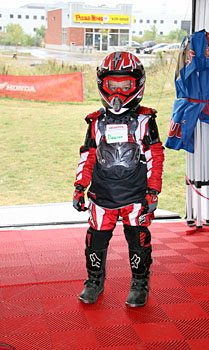
Every clubber is outfitted with the latest in Fox Racing gear from head to toe.
This includes elbow and knee pads placed over the top of the street clothes.
Next comes the Fox nylon riding pants (with padding in the knees and butt). A Fox nylon shirt covers up the street clothes on top. Over that sits a Fox Racing chest protector and tricep protector.
The tootsies are covered are covered up as well with the latest iteration of Fox motocross boots.
Of course, they could not have forgotten brain bucket. This was a brand new Fox helmet. It didn’t even smell like some kid’s sweaty head, so I figured it had to be relatively new.
Rounding out the ensemble was a pair of Fox motocross gloves and Scott goggles. Wow! What a set up! All equipment was clean and in pristine condition.
Each rider was assigned a mighty steed to mount. These consisted of Honda’s award winning 2006 motocross lineup, the smallest of which was the CRF 50. Next came the CRF 70, followed by the CRF 100.
Obviously the younger, smaller riders would mount the smaller bikes and so forth, you get the picture.
So let’s see — four hours of instruction, fully outfitted get-up, 2006 model bikes… How much does this all cost, you ask? A measly $100.00 (CAD). Yep, that’s it. You can see why I found it so appealing!
So with my son looking more like a warrior ready for battle than a motorcycle rider, we head over the gathering tent to be “introduced” to the bikes and instructors.
In total, there were five instructors for approximately 20 riders. Not a bad ratio in my mind. I figured that not one of them could have been over the age of 35, each with a love for what they were doing. Who wouldn’t?
As it began to rain outside the tent, the controls were explained systematically with a period of “quiz the rider” at the end of each major system (i.e. braking, clutch, steering…).
Also given were a series of hand signals so that the instructors could communicate with riders while out in the field. Stop, increase space between riders, slow down, speed up, and kill the engine, where among the most used.
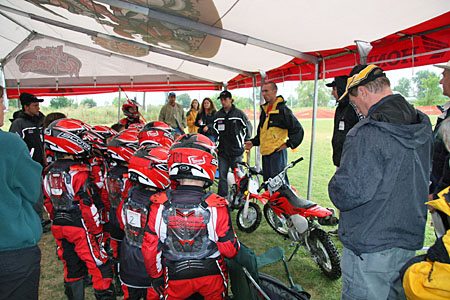 With their new found knowledge, the group was split into two smaller groups. They all headed to hop on their chosen ride for the very first time — a sense of excitement filled each rider. I could see it in my son’s eyes. WOW!
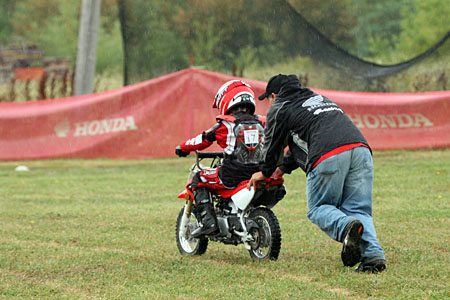
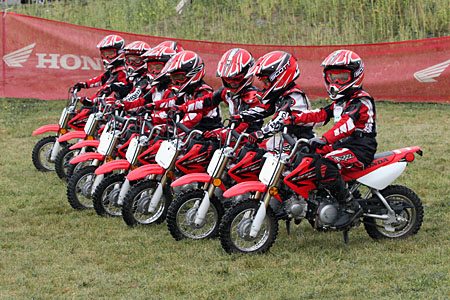 As the first order of business out in the field, an instruction was given that no front brake were to be used today, only the rear brakes! Each rider began with a push from an instructor over a short distance to get the feel for the bike and to test out the rear brake.
Several turns of this procedure lead to all riders being able to stay upright (without engine use) while also being able to execute the “stop” command at any time. OK. I’ll admit it — my son fell first, but in his words “It didn’t hurt a bit Dad”. I’m ok with that.
The concept of a neutral gear on the bike also threw a few riders for a loop…so to speak. The riders soon overcame these little obstacles, but I got a real kick out of some of the over zealous riders that forgot they were in first gear and revved the bike a bit only to have the bike shoot forward a couple of feet. If you have to learn that lesson, this is the place to do it.
With the bugs worked out, they began running short bursts on a flat grassy area. This drill enabled the rider to gain confidence with the start/stop procedure. It was quite amazing to watch.
After a break of mini Oreo’s and bottled water, the crew went out again this time to ride continuously around a pylon marked oval course. I could hardly believe the difference I saw in my son from the start of the camp to now.
After all, he had only been on a dirt bike for about 45 minutes and half of that was spent without a running engine. Cool!
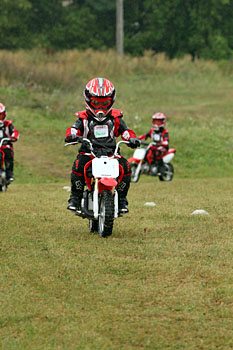
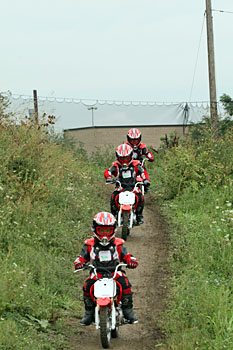
Each rider began to traverse the oval course a little faster every time around. The instructor then asked the group to navigate in and out of the pylons around the perimeter. Not one of those little riders fell — I was amazed.
So as not to become used to going only one direction (semi-clockwise) the group was then instructed to go the other way.
If there is anyone out there who used to roller-skate… (I know, you probably blocked that one from your memory) you’ll know that going in only one direction leaves you a bit one sided, so to speak.
Another short break and the gang headed to a dirt trail/course at the far end of the location. Time to shine!
The instructors donned their helmets and led the crew in a single file line through the route.
Minor mishaps were had by all, but thankfully, not a single one came back injured, which was a good testament to the training received.
My son chose to “blaze his own trail” at one point and ended up waist deep in weeds and other foliage. What a sight to see!
After a final break, the group gathered around a few 4 X 4 lengths of lumber. These were to be their “logs”.
Instruction began with a demonstration of the proper technique for going over an object in the middle of the trail. Approach the object slowly, eyes looking ahead, head up, off your seat, knees bent, and keep a constant bike speed.
Well, don’t ya know it, these instructions actually work — as each rider successfully traversed the log, I just kept thinking, why wasn’t this camp around when I was young? You know…when dirt was invented?
No, I’m not that old…
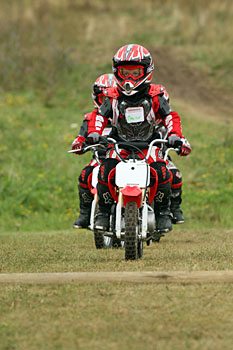
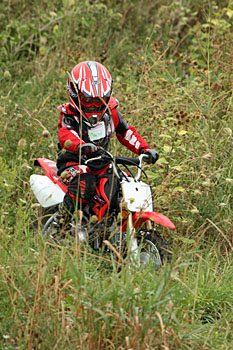
For the finale, the group once again headed to the trail/course for another loop. I sensed a difference in the riders — a sense of confidence.
A sense that they were having a blast. The lead instructor ran a brisk pace through the course and each rider was able to keep up without issue.
First rate equipment, new motorcycles, excellent instruction, and a suitable playground…Wow! What more could you ask for?
I was very impressed with the program. It does teach new riders the proper technique and method for riding a motocross style bike.
The only issue is that now my son wants a bike of his own. How am I going to solve this problem?
Master Listing of All wBW Motorcycle Product Reviews
Owner Comments and Feedback
See details on submitting comments.