

The Cardo Scala Rider Q2 Multiset is a simple and functional design and it is still among the best to be found as of this writing.
The system is user friendly and very reliable.
The lack of A2DP (stereo Bluetooth) support was causing the Cardo system to lose ground in an ever-evolving market, although adding the MP3 audio input, albeit a mid-release and stop-gap measure, was a positive move.
And Cardo Systems just announced a new Q2 Pro intercom system; more information in the sidebar below.
Based on its proven long range and multiple rider to rider link capability and typical reliability, the Q2 system manages to remain a leading system, especially given aggressive pricing.
A Late Play
Although the Midland BT2 and IMC Camos BTS 300 intercom evaluations were completed late last year, both are still being used for webBikeWorld intercom comparisons.
The highs and lows of these two systems vis-à-vis other systems evaluated over the last year or so remains relatively fresh in my mind.
And so it was that I realized a refresh of the Cardo Scala Rider Q2 system, as bundled in a set and presented as the ‘MultiSet Q2’ was long overdue.
Cardo Introduces the Q2 Pro
January 26, 2011 – Cardo Systems announced the new Scala Rider Q2 Pro Intercom system today. Here is an excerpt from the press release:
The Scala Rider Q2 PRO takes the world leader Q2 line of products to a new level with full A2DP stereo music and with technological advances for smooth and effortless communication.
Embedded PLC (Packet Loss Concealment) technology allows real-time compensation of audio losses in challenging environments and makes your conversations sound clearer than ever.
Thanks to MDC (Multiple Device Connection) technology, the Scala Rider Q2 PRO allows bikers to receive GPS voice instructions, communicate with other bikers or with a passenger on the back seat via intercom, conduct calls on their mobile phones and listen to music and radio.
Entertainment features now include wireless A2DP stereo music or MP3 player connection via cable as well as built-in FM radio with RDS.
The original intent was to evaluate the MultiSet along with the Midland and Camos systems, but other circumstances prevented this from going down as planned.
In reality, not getting to this evaluation until well in to the new year has worked out well.
During the March trip to Florida the MultiSet Q2 was the main system used, for the specific intent of putting it through the gauntlet for a full week or more.
With the trip still fresh in my mind, putting thoughts to paper and finally shaping the conclusion was quite easy.
Volumes are written, pro and con, about the Scala Rider, including the Q2 systems.
So, does this latest iteration of the Cardo Scala Rider Q2 system, bundled as a pair and presented as the MultiSet, represent a major step forward or just a minor facelift of sorts? Read on…
Background
Cardo Systems Inc. was formed in 2003 and is headquartered in Pittsburgh, Pennsylvania.
It is a major player in the wireless Bluetooth realm. offering up both consumer products and OEM support including R&D resources for third party solutions.
With a wide range of products for personal and motorcycle communications use, Cardo says that their products are found in over 50 countries.
Motorcycle intercoms are probably the best known Scala product for most of us. Their product lineup now includes the Solo, FM, Teamset and Q2 models. The Q2 variant has received some upgrades and is now also available as a MultiSet bundle – the subject of this evaluation.
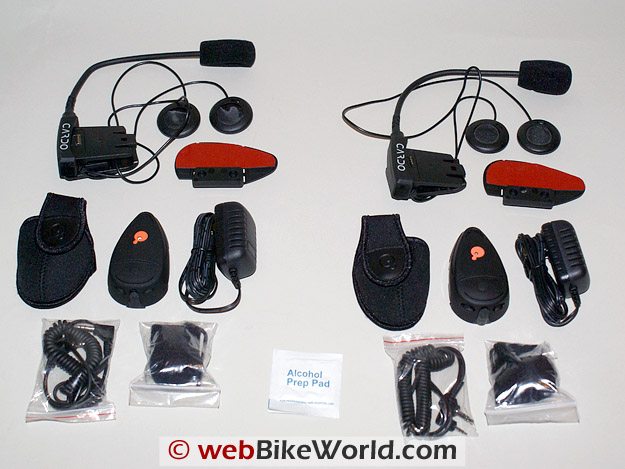
Cardo Scala Rider Q2 MultiSet intercom system parts from the box.In The Box
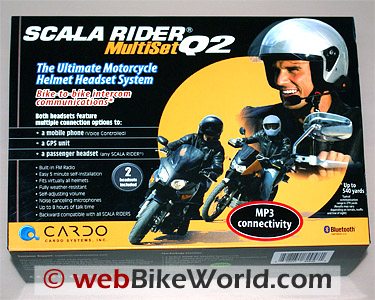
The Scala Rider MultiSet Q2 kit is housed in the now familiar black retail box, which has grown slightly to accommodate the two-system bundling. The box contains two plastic shell moldings stacked on top of each other, both filled with the necessary components for two complete systems.
Inside are two Bluetooth control modules, identified as headsets in the Guide. Also included are two helmet clamp (bracket) units with the integral wired stereo headset; these include a boom microphone component and MP3 jack input.
The package also contains wall chargers with country-specific plugs; adhesive plate brackets; MP3 (2.5 to 3.5mm) stereo cables; and 3 mm Allen key wrenches.
Accessory items provided in the box include two very useful soft foam carry pouches; four spare microphone sponges or socks; two cleaning pads; and two sets of Velcro pads. Last but not least, one User Guide along with some addenda and warranty instruction sheets.
The only question I had, given that everything else is packed in pairs, was why not two User Guides? I acknowledge that many users will use the pair of intercoms simultaneously, but this should not be a given nor an assumption.
After inventory and as reminded by the pre-use sheet, the first action taken was to start the initial charging of both headsets, which takes just under four hours. The red LED remains on while charging is underway. The new style chargers are an order smaller than the previous Q2 units, making them even easier to carry along; just don’t lose them.
Outside of the smaller power supply, the other two really noticeable changes are the 2.5 mm stereo plug at the back of the housing that allows audio input from a compatible and portable device and, the ‘long’ or extended boom microphones. This addresses an issue raised both by me and by other owners of Scala Rider intercom systems.
The Tour of the Cardo Q2 Multiset
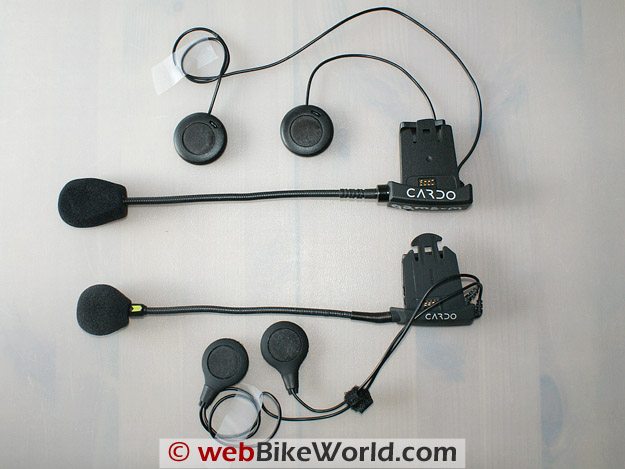
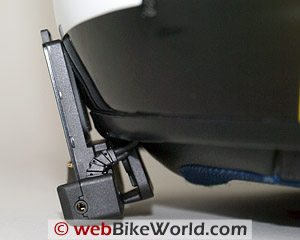
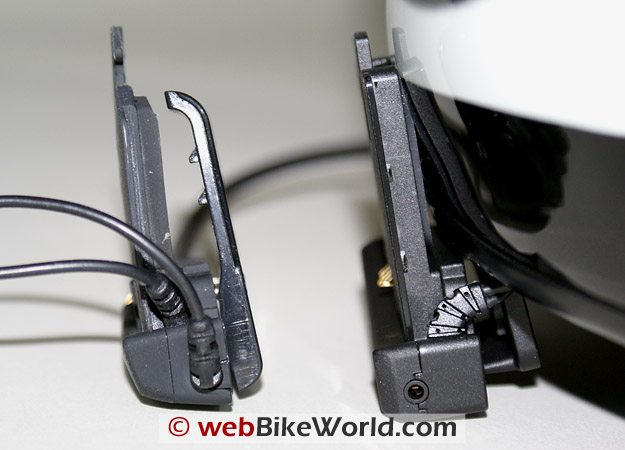
Less the changes noted above, the MultiSet systems appear to be identical to the standard Q2 units. The physical changes are more obvious when handling the headset bracket; the housing along the bottom of the assembly has a square shape and the sliding plate itself is thicker.
The reshaped bottom portion secures the microphone boom at the front and facilitates the new MP3 input plug at the back. Another appreciated change is that both headset leads are run into the housing via a single junction point at the top rear of the housing. There are no cables sticking out or bottom connections to interfere with clothing or the like.
This is good because the revised headset assembly locates everything about 8 mm (about one-third of an inch) lower, which means that it does protrude below the bottom of the helmet. But the whole assembly is so solidly mounted that the unit is not likely to be easily disturbed, something that cannot be said for other types of intercom mounts. Time and use will tell the final tale.
The whole assembly is actually comprised of two parts. The front sliding plate that the Bluetooth module fits onto and the back clamp plate is still secured with two 3 mm machine screws. The included adhesive mounting plates allow more placement flexibility with more permanency.
For size and fitment purposes, the extended boom microphone assembly is 22 cm (8.6 inches) long, as compared to 20 cm (7.8 inches) on the standard Q2 system. The left speaker wire is 18.5 cm (7.3 inches) in length while the right speaker wire is 52.5 cm (20.7 inches) in length.
The Scala Rider Bluetooth modules have always represented simple design and execution; not perfect, but far better than others who have been at the game just as long.
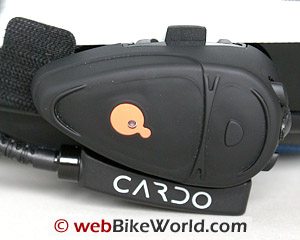
The front face section which represents about two-thirds of the surface area houses the CTRL input. This pressure control functions as the On/Off switch and Answer/Control input for mobile phone use.
Separated by a discrete raised line on the surface, the back third of the face is occupied by the ‘MC’ or Multi-Connection pressure control. The MC control provides Radio on/off control and tuning duties and also switches Intercom sessions between either the Primary or Secondary Buddy.
The back edge of the module houses the charging input port centered between the volume UP and volume DOWN pressure switch controls. With continued use of the Scala Rider modules over a couple of years, I have come to appreciate their simple design and functional user controls.
Helmet Hosting
To keep the playing field level, the Arai XD2 (review) helmets were again used for most of the evaluation. These helmets were used for the Midland BT2 and IMC Camos BTS 300 evaluations as well.
The MultiSet Q2 system has also been used with the RX7 Corsair (review), and using the adhesive mount, on the HJC Sy-Max II (review) flip-up helmet.
Although having made a mental note regarding the seemingly longer boom microphone, in mounting the systems up, the slightly longer length is readily apparent. A small clear label with red printing was actually affixed to the upper right corner of the outer display housing stating that this was an ‘extra long microphone’ kit.
The longer boom adds about three-quarters of an inch to the whole assembly and for larger helmet styles or flip-up helmets that have extended chin pieces this extra length is appreciated. With the Arai XD helmets, the microphone was just centered – good fitment.
On the minus side however, microphone orientation is not marked. I removed the microphone socks to make sure the correct side got oriented towards the mouth…needless to say the boom assembly now features a custom white paint marker indicator.
Previous Cardo Scala Rider units have all been marked with a small yellow orientation label and other brand system have featured an orientation mark of sorts as well. This is a small oversight that really does matter.
The speakers have been updated and upsized from the original Q2 units, ostensibly to provide better audio when using the MP3 stereo input. Best performance inside the XD helmets is gained by putting a small cushion pad behind the speakers, moving them closer to the ear.
The User Guide actually states that the speakers should touch the ears, but I find 2-3 mm of clearance is best in reducing any possible rubbing and allowing a bit of airflow.
Original Scala Rider Q2 mount (L) vs. Cardo Scala Rider Q2 MultiSet mount (R).Locked In Place
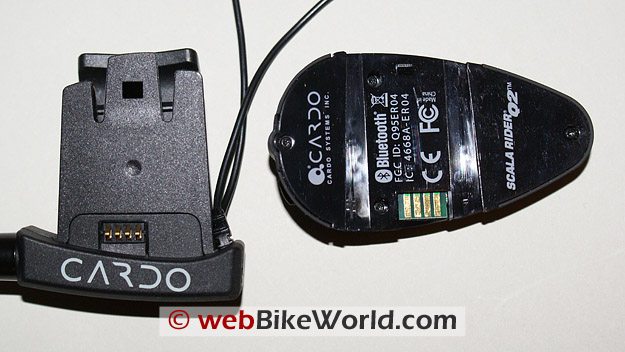
Headset assembly competed, the Bluetooth module is aligned with the sliding plate grooves and slide down until the wire contact surfaces mate indicated by a small ‘click’. The small square dimple on the module will snap into a matching cutout on the sliding plate, locking the two pieces together very tightly.
I have never experienced any issues with the two components separating. Between the tight tolerances, the alignment grooves and the dimple lock, it takes a fair bit of pressure on the release tab to get the two components apart.
Thus mounted, the only exposed connection is for the MP3 input, which unlike the charging port on the Bluetooth module itself, does not have a weather cover – another minor observation.
Speaking of small things, the sliding plate and module mated together presents a minimal 2.5 cm (one inch) profile to the airstream. While this profile is a bit more than the Midland BT2 and the Interphone systems, the Q2 profile is unobtrusive and does not impact on helmet stability in any way.
User Friendly
Something else I have always liked about the Scala Rider systems is that the Bluetooth module can be activated or paired with peripherals in the dismounted mode and then quickly snapped into place, even with heavy gloves on and the helmet in place.
Another bonus to this design approach is the ease with which the Bluetooth module can be removed for charging, cleaning or storage or transfer between helmets. Little things count.
Volume on the Q2 systems has never been a real issue, especially when the time is taken to properly position the speakers in the helmet. I found that the updated MultiSet Q2 system provides more than enough volume and with earplugs in, the audio is only slightly dampened.
The MultiSet Q2 pairs up to the standard devices – GPS and mobile phones, along with the other MultiSet Q2 as Buddy One, and one of the original Q2 systems configured as Buddy Two (any Scala Rider system will work), without muss or fuss and probably easier than previous iterations of the Scala Rider system.
Of note is the fact that the mobile phones paired up without any issues and even after extended periods of time (over a month), the two devices would re-pair without any prompting or by just ‘refreshing’ the connection via the mobile phone. This is something I wish a few more manufacturers would figure out how to do better.
Using the MP3 input jack for the first time was a revelation – the typical mono audio heard from voice communications or the lacklustre FM receiver was replaced with stereo audio. The speakers lack the overall response and tone found in the AKE intercom system, the Midland BT2 or the Camos systems, but the audio is still good, as is volume control.
And speaking of audio, the Scala Rider Q2 systems remain a preferred system due to their excellent communications range. Rider-to-rider link distances of 250 to 300 meters provide absolute clarity and connections in excess of 500 meters are possible while traversing open ground and the batteries will indeed last all day.
Initially pleased with having the FM functionality built-in, longer term use has convinced me that it is a finicky capability. In gaining the ability to plug in external audio, I simply use the (stereo) FM receiver that is built in to the portable MP3 player instead.
Cardo Scala Rider Q2 MultiSet Specifications (Per Cardo)
- MultiSet includes two intercom systems.
- Bike-to-bike Intercom up to 1,640 feet.
- Cell phone connectivity along with FM and MP3 audio.
- 500 meter (1640 foot bike-to-bike intercom range and cell phone connectivity.
- Rider-to-passenger communication.
- Optional receiving of GPS voice instructions or music from an MP3 player (cable included) or embedded FM radio.
- Headset automatically adjusts the sound level.
- Incoming calls may be rejected or accepted by voice-control.
Conclusion
In my original evaluation of the Q2 system, a number of observations were made under the “An Imperfect World” section. I am glad to say that many of these issues no longer exist, but other are obviously going to take a bit longer to address.
Pairing with the MultiSet Q2 units was fast, between two of them, three of them or with peripheral devices. The Buddy One and Buddy Two capability continues to be a distinguishing Q2 feature that works well.
The revised housing is a bit larger, but far stronger. The two pieces snap together with authority and it actually takes a bit of effort to remove the Bluetooth module, but I won’t complain when thinking of other systems that have real shortfalls in this area.
What is still missing and long overdue is A2DP compatibility, something I hope will also bring a more capable headset. A2DP or the Advanced Audio Distribution Profile is designed to provide a two channel (stereo) stream from a media player to a Bluetooth headset; it has become an industry standard.
With the pending release of the Scala G4 system, A2DP support has finally arrived in a Cardo system and I guess the phrase, ‘better late than never’ says it all. But, the question remains as to whether Cardo will upgrade current offerings, like the Q2 Multiset, to support A2DP. Anyone want to start the pool?
The Scala Rider Q2 Multiset system has grown on me and it gets used more and more as my default motorcycle intercom and communication system. It doesn’t have the largest feature set, and audio quality is really lacking, but it is sold, reliable and, most importantly to me, it has the best rider-to-rider range of any intercom system going: or at least of the many I have used or tested.
My Bottom Line Ratings
- Packaging: Excellent. Simple packaging, two systems in one box, all present and accounted for. Single multi-language manual is easy to use, but there should be two of them.
- Design: Excellent, bordering on Outstanding. Cardo has standardized their systems over time with good results. The beefier bracket assembly is an excellent example and while appearing obtrusive, it is not. The ability to remove, program and reinstall the module in seconds is one of my favourite features.
- Execution: Excellent. Everything is well made, but not quite as well finished as the pieces on other systems. The wiring harnesses are lightweight, although nothing has broken yet. Microphone audio input alignment is not marked.
- Features: Very Good. Pretty basic when compared to other systems on the market, especially regarding no A2DP support. But, overall everything works as advertised and everything just seems to work better than previous versions.
- Fit: Excellent. Simple, well-designed and sturdy. It all mounts up well and fits together without issues. The housing is larger and projects down below the helmet line, but didn’t become an impediment when wearing heavy, high neck clothing.
- Setup and Configuration: Excellent. Much improved over my last experience with configuring the Q2 systems. Pairing, re-pairing and getting the system ready for use was easy, aided by a well-written manual and simple controls.
- Performance: Excellent. Even though I see and hear lots of complaints about the systems, my experience with both Q2 system iterations has been very positive. The voice link still drops out unexpectedly from time to time, even in the middle of a conversation, probably due to a VOX issue, but recovery of the link is extremely fast.What keeps the Q2 high on my list is its excellent communications range and overall link reliability. Battery life is no slouch either. Volume control is very good and when within optimal link range, it takes very high speeds and a very noisy environment to degrade audio within the helmet.
- Ease of Use: Excellent. A very easy system to live with – it just plain works and does not demand a lot of interaction to keep it going. The audio priority feature keeps the inputs sorted out. For rider to rider use the intercom is reliable and pretty quiet when within optimum link range.
- Reliability: Excellent. Continued use has not identified any major weaknesses, other than the FM radio, and the intermittent and probably VOX related issue when using the intercom. Nothing else has failed. Battery life is more than up to the task.
- Maintenance and Support: Limited to charging the batteries. A low battery audio alarm provides warning in the headset and overall status is provided by the LEDs as well. No issues requiring support have arisen to this point in time.Cardo also has a pretty extensive listing of replacement items and accessories for the Scala Rider models, most of which are compatible with more than one model.
- Cost: Excellent. Pricing can vary widely depending on locale and seller, but the Q2 units are competitively priced and well worth the money for what is received.
- Value: Very Good. My experiences with the Q2 systems has been very positive overall, but not without some niggling points, many of which seem to have been addressed. The most specific issue, that being the lack of A2DP support (pretty much a standard now) brings my valuation of the MultiSet Q2 down from what could be an easy Excellent.
See Also: The webBikeWorld Scala Rider Q2 Review and our Scala Rider Intercom Review | Coming Soon: Review of a newly revised Midland BT2 intercom; the new Scala G4 and the new Twiin intercom system!
UPDATE: Cardo Systems Announces Two-Year Warranty Extension on Intercoms
Owner Comments and Feedback
See details on submitting comments.
More Comments: Scala Rider Q2 comments can also be found in our original Scala Rider Q2 Review and our original Scala Rider Intercom Review pages.
From “H” (2/10): “We bought the Scala Q2 for bike to bike com. It worked great the first week, but today it started cutting off intermittently. We would ride about 15 miles and while I was talking the connection would just drop. After about another mile or so it would reestablish the link. It was a little aggravating.
It only happened on my helmet. We even swapped units and still my helmet was the only one dropping the link. After reading more reviews I think I may try the “always on” option and see if that clears up the problem. Everything else works great.”
From “J.L.” (2/10): “I’ve been using my Q2 for over a year now, and about 8,000 miles of trips. It has worked flawlessly – Bike-to-bike, cell phone, FM radio, etc. Never had a problem hearing my riding buddy, even at 95 mph (maybe I just have a quiet helmet).
My big disappointment was to find out that you cannot pair a Garmin Nuvi GPS with the Q2 – it will not pair. Only the Garmin Zumo will pair with it. Of course, Scala Rider knows this, put refuses to publish this information on their website. This is an intentional neglect, because when I called them, they were very sheepish with their response.
My Nuvi does have an FM transmitter I could use, but there’s know way of knowing what station the Q2 is tuned to, and no way to tune it to a specific station.
Has anyone found a way to use a Bluetooth adapter (like an iCombi) that will plug into the GPS audio output and transmit the audio wirelessly to the Garmin Nuvi GPS? I can’t find any information on this anywhere. Help!
Editor’s Reply: We’ve had very good luck with the Sony Bluetooth adapter. It connects to everything we’ve tried. Never tried it with a Garmin Nuvi, but basically anything that has a speaker output port has worked for us.
From “N&L B.” (2/10): “The wife and I have been using the Q2 set for 3 months and have nothing but praise for them!
I did experience a problem with the FM radio on mine and after talking to their support people I sent it back for assessment. Nine days later I received notice that a replacement had been shipped. The radio in the new unit works fine.
We quickly discovered, as did other reviewers, that speaker placement is critical for successful operation. Being able to pair with our cell phones has been a great feature. People on the other end always comment that there is no wind noise at all. Voice activation makes this feature superb. Is the system perfect? No. Is it worth spending the money on? Absolutely!”
From “D.W.” (1/10): “I would like to add my review of my Cardo Scala Multiset Q2 units. I purchased the Q2 intercom for my wife at Christmas and we could not be more pleased. Everything works as advertised. I rate my units as excellent.
The pluses are: Battery life is great I have used the units for more than four hours and still on the same charge.
The radio reception is good, and the sound quality is also good the wind noise does cause a loss of quality but this is not the fault of the Scala unit it is to be expected and it sounds better than an external radio unit.
The VOX works great when listening to the radio and if a sneeze comes on the delay of a couple seconds can cause you to miss some of what you are listening to. I will try turning off the VOX while riding alone to eliminate this.
Very easy to mount to my two helmets one is a Bell ¾ face with face shield and one a Nolan flip up face. The clamps work great and the unit stays solid. When using the Nolan under chin protector the microphone comes in contact with my lips but with the chin wind deflector removed it is ¾” from my lips.
Total installation time both helmets was less than an hour this was including locating the ear pieces to the optimum location. It is very important that the ear pieces are located as close as possible to your ear the sounds is much better when they are mounted directly at the opening of your ear mine are about 1/8” from the opening and the sounds is great.
Cons: The instruction sheet that comes with the intercom is not clearly written and does not explain all functions clearly. I did have to call Tech Support to get some help on programming the radio. Tech Support was excellent.
The radio is difficult to program, the bottoms are hard to press and toggling through the channels is time consuming but once they are saved it is quite easy to change the channels.
The automatic volume control does turn up the volume a little too much on some occasions
Overall I totally enjoy this addition to my riding it is much better than the wired intercom that it replaced. I 100% recommend this system to anyone interested.
By some of the complaints I have read on this site I can honestly say that most of them are caused by improperly locating the ear buds and the microphone. I had to remove the foam from one of my units to identify which side the mic was on. I then marked the shaft with a piece of white tape to make certain it was facing toward my mouth.”
From “C.C.” (12/09): “Got the Cardo Scala Rider MultiSet Q2 from wife for Christmas for both of us. We’ve been using a StarCom 1 for the last five years on my VTX1800R. It works really well but when I bought a new BMW K1200 LT I either needed to wire it for the StarCom, pay $1400 for the BMW com system, or find another way to go. After reading your reviews we decided to go with the Cardo Scala Rider MultiSet Q2.
So, today I set about to install the units on our helmets. The helmet I wanted to put mine on is a Scorpion EXO-900. But, there just isn’t a good way to get it on the helmet.
The clamp doesn’t work because the base of the helmet is attached to the neck pad such that you would have to make a major cut in the pad to get the clamp on the bottom of the helmet. I don’t believe that it should be necessary to damage the protective materials of the helmet to install a com system.
In addition, the pad contains an air bladder that could be damaged. The glue on option doesn’t work because the “trim” piece on the bottom of the helmet is quite wide, made of fairly thin plastic, and is not flush with the shell of the helmet. The trim piece that isn’t sturdy enough to hold the unit by itself and the glue strip on the Scala attachment piece would have to bridge the gap between the helmet shell. It looked like only about half the adhesive would actually make contact with the surface. Just didn’t seem like a reliable arrangement.
So, then I tried it on my Nolan N102. After a fair amount of difficulty I got a unit installed on that helmet, but it’s not what I consider a nice fit.
It’s on there, but it’s ugly and even with the “extra long” microphone, it barely reaches the center of the helmet. The worst part is that there are no provisions in the Nolan N-102 for the speakers, which I found really disturbing because the N-102 is supposed to be designed for the Nolan com system. It must be some system if it doesn’t require speakers.
I ended up just sticking the speakers on the liner of the helmet and had a great deal of difficulty locating them so they didn’t pinch my ears. I’m not sure it will be comfortable enough to wear all day.
Finally, I installed the other unit in my wife’s HJC Sy-Max helmet. I had finally found one on which the unit actually clamps well, although there are still a couple of issues. Again, the neck pad on the helmet is in the way. In this case the neck pad is part of the glued in portion of the helmet liner. So, I had to pull it loose from the helmet and insert the clamp underneath it.
Then, there was no good way to get the wires for the speakers inside the helmet from the location on the rear of the unit without cutting the pad. So I had to put them back through the clamp to the front and around the helmet pads. There was just barely enough wire on the left speaker. While HJC actually thought about speaker placement, the location is less than ideal because the connections for the chin strap are so close to where the speakers need to be placed to get them close to your ears.
All this and I haven’t even turned the units on yet to see if they actually work. But after spending over four hours trying to install them on our helmets, I thought maybe others might benefit from my experience.”
From “D.N.” (11/09): “Just wanted to add some learnings on the Scala Q2.
I use the headset on HJC CS-2N helmets. Out of the box, the VOX and VOX timeout didn’t work as advertised. The connection for rider to rider communication would open up and could only be closed manually, it wouldn’t time out. My theory was the wind/road noise maintained the connection.
Spoke to Cardo support, they recommended turning the VOX capability off, which I was able to do per their instructions and at least solved the comm channel being open 100% of the time while riding.
The real point of this comment was a suggestion for other users of Scala Q2 – we put a home made windbreaker nylon sock over the microphones (didn’t remove the foam wind guards). That alone resolved the wind noise issue with the VOX. The VOX is now back at factory default and works as expected. Just a tip.
PS – the FM radio function is terrible. Reception is poor at best, I live/ride within 40 miles (as the crow flies) of Boston, Massachusetts.”
From “L.K.” (10/09): “I was very interested in your article comparing the Blue Ant (Interphone) and Scala Bluetooth systems. We own a Scala Rider Q2 MultiSet and a single Q2 unit, which my wife, daughter and I use to communicate when we ride.
My wife and daughter (on one bike) use the paired MultiSet and I use the single set on my bike, the reason we chose the Scala units over the Blue Ant (Interphone) was the ability to connect more than two units (albeit 3 units is the maximum, which you only find out by reading the instruction manual once you have purchased them, I could not find this information when researching these units).
My wife has the master unit and can communicate with my daughter as her pillion or me (at a maximum range of around 500m), I can communicate with my wife, but not my daughter.
When my wife has connected to my unit using the M/C button at the back of the unit, she can communicate with me using the voice activation with no problem and me to her also, we have noticed that when we are close together (at traffic lights) sometimes the connection drops out, but it reconnects automatically when we start riding again. She can also switch back to my daughter again using the M/C button, if I need to speak with her during this time I can speak and she will hear a beep in her speakers (this is the same if my daughter needs to speak to my wife), she will then tune back in to my signal.
Only issues we have with the volume, is when switching between conversation and FM radio, the volume needs to be increased for the radio and decreased when speaking, but generally it is quite easy to use the volume up or down buttons on the back of the unit even with gloves on, the volume also adjusts automatically whilst riding (increasing as ambient noise increases).
The great thing about the FM receiver is that my daughter listens to her favourite radio station while we ride (she is 9 and gets bored quickly, so the radio helps).
I must admit it did take us a few rides to figure most of this out, even though we read the manual and set them up prior to going for a ride (looked pretty silly sitting on the sofa with our helmets on), you do get some wind noise every now and then, but the sound quality is adequate.
I haven’t tried the voice activated mobile phone answering feature, as my phone doesn’t have this function, but I can answer a call manually with no problem (I do not use my phone when driving or riding, tried the feature again whilst on the sofa).
The only thing that I don’t like is the boom mike, it sits pretty much on my lips, my wife and daughter do not have this problem, (so maybe it is the shape of my Neanderthal skull) but it is quite annoying, it would be nice if future Scala units have a removable microphone, like the Blue Ant (you can fit a slim line microphone on these, which sticks to the inside of the chin bar of the full face helmets, so I’ve been told).
We have forgotten to charge them once and half way through the ride my unit went flat, It is amazing how much you come to rely on them, being able to communicate with another person on the go is very useful (pointing out hazards on the road and behind the wheel) and much better than shouting directions at each other at traffic lights, I’m sure people look at us strangely, you don’t realise how much you move your head when you speak. It also brings another level of enjoyment to riding as you can share the experience along the way.
So as you can tell we are very happy with the Scala Q2 system, not sure how old your test units were, maybe we have a more recent set (purchased ours in February 2009).
PS We all use full face helmets. (2xShoei 1x HJC).”
From “T.H.” (9/09): “My experience with motorcycle intercoms started with a wired Autocom system that I just couldn’t stand. Although the sound quality was incredible, the tangle of wires was just impossible to deal with on a sportbike (especially with passenger).
So, after reading your review, I picked up the then-new Cardo Scala Q2 Multiset. After the first ride I was completely hooked! Losing the mess of cables made the intercoms actually worth using, and as an intercom they were functionally awesome.
Unfortunately, there were a few flies in the ointment. Primarily, although the rider to passenger intercom volume is MORE than sufficient, volume when paired to a phone via Bluetooth is sorely lacking. Although callers would always be amazed by the sound quality on their end (“You’re doing what!? Riding a motorcycle!?”), I was deaf to them at anything above 40mph — and this is with careful positioning of the speakers.
Also problematic was the FM radio. Or lack thereof, I should say. I live about 80 miles from Seattle and never once was able to find a single station on the Q2. Also, I tried using an FM transmitter plugged into an MP3 player. Although the Q2 would at least pick up the signal from that, volume and sound quality were so pathetic as to render it useless.
So the final conclusion on the original Q2 was that it is an amazing intercom, but that’s it.
So, again based on your review here, I decided to upgrade to the new Q2 Multiset. The larger speakers and MP3 port seemed like the solution to every problem I had with the older unit.
Sadly, this was not the case. Although the speakers are larger, they don’t seem any louder or better-sounding. It’s still sounds GREAT as an intercom, but cell phone calls are still maybe only half the volume of intercom conversations and therefore extremely difficult to hear (I’ve tried this with two different phones at max volume).
Even more promising was the 2.5 jack for music, but this is even a bigger disaster. Although your review seems to talk up how great the stereo sound is from the MP3 jack, I’m going to have to side with two other commenters here and complain about the terrible sound quality and volume from the 2.5 jack.
I tried both a Zen and an iPod on max volume with the supplied cable and both were worthless. Not only is sound quality absolutely terrible, but the volume is so low that with earplugs in I can barely hear it in a quiet room and can’t hear it at all on the freeway.
The sound from the 2.5 jack is SO bad — and I’m sure the two other commenters with this problem would agree with me on this — that it seems more like a manufacturing defect than how it’s supposed to be. Maybe there are just a number of defective units?
Not knowing for sure, though, I would suggest to customers that the MP3 jack is not a compelling reason to upgrade from an older Q2 system.
There was one pleasant surprise, though: The new longer boom mic fits full face helmets MUCH better, positioning the clamp in a less intrusive position on the helmet and alleviating a lot of wind noise and drag. The clamp also seems a little bit sturdier than before and grips better. Weather or not this minor hardware improvement is worth the upgrade is up to the individual, I suppose. Otherwise, nothing to see here.”
From Cardo (9/09): Cardo released this information in a recent press release: “Cardo will design and manufacture a unique communication and entertainment system for the SCHUBERTH C3, C2 and Concept motorcycle flip-up helmets. The new and patented system which can be easily adapted to these helmets will be launched in 2009.
Besides connectivity with mobile phones, bike-to-bike intercom between up to 3 riders and wireless receipt of stereo music from compatible MP3 players, no further technical information about the system was provided. At this point also the name of the new system is still being kept confidential.”
From “D” (9/09): “While searching for solutions to the problems we are having with the Q2, I have read MANY user evaluations of the system. My opinion sides with many users…Junk!!! My new unit is virtually useless.
I sent my unit back for repairs (limited FM reception). My wife’s unit stays in a constant transmit mode even with the mike muffled and the bike shut down.
The Cardo rep was not receptive to a refund and the best advise given was to disable the VOX…What good is this?? The purpose of the Q2 is defeated when we lose “hands free” operation. I would not use another of these units if it were free.
Sorry Cardo! A “walkie-talkie” is better and more reliable.”
From “J.L.L.” (9/09): “As a counterpoint to your experiences with the Cardo Scala TeamSet units, I’d like to supply our review, after 2 full seasons of use.
Originally purchased at the start of the 2008 riding season for $279 CDN, we also found that the units were simple and tidy on install, having both units fully installed on 2 Zox modular full face Nevado R helmets in less than ten minutes.
Regarding communication quality.. as noted by Cardo, the speakers are not “hi-fi” in any way, and do result in a somewhat thin sound, however, this is logical considering the use.. the speakers operate well in the bandwidths that will ensure that the communication is legible and understandable. Enhanced bass response would likely “muddy” the conversation, so the “quality” of sound, although not high fidelity, is appropriate to the function, and works well.
We initially had a similar experience in the living room…it seemed as though the units barely functioned. It took a lot of effort to get the Voice Activation to work, and it seemed that we couldn’t get enough volume… however…. like other users, we found that once we got on the bike, the TeamSet came to life.
The Voice Activation function does take a concerted effort to open the mics.. we found that a cough or loud “hey” worked well once we were on the road, however we have since chosen to use the “always on” setting because we converse a lot, and found that the units would decide to close the channel just as we were about to resume a conversation.
An interesting note.. we both use chewing gum on the bike, and the units do NOT transmit this sound, even in “always on” mode.. we consider this a bonus (Mom DID teach us to chew with our mouths closed).
Volume is a bit of a weak spot.. we have them turned up all the way on the highway, and it’s adequate. In some situations, I would wish for just ONE more level of volume, however it is still usable and understandable in storms, high wind, and even in hail! In the city, when there’s less ambient noise (wind, etc) we turn them down, as they’re a bit annoying on max volume.
The monaural sound is perfect for spoken voice (since our voices are a single source, stereo reproduction of a monaural source is just a waste of time) and the units have performed exceedingly well over the last 2 years. Our one-day-use record is 9 hours of riding, with the units always on. They were becoming a bit erratic, static-y, and intermittent by the end, however we were well pleased with the time we got.
Under our normal use, we charge the units (over night) every second day of riding. We’ve found that when the units choose a channel that might be a bit noisy or quiet, a quick push of the power button will re-initiate the link, most often clearing it up with a single try.. this is excellent for BlueTooth technology, and better than our BT headsets for our phones.
As far as phone calls… I do not make outgoing calls on the road, however in a few situations I’ve had to answer calls, and the unit worked well. It beeped to let me know there was a call coming in, and with a loud “hello” the call initiated.. I did have to say “hello” again, but in all cases the callers had no idea that I was riding….on the highway….at 110 Kph.
They were shocked to hear that it was a on-bike call in every case, and my wife maintains that the Cardo provides better call quality than the wired headset I own for my phone. Cell phone use I would rate as “excellent”.
The quality of manufacture is very good.. the slide clips that hold the units onto the mic/clamp assembly have remained firm and solid, and I have never worried that the unit might fall off.
On one of the units, the small cover plate that holds the mic boom in place broke, however that was in a situation where the modular flip-down got closed on the boom and put extreme pressure on the unit in a way it was never intended to be stressed. I’ve repaired it, and it continues to work well. I would seek a set of longer screws or a different plate for thicker helmets.. the Zox we have are almost, but not quite, too thick to clamp to.
Overall, after 2 full seasons, we’re thrilled. Battery life continues to be excellent at 8 or more hours after an estimated 400+ hours (more than 20,000Km) of use. The speakers sound as good as the first day, the mics continue to function well, and we do not expect to replace the units out of necessity any time soon.
We will be upgrading to the MP3 capable clamp/mic bases next year so that we can enjoy satellite radio on longer trips, but that’s because we want to, not because we need to, and we will retain the original BlueTooth radio/battery units for use with the new bases (Compliments to Cardo.. the mic/clamp replacements are going for $57 CDN.. very reasonable).
Our final estimation.. we recommend the Cardos to anyone any everyone.”
From “T” (8/09): “We bought the SCALA Rider Q2 Multiset for a week-long ride of the Blue Ridge Parkway and surrounding area. At first, wonderful! Four days of lovely communication. We used them for intercom only, no other Bluetooth devices. What a difference it made to our enjoyment of the trip.
But on day five we hit rain. From that day forward my husband’s unit worked only intermittently, finally giving up the ghost. It won’t stay charged more for more than a few minutes at a time.
The owner’s manual says the units are water-resistant, and the web site says okay to ride in light-rain, but advises against downpours stating that the devices are not water-proof. On top of that, the warranty explicitly excludes damage caused by rain.
We are now looking at other options.”
From “T.H.” (7/09) (FIN): “Got the Q2 Multiset to replace the Camos BTS-300 (see T.H.’s comments on the BTS-300) that never really delivered. The first observation is that the (Q2) mount is a bit of an overkill in comparison to the Camos’ simpler system. The mount’s sharp corners touch the table or the fuel tank, so care must be taken when dismounting the helmet.
[Note: Wording in next 2 paragraphs revised from original for clarity, per T.H. 8/09]Intercom is superior to the Camos’ version in four ways: first, the VOX delay is about a second long vs. 4 seconds in Camos. Second, you hear a confirmation beep very instantly when you shout to the mic, not when the line actually opens as in Camos. Three, the mic is more sensitive to your voice, so you don’t need to shout as loud to wake up the VOX. Fourth, the line can be opened manually to prevent it from cutting out automatically, so the VOX won’t obstruct your conversation at all.
This is how we use this system, the delay in the VOX is still too prevailing, although not to as ridiculous extent as in the Camos system. When the line cuts out after 30 seconds of silence, there’s a 4 second long silent moment before the VOX comes back alive again.
However, if the line is cut out by an incoming phone call or navigator’s voice instructions, the VOX turns back on. After such occasion, there’s a 10 or so second silent moment before conversation over the intercom can resume. The passenger won’t hear anything and can’t know what’s going on. This feels annoying and should be fixed in future versions of the device.
The VOX delay or having a conversation over the intercom won’t affect navigator voice instructions at all (I tested this with TomTom Rider 1 only). My Nokia N95 worked well also. Its voice dialing worked flawlessly with the Q2 simply by touching the Q2’s power button and then saying the name of the person you want to talk with.
Incoming calls are answered simply by shouting something to the mic. The other party may not guess that you’re riding, the noise cancellation works pretty well.
The background noise compensation works also pretty well. The mic doesn’t feed any noise from the environment to the system. The wind noise from the passenger’s mic (inside an integral helmet) was minimal although noticeable.
There’s no stereo sound available over the Bluetooth, but the 2.5 mm jack in the Q2 Multiset version does the trick for just any device with a headphone jack.
The sound quality is rather thin in comparison to the Camos system. There’s enough sound to penetrate through my made-to-fit earplugs in highway speeds. When the earbuds are installed correctly, the volume can’t be turned to the maximum without wearing the earplugs, it’s that loud.
The integrated FM radio… well, there’s one and sometimes it’s better than nothing. Pity it’s all mono, and there’s no proper external antenna to improve the reception. A thin lead antenna would’ve been easy to hide inside the helmet.
The only MAJOR problem with the Q2 Multiset is that it cannot be neither connected nor even paired with a navigator and a cell phone simultaneously. And in case of TomTom Rider, the navigator wants to be paired first and the other Q2 unit comes next.
The Multiset units come pre-paired with each other, so the problems with the TomTom may start from the very beginning. If you pair your unit with your cell phone, you can’t connect the TomTom anymore unless you do a full reset of the Q2 and then pair the navigator. And eventually you end up with a situation where you can’t even pair your TomTom with the Q2.
This is when the full reset comes in. If you want to use your navigator (whatever make and model it is) and your cell phone simultaneously with the Q2, you must pair the cell phone with your navigator (if possible) and pair your navigator with the Q2.
The strange thing here is that the full reset is not mentioned in the device’s manuals, so here it is: Power up the Q2, then push the orange button for six seconds, and when the red and blue starts blinking, press volume up button for 3 more seconds. The blue light will flash 5 times and red light 3 times, and then the device powers down. Done. Power the Q2 up again and continue with pairing with your other devices.
Cardo says the Q2 can be paired with 3 other devices. Y ou may think that “great, my setup will then consist of another Q2, a cell phone and a navigator”. But it won’t happen.
In reality, the devices are another Q2, a third Q2 (or some other Scala’s Bluetooth headset) and just one device of your choice. It would be so much easier to live with if the Q2 paired with at least one more device. But it doesn’t and it badly cripples the usability and feasibility of this system if you want to listen to your navigator and cell phone when riding.
You can, however, use the 2.5 mm input to get the navigator instructions in from the kitchen door, but it won’t work if you talk over the intercom or listen to the integrated FM radio since the 2.5 mm input has the lowest priority of all the connections. Keep all the other devices silent and this should work.
To put it all together, this is a promising system but it’s not the ultimate headset yet. The limit in number of paired devices feels artificial and ancient, and the VOX operation isn’t transparent enough.
The sound quality for the music could be better, and the FM radio should be in stereo. I’m not complaining about the lack of A2DP profile here since the 2.5 mm input does the trick pretty well with existing players. Cardo, fix these problems and you’ll have a killer system.”
From “B.F.” (6/09): “I have the Multiset Q2 version of the Cardo Scala Rider and want to hook it up to a non-Bluetooth GPS (Gamin Nuvi 750). What I need to know is what Bluetooth format (version?) transmitter do I need to get?”
HBC’s Reply: It seems you need a Bluetooth Adapter or BTA to act as the BT host for the non-Bluetooth Garmin nuvi. Even though I thought, or had heard that Garmin was going to market one, I have not seen any more on it yet – which would be a logical step for them to support their non-Bluetooth devices, but…
By the same token, it might be worth if the reader posed the question to the Cardo Technical Support staff…I bet they would have some information and its something that I have been meaning to do,..
Specifically, the BTA procured should be Bluetooth version 2.0, 2.1 or better. This standard provides better connectivity, better bandwidth, and if the protocol is provided, A2DP or stereo streaming. Most newer Bluetooth adapters on the market, other than those specifically designed for standard cell phone use, are Bluetooth 2.0 or better and support A2DP and therefore, should work well in hosting the nuvi and with being paired to the Multiset.
Both Camos BTA devices evaluated previously are likely compatible and once paired, provide long life and great audio streaming.
I cannot stress enough the need for compatibility, as some Bluetooth devices, including adapters, do not have all the basic protocols implemented, which can cause problems with some headsets. As well, along the same vein, many manufacturers keep their product line intact by implementing specific protocols and features so as to provide the best performance with, or only with, their products. While not the ideal environment, this fact must be appreciated, when searching for a solution.
In poking around some forums, there is a lot of good reference material and posted comments that would likely provide a more direct answer regarding specific Bluetooth adapters that would work with the nuvi 750. Most good Bluetooth Adapters on the market should work…but the bottom line is that its always best to confirm compatibility, either directly or via a reliable source.
Not sure if this will help…without spending some more time in directly chasing down the issue, I’m hoping the information above answered the question about Bluetooth version and helps in finding a BTA…if I had a nuvi 750 it would be an easy test to conduct with everything held here.”
From “R.E.” (6/09): “Purchased the MultiSet after much review reading. Were easy to install on our HJC ¾ helmets. Extra long boom mic is perfect.
Did not purchase them for the Bluetooth, iPod, or the FM. Bought them especially for bike to bike communications. Took a 545 mile run down in Arkansas And Missouri and could not have been more pleased with them.
The volume is more than enough. The clarity is unreal at any speeds. The battery life is good also. Turned them on at 8:00am on Sat. Morning and turned them off at 6:30pm Sat. evening. Were still going strong. W ould highly recommend these for anyone wanting bike to bike communications.”
From “R.L.” (5/09): “After reading your reviews I went ahead and purchased a set. Nice quality components and easy enough to use per se.
As with the other posters, I am very disappointed in the quality and level of sound available using the MP3 jack. Even with the volume turned all the way up on my IPod, I can barely hear it once out on the road (the manual states that the Scala volume buttons do not come into play using an MP3). The sound quality is really abysmal, very tinny indeed.
Sound/volume for GPS voice instructions and phone seem to be just fine however. Much louder and good sound, but of course its just spoken voice.
Sound seems to be stereo using the jack, but not in other functions. The lack of A2DP is somewhat out of date.
One problem I do seem to have is having both of the headsets paired to the GPS (TomTom Rider2). It seems that I can only have one paired at a time, not both sets. If I pair one of the Scala’s, it seems to no longer “see” the other set. There is nothing in the manual regarding this, so I am unsure if that is just the nature of the beast or if there is a problem.
I bought this system mainly for its ability to communicate bike to bike and rider to pillion and to listen to my IPod. The intercom seems to work well, but again, I am sorely disappointed in the music department.
Also, the FM is a fairly useless feature in my opinion. I am rural and do not receive one single station. Whatever Cardo spent on the feature could have put to better use by providing a higher quality speaker.”
From “L.L.” (5/09): “We purchased the Scala Q2 after being miserable for one riding season with the Chatterbox (big mistake!). For the price, which is excellent, it is fantastically clear and works flawlessly. It Bluetoothed easily to our Motorola Razor phones. Even at highway speeds and heavy winds we can hear each other fine. I wish I would have bought these to begin with instead of wasting hundreds of dollars more on the worthless Chatterbox!”
From “M.A.” (5/09): “We’ve been using the Q2 for about 6 months now, bike to bike and wow – what a difference it makes. Our setup is to connect the headsets in the always on mode by pressing the main control button once after powering up, no VOX for us.
The batteries have never let us down even after 7 hour of continuous use. There is plenty of volume even with our foam earplugs firmly in place. We get excellent range and have found that these communicators have greatly enhanced our riding enjoyment.
When I ride alone, I pair the headset to the Bluetooth on my phone, it works great, and allows me to call ahead and let the wife know when to expect me – or not to expect as the road calls….”
From “E.H.” (4/09): “I have been using one for the past year. Phone link and Zumo 550 GPS both work great and were easy to set up. I use the MP3 player in the Zumo to play my favorite music through the Bluetooth. Stereo would be nice, but on long highway trips it is better then the constant wind noise. My only complaint is FM receiver is spotty and tough to find stations, but it maybe my rural location.”
From “S.M.” (4/09): “Thank You for your continued in depth reviews! I just purchased the Q2 TeamSet last week (for $259 from a dealer on eBay). I thought the inclusion of the MP3 plug to be the deciding factor on purchasing this set, since the vast majority of time, I am riding by myself commuting.
Unfortunately, maybe mine isn’t working properly. My Microsoft Zune and my iPhone hooked using the included cable to the Scala unit. The Volume is sorely lacking (even with the player’s volume all the way up) compared to the FM, or the intercom. It also doesn’t seem to matter using the volume controls on the Cardo unit, the volume from my two different players don’t change when using the Cardo’s volume up and down buttons.
The intercom/Bluetooth work FABULOUS. My 7 year old LOVES the fact that he can talk to me. The unit paired with my Garmin 2820 GPS perfectly the 1st time. The Teamset comes pre-paired, but adding another Q2 beyond that took several tries to get it to pair. But it’s paired, and working perfectly now.
The FM reception is pretty spotty on these things as well. Mine wont find any stations in the Milwaukee area over 97.3MHZ. Oh well….”
From “D.B.” (4/09): “I’ve owned and used a Scala Rider since it was introduced and it is the best I’ve tried. At this point there is no excuse for them not supporting stereo Bluetooth. If you don’t want to use the features on the latest phone, there is nothing better, but if you want state of the art, Cardo should go back to it’s roots.”