

Besides possible discounts on motorcycle insurance, installing and using a motorcycle alarm is just plain smart.
The Talon T-3300 system is a very good alarm system.
It’s easy to install and it has loads of features, but it is still extremely straightforward to configure and use on a daily basis.
It’s an attractive package, with or without the available options…although including the optional perimeter sensor is a no-brainer.
As most of us know — or have learned the hard way — a properly installed and configured alarm system that is also used on a regular basis is a strong theft deterrent and a key component of a layered approach to keeping our precious two-wheelers safe and sound.
Any benefit gained regarding reduced insurance costs (while not guaranteed even with an approved system) is a bonus as well.
The basic requirements or performance criteria remain unchanged and include decisions about the alarm or siren type (internal, external, silent modes or a combination system).
Also, sensing features (proximity/perimeter, movement or tampering); whether an immobilizer is desired.
And if it a remote paging feature is desired; ease of use; reliability and safety. And, of course, cost and support.
Marketed by Talon Motorcycle Technologies (TMT), a division of Talon Concepts International based in Vancouver,
Canada, four variants of the T-3300 alarm are available: the T-3300 with standard piezo siren; the T-3300i, which uses a battery backup piezo siren; the T-3300p, which includes the perimeter sensor; and the T-330ip that has both the battery backup and perimeter sensor features.
In considering the situation most owners face and reviewing the specifications of the T-3300 alarm, it seems that Talon has a good sense of what is needed and has put together a well rounded package, with some attractive options.
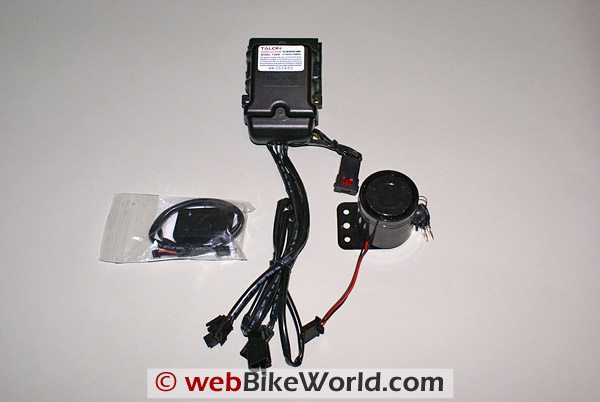
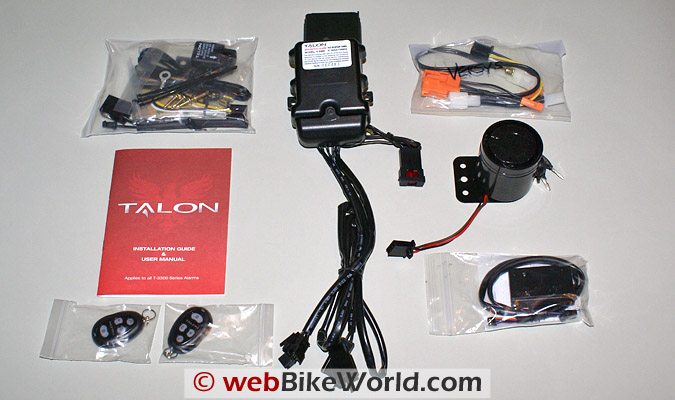
The system installed on the Kawasaki Versys test mule is essentially the T-3300ip kit, consisting of the main module, a battery backup piezo siren, LED indicator, immobilizer relay and harness, the perimeter sensor kit and the two small key-chain remotes.
A final option, the Factory Connector Kit for the Versys rounded out the package.
Talon T-3300 main alarm components.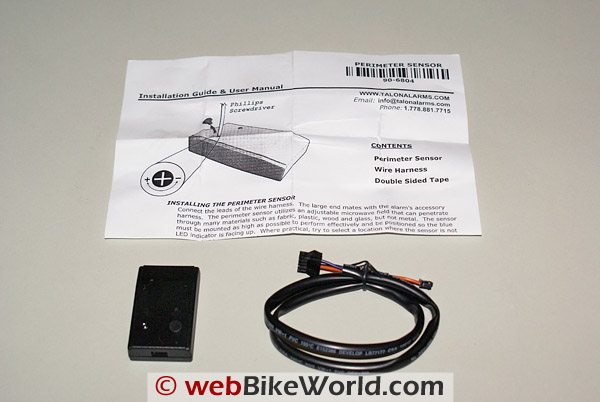 Talon T-3300 perimeter sensor components.
System Features
While more and more motorcycles are equipped with immobilizers and/or alarm systems as original equipment, there is still a healthy market for third-party devices.
With the original webBikeWorld review of the Talon T-2200 alarm published back in February of 2006 and with a new model available, it was time for another visit.
The new Talon T-3300 is a, ‘stylishly designed, compact, full-featured remote control motorcycle alarm system that will fit any motorcycle”, according to the Talon press materials.
At 2.9 x 3.9 x 1.2 inches in size it is not exactly compact, especially given the need for an external siren. But nevertheless the alarm does have an impressive feature list.
Some of the key features include: a digital accelerometer that allows self-referencing of the digital dual-axis tilt sensor; dual stage shock sensor; starter immobilizer; weatherproof design and an ultra-bright LED.
Options include a battery backup piezo siren and a perimeter sensor, along with model-specific connector kits.
The main microprocessor module is weatherproof, and it’s installed in the tail section real estate on the Versys. However, the needed piezo siren is larger than expected, and installing it might take some location planning on some types of motorcycles.
The two multi-function remotes are small and the surface is crowded with four control buttons. But with some finger discretion, the input functions are easy to use.
The optional perimeter sensor is a no-brainer and worth the extra $32.95 USD.
The kit plugs right in to the main harness and the small plastic module is easily mounted, in the right spot of course, and it only draws an average of 4.7 mA.
The small multi-function remote has four primary input buttons. At the top is Button One, which arms ) the system (1 Chirp, 1 Flash) by enabling the shock, tilt and ignition sensors. Button Two is located on the bottom and it disarms the system (2 Chirps, 2 Flashes).
Laterally, Button Three on the left arms the system as well (1 Chirp, 1 Flash), but if the optional Perimeter Sensor is installed, it activates it along with the other three. Button Four, on the right, basically sets a silent operation mode.
A multitude of functions and settings can be initiated by using one or more of the buttons in a specific sequence. The small but well diagrammed Transmitter Summary Table found in the User Guide is an invaluable tool in setting up, testing and using the system.
Users are advised to either learn the primary input settings or keep a copy of the table with them.
The system has a whole host of additional configuration options, best explored by working through the User Manual.
A couple of favourites highlighted here are the Panic Mode sequence that will activate the piezo siren, drawing attention to you and/or the vehicle during an emergency and, the Service Mode, which allows the alarm functions to be turned off quickly for local or shop work purposes.
The T-3300 alarm, like many others, provides a post-event memory function. If the LED is flashing rapidly when you approach your motorcycle, the system has entered the alarm mode while you were away.
When disarmed, the system will output additional chirps and flashing of the lights, documented in the User Manual, indicating which sensor was triggered.
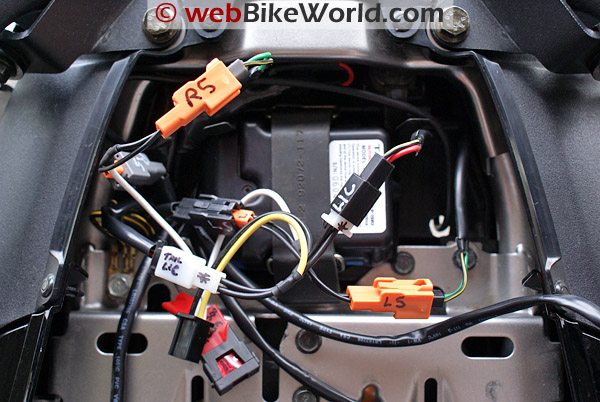
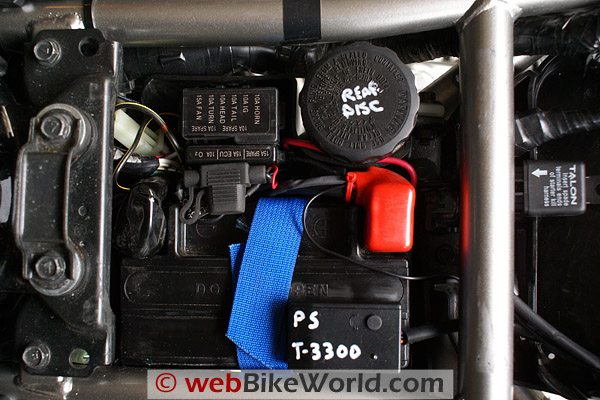 Talon T-3300 near final installation with perimeter sensor on battery and relay at right.
Basic Installation
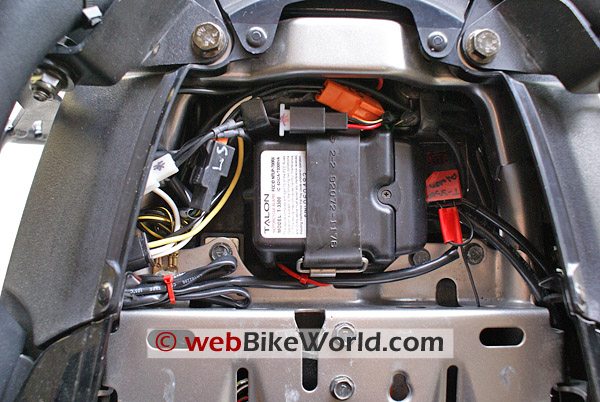
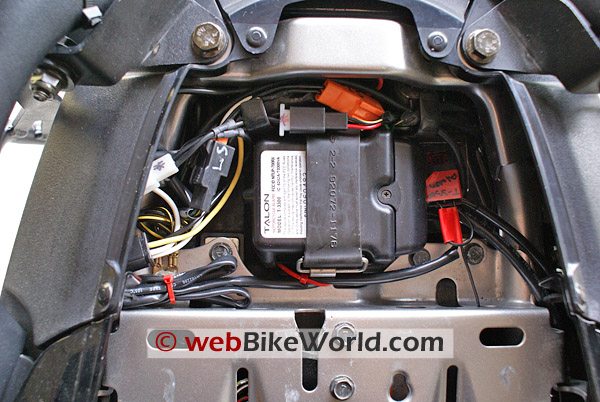
As spring became a distant memory, but before departing on a July-long trek out west with the Beemers, the Talon T-3300 main alarm module was test mounted into the space between the rear tail-light assembly and the main rear sub-frame bracket of the Versys.
In early August, having returned from the jaunt out west it was time to resume the working relationship with the versatile Versys, but only after suitable apologies were intoned for having neglected it for a month — it had never sat this long before, outside of its winter hibernation period.
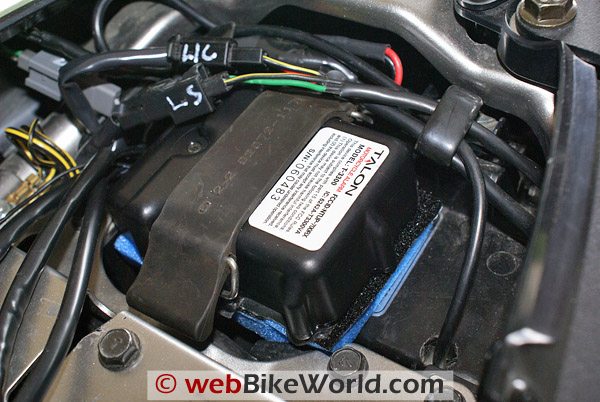
Having deemed that the original position chosen for the alarm installation was the best, the module was subsequently cushioned on an appropriately sized piece of thin blue sleeping-pad foam and secured by the OE rubber strap.
In this location it sits virtually horizontal (a good thing), needed signal light and taillight connections are at hand and, it looks every inch like a factory-installed option.
Even though the self-referencing technology used in the tilt sensing mechanism will help, optimum sensitivity is achieved when the control module is oriented when installed so that it sits close to horizontal. Mounting the module on the side of anything is not recommended.
Space-wise, the Talon system is definitely not the smallest – those extra components all take up room.
Thankfully the Versys has two storage areas that can house system components, even though the tool kit and any carried spares face relocation – not a big issue by any means.
With much of the plastic on the Versys removed for other work, the optional “Bright” LED indicator was installed in the dash.
A spot just to the right of the LCD display was selected and a small 9/32 hole drilled through the matte-black plastic piece that surrounds the instrumentation cluster.
A small rubber grommet is used to frame the hole and the LED housing is simply glued to the underside of the plastic piece.
The wire harness runs back under the right hand fairing panel and then into the battery box area, close to the main alarm lead connectors and completely out of sight with the trim panels installed.
After the battery leads were disconnected, the rest of the installation proceeded smoothly. The provided Talon manual is clear and concise and only a couple of minor questions arose, both answered by browsing the Talon User Forum pages .
The main site provides access to updated manuals, etc and is a good resource for Talon owners.
Appreciating the stated reasons for providing a “Stealth black wire harness”, it is likely to raise an eyebrow or two and cause some confusion initially, even though the main power line is fused.
I was willing to give up any “stealth” advantage, so I marked the wire and the fuse holder with red tape before running it to the battery.
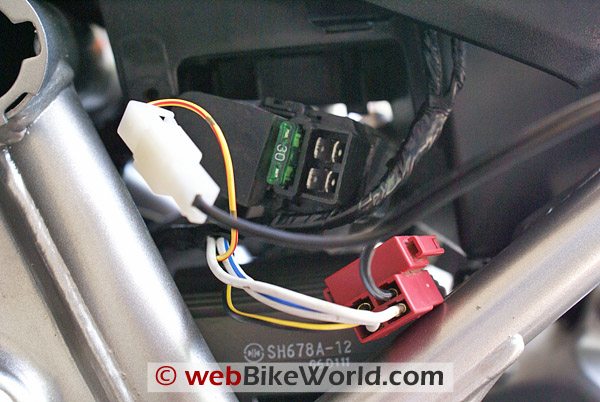
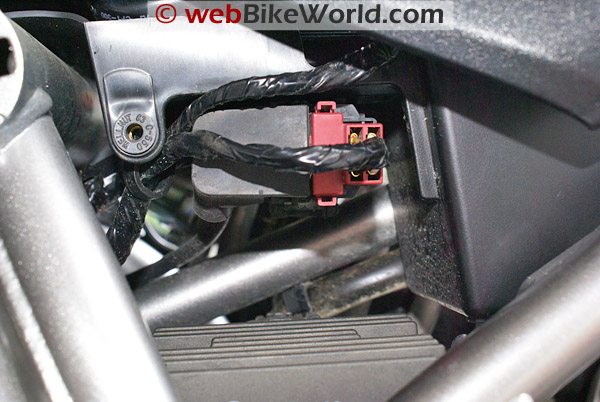
The supplied Factory Connector Kit (a model-specific option) makes the necessary connections to the OE harness simple and fool-proof. The most time consuming activity was in wiring up the Starter Kill Relay that provides the Immobilizer function.
Once the main fuse assembly is found (Shop Manual = Good) and accessed, the remaining steps are simple.
Note – if the supplied generic harness is used, the Starter Relay wire needs to be cut an inch or two back from the connector. The two black wires from the kit are then spliced to each cut end.
Make sure these connections are absolutely solid – if they ever fail, the motorcycle will not start.
In its original orientation, the alarm module leads were going to be a tad short. By simply turning the module 180 degrees, putting the harness to the left of the motorcycle, all leads would reach.
The leads are run around the frame cross-over assembly and then inside the plastic tray mouldings. With the seat and side panels installed everything is out of sight or easy reach.
The Piezo Siren got installed in the small middle (tool) storage area – some cushion tape keeps it isolated from surrounding surfaces and the OE retaining strap keeps the noise-maker in place.
The relay resides in a convenient notch in the front wall of the main plastic tray while the Perimeter Sensor sits on top of the battery – a recommended mounting point.
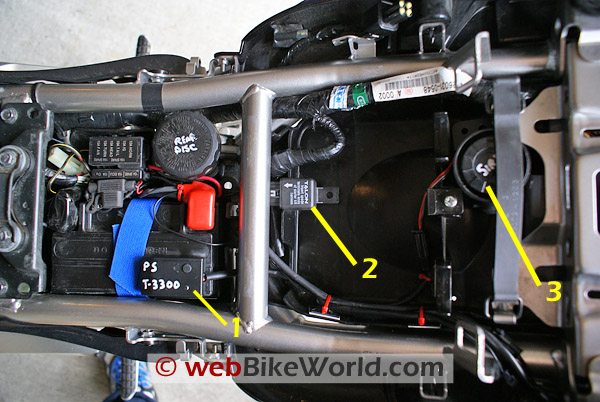 1. Talon perimeter sensor. 2. Talon immobilizer relay. 3. Talon piezo siren.
This Talon is Sharp
Base functionality of the Talon alarm is very good. With its self-referencing tilt sensor and a five-level adjustable shock sensor, which was left on Level 3 (factory default), the alarm provides an enhanced protection environment as soon as it is powered up.
Not having yet set up a good audio measurement facility (like the Editor has…), it can only be said that the Talon T-3300 alarm siren is loud, darn loud, and irritating, especially when the seat is removed. It has a sharp piercing tone that cannot be missed.
The cause of the irritation of course is the larger-than-I-like piezo siren.
Oversized or not, I cannot complain about its function. Additionally, with the battery backup option, the siren is good for about one hour of wailing when the power has been cut.
An important point to note is that the Battery Back-up Siren will sound off whenever one of the sensors triggers the alarm or, if the power supply to the alarm is cut.
Accordingly, it is highly recommended that when doing any work on the motorcycle, the back-up function be deactivated.
This action is completed by taking one of the two supplied keys, inserting it into the lock on the side of the siren and turning the lock from Green (On) to Red (Off). This disarms the backup feature and saves some wear and tear on the ears, trust me.
Just don’t forget to turn it back on.
Having the Battery Backup Siren can pay dividends of another kind as well – insurance savings.
The battery backup feature, when combined with an audible siren, a motion sensor and immobilizing circuit constitutes a system that meets insurance requirements in many areas of North America.
An enhancement that I really appreciate is the optional perimeter sensor.
This component adds a 3-stage range-adjustable ‘warn away’ capability to the system. By tuning the sensor’s potentiometer the range or approach area is varied and verified, visually when the Blue LED on the sensor module lights up and audibly by the warn away tones.
On the mid-point or default setting, the system would not provide a warning chirp until I was less than a foot away and directly beside the sensor.
For evaluation purposes, I wanted a larger detection field, so some adjustments were going to be needed.
Perimeter sensor tuning is done by making small incremental adjustments to the adjustment screw that resides under the rubber plug on top of the perimeter sensor module. A small Phillips screwdriver is needed for this tuning.
By turning the adjustment screw clockwise sensitivity is increased, turning it counter-clockwise decreases sensitivity.
I played around with the settings for a couple of days until the approach field around the motorcycle is activated from about two feet away along the sides, where sensitivity is the greatest.
Although utilized for most of the evaluation period, I don’t typically activate all four sensors – tilt, shock, ignition and perimeter, unless location and absence are factors.
Some discretion in setting sensitivity is needed as over-using all the features typically invokes the ‘Chicken Little’ syndrome and becomes counter-productive.
And speaking of using the sensors and the alarm, data supplied by Talon identifies a basic alarm draw of 4.5mA when disarmed and 6.5mA when armed.
With the perimeter sensor armed total draw is 12mA, which is not that bad considering the capability the whole system provides.
If the motorcycle is used regularly and if the battery is healthy the draw imposed by the system should never be of concern. If the motorcycle is not going to be used for two to three weeks or longer the alarm fuse should be pulled or the battery charged via a trickle charger.
With the seat on, the alarm is audible and recognizable up to 150 metres or just under 500 feet in a residential area and typically two city blocks in a traffic environment. This is good.
Not so good is the working range of the small remotes. In use I have been getting around 25 to 30 metres or 80 to 100 feet when in the open and about half that distance in built-up or parking lot environs, even with two new CR2016 lithium batteries installed in one of the two remotes.
The manual identifies a range of 70 metres or 200 feet, although I’m not sure if means for the remotes or for the audio output ranged of the siren.
While still adequate for typical use, that range is less than other systems evaluated or used with remote or pager features, like the Cyclone Motorcycle Alarm system evaluated earlier this year.
Talon T-3300 main processor final installation.Talon T-3300 Motorcycle Alarm – Features
- Perimeter sensor – Optional feature
- Digital Accelerometer – allows for self-referencing tilt sensor
- Code Hopping remotes – provides dynamic security feature
- Stealth black wire harness – low visibility
- Audible trigger type notification on disarm
- Multi-function LED status indicator and, brighter LED used
- Starter Immobilizer with smaller immobilizing relay
- Selectable pulse siren output – used when connecting external horn via another relay
- Compact microprocessor control module with weatherproof design
- Ignition sensor – prevents hot-wiring
- Two (2) multi-function four (4) button remotes
- Remote control arming and disarming – active or passive modes
- Remote controlled Panic operation
- Built-in flashing lights relay
- Built-in dual stage shock sensor with adjustable shock sensitivity – by using remote
- Built-in digital tilt sensor
- On/Off shock and/or tilt sensor – selectable by remote
- Plug-in wiring harness – Optional model-specific interconnect kits
- Service/emergency override switch
- Multi-code learning and remote searching
- Compact design Piezo siren – Battery backup option has batteries included
- Range up to 200 feet or 70 metres
- Two year warranty
Conclusion
Essential criteria and performance requirements for the Talon T-3300 motorcycle alarm were all met and exceeded in many areas.
Issues are few – the system is somewhat larger with more pieces than other systems on the market. Where space is limited the Talon T-3300 series could be a challenge to install, but still worth the effort.
The only other issue is the (observed) limited range of the remote feature. The perimeter sensor option works well – taking the time to fine tune it is the icing on the cake.
The Talon T-3300 is a very good system and highly recommended. It is also quite robust – it has survived mucho rain and has been shaken vigorously on numerous off road excursions, all without any complaints.
With or without discounts your insurance company might offer, installing and using any alarm system is just plain smart.
Part II: Talon T-3300 Motorcycle Alarm Installation Tips
|
wBW Review: Talon T-3300 Motorcycle Alarm
|
|
|---|---|
| Manufacturer: Talon Alarm Systems (As of September 2012, the company is apparently no longer in business). | List Price (2008): $129.95 USD; $184.95 as shown. The optional model-specific mounting harness is listed at $19.95 USD. Buy Motorcycle Alarms Here. |
| Colors: N/A. | Made In: Canada (With some imported components.) |
| Warranty: Two years. | Review Date: October 2008 |
Owner Comments and Feedback
See details on submitting comments.
From “T.S.” (10/08): “Being a Valet in my younger years, there’s a trick that is known to work (mostly) for all alarms and increasing it’s effective range for activation / deactivation. Hold the remote activator to your chin and press the button.
90% of the time, I could lock a car further away doing this method (no matter the obstruction) than without. It may be a wise tale, but just for laughs, give it a go. Walk a “normal” out of range location and press the button if it doesn’t go, put the remote to your chin, don’t move an inch. Give it a go, and it might work for you. If it doesn’t work immediately, wait a second or two before pressing again.
Oh, and holding the alarm enabler like a remote and “pointing it” is silly. Its omni-direcitonal (99% are anyways), not a TV remote! I laugh every time I see someone with their arm fully extended pointing their motorcycle / car two feet away to arm it. Silly silly silly.”