

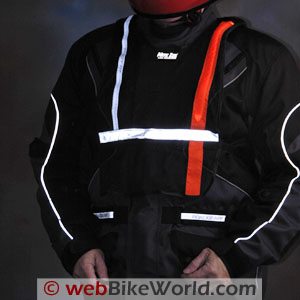
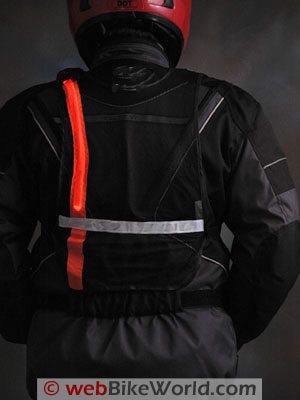
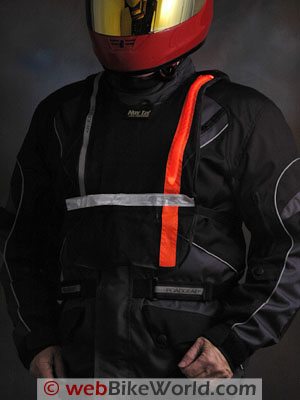
The Roadgear LED lightweight mesh vest includes separate front and rear LED flexible light tubes.
These can provide good visibility in the dark, but not without some issues in execution and construction.
I think the visibility thing is catching on with motorcyclists, or at least I’d like to think so.
I should qualify that statement though — it’s the North American motorcyclists who seem to be catching on to the high-viz craze.
Not European motorcyclists, who have long since learned about the benefits of life-saving gear like helmets, full leather and Scotchlite.
Maybe — just maybe — it’s actually becoming “cool” to wear proper safety gear and colors other than black?
Even Scorpion and Icon, two companies whose primary audience are twenty-something motorcyclists, now offer high-viz products like the EXO-700 Neon helmet and the Icon Mil Spec Vest.
I’m not sure how many 20-year-old stunters will be wearing Neon helmet any time soon, but the vest sure seems like a winner.
Crawl out of any Tube station in London though and just about every “motorbiker” you see is fully outfitted in leather, head-to-toe protective gear and some type of highly visible and reflective vest.
Lime yellow with white reflective striping seems to be the eye-burning color of choice and you see it on everyone from construction workers to Bobbies to signalmen.
The BikeSeen jacket we reviewed some time ago is an example of that type.
And since it’s also waterproof, some riders wear over their leathers.
But we’ve also published many other reviews of lighted and reflective vests, jackets and other high-visibility motorcycle gear over the years.
Here’s one more: the Roadgear LED vest. This one is quite different, and that’s both good and bad, as we’ll see.
The concept of a self-lighted high-visibility garment isn’t new.
We reviewed the Safe Lites Beaconwear Vest (review) a few years back, and this remains one of the most interesting self-illuminating vests available.
The Safe Lites vest uses the flat “GlowSkin” technology, which consists of magically thin, lightweight, flat stripes that self-illuminate with an eerie glow. The GlowSkin is powered via a small battery pack that fits in a pocket.
That vest is also very well made, with a body consisting of heavy-duty mesh and a thick nylon zipper.
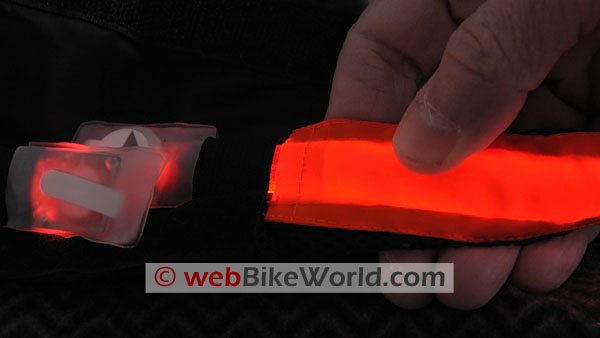
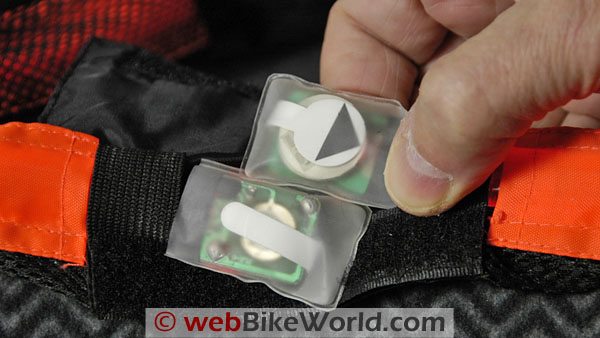
 Fabric covering the batteries. CR 2032 batteries power each LED light tube and are protected by a plastic slip-on cover.
The Roadgear LED Vest
The Roadgear LED vest takes a somewhat different approach.
And guess what? The label says that the vest is made by Poly Brite for Roadgear.
It just so happens that we reviewed a Poly Brite brand lighted LED vest, which is similar, back in 2005.
The Roadgear vest uses “Nite Ize” lighting technology and “Actiglo” illumination tubes, the same technology used in the Poly Brite vest.
I’m not sure why Roadgear is calling this an LED vest rather than an Actiglo or Nite Ize vest. Licensing cost issues, I’d guess.
But I did find some information that states that “Actiglo illumination is a patented light technology that transmits light from an LED through a flexible plastic material called a polymer lens.”
The Roadgear vest — which is really a bib and not a vest — has a very light mesh body and it carries the two separate LED light tubes on the front and back on the left side, mounted vertically.
I’m assuming that the LED Actiglo tubes are on the left because motorcycles travel on the right in North America, but I’d rather have the LED tubes run diagonally across the front and back of the vest.
Each light tube is powered by a single CR 2032 flat watch battery, which Roadgear says should last about 150 hours.
The LEDs are said to have 150,000 hour lifespan.
The batteries sit on a very small circuit board at the end of each tube.
The tubes end at the top of the left shoulder, covered by a thin section of fabric that is secured with some hook-and-loop fastener.
The body of the vest includes a reflective strip across the front and back. This strip is made from a type of clear vinyl that covers the retro-reflective material. A single “Roadgear” reflective logo strip runs vertically up the right side in the front.
The vest has two thin elastic straps on either side of the bib and they attach to the front or back panels with hook-and-loop.
The LED light tubes are contained inside of translucent orange fabric channels.
The tubes do not contain individual LED “bulbs”; rather, the entire tube itself lights up. I’m not sure how it works — perhaps there is a single LED somewhere in the tube and the Actiglo technology diffuses the light throughout the tube?
The tubes have an oval cross-section, so they lay relatively flat.
The entire vest, including the batteries, doesn’t weigh much at 96 grams (3.375 oz.).
How It Works
Each battery is held in a sort of metal membrane.
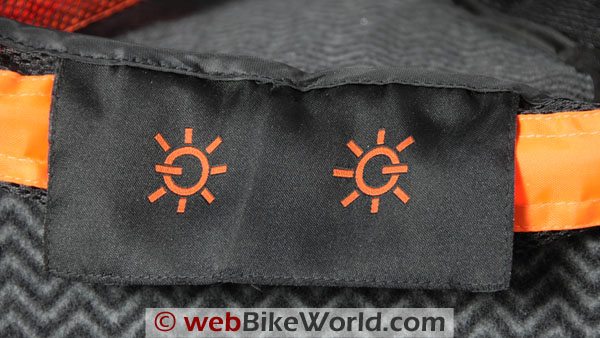
Pressing the membrane “clicker” switch once and the LED tube light will burn steady; press it again and it will blink, and press it once more and it turns off.
Since there are two tubes and two batteries, each must be pressed to turn on both the front and back lights.
This also allows the lights to be switched differently; for example, the front can be steady while the rear LED is blinking.
It’s very difficult to capture the effect with the camera or videocam.
The LED lights are not extremely bright, but they do show up very nicely in the dark and the retro-reflective material on the vest also works well.
The photo at the top of the page was taken with a flash, and you can see the reflective material on the vest along with the same on the Roadgear Tierra del Fuego Jacket (review).
So far, so good, right? But there are a couple of problems.
First, I think the vest material is too lightweight. It’s very thin and gossamer-like, and the vinyl LED light tubes seem to have a natural bend that is constantly trying to twist the material.
This means that I have to keep pulling on the lower part of the bib to keep the vest in place — you can see the model in the video doing it too.
I think Roadgear would have been better served to license the original Poly Brite brand lighted LED vest we reviewed in 2005.
Having both tubes on one side doesn’t help either, because this offsets having no tubes on the right side of the vest, making everything feel out of balance.
The combination of the thin carrier material and the twisty tubes also makes the vest rather difficult to put on.
Once I’m all tucked in to a heavy jacket, I find it very difficult to reach around and find the thin elastic straps and get them secured under my arms on each side.
It’s best to find someone to help, but if there’s no one around, it’s a struggle.
One other small problem involves the placement of the batteries.
The two tubes meet at the top of the shoulder, but on this vest, the tubes overlap right at the batteries (which are covered, by the way, by slip-on plastic sleeves that I hope won’t get lost).
So whenever I want to turn on the lights, I have to fumble around to select each battery to turn it on. It’s impossible to tell what’s going on in the rear tube, so the only solution is to turn on the lights before you put on the vest.
The light “clicker” membrane switch on the batteries is also nearly impossible to feel when wearing gloves, so it’s difficult to turn the lights off if necessary when riding, although I’m not sure why that would be necessary.
Conclusion
An interesting and very lightweight, unobtrusive vest that can be worn over motorcycle clothing for added visibility, but a bit difficult to actually wear.
My suggestion would be to make the vest of thicker material.
It could be made in a true vest style, with a single zipper in front like the Safe Lites Beaconwear Vest (review) rather than using a bib style, which is much harder to put on over a heavy motorcycle jacket.
Another idea would be to have four individual light tube pockets in the vest so the owner can insert the LED tubes (or buy another pair to have 4 tubes) in a variety of positions.
More webBikeWorld:
Owner Comments and Feedback
See details on submitting comments.
From “Doug” (11/08): “I’d be concerned that motorists would confuse “blink mode” with a left turn signal.
Having 2 “tubes” on each front and back surface would help prevent that.
I would cross them because a bid red “X” is a fairly universal sign of danger or at least a situation requiring caution or extra attention. Anything to jolt the half-asleep cagers on my morning commutes would be helpful.”
Editor’s Reply: Good point…
From “P.M.” (11/08): “I just read your review on Roadgear’s LED vest. Seems like a product that may be more useful in pieces than as a whole.
Are the LED “polymer lenses” easily removable from the vest itself (for cleaning, etc.)?
Are the strips themselves colored, or is the glow color a product of the orange material they’re behind?
With a little creativity (and a bit of waterproofing of the switchgear) those strips would make killer side-markers for saddlebags, lit “notice me” strips on helmets, glowing arm stripes sewn onto a jacket… and for $40 it’d be a cheap project.”
Editor’s Reply: The LED strips are removable, but try Nite Ize for ready-made strips.
From “D.J.W.” (11/08): “I have to wonder reading the article about the LED vests and the prior reviews of similar products (and some manufacturers no longer in business).
Why Firstgear, Roadgear, Icon, Joe Rocket, Olympia, Tourmaster, etc. just don’t add the $5-10 worth of LED/wire/battery (to) their already seriously expensive armored and weatherproof jackets.
At overseas manufacturing costs (which they all do) and volume it would seem to be a trivial additional cost in material to an otherwise sturdy bike jacket.
I often see giveaway led flashing bike light-type promo items at shows, so you know the material cost is nominal. You’d think they would jump on differentiating their products at a relatively tiny incremental cost when these jackets often run $250-$400 to begin with.”
Editor’s Note: Excellent suggestion! How about it, manufacturers?