

The OptiMate 3 is a small and compact motorcycle battery charger.
It is claimed to have the ability to de-sulfate batteries in addition to its normal battery maintenance charging duties.
UPDATE: See our Optimate 4 Review
I can’t think of a reason why a motorcycle owner wouldn’t want to keep their bike on a battery charger.
Wait — that’s a double negative, so let me try again: I’m always surprised to learn of a motorcycle owner who doesn’t use a battery charger on a regular basis.
The motorcycles in the webBikeWorld garage have everything from lead-acid to gel internals, and they all go on a charger just as soon as their parked for the day.
The Battery Tenders we’ve been using have been in continuous operation now for over 8 years without a hitch. The motorcycle batteries seem to last forever, and I credit the maintenance chargers for that miracle.
But I don’t know how much longer the Battery Tenders will last.
An unheated garage probably isn’t the best environment for electronics; it gets way hot in there in the summer and frigid in the winter, and the humidity can sometimes make it feel like rain will drop from the ceiling at any moment.
So we’re always looking for something new and different, and I picked up this OptiMate 3 battery charger at a local shop a few weeks ago to give it a tryout.
The OptiMate 3
The OptiMate 3 is one of the most popular motorcycle battery chargers in the UK, although it probably is not as well known as the Battery Tender brand in the U.S.A.
Perhaps that’s because buying an OptiMate 3 can be a bit confusing — online retailers sometimes mis-label it by calling it an AccuMate battery charger, and I’ve also found it labeled as a TecMate battery charger.
The manufacturer of the OptiMate 3 (and the brand new OptiMate 4; more on that in a minute) is TecMate International, S.A., headquartered in Belgium, with North American offices and distribution located in Ontario, Canada.
TecMate makes industrial-grade battery chargers like the AccuMate Pro series and the AccuMate V, a fast battery charger.
Also the TestMate, a cool-looking little battery analyzer that can be connected to the motorcycle’s electrical system and the AccuMate 6/12 Mini, a 0.9 Amp charger.
They also make a few more, including motorcycle battery chargers labeled for Honda. Thus the possible cause of confusion over the names…
The OptiMate 3 battery charger shown here is probably the most popular unit used by motorcyclists, and it’s claim to fame is that it “will save neglected, deep discharged batteries other smart chargers can’t!”, according to TecMate.
The OptiMate 3 is labeled as a “Desulfator-Charger”, and although I hope to never let a battery become so neglected that it suffers from deep discharge and sulfation (and if I did, I’d simply buy a new battery), it’s nice to know that the OptiMate 3 is up to the task.
OptiMate3 Features
As a motorcycle battery maintenance charger and as a potential replacement for the Battery Tender, the OptiMate 3 has proven to be a very nice system.
It has a compact heavy plastic body, measuring about 160 mm by 60 mm by 53 mm at its widest point (6-3/8″ by 2-1/4″ by 2″).
It weighs about 565 grams (1 lb., 3-7/8 oz.), not counting the wires.
The electric cord is about 1.7 m long (6′ 6″) and it’s permanently attached to one side of the unit, while the working end is the same length and includes a two-pronged adapter on the end.
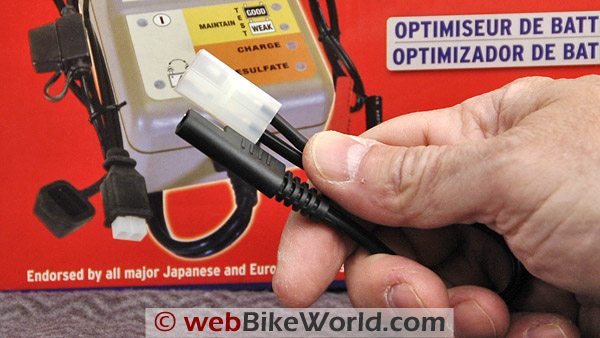
The OptiMate 3 comes with a short 230 mm (~9″) adapter that converts the SPT-2 two-prong plug to an SAE Battery Tender type plug, so anyone with an SAE harness already attached to their battery will be all set.
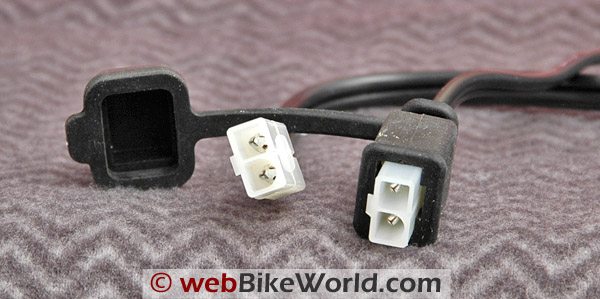
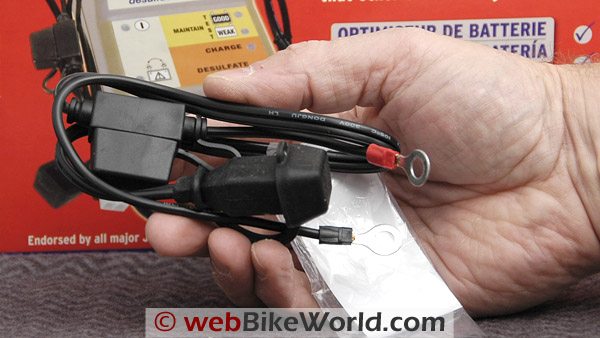
TecMate also provides a nice SPT-2 two-prong harness with a water-resistant inline fuse holder, which includes a 15A fuse. This harness could be attached to the battery also to use in place of the SAE adapter if desired (see photos below).
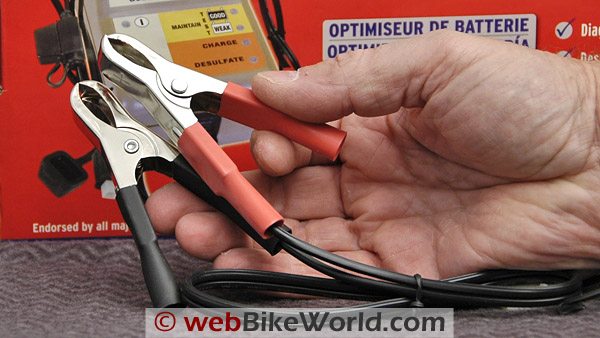
They also throw in a set of Alligator battery clips with the SPT-2 two-prong adapter on the end ($9.90 if you had to buy it), and the box shown here also includes a free wall hanger, which is an $11.90 option if you had to buy it.
I proceeded to immediately lose it somewhere though, yet to be found.
About TecMate
TecMate is serious about the North American (and European, for that matter) market, and all of the parts and many accessory SAE and SPT-2 cables and adapters are readily available for sale online.
TecMate also has service centers in the North American and European markets if any repairs are needed. The OptiMate 3 comes with a 2-year warranty.
They said that the company strives to maintain a “strong emphasis on service, whether in response to technical enquiries or in providing after-sales back-up” and that they also focus on maintaining a high level of quality.
They claim that this has given them the ability to partner with several original equipment motorcycle manufacturers to offer the chargers under the various brands.
Evaluating a Motorcycle Battery Charger
It’s pretty hard to run a proper evaluation on a battery charger; for our purposes, it either works or doesn’t.
But the OptiMate 3 works well; something about it makes it easy to use and the unit seems more robust than — I hate to admit this — the Battery Tender.
The instructions that came with the OptiMate 3 are relatively easy to understand, although like any new electronic device, I read through them slowly a couple of times to make sure I understood everything.
The instructions are written in English, French and Spanish.
Using the OptiMate 3
The instructions state that the charger should be first connected to the battery via the wiring harness of choice before the unit is plugged into the “mains”, i.e., the electrical outlet.
Note that the Battery Tender Plus instructions are similar; they read “Do not connect the charger AC power plug to the electrical outlet until all other connections are made.”
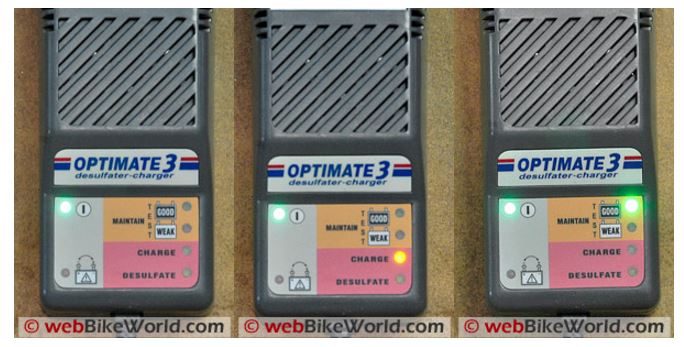
The OptiMate 3 has 6 LED lights in various colors on the front panel. Turn it on and the light on the upper left (left photo above) immediately glows green; it’s the light next to the “I” bar inside a circle.
The yellow-orange “Charge” light displays after the unit goes through some checks (middle photo) and if the battery is accepting the charge.
The OptiMate 3 averaged about 1 hour of “Charge” time on each of the four different motorcycles we connected it to, all with batteries at different levels of charge, having sat in the garage for various amounts of time.
This seems slightly longer than the Battery Tender to run the checks and before it indicates that the battery is charged, but that’s not a problem, just a curiosity.
If the battery is “Weak”, the red light next to the “Weak” logo will glow instead of the “Good”, which glows after the battery is fully charged.
The light at the lower left is the reverse polarity indicator; if the positive and ground wires get crossed somehow, the OptiMate 3 has a lock-out protection that will prevent any damage and the reverse polarity LED will glow.
Desulfate Mode?
If the battery is discharged or sulfated, the “Desulfate” LED will glow yellow-orange and as long as the battery has 2 Volts or more. The OptiMate 3 will provide up to a 20V charge maximum at 200 mA to try and force a charge.
As soon as the battery will take a charge, the “Desulfate” light will go out and the “Charge” light will go on.
Note that if the battery is in a serious state of discharge, it should first be removed from the motorcycle before the charging attempt is made.
The instructions say that during the charging state, the OptiMate 3 will deliver a constant current of 0.6 Amps to the battery “whose progressively rising impedance will cause the charging Voltage to increase (to) 14.3V, when the OptiMate 3 will start the absorption and verification stage”.
The unit is programmed to check for Voltage drops and other indicators to make sure that the battery becomes fully charged and can be maintained.
During the maintenance, or “float” stage, the OptiMate 3 checks the battery Voltage every 30 minutes to make sure everything is OK.
Finally, the red LED next to the “Weak” logo will glow if the Voltage can’t be maintained or if the battery could not be saved due to things like a short-circuit (fairly common in motorcycle batteries and can happen suddenly) or total sulfation.
Alligator battery clips provided with the OptiMate 3. This is the SPT-2 battery wiring harness with fuse block provided in the kit. SPT-2 Adapter ends (for illustration; these are on the supplied SPT-2 wiring harness). The SPT-2 (white) to SAE adapter cable.Amp Draw
By the way, the OptiMate 3 understands that the motorcycle may need to draw up to 200 mA of current each 30 minutes to support any accessories, such as a clock, alarm system or other losses due to wiring problems, so it takes that into consideration in the program.
The instructions say to first disconnect the OptiMate 3 from the “mains”, or electrical outlet, before removing the connection to the battery. I think this is pretty typical for battery chargers, but I’m not sure how many owners really follow this advice.
Also: The Optimate 4
And about that OptiMate 4: it’s brand new to the North American market, and it has a sleek-looking new case. It has 19 different LED indications, and it will time out after 48 hours if it can’t get a battery recharged.
It has several other features, but so far TecMate is still selling the OptiMate 3, which seems simpler and possibly easier to use.

UPDATE (December 2008): See our Optimate 4 Review It’s much more complicated, so the OptiMate 3 may be the way to go.
Conclusion
That’s about all there is to it — the OptiMate 3 works really well and it’s smaller and more compact than our old Battery Tender.
It also works with just about any size battery, from 2 Amp-hours to 45 Amp hours, according to TecMate, although the company says it will also work on larger batteries but may take longer to bring them to full charge.
I can understand why the OptiMate 3 has become one of the most popular motorcycle battery chargers in the world; it’s easy to use, the indicators are bright so you always know what it’s doing, and it works.
The warranty is shorter than the Deltran Battery Tender Plus, which has a 10-year warranty, which I suppose is something to consider.
wBW Motorcycle Battery & Charger Reviews | Maintenance & Repair Articles
| wBW Review: OptiMate 3 Motorcycle Battery Charger | |
|---|---|
| Manufacturer: TecMate | List Price (2008): $59.50 |
| Review Date: August 2008 | Made In: China |
Owner Comments and Feedback
See details on submitting comments.
From “D.J.” (February 2017): “I’ve bought a few of these second hand over the years and found them to be so well built they seem to go on forever.
I’ve even used them on my Audi A2 1.4 TDI battery as well as my Royalstar XVZ1300. Just follow the instructions. Marvelous, highly recommended.”
From “D” (12/08): “I was perusing the pages and came across your reviews on the OptiMate 3, and to be honest i am in agreement totally with the general information on them.
I have been running one on my bikes for 4 years now without problem, and have revived a deep cycle 75ah leisure battery that was expected to be thrown, it now performs as new thanks to the OptiMate 3.
I have never had a start problem nor had reason to doubt the OptiMate, I would recommend this unit 100% to anyone.”
From “S.C.” (9/08): “I have had the OptiMate 3 charger for a couple of years now, it has maintained my car’s battery during the summer and the motorcycle’s battery during the winter.
It has brought back to life the car’s battery from complete drain when I left the inside lights on the car for over a week.
Never had to purchase a new battery since I bought the OptiMate, frankly with the options that came with it as noted in the review, I have been totally satisfied from my purchase.”
From “R.O.” (9/08): “I have the OptiMate 3, after replacing my (Yamaha) R1 battery twice due to the LoJack system. I have to admit it’s very easy to use, because I have the pigtail I used it a lot. I never have a weak start or dead battery again.
My friend had a dead battery that was 4 year old that the service (departments) said had to be replaced, well after leaving it overnight he is using the same battery and he has strobe light, (and) LEDs with an alarm. And so far it been working real good, no issues.
Take that, stupid service department!”
From “T.B.”: “I have the ubiquitous Battery Tender Plus. I don’t have the instructions in front of me, but I believe Deltran recommends plugging the unit into an outlet first then connecting the battery.
Having read the opposite in the OptiMate 3 review, I would be less than enthusiastic about this product out of sheer convenience. Often, as in my case, the outlet is nowhere near the unit nor the battery being maintained.
From personal experience, the reason for the Battery Tender purchase was for the car after the purchase of my first bike. What happened was that the car got so little use over the first 8mo that the battery started to fail.
This was demonstrated by the fact that the accessories would not work for more than a minute without the engine running.
After being on the Battery Tender for about a week, the car would start without struggle. Now, and ever since, the car’s battery has been great with normal accessory capability and strong starting power.
It seems that TecMate may want to review their procedure if they want to successfully penetrate this market, in my opinion.”
Editor’s Reply: Battery Tender Plus instructions read “Do not connect the charger AC power plug to the electrical outlet until all other connections are made.”