

For some reason, it’s not “cool” to be seen wearing ear plugs while riding a motorcycle.
I know I probably sound like dear old Mom, but let me tell you something — it’s not cool at all to lose your hearing, and it’s really, really easy to do so.
I urge you to check out the websites listed above in the “More Information” section to learn about the effects of noise and hearing loss.
Riding a motorcycle is a very noisy endeavor.
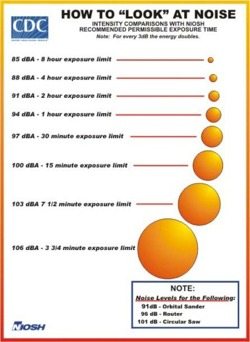
Sound levels can easily reach over 90dB at only 50mph, and 90dB exceeds the levels at which hearing protection should be used.
If you were working inside a factory, various local and national governments strongly advise wearing hearing protection at those levels.
At 60 mph, a motorcyclist can experience the same noise as if using a circular saw (100dB).
Also, decibel levels increase logarithmically, which means that each bel is a tenfold increase in the level of noise.
Note that the chart above, supplied by the U.S. National Institute of Occupational Safety and Health (NIOSH) recommends no more than a 15 minute exposure to 100dB noise.
Longer than that, and you risk permanent hearing loss.
It’s very easy (and likely) to exceed 100dB while riding a motorcycle, and at those noise levels, permanent damage can take place in a matter of minutes.
For some reason, people just don’t seem to think it’s happening to them.
This is probably because the damage happens slowly, and it’s not hard to get used to the reduced hearing levels, which then become the norm..
Don’t count on a motorcycle helmet to protect you from harmful noise either.
Helmets provide only a very minimal amount of hearing protection. Some helmets can actually increase the amount of noise; air flowing over and through the helmet can amplify the sound levels at various frequencies.
About the only defense we have is to wear high quality ear plugs that fit comfortably and are correctly inserted.
The shapes and sizes of ear canals, the way we perceive noise, and the hearing damage we’ve already received can affect the choice, comfort and fit of ear plugs.
Earplugs are available in a corresponding variety of all sorts of different shapes and sizes, and they are manufactured using various types of materials to control noise, including down, plastic, rubber and silicone.
So it’s important to try several different brands of ear plugs to find the one that works for you. If one style of earplug doesn’t fit comfortably, or interferes with the helmet liner, there are other brands and styles that will work.
If you’ve tried wearing ear plugs and you find them uncomfortable, I suggest you make the effort to try and find a brand that you like.
Lucy Dell Earplugs
Lucy Dell is a “one stop shopping” source for ear plugs. They have a huge selection of dozens of earplug brands and models, and most of them are very suitable for use by motorcyclists.
Various quantities were available for purchase, with discounts on bulk orders.
If you’d like to try a variety of different ear plugs to see which one is best for you, I suggest purchasing one of their sample packs, called the “Testpack”.
The Testpack includes a sampling of 20 different pairs of ear plugs, all stocked by Lucy Dell Earplugs. This is a great way to try all of the different brands until you find one or more that you like.
Chris Dell sent over a Testpack, and I have provided my comments on each of them (below).
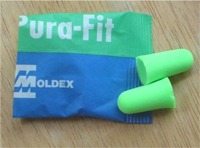
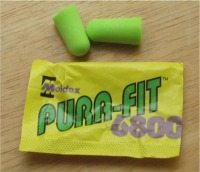
My earplug of choice recently has been the disposable Moldex Pura-Fit 6800. They’re comfortable, they provide excellent noise control, and they’re fairly easy to roll up and insert.
The only problem I have is that my right ear canal is very large — much larger than my left ear canal. I have to insert the 6800 backwards into my right ear for it to fit correctly, so I’ve been on the lookout for a good replacement.
Lucy Dell Earplugs suggests that an earplug with a high noise reduction rating (NRR) can be worse than an earplug that fits correctly but has a lower NRR, so this is a good reason to purchase a Testpack and sample them all.
Earplugs can either be too big or too small, so it’s a good idea to make sure the earplug is big enough so that it doesn’t disappear into your ear canal.
You should always be able to grab the end with your fingers to rotate it and gently remove it.
But it’s also important to ensure that the earplug doesn’t protrude too far from the end of the ear, or it may interfere with the helmet’s liner.
This can actually channel more noise directly into the inner ear than you’d expect.
To insert ear plugs, first make sure your hands are clean. Disposable ear plugs are designed for one-time use only; they should be discarded after each use.
Reusable ear plugs should be cleaned with soap and water and rinsed and dried prior to each use.
It’s important to inspect the earplug prior to use — look for any cracks, tears or imperfections.
I’ve noticed over the years that some brands of ear plugs don’t have “six-sigma” quality, which leaves some fairly dramatic differences in earplug shapes, even within the same batch.
To insert a disposable foam earplug, roll it between the fingers and thumb until it becomes a long, narrow cylinder. Use a progressive, firm motion to help avoid creating any wrinkles or folds as the cylinder becomes smaller.
Reach one hand behind your head and pull your ear outward and upward to widen the ear canal; sometimes it helps to open your mouth and throat while you insert the earplug.
Insert the earplug well into the ear and hold it in place until it expands.
One of the most common mistakes is not inserting the earplug far enough into the ear. It’s pretty hard to damage anything in there, because most ear plugs aren’t long enough to reach that far.
If the seal is not tight, the earplug will not be effective.
As the earplug expands, you should get a feeling like the world is closing in and most sounds should disappear.
Lucy Dell Earplugs “Testpack”
We compared a variety of ear plugs available from Lucy Dell Earplugs to the Moldex Pura-Fit 6800 brand that I’ve been using recently (only available in the U.S.A., and not provided in the Testpack).
Remember that my results with these ear plugs will most likely be completely different than yours, due to the variation in ear shapes, comfort issues and more.
Lucy Dell Earplugs ships worldwide, so feel free to contact them for more information on any of the products shown in this review.
I measured the ear plugs for length and width for comparison purposes. These measurements are approximate.
The measurements are in millimeters, and the designations are L = length; W = width.
If the ear plugs are tapered, the lengths are listed wide end/narrow end; i.e., W130/110 means that they were measured as 130mm at the widest end and 110mm at the narrow end.
|
|
| Moldex Pura-Fit 6800: I’ve used these for about the past 3 years. Comfortable, soft, lightweight and they do an excellent job of controlling noise when properly inserted. Easy to roll up, and they stay rolled up just long enough to get them inserted, as long as you’re quick about it. The quality control varies from package to package; some are noticeably shorter and/or thinner than others. U.S.A. and Canada only. L265, W130/110 | Moldex PuraFit 7700: Slightly shorter than the Pura-Fit 6800, and slightly smaller on the small end, but functionally about the same. Feels just a tiny bit more rubbery than the 6800, but may be my imagination. Provide excellent noise control. I’ve found that these fit me better than the 6800s because of the shorter length. The European version of the 6800. L240, W130/100 |
|
|
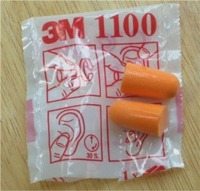
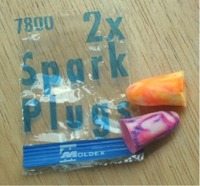
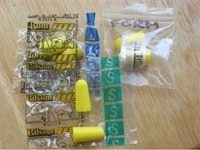
| Moldex 7800 “Spark Plugs”: Colorful design, apparently meant to promote earplug use in factories. Rubbery feel, a bit hard to roll up because they seem to offer more resistance than the 6800. A different style tapered bell shape that will fit some, but may work their way out of the ears of others, as they are hard to get inserted all the way into the ear canal. Protrude slightly from the ear and may interfere with helmet liner. L220, W110. (See comments) | 3M 1100: Soft feel; “spongier” and more rubbery-like feeling than the PuraFit with slightly more body and fast expansion that fills the ear cavity better, but you can feel a bit of pressure in your ear after expansion. A bit harder to roll up, and the quick spring back means you have to be quick about placing them in your ear. I don’t feel like I have to poke them as far into my ear as the PuraFit, which is good. Seem to control noise as good as the best. L230, W130/100 |
 |
|
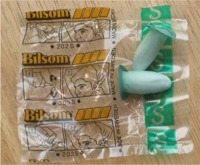
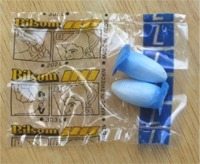
| Bilsom 303L, 303S and “Form”: Soft, comfortable. These are basically the same earplug offered in three different sizes. A bit firmer than the 3M 1100. Doesn’t expand as quick as the 3M, which makes it easier to correctly insert. The length of the “Form” provides a better fit in larger-sized right ear. Provide good noise control. Form: L220, W120/100. 303L: L230, W120/100. 303S: L220, W115/85 | Bilsom 202S: Filled with down; covering feels like a plasticy condom. Hard to keep in due to slippery covering. These ear plugs do not take any compression, so they can’t be placed far enough into my ear. Don’t offer much in the way of hearing protection for motorcyclists; apparently will provide a very low level of protection for other uses. L230, W85 |
|
|
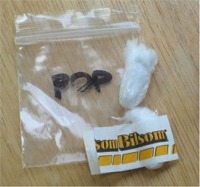
| Bilsom 202L: Larger version of 202S with same characteristics; non-compressible and slippery. L230/W100 | Bilsom “POP”: Down filled with open-ended plastic type covering. Easier to insert than the other Bilsoms, seem to provide a modicum of noise control. Good for those who can’t use foam or rubber ear plugs. W250, L110 |
 |
|
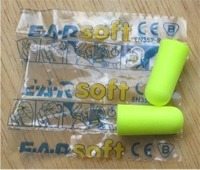
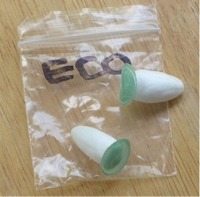
| ECO: Same type of fiber filling as the Bilsom 303 and 202. A bit stiffer, so easier to insert. Doesn’t offer anywhere near the noise control of the foam plugs. L250, W120 | E.A.R. Soft: Very soft, comfortable feel. A bit more of a rubbery feel than the PuraFit 6800. Quicker expansion and softness make them a bit trickier to insert; you have to be quick about it. Provide decent noise control, but seem about 25% louder than the other foam disposables. L250, W120/95 |
|
|
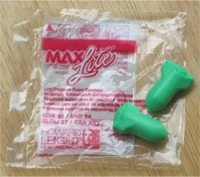
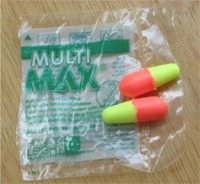
| Howard Leight Multi-Max: Very soft, don’t have as much “body” as others. Comfortable; not as much pressure as the 3M 1100 or even the Pura-Fit 6800. Expand fast but with just enough time to get them inserted. Fits a wider variety of ears and works well for riders with different size ear canals, as the larger end can be inserted first. Only downside is that their rather extreme length means that they might contact some helmet liners. Excellent noise control. L300, W110/80 | Howard Leight Max Lite: Different shape than most due to wide end. Slightly rubbery feel, quick expansion but not as fast as the 3M 1100. Has stronger “body” than similar ear plugs, and although they seal out noise, the expanded pressure may bother sensitive types. Longer than many other ear plugs, but doesn’t protrude out to where it hits the helmet liner. Makes a gurgling sound during expansion. Greater noise protection than other plugs. Normal insertion doesn’t quite fill my larger right ear canal, and can’t insert backwards due to shape. Would be a good choice for noise control for most riders. L260, W165/100 |
|
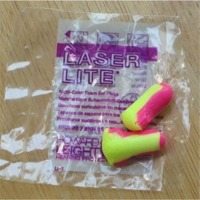 |
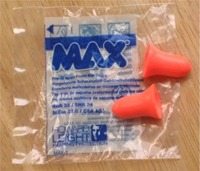
| Howard Leight Max: Yet another different shape, but the wide ends make them a bit difficult for me to insert correctly all the way into the ear. Slightly rubbery, soft feel. May interfere with some helmet liners. But if they fit and if they will stay in, they’re among the best in providing excellent noise control. L230, W165/110 | Howard Leight Laser Lite: Very similar to the Max Lites (above), but more colorful. L265, W165/110 |
|
|
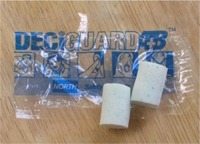
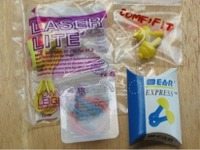
| Howard Leight Laser Lite & Air Soft; Comfifit; and E.A.R. Express: Lucydell carries a variety of corded and non-disposable ear plugs. These work well and are usually easy to insert and remove, but not appropriate for motorcycling. The E.A.R. Express and Comfifit have protruding handles that would interfere with a helmet liner; these also don’t feel as comfortable as the foam types. I couldn’t get the Air Soft ear plugs to stay in my ear – the silicone was too smooth to grip. | North “DeciGuard”: Very stiff foam; hard to roll up into a cylinder. Offer good noise control. Apparently not designed to fit very far into the ear canal, these would be appropriate for those with sensitive inner ears. But can interfere with some helmet liners, which might channel noise directly from the helmet into the ear, which can actually be louder than no ear plugs at all. If they fit you, they’ll work good. L185, W130 |
|
|
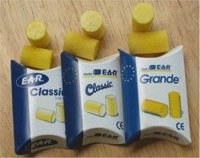
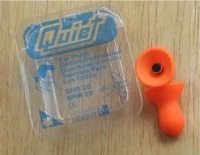
| Howard Leight Quiet: Non-disposable, easy to insert, comfortable silicone. Slightly slippery when new. Don’t provide as much noise control as the foam plugs, but would probably work well for those who can’t wear foam. L200, W95. | E.A.R. Classic Small, Classic and Grande:These have been around forever, and they work. Very stiff foam, but rolls up into a nice, narrow diameter. Slow expansion provides time to get them correctly inserted. Provide good noise control. The variety of sizes mean that riders should be able to find one that will fit without rubbing against helmet liner. Small: L185, W130. Classic: L200, W130. Grande: L230, W130. |
For More Information
The U.S. National Institute for Occupational Safety and Health has a website devoted to hearing protection.

ISVR Consulting graphic – motorcycle noise levels regularly exceed 90dB.
More on motorcycle noise, exposure limits and hearing on the Free Hearing Test website.
A drawing and description of the functions of the human ear.
More wBW Ear Plug Reviews | All wBW Motorcycle Product Reviews
| wBW Review: Ear Plugs | |
|---|---|
| Manufacturer: Lucy Dell Earplugs | List Price: Varies |
| Colors: Varies | Made In: Various |
| Review Date: 2004 (?) | |
Note: Item provided by a retailer, distributor or manufacturer with these Terms and Conditions.
Owne Comments and Feedback
See details on submitting comments.
From “M.P.” (September 2014): “The Quiet Down 202s are the only ear plugs I’ve tried which actually stay in my ears all night and they block out way more noise than anything other than over-the-ear muffs.
Foam plugs block nothing out and constantly expand to pop out of the ear and the plastic/rubber ones with flanges are painful.
I think your review of the fiber/down filled plugs is unfair and inaccurate and could be driving people away from a solution that might just work for them, as they have worked for me.”
Editor’s Reply: Note that our reviews are about ear plugs for motorcycling, not sleeping.
Different ear plugs perform differently with different people. Ear plugs also come in many shapes and sizes; perhaps you have not found a foam type that fits your ears.
The foam type ear plugs generally perform better for reducing noise when riding a motorcycle.
From “C.M.” (9/09): “Despite the high reviews, I’ve found the Moldex Pura-Fit 6800 ear plugs have not worked for me. The box of 200 that I recently purchased are all too long and quite thin.
They tend to jam up against my ear drum while failing to expand enough to make a tight fit in my ear canals, consequently reducing noise levels by only a very modest and unsatisfactory amount.
The brand of foam ear plugs that have worked best for me are the E.A.R. brand with a NRR of 29db. They’re not tapered on either end and are sometimes difficult to insert.
However, they’re thicker than the Pura-Fit plugs and, once inserted properly, do a very good job blocking sound.
My experience might show that ear canals differ, and the plug that works for one person might not work well for the next.”
From “S.Y.”: “Thanks to your website I now use (Moldex PuraFit 6800 ear plugs) when riding. This may be helpful for some readers who find it difficult inserting ear plugs even after rolling the plug and pulling back the ear.
Wetting the ear canal with a wet finger or the plug itself makes for easy insertion but you have to be careful because it can slide in too easy and touch the ear drum which can be painful.
Hope this is of some benefit.”
Editor’s Reply: I sometimes hold the ear plug near my mouth and breathe on it a few times, which heats it up slightly and moistens it just enough to insert.
Be careful of moisture in the ear canal, however, which could cause problems.
From “T.W.”: “I have tried both the 6800 and the Spark Plug. I actually found the Spark Plug to be easier to roll and insert.
Overall a softer plug with a very similar rating. Here in Canada the Spark Plug was about 0.03 per plug cheaper than the 6800.”