

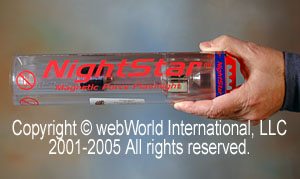
The NightStar “Shake” flashlight batteries are charged when you shake the light back and forth.
This flashlight is waterproof and the manufacturer claims it can be stored for years with the expectation that it will still work when needed.
It has a five-year replacement warranty.
My flashlight obsession has most of my family thinking that I’m slightly off-kilter.
I always carry one on the bike, and I also make sure that there are at least two next to me before I go to sleep.
The truth is that my night vision is so bad that I’d be completely helpless without a flashlight if the bike stalled at night, especially in the deep darkness that covers our rural county after sundown.
But there’s a problem: the batteries always seem to be in one of two states: dead or dying.
Flashlights are great in an emergency, but only if they work when the switch is thrown!
That’s why I became curious about the new “shake flashlights” that have recently been made available to consumers.
The advertisements seem too good to be true: shake the light a few times and you’ll be blessed with eternal light.
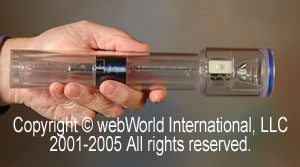
Photo 2: The charging coil can be seen under the model’s thumb.Night Star Shake Flashlight
We purchased the NightStar flashlight shown here, which is a “full size” flashlight.
It’s about equivalent in size and heft to a double D-cell standard flashlight.
Note that the technology for these products is rapidly evolving, and there are smaller shake flashlights now available.
But there aren’t any that I’ve found that are as tough as this one, as you will see.
The manufacturer claims that the NightStar requires “no batteries, no bulbs, no maintenance…ever!”, which definitely piqued our interest as a motorcycle flashlight solution.
How It Works
All of these shake flashlights operate on the same principle, more or less.
If I had paid attention in high school physics, I’d be able to tell you what that principle is.
I think it has something to do with a magnet passing through a coil of wire, which creates electricity. Wasn’t Faraday the chap who discovered this effect, back in the early 1800’s?
A shake flashlight has a fixed coil of wire, usually in the handle (see Photo 2), and a moveable magnet that passes through the coil.
By shaking the flashlight back and forth, the magnet passes through the coil and creates electricity.
The electricity is stored in a capacitor, which becomes charged. This is enough to power the LED bulb and provide light.
Flashlight Details
The body of the NightStar II Clear Magnetic Force model that we purchased is made from a clear, heavy-duty plastic of some sort. The manufacturer claims to have the patent on the “original shake light” .
The body is apparently sealed for life; I can find no way to open the tube to change the bulb, which I assume probably will never need changing anyway, since it’s a single LED.
The flashlight weighs 11.125 ounces, or 315 grams. It’s exactly 10″ long (25.5 cm), and the handle is 1-7/16″ in diameter at the handle (~33 mm) and 2″ at the head (~51 mm).
There are warnings on the flashlight and in the owner’s manual about the strong magnetic field that surrounds this flashlight, and they aren’t kidding — I can’t place a steel tape measure anywhere near the thing without it getting instantly attracted to the flashlight.
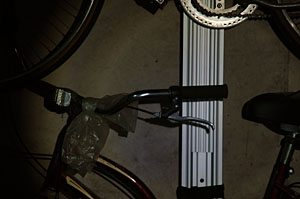
Photo 3: NightStar beam from 10 feet away in complete darkness.So it’s important to be careful about using or storing this type of light near any materials that might be affected by a magnetic field, such as a computer floppy disk.
I had no idea that the field around a shake flashlight would be so strong, and this is a definite downside to using this type of light.
Just in case you get lost, the instructions claim that the NightStar can be hung by a string, and it will automatically indicate north and south, just like a compass, with the light always pointing north.
The “glow in the dark” on/off switch on the NightStar looks to be completely unconnected to the circuitry; that is, I can see no wires or anything that might indicate how the switch actually makes the light turn on and off.
But somehow the switch does indeed turn the light on and off, so this remains a mystery.
The manufacturer claims that the switch will glow for several hours after only 10 minutes of direct exposure to sunlight or room light.
The switch does not look waterproof to me, which is another mystery, but the instruction booklet claims that the NightStar can be used to a depth of 430 feet (131 meters), and has a crush point of 180 pounds per square inch.

That must account for the weight of the light and the thickness of the clear plastic body. 430 feet is definitely waterproof, I’d say. This is a plus for the NightStar.
The manufacturer also claims that the light can be “repeatedly” dropped from a height of 4 feet (1.2 meters) with no problems.
And in case you were wondering, they also claim that it will remain operational “after three days immersion in solutions of salt, water, isopropyl alcohol, methanol, bleach, ammonia, and acetic and phosphoric acid (10% solutions).
This is one tough flashlight!
It also carries a 5 year warranty. If the light fails within 5 years, they will replace it for free. They must have a lot of faith in the NightStar for sure.
Charging the Flashlight
The NightStar is charged from empty by shaking it back and forth for about 3 minutes at 2-3 times per second.
The light must be held parallel to the ground and the magnet must pass completely back and forth through the coil. It sort of has a spring effect, I think due to the sealed chamber, which doesn’t let any air escape.
The air acts as a cushion at either end of the shake.
If the flashlight is partially charged, it takes about 90 shakes to bring it back to full power. Full power is a bit less than what I expected, but it’s about as much power as one can get out of a single LED.
It’s adequate, but don’t expect the same brilliance as you’d get from, say, a two or three D-cell halogen flashlight like a Mag-Lite.
The manufacturer claims that the NightStar’s beam has a 5 foot diameter at 50 feet, with an effective range of “50 feet non-reflective and 150+ feet reflective, visible from over 1 nautical mile away”.
Conclusion
The combination of an incredibly tough body and ultra-waterproof performance makes the NightStar hard to beat as a flashlight that may bounce around in the saddlebags for years before it’s actually used.
If you can live with the strong magnetic field that surrounds the light at all times, and you don’t mind the size, this one’s a keeper.
|
wBW Review: NightStar Shake Light Flashlight
|
|
|---|---|
| Available From: Applied Innovative Technologies | List Price (2005): $34.95 |
| Colors: Clear, Yellow and Black with various designs also available. | Made In: China |
| Review Date: November 2005 | |
Owner Comments and Feedback
See details on submitting comments.