

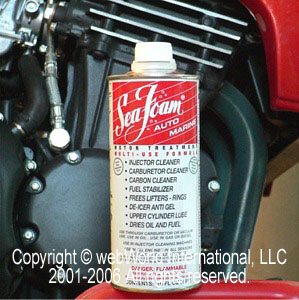
Sea Foam is a “do it all” motor treatment, fuel additive, carbon cleaner, fuel injection cleaner, fuel stabilizer and more.
Works in two-stroke, four-stroke and Diesel engines.
I’m probably the only person in the world who can’t wait for the next oil thread in my motorcycle discussion group.
I love ’em!
Motorcyclists who know better than the manufacturer giving all sorts of advice to newbies on which oil to use.
It never ceases to amaze me how much myth, legend and pure B.S. surrounds the whole issue of motorcycle engine oil.
I’ve run into owners who ride no more than 3,000 miles per year obsessing over ten-buck-per-quart oil bottled by some obscure refinery.
The smart rider knows there’s one answer and one answer only to the motorcycle oil question. It’s in the owner’s manual.
Do what they say, change it when they tell you to, and you’re golden.
You’ve probably deduced by now that I am not a big fan of fancy oils, additives and other magic potions.
So what am I doing writing an article about Sea Foam?
Well, it’s a long story…
Background
We recently acquired a 1998 Triumph Tiger “Steamer” to play with as the webBikeWorld Project Bike.
The bike is in like-new condition, only 1,900 miles away from factory fresh. The paint, seat, accessories and trim look like they did on the day it left Hinckley, as it should be with so few miles on the clock.
But there’s a flip side to that 1,900 miles.
The bike has basically sat around for seven-odd years with stale gas crusting up the insides.
We changed the oil (using the owner’s manual recommendations, of course!) and filter, changed the molasses that passed for brake and hydraulic clutch fluid, and replaced the hard-as-rock original Metzeler Tourance tires.
I drained and refilled the fuel tank and threw in a can of dry gas and a bottle of Techron just for luck. The bike started right up, and actually didn’t run all that bad, considering. But lots of stumbles, hesitation and general wheeziness indicated a definite carburetion problem.
A peek inside the airbox exposed an air filter that must have played home to a family of mice. Triumph engineering calls for an entire new airbox assembly instead of a simple air filter replacement, so a new $60.00 airbox with filter was installed.
The Triumph ran better but still stumbled and hesitated, most noticeable when first rolling on the throttle or on light acceleration from 3,000 to 4,000 RPM.
Sea Foam
I didn’t relish the thought of ripping apart the bodywork again for a carburetor cleanout, so I looked up a mechanic who I know and trust to offer him the job.
I was surprised when he recommended that we put a can of Sea Foam through it and run it for a hundred miles or so — I figured he wasn’t interested, and that was his way of giving us the brush-off.
I’m not a fan of any of these additives, but I ran the suggestion by a couple of other trusted friends and they sang the praises of the stuff, so I figured I’d give it a try. I had no idea why I’d never heard of it before.
Sea Foam Motor Treatment has been around since 1942, and was originally developed to remove varnish in carburetors in outboard engines.
So the product has been around virtually forever, and is now used as a fuel injector cleaner, carburetor cleaner and all-around cleaner for anything touched by gasoline or diesel fuel.
It’s also claimed to be a fuel stabilizer, an engine top lube, dry gas and de-icer.
The manufacturer claims that it “cures hesitations, pinging and rough idle”. It carries a money-back guarantee, so what’s to lose?
The instructions are a bit confusing, because there are so many different uses for the stuff, but I went with the high side of the recommendations and poured half of a can (8 oz.) in the Tiger’s fuel tank when I filled up with Ultra. It didn’t do much at all for the first tank, and I pretty much walked around with the “I told you so” grin for a few days.
I had half of the can left, so I dumped it in at the next fill up. I rode around for about 50 miles and still didn’t notice any difference, so I parked the bike for a couple of days in the garage while I worked up the motivation to rip apart the carbs.
I decided to take the bike out one more time to drain the tank before removal and I sort of noticed right away that the bike was running differently. Lo and behold, the stumbling, hesitation and roughness were gone! J
ust a tiny hesitation when rolling on the throttle, but it’s my understanding that “they all do that”, at least the ’98 Tigers with the Keihin carbs.
I have to say, the stuff worked. I guess it took some time to work its way through the fuel system while purging all the crud and varnish that have been gathering for the last 7 years in the carbs.
Probably letting it sit for a couple of days helped also — I’m guessing that the Sea Foam had a chance to work its way into the varnish.
Now, there’s always the “compared to what” question — that is, maybe I would have gotten the same results if I just ran a couple of tanks of good quality gas through the bike.
Maybe, but something tells me the Sea Foam did the trick.
I paid $2.99 for the 16 oz. can in the local auto parts store, but I’ve since seen it for as much as $5.99. Still cheap when you consider what it would cost to rip out that bank of carbs…

More: Poor Man’s Motorcycle Carb Adjustment
▪ Motorcycle Product Reviews
▪ Maintenance and Repair Articles
Owner Comments and Feedback
See details on submitting comments.
From “B.L.” (05/11): “I own a 1979 Honda CB750K. I bought it with 9,600 miles on it, in 2006. I changed all of the fluids, and then I took a chance, and I added Sea Foam to the crankcase.
My oil was caramel colored when the Sea Foam was added, but after idling five minutes, to warm the oil up for a change, and to circulate the Sea Foam through the engine and transmission (ran it through all of the gears, on the center stand, while idling), my oil had turned coal black!
The Sea Foam did what it promised: it dissolved the varnish, and sludge inside of my engine, and my transmission. Three years, and 9,000 miles later, I decided that maybe my engine could use another cleaning inside. I added the correct amount of Sea Foam to the engine, and I ran it for 100 miles. I checked the oil, and it looked just as nice, and clean, as it was when I added the Sea Foam.
Following the manufacturer’s instructions, I kept checking my oil, but it never darkened, even after 500 miles. At that point, I became nervous, so I changed the oil and filter, just to be safe.
Since then, I have put another 7,000 miles on my bike. There are no signs of problems with the engine, or the transmission (no clutch issues whatsoever).
I have since added it to the engines of my other two motorcycles (a 1983 Kawasaki 440 LTD, and a 1993 Kawasaki Voyager 1200), as well as my two cars — never a problem with any of my vehicles, some of which have been run for 10,000+ miles after using the Sea Foam in the crankcases.
I am a firm believer in Sea Foam, both in the gas tank, and the crankcase. It has proven itself to be safe, and reliable to use. The fact that my Honda’s oil did not darken after a second application, 9,000 miles after the first, tells me that the new oil changes (using Shell Rotella T and Rotella T6 Synthetic diesel oils — much higher detergent levels than automotive oils) were keeping my engine very clean.
I am moving to a 15,000 mile Sea Foam oil treatment regimen, but if it shows no signs of oil sludge being removed, I will extend the treatment routine to 20,000 miles, and possibly 25,000 miles, depending on what the results indicate.
I also use it to stabilize my vehicles’ gas tanks during winter storage (I live in Minnesota). In the spring, my bikes start like they have been sitting for a week, not 3+ months! Sea Foam is a great product. Follow the directions on the can, and you will likely enjoy great, safe results. Cheers!”
From “M.J.N.” (4/10): “I never put much stock into the ” Tune up in a can ” stuff as the results are usually disappointing at best but this Sea Foam stuff really works.
I used it on my 99 Aero that would die whenever trying to turn the idle all the way down. Having only 4 thousand miles when I bought it she had spent most of her life sitting and as we all know the worst thing you can do for a bike is not ride it. She had sloppy throttle response, backfired constantly and would never idle.
I poured a can in with 4 gallons of new gas and went for a ride ( choke on as usual ) and got a little white smoke that cleared up fast. After about 10 minutes I came back and pushed the choke in and it ran ! I couldn’t believe it! The next day she ran even better, throttle response is sharper and the backfiring is nearly gone. Great stuff, I couldn’t be more happy with Sea Foam.”
From “B.S.” (3/09): “I use Sea Foam in my van, 1946 Ford, lawnmower, snow blower, wood worker, and chainsaw. My van has 175,000 (miles); at 300,000 I get rid of my cars and it runs fine and I advice 25 mpg. My antique car sets all winter in April I start it up with no problems and it has a 6 volt system. My lawn tractor, weed whacker, and chain saw I have had for 11 to 18 years I have never rebuilt the carburetors just changed plugs. People tell me that I need to get rid of them before I have problems. NO just use Sea Foam and enjoy what money you save in the long run.”
From “J.M.”: “Good article on Sea Foam. I recently had a problems with my idle getting lower and lower so I kept turning up the idle screw. I ride a Nomad Kawasaki. Finally I dumped in some Sea Foam and that helped a little. I took the injection intake cover off and held the throttle at about 1500 RPM and shot some in the intake. It smoked and cleared up a little more. I finally took my can of spray Power Foam from Amsoil and shot it in each side till that cylinder quit firing.
After loading the second cylinder till it quit running I let it set and put the cover back on. I went for a ride to burn out the Power Foam. I had to turn the idle screw down over 2 turns. I’ve been using Sea Foam in every couple tanks and I still will. I never saw such an improvement in a engine performance as I did with the Power Foam. Maybe you could do a test and see if it works for you and report about it.”