

And what, you might ask, is a “photochromic” visor?
Good question! The words “photochromic” and “photochromatic” are used interchangeably, so I decided to consult Merriam Webster to figure it all out.
Both words are adjectives (a word that modifies a noun), and photochromic is defined as “capable of changing color on exposure to radiant energy (e.g. “photochromic glass” or “photochromic visor”).
And it is also defined as “of, relating to, or utilizing the change of color shown by a photochromic substance”.
I guess that makes sense, but I’m still not sure why the word photochromic seems to be more commonly used than photochromatic.
In any case, the Sunshift Photochromic (that’s the word they use) motorcycle visor is claimed to be “the worlds [sic] first, fully patented, photochromic visor available for motorcycle helmets.”
UPDATE: Is it the first? See the comments section below…
World’s first? You may recall the Fog City and ProGrip photochromic visor inserts we reviewed a few years ago, but note that they are not complete motorcycle visor replacements, only inserts that must be separately fastened to a helmet visor, which gives them what I think are some serious drawbacks, as we noted in the reviews.
Before I describe the A.C.A.S. Technology Corporation “Sunshift” photochromic visor, let’s take a little foray into the future…
The ultimate motorcycle helmet visor of the future would have a feature set something like this: a control that allows the rider to infinitely adjust the amount of tint from perfectly clear to limo dark.
Also, the ability to instantly turn it on or off and maybe store a few settings for something like bright sunlight, riding into the evening sun and morning.
While we’re at it, how about adding the ability to program in a gradient, and we may as well have the ability to completely customize the position of the gradient (dark on top and lighter on the bottom?) to the rider’s preference.
Oh, and let’s see: how about this — a knob that allows the rider to change the tint color and create any color combination in the spectrum?
That may sound like the visor on George Jetson’s helmet, but with today’s incredibly rapid pace of technological evolution, I’m sure we’ll have one sooner than you think.
In fact, here’s a little secret: A.C.S.A.S., the developer of the Sunshift photochromic visor described here, is already working on an “electrochromic” visor. They said they’re called T.O.D (Tint On Demand) and will be available exclusively through Akuma Helmets in North America.
The electrochromic visors will be powered by the A.C.S.A.S. “M5 Switchblade” power system.
That system was described in the webBikeWorld reviews of the AFX FX-11 Lightforce helmet (review), where it’s used to power the built-in fan and LED light and also in the Shoei Syncrotec Police Helmet (review), where the system is used to power an LED light.
The plans are for the A.C.S.A.S. electrochromic visor to go from clear to tinted and back with the push of a button. How cool is that?
But until that day arrives, we have the Sunshift photochromic visor.
The Sunshift is currently available for Akuma helmets, like the Akuma Ghost Rider that we reviewed not too long ago and which has become very popular with motorcycle riders all over the world, but visors for more helmet brands and models are coming soon.
The Sunshift visor looks just about like any other replacement visor — when no UV light is present, it’s about as clear as a normal visor. There’s maybe a very slight tint, but many “clear” visors have a very slight tint also.
The Sunshift is virtually indistinguishable from any other clear visor and it weighs nearly the same. The standard Akuma dark smoke visor for a size XL helmet weighs 111 grams (3.875 oz.) and the Sunshift visor for the same helmet weighs 118 grams (4.125 oz.)
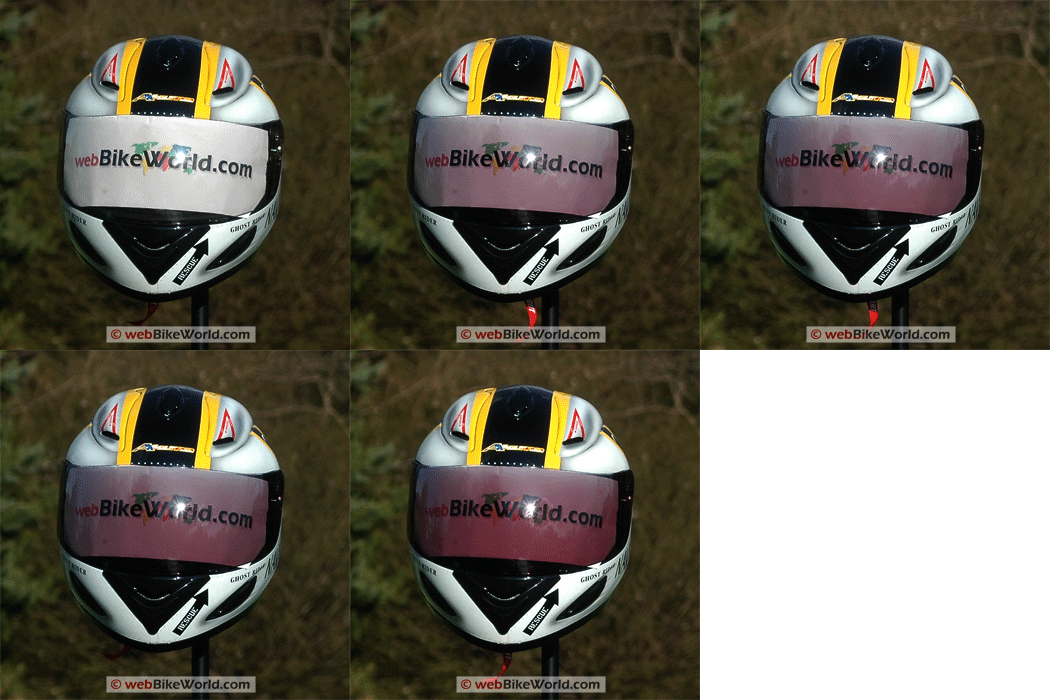
Bring the visor out into the sun and the Sunshift turns dark gray, going from clear to about a 50% light transmission tint within a couple of minutes.
We haven’t had much sunshine around here lately, but one afternoon Chris and I took advantage of a sunny interlude to try it out and take some photos.
Temperature and, of course, the amount of direct sunlight will slightly affect the photochromatic effect. In late afternoon direct sun and about 60 degree temperatures, the Sunshift went from light to full dark in about 2 minutes.
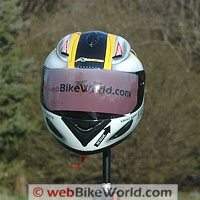
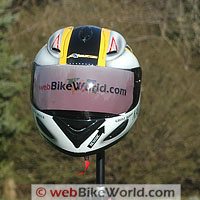
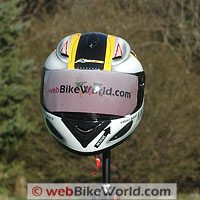
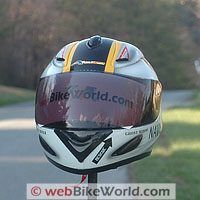
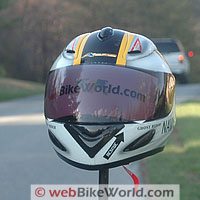
We discovered that it isn’t easy to record the changes with photographs, but here’s a sequence of 6 photos (Photo 1 through Photo 6) taken about 30 seconds apart:
The helmet was directly facing towards the bright sun as we took these photos, which we have posted un-retouched. The bright sun and the white paper behind the visor makes the tint appear lighter than it is.
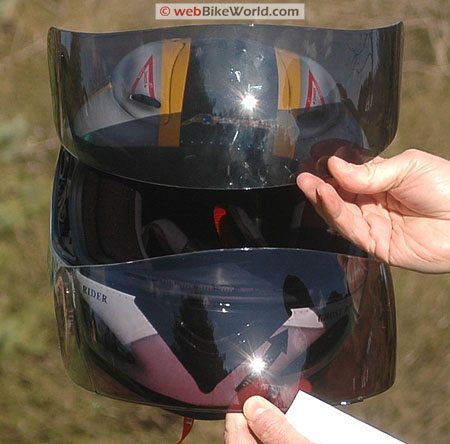
In reality, the tint is virtually as dark as the dark smoke visor that came with our Ghost Rider helmet, as you can see in the next photo.
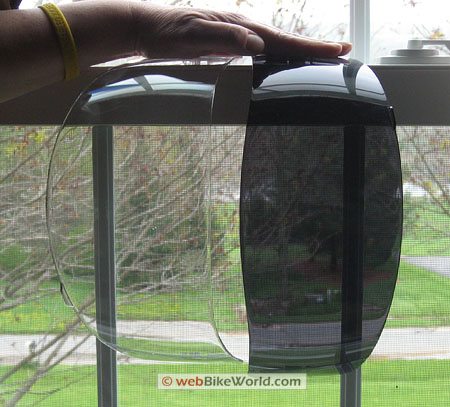
This photo comparing the standard 50% light transmission Akuma tinted visor on the top with the Sunshift photochromic visor on the bottom:
Sunshift Photochromic visor before change (left), Akuma dark smoke visor (right).When the Sunshift visor is at full tint, it takes several minutes for it to go back to clear once it’s removed from the UV light.
We placed the fully tinted Sunshift visor in the shade, facing away from the sun, for more photos, but it didn’t become noticeably clear until we brought it indoors.
The UV reflections and ambient UV light will keep it tinted at various levels of light transmission, whether its sunny or cloudy.
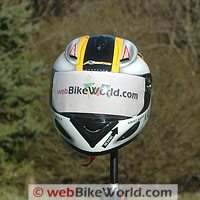
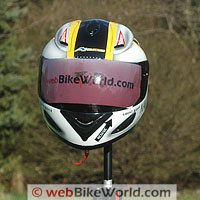
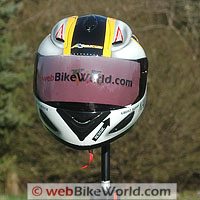
The two photos below show the tint of the visor as it was taken immediately out of the sun in Photo A, then about 3 minutes later in Photo B.
It’s important to note that with current photochromatic technology, a visor (or eyeglasses using the technology) will not instantly turn from clear to dark and back to clear again like, for example, when riding in and out of a tunnel or in and out of the shade on a tree-lined road.
That’s an unrealistic expectation and we’ll have to wait for the electrochromic visor for instant “on/off” capability.
Where the Sunshift visor does shine, if you’ll pardon the pun, is when the owner will be riding from daylight into darkness or vice versa.

There are a few reasons I can think of why the Sunshift is a good idea; first, it’s not always easy to remember to take a separate clear or tinted visor and they’re not easy to store on a motorcycle.
Also, you may not know beforehand that you’ll be caught out at night.
And on many helmets, it’s not very easy to switch visors — I’ve had more than one visor or attachment mechanism break while I was in the process of changing it, even under perfect conditions (e.g., on my kitchen table).
By the way, when riding in and out of a tunnel or other temporarily dark (or light) area, treat the Sunshift photochromic visor just like a tinted visor; that is, open it or stop until your eyes are adjusted.
The Sunshift visor was designed by A.C.S.A.S. but, believe it or not, the manufacturing process was developed by MXL Industries and they also manufacture the visor, right here in the good ‘ol U.S. of A. (Pennsylvania, to be exact).
Be sure to read our report “How to Make a Motorcycle Helmet Visor“, which is a description and a photographic tour of MXL Industries.
MXL is one of those unseen heroes of the motorcycle industry — they make visors for Shoei and many other helmet manufacturers but, unfortunately, very few motorcyclists even know the company exists.
The Sunshift retails for $75.00, which is relatively inexpensive, if you’ve priced any new tinted visors lately. It’s a brand-new product and it currently fits only Akuma helmets, but they’re working on more versions for all of the popular helmets.
Akuma also raves about the anti-fog properties of the Sunshift visor, but we haven’t been able to verify this due to the weather.
Conclusion
Sunny day riders may find that the photochromic capabilities of the Sunshift photochromic visor may not be fully exploited.
But for those motorcyclists who don’t want to worry about getting caught out with the wrong visor at the wrong time, the Sunshift is a wonderful invention.
The price is right also, and this may just be one of those technological trinkets that you’ll want to own just to show off to your friends!
| wBW Product Review: Sunshift Photochromic Helmet Visor | |
|---|---|
| Manufacturer: Akuma Helmets (defunct) | List Price: $75.00 |
| Colors: Clear to dark. | Made In: U.S.A. |
| Sizes: Fits various helmets | Review Date: April 2007 |
Note: Item provided by a retailer, distributor or manufacturer with these Terms and Conditions.
Owner Comments and Feedback
See details on submitting comments.
From “D.”: “I just finished reading the article on the Sunshift Visor and was wondering why there is no mention of the version Scorpion makes for there helmets.
I use one of their “Shade Shifter” visors and it works great, especially on overcast mornings that turn clear. Plus it doesn’t fog up.
I imagine the technology is similar if not the same, and the price is in the same range. I hope more manufacturers start coming out with this.”
Editor’s Note: Good question! I sent an email to the manufacturer asking about their claim to be the first. Their response was that they are the first, as the the Sunshift was patented in 1997; here’s the official U.S. Patent and Trademark Office “Photochromatic Visor for Use With a Crash Helmet” patent that was filed on April 26, 1996.
Note that the Scorpion page for the Shade Shifter claims that the visor is “Standard on all EXO helmets.”, but we’re in the process of evaluating a Scorpion EXO 400 and it has a clear visor only. Interesting….