

Decent sound quality with too many wires.
Doesn’t work very well to actively reduce motorcycle helmet noise.
This one should be quick, because I’m not sure what to say about these Philips “Active Noise Canceling” earbuds.
They were recommended to us by some of our readers who commented on our recent Comply noise reduction earbuds review.
The Comply earbuds don’t have the “active” noise reduction feature, as I discovered.
In theory, active noise reduction technology should be perfect for reducing noise inside a motorcycle helmet.
I can picture a battery-powered system working together with a pair of stereo earbuds inside the helmet, producing a silent cocoon for the rider, who wouldn’t have to worry about ear plugs.
I’m hoping that someday soon we’ll have a system like that — after all, the technology exists today, if only one of the helmet manufacturers would make the leap.
Apparently Amar Bose isn’t a motorcyclist, or we’d have long since been riding in a cocoon of silence.
Maybe some day I’ll try a pair of the Bose QuietComfort 3 Acoustic Noise Cancelling Headphones, which are supposed to be the current state-of-the-art, but at $349.00…well, it’s going to be a while yet.
I’m wondering if I could rip them apart and stuff ’em into a helmet and get them to work.
In the meantime, we can mess around with consumer active noise cancelling systems like this one from Philips, the electronics giant.
We followed your suggestions and found the Philips Noise-Canceling Earbuds for about $20.00 — about 90% cheaper than the Bose units!
But, if they don’t work, it’s still money down the tubes, right?
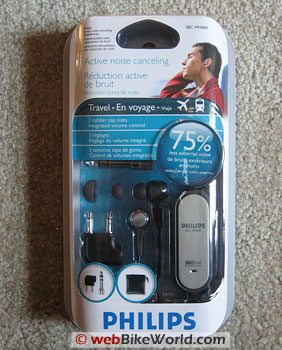
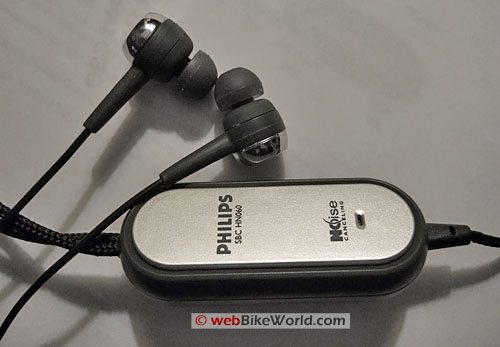
The Philips Active Noise Canceling Earbuds
Not necessarily, at least in this case.
Because one thing I can say about the Phillips earbuds is that they have very good sound reproduction — again better, in my opinion, than the $139.00 Etymotic Research ER-6 earbuds I own and which I think are way overrated.
The Phillips earbuds even come with a nice carrying pouch, an extra set of rubbers — uh, I mean earbud covers — and even a two-into-one plug converter that I promptly lost.
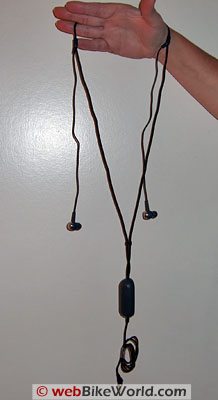
I’m not sure about other similar Phillips earbuds, but the Philips “Active Noise Canceling” earbuds have a strange wiring system (photo below).
The wire loops around the neck and forms the neck strap, and each earphone is spliced out of the side of the loop.
A control box hangs down at the bottom of the neck strap and it has an on/off switch and a volume control.
The controller takes one AAA battery (supplied with the kit). I assume that this box is supposed to sense the ambient noise levels and then control the amount of active noise cancellation that is produced.
At the bottom of the control box is another wire, which must be connected to an MP3 player or other device.
The idea is that you’ll be able to listen to music as the active noise cancellation system does its thing.
This is a lot of wire, and they can all get tangled up very easily.
The earphone speaker wires that are spliced into the neck strap seem to be the worst offenders.
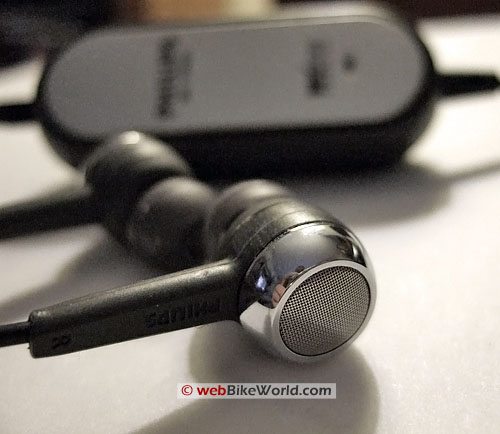
The earphone units have what look like a speaker or microphone on the back, but I’m not certain if this isn’t just a styling cue or if they are part of the active noise cancellation functionality.
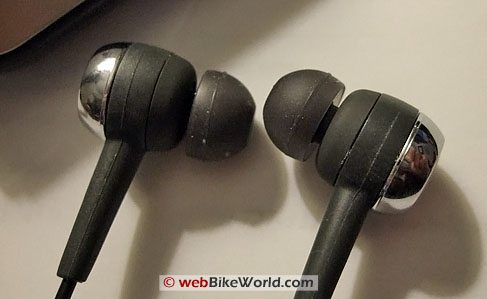
The earbuds are very round and they neither fit my ears very well nor do they stay in.
They tend to pop out and sort of hang inside my ears, which allows a lot of ambient noise to bypass the seal that the earbuds are supposed to make.
Actively Cancelling Helmet Noise?
OK, so here’s the big question: What about the active noise cancellation features of the Phillips earbuds?
As long as I’m careful, I can easily slip most full-face helmets on my head over the earbuds and I can turn the MP3 player on and store it in an upper pocket in my jacket.
With the MP3 player and the Phillips system turned on, the sound and music is very clear with good response from the speakers.
But as soon as I start the bike and get moving, things get loud. In either case, I can notice no difference in ambient noise levels, whether I’m riding with the Phillips active noise cancellation on or off.
As soon as the bike is started, the noise level increases and it becomes hard to hear the music
I’ve tried these on multiple bikes, wearing a variety of helmets, behind fairings and not, at a many different speeds, in many different environments and even while wearing them in pickup trucks, cars and elsewhere.
I’ve tried placing the control box in different positions; up by my head, on my chest and under the helmet.
I have found no difference whatsoever in the noise levels when using this unit. That’s zip, zed, zero, nada, nothing.
Maybe my set isn’t functioning correctly, but I have no reason to believe this is the case, because the earphone work nicely and the on/off and volume control work with no problems.
But my experience has been that the Phillips Active Noise Canceling do nothing to control or limit the noise when wearing a motorcycle helmet.
Conclusion
[asa2 tplid=”6″]B00061IYJC[/asa2]The Phillips Active Noise Cancelling earbuds make for a decent set of earbud speakers.
But it’s a complicated nest of wiring and the unit requires a battery, so it’s really not very useful as a substitute for a good simple pair of earbud speakers.
The earbuds are larger than normal and don’t fit or stay in my ears properly.
I can’t determine if the active noise cancellation function works to reduce the ambient noise when I’m riding a motorcycle.
More wBW Noise Cancelling Earbud Reviews
Owner Comments and Feedback
See details on submitting comments.
From “D.C.” (October 2012): “There has been some academic work in this area. I found this promising technical paper. (.pdf)”
From “G.B.” (12/10): “I bought these exact headphones about two years ago for use in my (rather noisy) diesel VW truck.
I can tell you that even when not in a helmet or on a bike, the noise canceling did absolutely nothing, just as you’ve reviewed here! Literally zero difference with the power switch on or off.
I wasn’t even a fan of the sound quality, kind of average. I bought them at a Target, returned them at another Target about an hour down the road, and bought a pair of cheaper Sony headphones.
Better sound quality and no wiring mess.”
From “J.G.” (12/10): “I have owned 2 sets of these. The noise canceling for me is actually pretty good and you can tell by turning on and off the system.
It probably has something to do with how much the integral microphones are covered.
It would be ideal to have the mic outside the earphones, I think. For me the sound quality is subpar.”
From “D.B.” (10/09): “I had these earphones as well. The box on the cord only houses the battery, switch, and volume control.
The receivers or microphones that enable to noise cancellation are indeed in the backside of each earphone, so the reviewer that tied their lack of performance to the location of the microphone on the cord was incorrect.
These earphones do not have anywhere near enough noise cancelling ability to be suitable for motorcycle use. They have minimal noise cancelling ability, even for use in airplanes and such.
But for motorcycle use, they are worthless.
At highway speeds, I would turn on the noise cancelling (which does boost the sound level as well) and then turn my mp3 player all the way up and the earphone volume control all the way up, and I could almost hear the music.
Please don’t waste your money on these for motorcycle use. You will be disappointed.”
From “A.J.”: ” ‘But as soon as I start the bike and get moving, things get loud …’
Based on the design of the system and the way it was being used, the result is exactly what would be expected.
Everyone seems to know how active noise cancellation works:
The electronic part is a microphone that listens to the ambient noise, an amplifier that generates a signal that is 180 degrees out of phase with the ambient noise.
A mixer that mixes the out of phase with the signal of interest (the MP3 player input) and the transducer that converts the electrical signal to sound waves.
The “mechanical” part is where the ambient noise and the sound from the transducer get mixed together in the air space between the transducer and your ear drum.
In theory the ambient noise and the 180 degree ambient noise from the transducer cancel one out and you are left with only the signal of interest.
Even in a perfect situation the theory breaks down because the air space is not a perfect mixing bowl so some ambient noise and some of the 180 degree signal do not cancel out and some noise is perceived.
But that is not the major item that is wrong in this particular scenario.
Lets look at how things are arranged. The ambient noise being received by the microphone is on control box.
This is outside the helmet and two feet from the ears. The air space where the “mechanical” mixing is taking place is inside the helmet between the earbud and the eardrum.
So what is being mixed is the 180 degree signal from the microphone that is significantly different than the ambient noise that is in the mixing air space.
We now have a worst case condition: the ambient noise in the air space, the ambient noise from outside the helmet, and the signal of interest all being mixed together to make random noise.
As a side note I have the Bose QuietComfort2 and have both LightSpeed 25, 3xl and Bose X headsets that I use when flying, both as a passenger and as a pilot.
All are much quieter than any passive systems I have used.
All have the microphone on the outside of the ear cup.
This appears to give the system the best available information about what the “external ambient noise” signal will look like in the mixing air space just inside the ear cup.
A 180 degree flip of the electronic signal and some attenuation to adjust for the passive attenuation that will be applied to the “external ambient signal” as it passes thru the earcup into the mixing air space, and you get very effective noise reduction.
Note that you can not put the microphone in the air mixing space to get perfect information about the ambient noise in the space for obvious feedback reasons.
If we want it to work the way is should, the helmet makers would be the best placed to start so insure the microphone is installed in the correct place.
If that is not on the horizon, at least now we know where we would need to put all of the appropriate sensors if we decide a DIY project is in order.”
From “M.P.”: “(My girlfriend) bought the Philips Noise Canceling headphones for a long trip this summer. Her review was that they stunk. They were uncomfortable, kept falling out, the wires got all jumbled, and the noise canceling technology didn’t really work.”
From “R.S.”: “I read with interest your article about the noise reduction earphones but there’s something I think you might be interested in about Noise Reduction technologies.
There was a fairly recent study done on Marine Corps Helicopter Pilots that had been using Active Noise Reduction (ANR) in their flight helmet headphones.
Despite the ANR there was still hearing loss in many of these pilots and it is now known that ANR itself, while reducing perceived noise, is generating a canceling noise that still affects hearing.
The latest hearing protection system is a passive system very similar to the Comply Earphone that you wrote about.
Another hazard is the fact that the digital music from MP3 players is generally so distortion free that many people unwittingly crank the volume to damaging levels without realizing it.
I’m not an audiologist, but I would like to keep my hearing intact as long as possible and I believe that Passive Noise Reduction is the best way to achieve this.”
From “A.K.”: “I totally agree with the reviewer regarding the inactive active noise canceling system on these. However, I believe that the sand quality is so fantastic that you can have it while the active unit is turned off.
So in my opinion, the earphones give excellent sound but the active noise canceling is in reality a sound booster device.”
From “W.W.”: “I’m not surprised that the reviewer had such a terrible time with these headphones.
If you Google these headphones and add ‘amazon.com’ to part of the Google, you’ll get taken to the Amazon website and read about 100 reviews by users. About 75% give these a terrible review.
I’ll stick with the Comply noise cancelling headphones (review). With the custom silicone tips they fit great.
Now that the weather is getting cold and I’ve switched back to a full face helmet, the only problem I find with the Comply headphones is that you have to be a bit more careful that the headphones don’t pop off as your ears go into the helmet.”