

Meets DOT and Snell standards.
The size XL fits “Round” or “Earth” shaped heads best (see the Motorcycle Helmet FAQ).
Light weight at 1426 grams.
Flimsy top vent extractor is attached to helmet with double-sided tape.
Verdict? Spend more and get more.
Can a motorcycle helmet be too cheap…or rather, too inexpensive?
You’re looking at one of the most inexpensive full-face helmets you can buy that meets DOT standards and is also Snell approved.
“Snell approved” means that the helmet is listed in the“Snell Certified M2000 Motorcycle Helmets” page on the Snell Memorial Foundation website.
If a helmet isn’t listed on that page, then as far as we’re concerned, it’s not Snell approved.
When you’re shopping for a Snell-approved helmet, beware!
As we were researching this article, looking for the most inexpensive Snell-approved full-face helmet we could find, we came across several helmets that were listed on various manufacturers’ websites as Snell approved.
But when we checked the official list, the helmet (and sometimes even the manufacturer!) were nowhere to be found.
We received no response to our emails to several of the manufacturers requesting proof of Snell approval, which adds to the mystery. If we give a manufacturer the benefit of the doubt, we can postulate what might happen — a helmet may have passed the Snell tests at a third-party testing facility that may or may not be authorized to conduct Snell testing.
The manufacturer, in their haste, may have listed the helmet as Snell-approved before the formal approval was provided by Snell. At the very least, this would be misleading. The bottom line? Caveat Emptor – let the buyer beware.
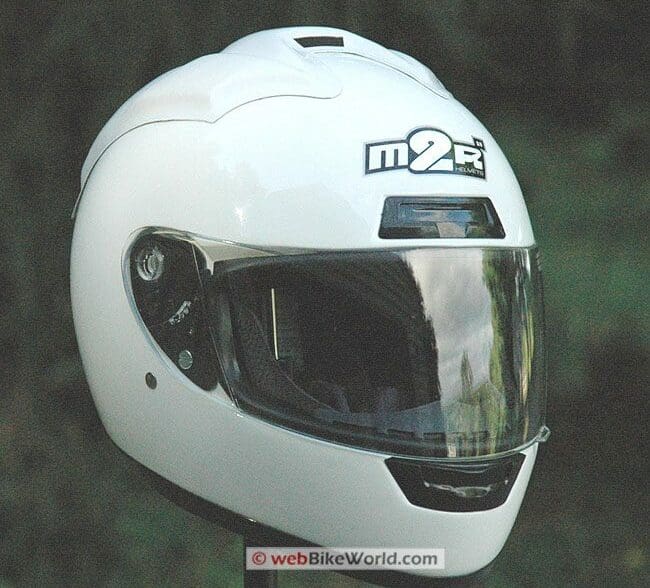
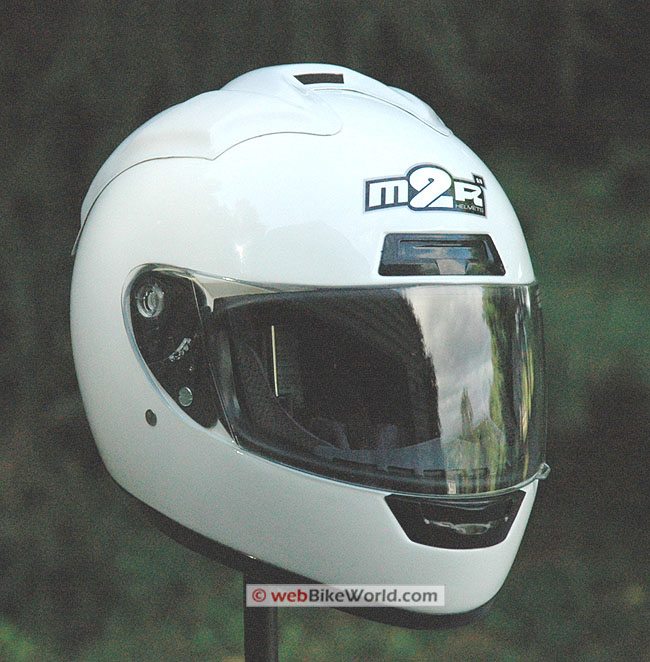
The M2R MR10 Helmet
OK, back to the MR10. What do 65 Washingtons buy? Well, the MR10 had the misfortune of having been delivered to our doorstep on the same day as the incredible Shark RSR (wBW review coming soon). When we first opened the box, we were prepared to be underwhelmed, and the MR10 didn’t disappoint.
But first, let’s address the good points. The MR10 is the lightest size XL full-face helmet we’ve reviewed at 1426 grams (3 lbs., 2-3/8 oz.). That’s definitely a plus, because lighter weight helmets can help prevent neck strain in addition to simply feeling better to the rider.
We were also surprised to find that the MR10 was relatively quiet when used on a “naked” bike. There is some apparent noise generated from under the neck area, which is an all-too-common problem on almost every motorcycle helmet we’ve ever tried.
But when properly controlled, either through correct fitment or with the Windjammer helmet wind blocker (see the wBW review), which very effectively prevents buffeting from under the helmet, the MR10 seemed fairly quiet to us.
Remember, of course, that helmet noise levels will vary tremendously, depending upon the rider, the type of motorcycle, and fairings or windscreens. Also, we always use properly fitted earplugs when riding, and we also use helmet liners (aka “skull cap”) whenever we ride. See the wBWEarplugs and Hearing Protection page for more information.
The MR10’s liner is acceptable, which is surprising, considering its appearance and its thickness (or lack thereof). The liner is very thin compared to some other helmets we’ve tried and it sure doesn’t look like very plush. There is no liner at all on each side next to the rider’s ears – bare shell is all you get.
This might help those who plan on installing speakers in their helmet, and it (surprisingly) doesn’t really seem to affect the noise levels. The absence of a liner in this area also provides more room for those with big ears or who wear eyeglasses.
The liner cheek pads are also removable, which I suppose some owners will rate as a plus. The ad copy for the MR10 claims that the liner is removable, but it wasn’t apparent to us that it could be separated from the helmet. Since we’ve never removed a liner anyway, this wasn’t a big deal.
We didn’t see any listing on the M2R website for different sized cheek pads, so we’ll have to assume the pads in the MR10 are removable only so the manufacturer can claim a “removable liner”. One thing’s for certain: when compared to the Shark RSR, the MR10’s liner (and overall fit and finish) is decidedly crude.
M2R MR10 Ventilation
The MR10’s air vents actually seem to work fairly well. The helmet provides a good volume of air flow through the top vent and across the interior (top) of the helmet down on to the head. The chin vent was less effective; it blew some air up on to the back of the visor, but it’s difficult to tell if this is coming from the vent or up under the chin.
The downside? Well, the air vent doors are flimsy, and they feel and look cheap. Feeling cheap is one thing – looking cheap is another. Both the helmet’s shell and its interior lining can be seen through the vents, and it isn’t pretty. The plastic vent surrounds on our sample are misaligned.
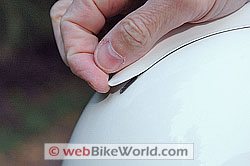
We assume M2R wanted to spice up the looks of the helmet, so they applied a very thin and not very nice looking (our opinion) air extractor appliqué on the top of the helmet.
It’s made from some type of flimsy plastic material, it bends easily under thumb pressure, and it’s a slightly different color than the helmet shell.
But the worst part is that it was applied with double-sided tape, and parts of the extractor were already separated from the helmet right out of the box.
Our feeling is that this piece of plastic would probably be destroyed if the helmet were dropped or bumped but a single time. It really gives the helmet a cheap look, and M2R would have been better off forgetting about the boy racer look or spending a few extra cents to do it right.
Other than that, the finish is acceptable, although we haven’t used the helmet enough to make any guesses on how long the paint might last. Your 65 dollars buys any color you like as long as it’s white, red, blue or black.
Graphics are about $10.00 extra, and we haven’t seen one up close, but I’m afraid to think about the quality of the decal that might be used. At this price, you’re probably better of buying a solid color and jazzing it up with decals and retro-reflective stickers.
Face Shield
The face shield is clear enough to see through, and it does have a strong detent at the first “click” that opens the helmet up about 3 mm or so (~1/8″), which is always nice for defogging purposes. The visor has a very strong initial resistance to opening, which is good, but the relatively thin visor twists against the force needed to open it with one hand.
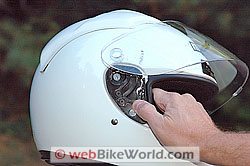
It opens up about as wide as any other helmet, and it’s fairly easy to remove, using a spring-loaded system similar to the Shoei RF-1000.
The plastic parts that make up the visor locking assembly seem brittle, and in fact, one of the small plastic tabs that holds the visor in the removal mechanism broke off the first time I tried it.
In our opinion, the MR10 will fit round-headed riders best. I border on a size large and extra-large, depending upon the helmet.
When I looked at M2R’s helmet sizing chart, I thought a size XL would fit best, but it turns out to be at least one size too big because it has such a wide internal shape.
The width may be due to the absence of padding next to the ears, but I surely could have used a size large instead. This was confirmed by other webBikeWorld riders with similar shaped heads, so our opinion is that the MR10 probably has a fit that is one size bigger than normal.
The chin strap is padded, and uses the tried-and-true D-ring system of attachment. There’s a snap on the end of the extra piece of strap, and it can be secured just above the D-ring with a companion snap attachment.
By the way, the interior of the MR10 also seemed to have a slightly shorter front-to-back internal distance than other full-face helmets. So if you have a big nose or chin, you may find the internal dimensions come up slightly short.
Conclusion
So what’s the final verdict? One side of the argument goes like this: Very few people in the U.S. and U.K. use a motorcycle 100% of the time for transportation. Motorcycles are more of a luxury than a necessity.
So if you have the disposable income to own and maintain a motorcycle, surely you have more than $65.00 to spend on a helmet. What’s the sense of trying to save a few bucks on probably the most important safety item you can own? Spend another $40.00 or so and get a decent quality helmet.
The other argument is this: If you can only afford $65.00 for a helmet, the MR10 at least gets you a Snell approved helmet, for what it’s worth.
Rather than riding without a helmet, and rather than using one of those ridiculously thin, non-DOT safety standard brain buckets, you’d probably be much better off with the MR10
By the way, although the marketplace seems to demand Snell approval, we’re not aware of any scientific study that demonstrates that Snell approval is “better” or creates a “safer” helmet than ECE 22-05 or DOT approval.
What would we do? It’s not necessary to spend, for example, $500.00 on a helmet like the Shark RSR.
Many very good helmets can be found in the $100.00 – $200.00 range that are comfortable, have DOT and Snell approval, quality manufacture and many other nice features.
Save up a few more bucks and remember the old adage, herewith adapted: If you have a 65-dollar head, get a 65-dollar helmet.
Owner Comments and Feedback
See details on submitting comments.
From “G.F.” (June 2015): “This review is really just to endorse your exceptionally accurate opinion, since this is out of production. I bought a XL about three years ago because a buddy recommended it.
I had an Urban N20 (review) and it fit great, but couldn’t get visors anymore. I found much more cheek room on the MR10; definitely more for round heads. Lighter than the Urban.
No chin cover, so there was much more noise and air flowing underneath — it became my Summer helmet.
Actually was impressed by the finish, but that didn’t last a year — scratches everywhere, seemingly from nothing. Dropped it onto a table from about a foot above, cracked one of the cheap vent covers.
Whenever I turned my head over about 40 mph, I could feel the helmet trying to torque my neck further over. This week, the chin strap broke — never seen that before! Time to get a new helmet.”