

Remember the old ´70’s automobile commercials that extolled the “road hugging weight” of the latest behemoth?
I used to get a chuckle out of those ads.
Let’s face it — if greater mass meant better “road hugging” ability, then Michael Schumacher would be driving a Kenworth!
The same can be said about motorcycle helmets. If more weight meant more protection, then Valentino Rossi would be wearing Captain Nemo’s diving bell.
In fact, it’s been argued that lighter weight helmets (when properly designed, of course) can offer better protection than heavier models.
It gets into some of the physics that I deliberately avoided during my misplaced youth, but I surmise that it has something to do with mass times acceleration.
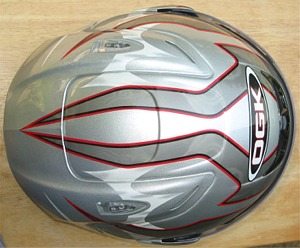
Which brings us to the OGK FF-4, which is the latest evolution in the OGK line. The previous model OGK, the FF-3, (read the wBW FF-3 Review) is one of my all-time favorite helmets, because it was light in weight, it fit my “earth” shaped head like a glove, and it flows plenty of air.
The FF-4 improves upon the FF-3 in a number of areas, especially in the quality of the finish and in the styling. But the biggest difference in the FF-4 is noticeable as soon as you take it out of the box; this helmet is a real featherweight.
At 1409 grams (Euro version), the FF-4 is a full 210 grams (13%) lighter than the FF-3! This is astounding — to get this much of a weight reduction in an already lightweight helmet, while still meeting Snell M2000 and the tough ECE 22.05 standards, is revolutionary.
These are real-world weights I’m talking about here that were measured in the webBikeWorld “laboratory”, not public relations fantasy weights provided by the manufacturer’s PR firms. Just for grins, I grabbed a batch of helmets that we had on hand and weighed them for comparison purposes with the FF-4.
As you can see from the table below, our FF-4 is actually closer in weight to the open face HJC CL-5 than it is to the next lightest helmet, the FM Force 10. Notice that most of the helmets hover around the lower-to-mid 1600 gram range.
1600 grams apparently is some type of barrier, as many helmet manufacturers seem to have trouble getting lower than 1600 grams and still meet the various international safety standards. NOTE: Our helmet is the European version; the U.S. version is apparently heavier, see the note below in the Comments section.
Now don’t get me wrong — weight is an important factor in a helmet, for a number of reasons. But I’m not saying that lighter helmets are always safer, as they still need to meet the necessary safety standards. Also, when a heavier helmet is properly designed, its weight can be distributed with a lower center of gravity, and this can help make its bulk less noticeable.
See the wBW Motorcycle Helmet Weights page for a comparison table and chart of helmet weights.
| Helmet | Size | Weight (grams) | Weight (lbs/oz) |
|---|---|---|---|
| HJC CL-5 (Open Face) | L | 1301 | 2 lbs. 13-7/8 oz. |
| OGK FF-4 | L | 1409 | 3 lbs. 1-3/4 oz. |
| Baehr Silencer (FM F10) | L | 1607 | 3 lbs. 8-3/4 oz. |
| KBC VR-1 | L | 1616 | 3 lbs. 9.0 oz. |
| OGK FF-3 | L | 1619 | 3 lbs. 9-1/8 oz. |
| Shoei X-Eleven | XL | 1635 | 3 lbs. 9-5/8 oz. |
| HJC Sy-Max | L | 1667 | 3 lbs. 10-3/4 oz. |
| Lazer Century | XL | 1710 | 3 lbs. 12-3/8 oz. |
Fit and Comfort
The light weight of the FF-4 makes it more comfortable to to wear. The light weight of the FF-4 is noticeable when riding, which provides a sense of freedom, especially when doing side-to-side traffic checks.
The lower mass of the FF-4 is easier on my neck muscles, because I don’t feel like I’m trying to counter the higher resistance of a heavier helmet felt when initiating a head turn and also when stopping the mass at the end of the rotation.
I believe this helps promote safer riding, because it allows quicker head checks in traffic or when making a sharp turn after a stop sign.
Face Shield
The FF-4 has a nice, wide visor opening. The sides of the visor opening are way past the boundaries of my peripheral vision when looking straight ahead.
Better peripheral vision is safer; there are a couple of intersections near my home where the cross traffic enters at an acute angle.
Most of the helmets that I’ve worn have narrower visor openings, which means that I have to turn my head much farther to see oncoming traffic.
A couple of helmets are so bad that I literally have to put the bike in neutral to get my feet on the ground so that I can pick my whole body up to turn and see what’s coming, and that’s dangerous, especially when stopped on a hill! It’s no problem at all with the FF-4 at those same intersections; I’ve found that I don’t have to turn my head nearly as far, yet I can see as far up the road as I’d like.
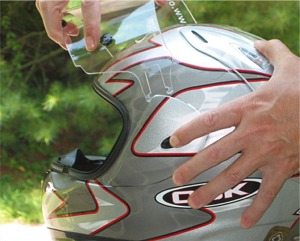
The FF-4’s visor is easier to remove and replace than any other helmet I’ve tried. I usually have to dig out the owner’s manual for other helmets to figure out how to change the visor. The OGK “Quick Change Shield System” is so ingenious, it’s patented.
To change the visor, first raise it to its highest level. Push the button on the side pod, pull, and the visor comes right out with very little effort. To re-install the visor, push it back in to the side pod until you hear the “click”. Simple as that. The standard OGK face shield also comes with tear-off posts, and OGK provides a handful of tearoffs and also a nice helmet bag with the FF-4.
Ventilation
OGK also has a patent for the ventilation system. It’s called the “Top Aero Ventilation System”, which replaces the “Aeroblade II” ventilation system used on the FF-3.
The older system used the low pressure created by air flowing through the Aeroblade diffuser to pull air from inside the helmet.
The newer system uses both positive and negative air pressure to flow the air.
The positive air flow forces air into the top of the helmet through two holes near the front of the diffuser, and negative air pressure is used towards the back of the diffuser to pull air through the helmet and out the back.
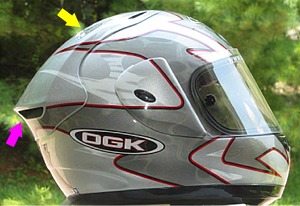
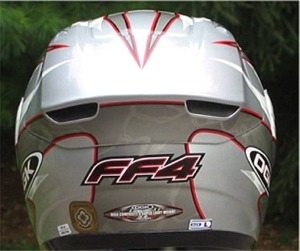
The air exhausts out the back of the helmet in the negative pressure zone created by the shape of the diffuser (pink arrow, photo left).
The air on the FF-4 now exits lower in the rear of the helmet than the FF-3, and the shape of the diffuser provides greater stability at speed by reducing buffeting. The Top Aero Ventilation System can be shut off by sliding the two top flush-mounted buttons forward (yellow arrow, photo left).
The rear exhaust vents are kind of cool-looking; they are painted matte black inside, and they remind me of the exhaust outlets on the F-117 Stealth fighter.
The FF-4 also has a slightly modified version of the simple, yet effective, forehead and chin bar air vents from the FF-3. The forehead vent is located in what appears to be an aerodynamically designed recess.
Some filtering material lives in there to prevent the ingress of bugs or debris, and the vent opens and closes with a more positive feel than on the FF-3. The chinbar vent is also mounted flush with the helmet’s shell, and it provides a good flow of air to the rider’s mouth and cheek area.
 FF-4 Helmet Liner
I really liked both the liner and the fit of the FF-3, so it would be hard to improve on that.
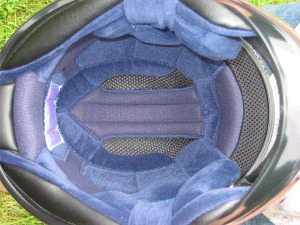
The FF-4 uses a very similar lining, which is removable and washable. It consists of separate pieces, including the neck pad, cheek pads, and lining.
There are mesh openings at the top of the lining, which allow air to freely pass on to and over the rider’s head. The material has a soft, velvety feel, similar to the material used by Arai and others.
The chin strap pads can also be removed for washing or replacement. The chin strap uses the simple yet effective double D-ring closure system, and there’s a nice button provided to secure the loose end of the strap when riding.
I found that the FF-4 has a slightly different fit than the FF-3. The FF-3 fits me better than just about any other helmet I’ve ever tried. But the problem is that I have what apparently is a rather strangely shaped head. There are basically three head shapes: the so-called “long oval”, the “round”, and one I’ve added, which I call the “Earth” shape. My earth shaped head is widest right above my ears at the temple area.
The FF-3 seemed to be designed expressly for my Earth shaped noggin, but unfortunately for me, I’m told that most humans have the “long oval” head shape.
I can only guess that the FF-3 didn’t quite fit the long oval types, and it seems to me that they’ve narrowed the sides just slightly on the FF-4 to give it a more neutral fit that would suit a greater majority of head shapes.
I still like the fit, and it’s more comfortable than many other helmets, but it’s just a wee bit tight for me on the sides, although I’m sure it will get better as it breaks in.
See the wBW Motorcycle Helmet Weights page for a matrix and chart comparing the weights of all of the open-face, full-face and flip-up helmets we’ve reviewed.
Noise Levels
Evaluating helmet noise levels is extremely difficult. Helmets that I’ve thought were quiet, others said were noisy. There are several factors at play in evaluating helmet noise; for example, some riders may be more sensitive to different frequencies.
I’ve noticed that noise is usually generated in two different areas on a helmet. Vents, openings, or the helmet’s design can sometimes cause a higher frequency “whooshing” sound over the top of the helmet. Buffeting around the neck opening can cause a lower frequency “booming” sound.
I’ve also found that most helmets would be much quieter if closer attention was paid by the manufacturers to the air flow around the neck.
The lower frequency sounds seem to be more intrusive and louder, but can paradoxically be more easily controlled by a properly fitting neck pad.
I can usually take one finger and place it up around the bottom of the neck pad and decrease helmet noise by at least 50% or more.

It would be great if the manufacturers made different shapes and sizes of replaceable neck pads that allowed riders to customize the fit and decrease the noise from this area.In any case, I always use earplugs when I ride, no matter what, and earplugs, when properly inserted, can greatly reduce helmet noise levels.
I strongly recommend the use of earplugs; please visit the webBikeWorld Earplugs and Hearing Protection page for more information on choosing and wearing earplugs.
Some riders complained about the noise levels of the FF-3, but I have not found that helmet to be any noisier than most of the other race-oriented helmets (when wearing earplugs). My opinion is that the FF-4 has slightly less noise than the FF-3 at the higher frequencies.
I’m guessing that the new diffuser and its nearly flush mounted buttons have reduced some of the noise generated in that area.
The FF-4 does seem to be slightly more sensitive to buffeting around the neck opening, but this is only apparent on some sportbikes or motorcycles with fairings or windscreens that direct the “dirty” air right at the rider’s neck.
The lower frequency sounds are not noticeable to me as a significant noise generator when I’m riding a bike sans windscreen.
Again, if you choose to wear any helmet without earplugs, all bets are off, and I can’t tell you one way or the other how the helmet will control noise, other than to tell you that without correctly fitted earplugs, ALL helmets are way too noisy in my opinion.
Other Features of the FF-4
The FF-4 is listed as meeting the Snell M2000 standards, according to the latest Snell list on their website. The FF-4 also meets the ECE 22.05 standard, and is BSI and ACU approved for racing.
OGK helmets are used by many motorcycle racers, the most famous of whom might be Steve Hislop and the late, great Dave Jefferies (see the webBikeWorld memorial page to Big Dave). It would be really great to ride with a Dave Jefferies replica FF-4 to honor his memory, as he will be sorely missed.
The FF-4’s shell is made from a combination of fiberglass and carbon Kevlar fibers, which help account for its low weight.
The fit and finish of the FF-4 is a step up from the FF-3, and the paint and graphics on the “Graphic” model shown in these photos is first-rate. It doesn’t show up in the photos, but the darker grey areas of the helmet have a really nice sort of “cloud smoke” pattern that give it a nice 3-D feeling of depth.
Conclusion
OGK helmets are probably one of the best kept secrets around, and I kind of like it that way. I believe the quality is on par with the best helmets on the market. Many racers use OGK helmets, and the FF-4 is a result of racer input from around the world. It’s great to see a company that’s not afraid to continuously improve their products.
But I think one of the neatest things about the FF-4 is that it sort of has a Zen-like simplicity to it. It’s not overloaded with wild features that add complexity, yet it provides all of the functionality of its competitors and more.
The light weight of the European version of the FF-4 provides a liberating feeling when riding, and other helmets feel bloated in comparison. If you’re in the market for a race-inspired lid, make sure you check this one out before you make your decision!
| wBW Review: OGK FF-4 Aeroblade Helmet | |
|---|---|
| Available From: OGK Helmets | Made In: Japan |
| Colors: Black, Gunmetal, White; Graphic with Silver, blue, yellow, or red; Replicas for Steve Hislop or Dave Jeffries. | List Price: £249.99 (solids) to £349.99 (replicas). |
| Product Comments: Extremely lightweight, flows lots of air with patented system, visor very easy to remove and replace, typical OGK comfort. The U.S. version meets Snell M2000, ECE 22.05 and AS-1698/AS1609 (Australia) standards, is BSI and ACU approved. Approved for racing in FIM, AMA, FUSA, WERA and more. Review Date: 2004? | |
Owner Comments and Feedback
See details on submitting comments.
From “M.”: “As B.S. has already mentioned (below) on the OGK FF-4 article, here in the U.S. you can get the Snell/DOT safety standard helmet and it is indeed heavier than the other specs. Even though it is not that light I do find it to be a nice fitting and well made helmet that fits my long oval shaped head well but with a few small annoyances and those come from wind noise/venting.
I find depending on how I have my head is angled I either get some high pitched whistling from the top vents or I get the low boom effect coming in under the chin. I usually get them at in town speeds (for me around 35-50mph) on the highway moving at 60+ I don’t really notice it.
I guess venting could be better as well in my opinion. I am in Florida where it is almost always hot and muggy and I tend to get quite warm in this helmet compared to my Arai RX7-RR3. For the record I ride a 2002 ZX6R and have a Double Bubble windscreen which could be affecting the wind noise in one way or the other. Anyway just thought I would give my 2 cents on this helmet.”
From “B.S.”: “I bought an OGK FF4 helmet partly on the strength of your review of it. After receiving the helmet, I had a hard time detecting the difference in weight between it and my old HJC AC-11. So I got out a scale.
By my scale, the FF4 checked in at 1655g. No lightweight here! Note that this one is Snell rather than ECE. So, those of us in the States are once again getting hosed by helmet makers hellbent on satisfying the Snellions. Ah well. I’ll give it a try, to see how the ventilation and noise go, but I may also give up and switch to a Shoei RF-1000 (marginally lighter, and way comfortable).
Perhaps it’s worth noting on your review that the USA version is not even close to 1400g?”