

Icon Helmets are relatively new, having only appeared within the last couple of years, along with other Icon branded products.
The edgy Icon ads have appeared in just about all of the motorcycle print magazines in the U.S.A., but apparently the products are not available in the U.K. or other parts of the world.
I’m just guessing, but apparently the Icon brand is a marketing strategy developed by Parts Unlimited, one of the biggest distributors of motorcycle related products and accessories in the U.S.A.
I’m not much of a fan of this method of brand marketing and global sourcing.
That’s because I’m partial to companies that have their own factories where the products are developed, manufactured and marketed; for example, companies like Arai, Shoei, Vendramini and others.
But that’s my personal opinion, and I’m sure not everyone will agree. The bottom line for me can be summed up by two words: quality and functionality.
In the end, the marketing isn’t really important; if the product suits my needs, and meets my expectations for things like price, style, etc., then it’s OK by me.
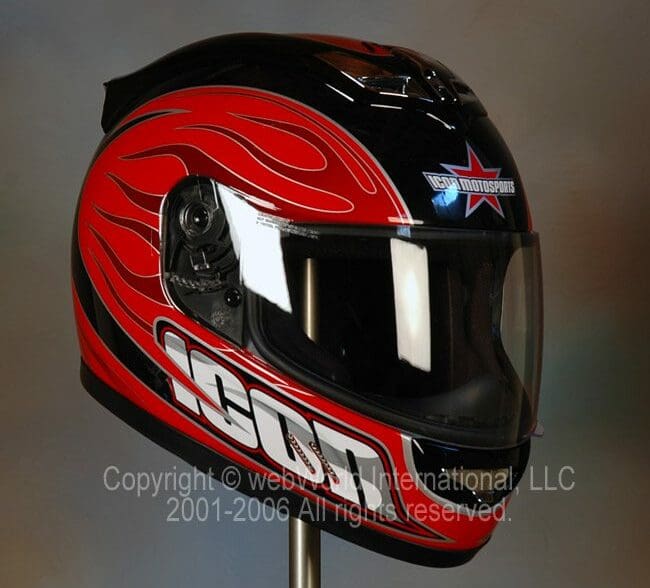
The Mainframe has been around for a year or so, and it serves as the top-of-the-line Icon helmet.
One of the strategies that differentiates Icon from their competitors is their ability to offer many different choices, styles and colors for all of the products in their lineup.
This is certainly apparent with their line of helmets, which are available in a dazzling array of colors and graphics.
The Mainframe helmet is a good example; there are too many color combinations to list, including a “Bling” model with gold trim; the “Kitty” model, designed specifically for women, the cool “Rubatone” matte color and several others.
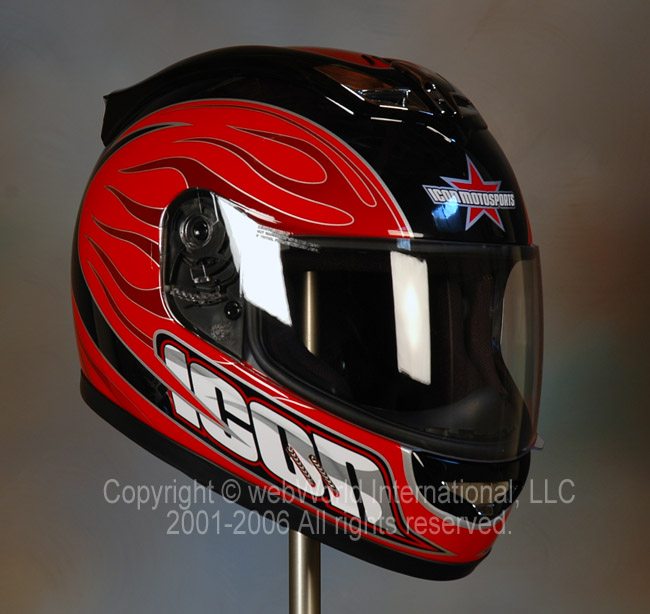
We chose the “New for 2006” version of the Hooligan pattern shown here, in size XL.
First impressions are important with motorcycle helmets, and we were suitably impressed when we first pulled the Mainframe out of the box.
The deep red color and the flames of the Hooligan pattern are very nicely done. The edges around each flame and the large black contrasting “swoosh” are finished with a very close imitation of a hand-painted pinstripe.
I had to look at it a couple of times to see if the helmet was hand striped or not.
The chin vent and top vents have chrome-plated fixtures, which also lend a touch of class. Overall, I’d say that the finish on our example is excellent, especially considering the reasonable price.
Continuing with my out-of-the-box inspection, I flipped up the face shield, which immediately popped off the helmet on the left-hand side. My wife, who was standing nearby, said “That’s not a good sign”, an ominous statement if there ever was one, as we shall see.
But problems like this do happen on occasion when a helmet is first handled, and I usually chalk it up to a misalignment during final assembly.
Ventilation
The Mainframe’s chin vent opens from the bottom up; that is, the vent cover flips up, instead of down, to let in fresh air. This is a good idea, and I’m not sure why we haven’t seen it on other helmets, because it makes sense.
The upward rotating vent cover acts as a scoop that catches the air at what is probably one of the highest pressure points on the helmet and forces it through the vent and into the helmet, with a sort of “ram air” effect.
The air from the chin vent is then directed through two portholes on either side of the inner portion of the chin bar and then on to the rider’s face.
The vent cover also has a positive and secure feel when opening or closing, unlike too many other helmets we’ve tried, including some very expensive brands, that have sloppy or ill-fitting covers.
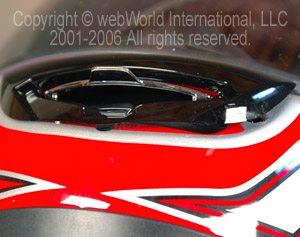
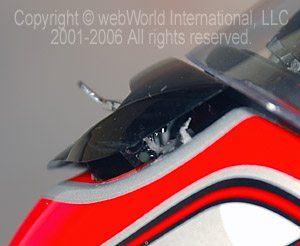
However, on only the second time I opened the vent, the entire front vent assembly popped out of the helmet. Here are two photos illustrating the problem:
(L) Icon Mainframe chin vent, side view. (R) The black assembly that holds the vent has pulled away from the helmet. Icon Mainframe chin vent, bottom view.
The chrome-tipped vents at the top of the helmet are arranged on one of those “aerodynamic” spoilers appliqu�s that seemingly now included on just about every helmet made. These are supposed to take air in the front and exhaust it out the back.
The Mainframe has a centrally located sliding switch that can be pushed back to open the vents. This switch also has a positive feel on opening or closing, and it is easy to operate while wearing gloves.
The chin vent and the top vents seem to allow a relatively large volume of air to flow into the Mainframe, although it’s hard to notice a difference in volume whether the top vents are open or closed.
You’d be surprised — or maybe not — at how many helmets, despite their scoops and vents — flow almost no air.
We’ve mentioned this before; there doesn’t seem to be a single best practice when it comes to designing air vents that flow decent amounts of air, and it almost seems like more scoops and protuberances equal less air flow (and more noise), contrary to what the designers would have you believe.
The Mainframe also has four small mesh covered exhaust vents, located in pairs on each side of the chin bar. These are claimed to exhaust air out the sides of the helmet.
Helmet Fit
In our opinion, the Icon Mainframe is designed to optimally fit an “oval” to “egg” shaped head. The helmet seems to have lots of room inside towards the top of the liner, and it tapers down slightly towards the sides.
The cheek pads seem slightly thicker than normal, causing the helmet to fit tightly around this area, which may be a problem for those with “round” head shapes.
See the wBW Motorcycle Helmet FAQ page for more information on choosing and fitting a motorcycle helmet and for a discussion regarding human head shapes.
But overall, the Mainframe feels relatively comfortable on my round head. The tighter fitting bottom and the padded fabric neck roll help to decrease the low-frequency “booming” noises that are often caused by turbulent air spilling off of a fairing or windscreen.
The liner is comfortable; I’d say it’s about average. The Mainframe does seem to have very large ear pockets, which may be an advantage for those who may wish to install speakers. Also, the cheek pads are removable.
A small section of fabric is located under the chin to help prevent turbulence and air from entering under the front of the helmet.
Noise Levels
Overall, the Icon Mainframe seems relatively quiet. There are two factors to be considered regarding the noise levels of this helmet. The top vents seem to cause some higher frequency “whistling” noises, although the overall volume seems low, especially considering the amount of air that flows into the helmet.
The other factor is related to the helmet shape, as discussed above. The tighter fitting bottom does seem to help decrease the lower frequency noises caused by turbulence.
Also, the Mainframe has what appears to be a good quality neck roll and some extra padding around the bottom of the helmet, which also helps to attenuate noise.
Here’s an MP3 recording of the Icon Mainframe from 0 to 60 MPH, recorded behind and outside the short fairing on our 1998 Triumph Tiger.
This bike is perfect for evaluating helmet noise, because standing up on the pegs brings the helmet out into the clean air stream, which makes it easy to also evaluate the noise levels for riders on unfaired bikes.

See the wBW Motorcycle Helmet Noise page, which has other MP3 helmet sound recordings for comparison.
Also, don’t forget that we always wear correctly fitted earplugs and a helmet liner when riding. Motorcycle helmet noise is relative; that is, a “quiet” helmet may still transmit enough noise to be dangerous.
There are also many other factors that can cause helmet noise, including crosswinds, engine noise and more. Please see the wBW Earplugs and Hearing Protection page for more information on choosing and wearing earplugs.
Face Shield
Remember that bad omen about the face shield? Well, it turned out to be a prescient warning.
The face shield on the Mainframe popped off during my first ride with the helmet, the first time in all of my many years of riding with full-face helmets that this has happened to me.
After studying the quick release mechanism, I see what is causing this and why it continues to be a problem on my helmet.
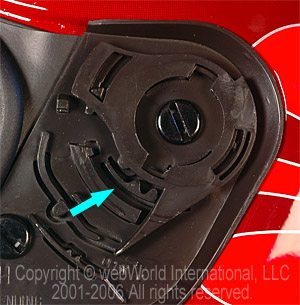
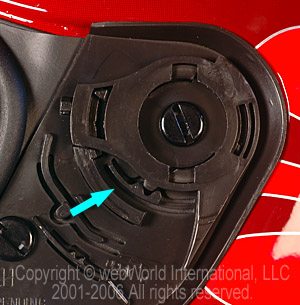
Pushing the face shield up into its uppermost position exposes the quick release mechanism on each side of the helmet.
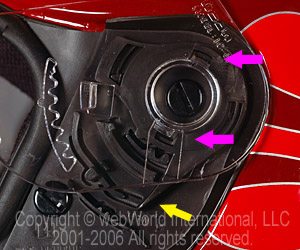
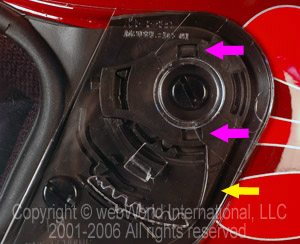
The mechanism has a locking lever that is pushed back to lock the face shield and pushed forward to allow two tabs molded on to the clear face shield to escape through two corresponding notches in the mechanism.
The problem on our helmet is that as the face shield is opened and closed, the locking lever is gradually pulled forward, due to the friction between the face shield and the lever.
After opening the face shield 2-3 times, the lever is pulled far enough forward to expose the two notches in the quick release mechanism that are designed to allow the face shield to be removed, and the face shield is then free to pop off the helmet.
Here are two sets of photos that illustrate the problem:
We’re not sure if this problem is common with other Mainframes or Icon helmets or if ours is a fluke, but my feeling is that this is a serious flaw, and has greatly decreased my confidence in the helmet.
By the way, the face shield also seems more prone to fogging than other helmets we’ve been using lately.
Weight
This size XL Icon Mainframe weighs 3 lbs. 9-1/2 oz., which is 1632 grams. This puts it right between the Arai Quantum II and the Shoei X-Eleven, which is pretty good company.
Although the Mainframe’s weight feels evenly distributed, for some reason the helmet feels heavier when I pick it up, and I was surprised that it didn’t weigh more when placed on the scales.
See the wBW Motorcycle Helmet Weights page for a chart comparing the weights of every helmet we’ve reviewed.
Miscellaneous
The Icon Mainframe is labeled as meeting U.S. DOT and Snell standards.
The Mainframe uses the classic “D” ring attachment system, a plus in our book. There’s plenty of extra length on the strap, which can be secured from flying around in the wind via a snap.
Conclusion
The Icon Mainframe is a paradox if ever there was one. The paint and graphics are very nice, the vents seem to work well and have a positive opening and closing mechanism and the price is competitive.
However, the poor quality of the chin vent assembly mount on our example (which was purchased anonymously via retail) and the unacceptable problems with the face shield are very discouraging and are, in my opinion, serious flaws.
| wBW Review: Icon Mainframe Helmet | |
|---|---|
| Manufacturer: Icon | List Price (2006): $250.00 |
| Colors: Colors and graphics. | Made In: Korea |
| Review Date: December 2006 | |
|
Note: Item was provided by a retailer, distributor or manufacturer with these Terms and Conditions.
|
|
Owner Comments and Feedback
See details on submitting comments.