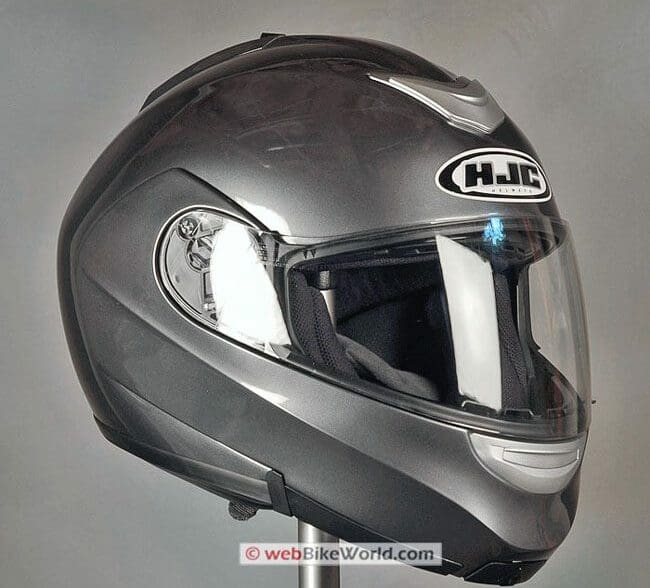
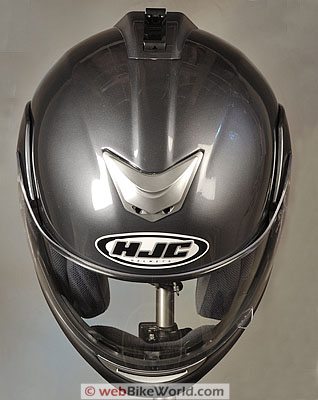
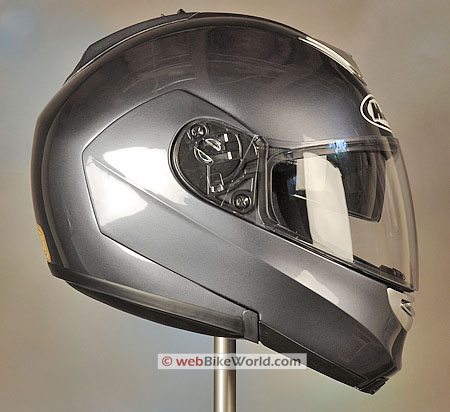
Average modular helmet with no real outstanding features. Includes an internal sun shade.
Relatively quiet with comfortable liner. New and unique type of face shield removal mechanism.
Our example had some quality flaws. This helmet in size XL is very heavy.
NOTE: See our review of the HJC Sy-Max II, which is the North American version of this helmet.
The job of evaluating the new HJC FS-Max flip-up helmet was assigned to me.
The reason?
It’s because everyone wants me to dump my crusty old Shoei Duotec flip-up, the one that needed replacement about, oh, maybe five years ago…
Even with all the helmets in the webBikeWorld inventory, I always seem to go back to the Duotec because it’s just so familiar.
I never really liked the Shoei Syncrotec, which was Shoei’s attempt at an “improved” Duotec and I haven’t tried the new Multitec yet. (Editor’s Note: Burn may not have tried it, but we reviewed it).
But I have tried just about every other modular helmet and I just haven’t discovered any compelling reason to make me leave the Duotec behind. Will the new HJC FS-Max change my mind?
The HJC Sy-Max, one of HJC’s “AC” series helmets, has been around for several years without an update.
The word is that the FS-Max shown here, which has just been released in Europe, will be sold in the U.S. as a 2008 model. Will it be called the Sy-Max? Sy-Max II? Who knows…
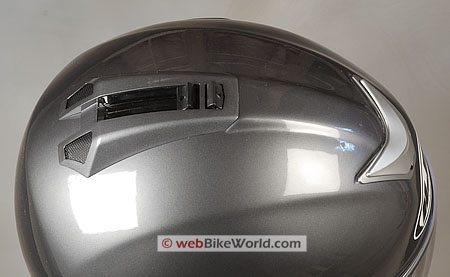
The styling of the FS-Max isn’t revolutionary by any means, but the new, simpler vent arrangement and the addition of an internally rotating sun shade caught our interest.
We wanted to try one and couldn’t wait for the U.S. model to appear, so we purchased an FS-Max in England and had it shipped over (which cost a fortune with the current exchange rates). Is it worth waiting for? Let’s take a look…
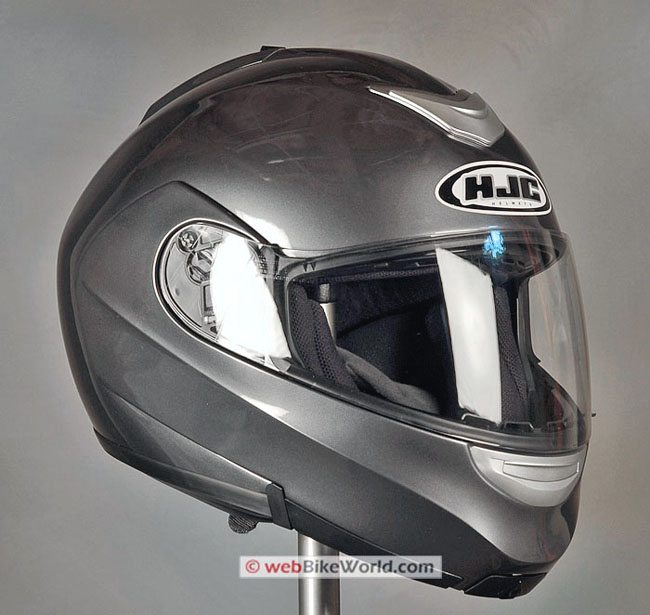
HJC FS-Max Fit and Finish
webBikeWorld has been impressed with HJC quality in the full-face helmets that have been reviewed on these pages; the CL-14, the CL-SP, the AC-12 Carbon possess excellent quality and are a super value.
But it sure seems like HJC has been on a cost-cutting bender recently. The HJC CL-XS Endurohelmet we reviewed started the trend — it seemed different than the HJC helmets we knew and loved and the FS-Max shown here also has more than a few flaws that leave us puzzled.
Although it’s important to note that both the CL-XS Enduro helmet and the FS-Max shown here are European-only models; could it be that Americans are pickier when it comes to quality faux pas and HJC U.S.A. has different standards for this market?
Let’s start with the paint quality on our example, which doesn’t impress. It has some orange peel, uneven coating and even some dust particles visible in the surface (see the photo below).
Even some tooling marks can be seen here and there across the surface, like on the plastic “ears” towards the back of the rotating visor.
The top vent doesn’t quite fit as tight as we’d expect, and some glue or paint or clearcoat bubbling is visible where the vent meets the helmet. We also experienced a couple of other problems with the visor fit and finish which I’ll describe later.
As if that isn’t enough, there’s more: the right cheek pad keeps coming loose because the female side of the plastic pin attachment was defective right out of the box. The cheek pad comes loose just about every time I take the helmet off.
One or two of these flaws might be overlooked, but when you add them all up, it gives us the impression that something has slipped in the quality department.
And the available colors don’t help: the FS-Max, at least in its UK guise, is only available in Silver, Anthracite and Black, three of the most somber hues I can think of.
I rate the fit and finish of our HJC FS-Max as poor (see the ratings scale in the summary table at the end of this article).
Helmet Fit and Comfort
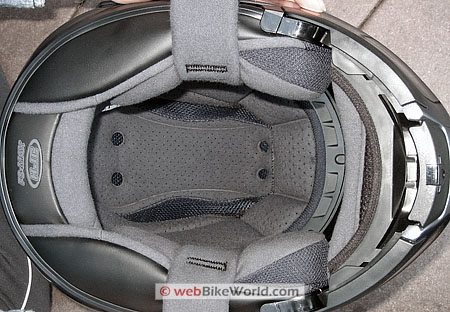
My opinion is that the FS-Max will fit riders with round heads best. The upper section around the brow on the inside of the FS-Max is shaped for a round head, but the cheek pads feel like they’re a size too thick for the helmet, which is a size XL (it otherwise fits about like an XL should, so I’d say it’s true to size).
The helmet feels like it sits lower than the original Sy-Max, which is a good thing. I tried a Sy-Max when it first came out and it felt like it rode way too high, so I didn’t buy one.
One of the big selling points of modular helmets is that they work better for motorcycle riders who wear eyeglasses. That’s really the main reason why I wear a flip-up most of the time and why I’ve stuck with my old Duotec — it fits easily over my glasses, especially now that it has several years worth of break-in time!
However, the FS-Max doesn’t seem to be eyeglasses-friendly to me.
The cheek pads and the padding on the side push on the side of the ear pieces on my glasses, forcing them against my head, which causes some discomfort after wearing the helmet for only a half-hour or so. I’m hoping this will change over time as the helmet gets broken in.
But you’d think that HJC (and other helmet manufacturers) would design a groove or a space in the padding on the sides to give eyeglass wearers some relief in that area…
I can say that otherwise, the liner is pretty comfy. It’s a soft type of microfleece fabric and it looks comfortable and has enough padding on top and the sides. The top portion of the liner has tiny perforations; I don’t know if they really help with ventilation, but they look nice anyway.
Overall, the HJC FS-Max has what I’d say is an average feel. Nothing fantastic to rave about, just OK. I rate it a good.
Flip-up Visor
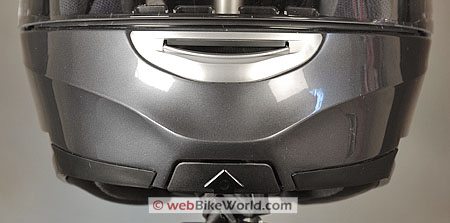
A rather nice, large 50mm wide (2″) button or lever is located at the bottom center of the chin bar to unlock and raise the flip-up, or modular rotating visor. It’s easy to hook the button with a thumb to pull the visor open in one sweeping motion.
I think this type of button and its location is the best arrangement for modular helmets.
The rotating modular visor has a pretty smooth feel as it opens — not the smoothest I’ve tried, but it’s acceptable. It doesn’t have a detent or stop at the upper end of the movement, but there seems to be enough friction to hold the modular section open when necessary.
The helmet has metal hooks that grab metal bars that are riveted into the helmet itself and this design seems to be rather typical for modular helmet latches lately.
I’m hoping the rotating mechanism gets broken in over time without getting loose or sloppy, because although its movement is acceptable, it’s probably not as smooth as it could be. I wonder again if price pressures had an effect on the design.
Face Shield – Clear Visor
The face shield has some problems. Ours definitely has some waviness that can be seen through the polycarbonate, and it also is the first face shield I can remember that showed scratches after the first time I used the helmet.
I have no idea where they came from — I’m always very careful about my helmets and cleaning the face shield, so my guess is that the material is softer or somehow different than normal.
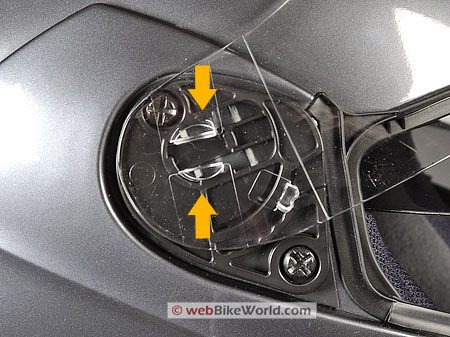
The material difference may have something to do with the new face shield removal mechanism on the FS-Max. It’s a unique new design and the first system we’ve seen that uses no moving parts.
The face shield must first must be lifted to its topmost position before removal and then it can be detached by simply pulling it out of the side plates. At first, I thought this was a good idea because it’s probably the simplest and easiest system I’ve seen.
But the problem is that the face shield attachment depends upon the strength of the polycarbonate tabs molded into the sides that fit into the matching slot on the side of the helmet.
This means that there’s no actual moving mechanism to lift or lower the face shield — it works by friction. After only a dozen or so uses, it seems to be getting worn and the face shield doesn’t shut tight without slamming it home.
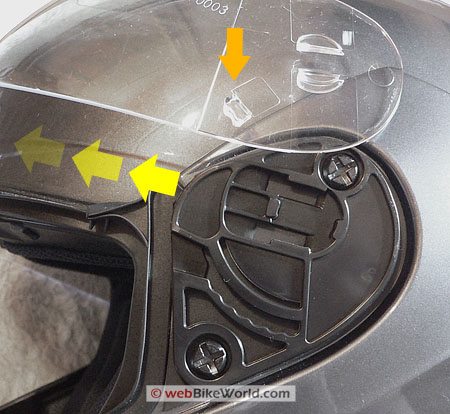
Here are two photographs that I hope illustrate how the system works. In the first photo below, the orange arrows point to the two plastic tabs inside the face shield. These are a press fit into the slot; see the next photo.
The photo above shows the face shield after it has been removed from the helmet. The two plastic tabs slide out of the tongue-shaped section in the middle of the black-colored mechanism. The face shield is pulled forward to release it, as illustrated by the yellow arrows.
Note also the orange arrow, which points to the molded-in piece that allows the face shield to ratchet up and down on the stops, which can be seen in the mechanism as the jagged teeth towards the bottom.
Overall, the removal mechanism is a good idea, but it somewhat inhibits the face shield from securely closing and I just hope it doesn’t wear out too soon.
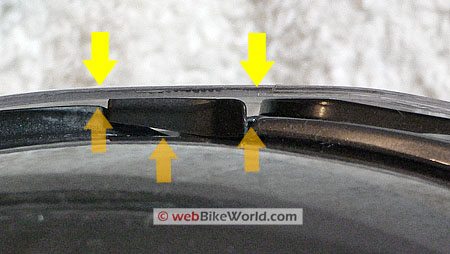
There are also some relatively large gaps between the face shield and the helmet. Note the extra section of gasket that can be seen just below the middle yellow arrow; it looks to me like this was added after the original design to try to fill the gap between the face shield and the helmet.
Here’s another photo below that shows the gap from above.
The tips of the yellow arrows are just touching the face shield; follow through the thickness of the face shield and you can see the gaps on either side of the top of the triangular shaped extra gasket (described above), between the yellow arrows and the faded orange arrows.
There’s also a gap between that piece of gasket and the helmet body, shown by the lower middle orange faded arrow.
The eye port isn’t nearly as wide as the fish-bowl view provided by, for example, the Zeus ZS-508.
Overall, the rather poor quality of the face shield on our example and its propensity for showing scratches forces me to give it a poor rating.
webBikeWorld reviewers haven’t been very fond of these devices and this one hasn’t changed our opinion. The sun shade has an on/off capability only — it can only be lowered to its fully extended position.
The visor is spring-loaded and it works by sliding forward a lever on the upper rear of the helmet. There’s a separate button that must be tripped to pop the sun visor up into its stored position. I’m not sure why the extra parts to make the thing either open or close but no in between…
Like every other one of these devices we’ve tried so far, it adds even more waviness to the already wavy clear visor; that is, it decreases visibility, which is not a good thing.
Also like every other one we’ve tried, the bottom of the sun visor is just below the rider’s field of view, which is very annoying. Why can’t they make these things to extend down to around your upper lip or so?
Internal sun visors have promise, but in my opinion, no one as of yet has successfully implemented the technology.
Noise Levels
You may accuse me of nitpicking about the visor though, because after all of my carping, the gaps don’t really seem to affect the noise levels of the FS-Max, which is surprisingly quieter than I thought it would be.
The helmet is provided with a chin curtain under the chin bar, and this seems to help lower the wind noise that might otherwise come from that area.
However, some low-frequency “booming” noises are apparent around the lower rear of the helmet, but this noise is only heard when riding behind some types of windscreens that direct the flow of turbulent air to that area.
I also notice a rise in wind noise when I turn my head from side to side as the air flows through the gaps in the modular visor and over the vents. But overall, I’d rate the ability of the FS-Max to keep the noise level attenuated as a very good.
Note that we always wear correctly fitted, high quality earplugs and an extra helmet liner when riding, and we strongly recommend that you always wear hearing protection also.
See the wBW Earplugs and Hearing Protection page for more information on choosing and wearing earplugs.
Note also that your experience with this helmet’s noise levels may be different, depending upon many factors, including your head shape, motorcycle configuration, prevailing winds and more.
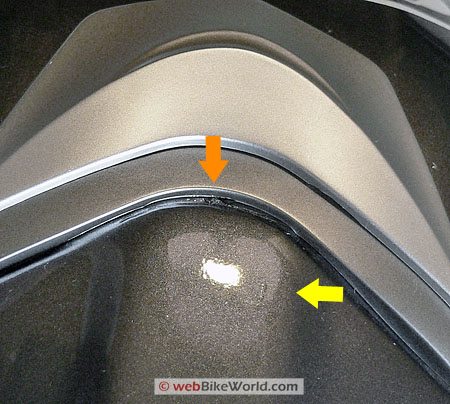 The orange arrow points to a gap with a poor quality finish to the glue or paint (I think it’s the clearcoat). The yellow arrow points to one of the dust marks that show through the finish. The relatively rough surface of the finish can also be seen around the reflection of the light and there are gaps around the plastic vent housing.
Venting and Air Flow
The FS-Max has a wide chin vent in the shape of a scoop that directs air on to the back of the face shield. There are no direct ports to flow air through the chin bar and on to the rider’s face.
The top vent is a simple slider that uncovers two small holes in the forehead of the helmet. The air theoretically flows over the top and somehow down on to the rider’s head, but I can’t find any direct path from the top vent holes through the liner.
This is probably why I don’t feel much or any air on top but I can feel a bit of fresh air on my face through the chin vent.
The face shield does have 6 detents to position it up or down and the first detent allows the FS-Max to be cracked open about 6mm or so for fresh air.
I’d say that the venting is slightly below average, but I don’t feel like I suffer for it, so I’ll give it a good rather than a very good or excellent.
Helmet Weight
This FS-Max in size XL weighs a whopping 1911 grams, or 4 lbs., 3-3/8 oz., which gives it the very dubious distinction of being the heaviest helmet we’ve ever reviewed, number 68 out of 68.
To be honest, I was rather surprised to discover this, because although most modular helmets feel heavier than their full-face counterparts, I didn’t think the FS-Max would be that heavy. Hmmm….maybe now we know what the “Max” stands for?
The helmet doesn’t feel as heavy when I’m wearing it, probably because it fits better and lower than the Sy-Max. I can honestly say I don’t really notice the weight when I’m riding and I’m not sure why.
I didn’t know how much it weighed until Rick put it on the Polder scale.
So this may or may not be an issue for you.
I don’t know how much the other sizes weigh. I do know that HJC advertises that they use 3 different helmet shell sizes for the FS-Max: a small shell for sizes XS and S; a large shell size for M and L and an extra-large shell for sizes XL and XXL.
Kudos to HJC for letting us know not only that they use different shell sizes but also how those shell sizes match up to the hat sizes.
So this may be one of the reasons the XL is so heavy — it uses the same shell size as an XXL and I’ll be the XXL is virtually no heavier and, in fact, it may even be lighter because the padding is probably thinner to make up the difference for the same shell size but larger hat size.
I’ll be the rotating internal sun shade also adds several ounces.
See the wBW Motorcycle Helmet Weights page for a chart that compares the weights of all the helmets reviewed on webBikeWorld.
Miscellaneous
HJC uses a very frustrating chin strap buckle on the FS-Max, which, by the way, surely doesn’t subtract from the weight on this baby. I have no idea why the Europeans seem to be going for these horrendous contraptions in such a big way.
A D-ring is so efficient, so simple and works so well to provide instant infinite adjustment…why change?
The buckle on this helmet is even more complex than some of the other so-called “quick release” buckles we’ve seen. It took me nearly 20 minutes of fussing around to get the thing adjusted correctly the first time out, and let’s hope I never have to do it again.
You’ll never have that problem with a D-ring…
The helmet does have some thicker and wider than average padding sections under the chin strap, but that large, long and complex buckle make me feel like I’m choking.
Other than that, HJC says the liner is made from “AquaTrans” and it is removable and washable. The face shield is supposed to be anti-fog treated but it’s been too warm to tell if it works or not; I suspect it does from the couple of early-morning go-outs I’ve experienced.
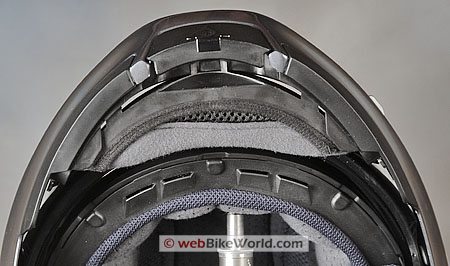
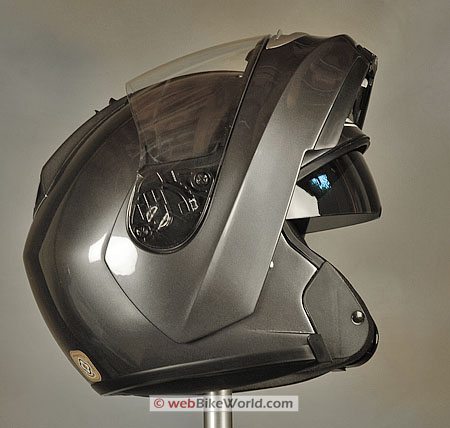
Internal sun shade shown in lowered position behind clear face shield. Top vent (open) and mechanism for internal rotating sun visor. Photo of the underside of the modular visor after it has been flipped open. The chin curtain and the release for the rotating visor can be seen.Conclusion
The HJC FS-Max seems to show lower levels of quality than we’ve come to expect from HJC. My opinion is that the helmet is not outstanding in any one area, except maybe its noise control, which seems very good.
There are probably better modular helmets out there in the same price range; try the AGV Migliaand the Shoei Multitec.
It is possible that HJC will improve the FS-Max when and if it comes to the U.S.A. to replace the Sy-Max or as a new helmet and we’ll try to stay on top of that story.
| wBW Review HJC FS-MAX Modular Helmet | |
|---|---|
| Available From: HJC Helmets (Europe) | List Price: �179.99 (Solids) |
| Colors: Silver, Anthracite, Black. | Made In: Korea |
| Review Date: May 2007 | |
|
Rating Scale is subjective: Unacceptable, Poor, Neutral, Very Good, Excellent, Outstanding.
|
|
Owner Comments and Feedback
See details on submitting comments.
From “A.G.”: “I’ve had the FS-MAX for over 6 months now (I live in Spain and it came out here last year). It’s my first modular helmet and I’m happy with it. It’s heavy, compared to a full face, but like you said I don’t feel it while I wear it.
The sun visor is just great, although it should be bigger. The mechanism is easy to manipulate even with winter gloves.
My unit is not as low quality as the one you tested, being mine in a lighter grey. It does have some issues, like the side padding coming out a little every time I take it off, but not the cheek padding.
Venting is insufficient during hot days, unless you leave the visor open on its first position.
I also liked the fact that was a multifiber helmet, made from Kevlar, Spectra and fiberglass, but I don’t know for sure if that means better helmet compared to the many Lexan and plastic modular helmets around.
The visor is fog-free but only for a few months, and not able to fit a Pinlock. The buckle is just fine for me, easy on and off, no hassle, at all. And last, at around 240 Euros it is a good 100 Euros cheaper than a Shoei Multitec and I’ll say I’m fairly happy with it.”
From “G.”: “First off, love your website!! I visit often for information and steer others your way… Anway, I contacted HJC about the availability of the FS-Max in the US Market. My last two helmets have been the SyMax and fit my noggin well. Here (in part) is their reply:
‘Actually, the FSMax will be in U.S. on February 1, 2008. It was released in Europe first and it has received positive reviews. Meanwhile, if you are interested in a sun shield helmet, we do have a new helmet just released in U.S. with a sun visor called FS10.
It is not a system helmet (Editor’s Note: I think they mean modular?) but has the patented sun shield on the helmet. It is DOT and priced at $250 MSRP. It has a great fit and styling. The helmet is so new, it won’t be in our website until Monday of next week (September 17, 2007).'”