



Here’s another installment in our continuing search for the “perfect” motorcycle visor anti-fog treatment.
Until a visor is invented that absolutely and completely resists fogging under any conditions, there will always be room for one more anti-fog spray.
If you recall, we recently compared four different anti-fog treatments; none were satisfactory. So we continued on with the quest, which led us to the discovery of Salclear, located on the Isle of Man.
Surely, we thought, a company located on the Isle of Man must know a thing or three about fogged-up visors — and prevention of same.
Salclear makes a wide variety of anti-fog and anti-mist fluids and other products used in scuba diving, “motorbiking”, sports, leisure, paintballing, fishing and — yes — even for casual leisure use.
The good news is that Salclear TT, the company’s “flagship” motorcycle visor anti-fog product, does seem to work better than any other anti-fog solution we’ve tried, under certain conditions.
About Salclear
Salclear provided a good deal of assistance during our investigation, and we uncovered some interesting quirks in the application of visor anti-fog treatments.
We were impressed with Salclear’s extensive line of anti-fog solutions and other products, which includes something like 40-odd different solutions for the activities outlined above.
Some of the products carry interesting and quirky names like “Salshield Mosipel”, “Sinazo”, “Scubalube”.
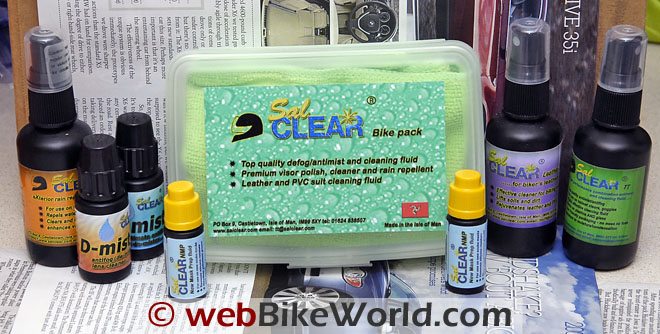
Deciding which product to order can be a bit of a head-scratcher, so we ended up with the Salclear “Bike Pack” (photo above).
It includes a bottle of Salcear TT, TT-X and even a bottle of Leather-Buff, a leather “cleaner and rejuvenator” for “biking suits” which we have yet to try.
Salclear Details
Salclear TT is the company’s basic motorcycle visor anti-fog/anti-mist treatment, but it’s also claimed to be a “highly effective cleaning fluid” that works on both plastic and glass.
The photo of the Bike Pack at the top of the page also includes Salclear “D-mist”, “D-mist+” and two bottles of “Clear NMP”, which is used to de-grease and prepare new diving masks; more on this in a minute.
One thing we should reiterate is that It’s important to know if your anti-fog solution is recommended for use on polycarbonate or glass.
That’s because there is a difference, and a solution designed for glass may have chemicals in it that will harm polycarbonate motorcycle visors.
For example, during our search for the ultimate anti-fog solution, we again tried a product called “Never Fog”, which seems to work rather effectively.
The Never Fog bottle that we have (which we’ve owned for several years so the new labels may be different) has no information about using the product on visors.
But when we called the manufacturer to ask if the product can be used on polycarbonate motorcycle helmet visors, the answer was “no”.
Apparently, the chemicals in the solution will permanently damage the visor.
This is unfortunate, but, as it turns out, it’s harder to treat polycarbonate than glass for a variety of reasons, as we discovered.
Salclear Anti-fog Solutions
We placed our Salclear order online and anonymously, as usual, and it was dispatched and received in short order, all the way from the Isle of Man.
I was rather hoping it would arrive with some of those cool TT motorcycle postage stamps, maybe hand-cancelled by a Manxman, but alas, it was not to be…
In any case, shortly after the package arrived we received an email arrived from Dr. David Salter, Salclear’s Managing Director, offering his assistance if it was required.
A nice touch that apparently goes out to all customers.
At this point he had no idea we were anything other than another overseas customer, but this would soon change when we took him up on his offer.
In addition to the basic Salcear TT anti-fog product, the Bike Pack includes a bottle of “TT-X”, which can be used on the outside of the visor to repel water (rain) and to keep the visor clean.
This is a somewhat analogous product to “Rain-X”, which may be more familiar, but Rain-X is not recommended for use on polycarbonate.
The Salclear bottles come in a water-resistant and re-sealable hinged plastic container, and they even include a nice microfiber cleaning cloth to make those visors nice ‘n’ spiffy.
So we broke out the webBikeWorld visor fogging evaluation equipment and went to work.
This time, we used a brand-new visor from an HJC CS-R1 that we’re in the process of evaluating.
The review will be published soon, but in the meantime we discovered that the visor that came with our helmet seems to fog up very quickly.
Either it had not been treated at the factory or the treatment they use isn’t working, because it is much below average in terms of its ability to eliminate fogging when compared to other OE visors we’ve tried.
The visor was thoroughly cleaned before each new anti-fog treatment that we applied, of course, to avoid any influence from the previous trial or from any chemical that might have been left on the visor during its manufacture.
First, the visor gets a double batch in dishwashing soap.
Then we dry it, then give it the once-over with rubbing alcohol to make sure there’s no residue from the previous treatment.
We always use a new paper towel for each wipe and dry and for each application of anti-fog treatment.
That’s to make sure we’re doing all we can to ensure an honest evaluation with no bias from any leftover residue from anti-fog treatments used previously.
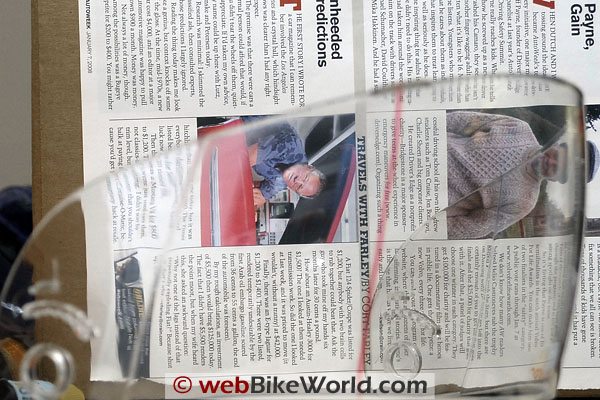
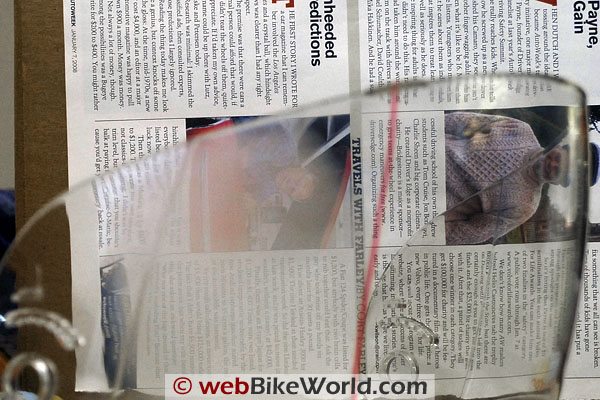
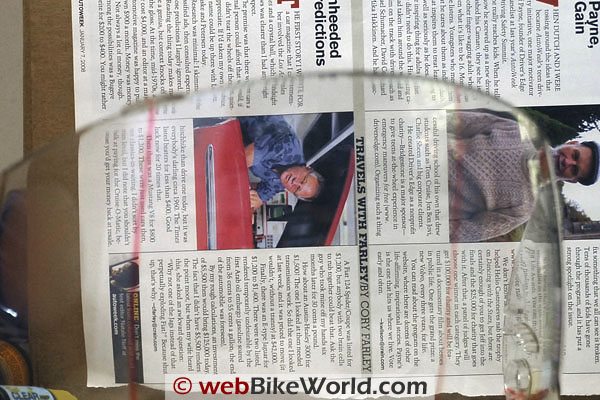
Here are some photos of the results, with “control” photos before each application.
The inside temperature was approx. 50 degrees F, so we used breath fog instead of steam from boiling water. We think this better simulates the motorcycle helmet visor fogging experience.
Photo 1 – Control: Cleaned and de-greased visor with no anti-fog treatment applied. Photo 2 – Control: Cleaned and de-greased visor with no anti-fog treatment, breath fog visible. Photo 3: Cleaned and de-greased visor, Salclear TT spray applied. Shown prior to breath fog. Photo 4: Same visor with Salclear TT applied on outside of visor, breath fog not apparent. Photo 5: Cleaned and de-greased visor, Salclear D-mist applied. Shown prior to breath fog. Photo 6: Cleaned and de-greased visor, Salclear D-mist applied on outside of visor, breath fog visible.First Results
We had originally anticipated good results with Salclear TT.
But when we applied it as directed and took the visor out into the cold (~38 F), fog and damp and breathed on it just a little, it immediately became fogged.
Hmmm….very puzzling!
We tried washing and drying the visor again and another careful application of Salclear TT but had the same results.
So we decided to take Dr. Salter up on his offer and explained the situation. What ensued was an extended correspondence that proved to be of some interest.
Salclear has a great amount of experience in creating anti-fog treatments for scuba diving masks and goggles.
They have found that many visors have some type of release agent left on them as part of the manufacturing process that can alter the effectiveness of the anti-fog treatment.
Dr. Salter suggested that the visor may not have been properly de-greased before it left the factory and that we might want to make sure that the visor was thoroughly cleaned first.
Cleaning Visors for Defogging Treatment Application
The problem of leftover release agents is common with pure polycarbonate visors that are sold untreated, such as the polycarbonate diving mask lens shown below, made in the U.S.A. byHydroOptix.
(By the way, HydroOptix also makes a very interesting-looking “Double Dome” curved diving mask that is claimed to provide a “razor sharp natural panoramic field-of-view”).
Salclear worked with HydroOptix to find a solution to the constant fogging inherent in diving masks. Diving mask lenses are usually made of tempered glass, and glass is easier to defog than polycarbonate.
But scuba masks are very prone to fogging, due to problems like sea water and wide variations in temperature and humidity.
Glass is supposed to be the easiest material to de-fog because it has a high surface energy and is readily wetted, according to Salclear.
Low surface energy plastics like polyethylene, polystyrene and polycarbonate are difficult to defog.
Based on Salclear’s experience with scuba masks, Dr. Salter recommends de-greasing any new visor before applying an anti-fog treatment.
He said “Manufacturing practices differ from one visor producer to another, some use mold release agents, some don’t, others use different types.”
“The agents used vary greatly from silicone oils, fluoropolymers and mineral waxes, but they all have one thing in common, they hate water and are very hydrophobic, so they are the arch-enemy of any anti-fog solution.”
Salclear developed a product called “Salclear NMP” (NMP = New Mask Prep) to de-grease new polycarbonate visors.
Dr. Salter told us that “The procedure of preparing and degreasing the (motorcycle helmet) visor is not as imperative as it is in the scuba industry, where it is almost impossible to defog a scuba mask without degreasing and cleaning the inside mask surface first.”
Salclear sent us a second package that included a couple of small bottles of Salclear NMP and also a bottle each of “D-mist” and “D-mist+”.
D-mist is a relatively thick, “oily” concentrate solution that can also be used for anti-fog treatment, and D-mist+ is the same product but with a cleaning agent included.
We used the Salclear NMP to do this, but our next round of Salclear TT treatment yielded the same results.
Salclear TT
We then decided to try applying the Salclear TT and the Salclear D-mist to the outside of the visor instead of the inside.
Our thinking was that something on the inside of the visor was affecting the ability of the anti-fog solutions to do their job.
This time, the Salclear TT anti-fog solution worked as expected, as you can see in the photos above.
The D-mist anti-fog solution was not as successful.
So we have now discovered that auxiliary anti-fog treatments can be affected by the release agents and other chemicals that may be deliberately or mistakenly left on the motorcycle helmet visor.
Also, the anti-fog treatments applied at the factory can affect the performance of any anti-fog treatment.
And that’s probably why you see such varied results in the reviews and opinions of many different anti-fog solutions.
The Anti-Fog Paradox
There is some irony here — the factory treats the visor with something that isn’t very effective at preventing fog, but it is effective enough to prevent additional anti-fog treatments from working!
Thus, unless the factory visor has an effective anti-fog treatment, it may be better to have an untreated visor.
It will then work with an accessory anti-fog solution, rather than having a visor with a factory-applied anti-fog treatment that doesn’t work and on which an accessory treatment will be ineffective!
The alternative is some way to completely remove the anti-fog treatment on a new visor so that a product like Salclear TT can be used instead.
We corresponded with Dr. Salter during this process, and we thought it would be interesting to include some of his (edited and excerpted) responses:
We told Dr. Salter about our findings, and he said:
“If the visor is uncoated, and has for example no factory applied anti-fog coating, then its straightforward. If, however, the visor has a pre applied coating, it could get complicated.”
He also said:
“In our tests, and we’ve not conducted exhaustive experiments on the subject, the factory applied coatings are ineffective in our standard anti-fog test.”
Better than having nothing, but 10 or 100 times worse than a designer anti-fog.
These coatings also tend to be soft and fragile. Regular cleaning can easily remove them, resulting in patches or areas of fogging and non fogging on an older visor.”
A Test for Aftermarket Anti-fog Solutions
Dr. Salter also told us that Salclear has “tested brand new anti-fog swimming goggles and ski goggles and they failed the anti-fog test miserably.
So our conclusion is that all visors, and all anti-fogs, are not equal.”
He recommends that motorcyclists ask the following questions about any new anti-fog treatment:
-
Is the anti-fog water resistant, or used in scuba/swimming?
-
Is it easy to apply without leaving streaks or smear?
-
Does it pass a simple ‘breath’ test? or tougher ‘steam’ test?
-
Is the anti-fog recommended for plastics, including polycarbonate?
“These four basic questions would eliminate maybe 80% of all the defogs on the market, including the homemade remedies such as shampoo and dish washing liquids”, he said.
On Salclear TT
Salclear TT has been formulated specifically for polycarbonate visors. “In most instances regular anti-fogs don’t work on polycarbonate because this thermoplastic has a low surface energy, is un-reactive and difficult to wet.
By its very nature therefore polycarbonate is hard to prevent from fogging”, according to Dr. Salter.
He also told us the following:
[START QUOTE] “We’ve formulated the Salclear range to wet out plastics, glass and other reflective surfaces, and additionally we’ve used chemical components which enhance water resistance… so the products are effective for longer.It’s common practice to use things like baby shampoo and dishwashing detergents as cheap anti-fog solutions.
These work up to a point, but such products are designed to be water soluble and hence their effect is only short-lived.
They also cause a great deal of smearing inside the visor which impairs vision.
A good point to start from is to ask whether the anti-fog you are using, or the brand, is applicable to scuba diving.
This is the worst case scenario, because it often combines high humidity, low temperatures, and lots of water sloshing around…
Scuba divers cant crack open their visor and give the inside a wipe if their mask fogs up.
In our experience, the products that are capable of being used in the scuba scenario offer a good technical starting point for motorbike visor defogs.
That’s where our products come from.
So humidity resistance, wash off resilience and low smear characteristics are all a given.
Salclear TT is a combination defog and cleaning fluid.
So you can use it equally on the outside of the visor to remove dirt, oil and bugs, as well as on the inside to remove finger marks and as a defog.
It’s worth noting that many anti-fogs on the market are not ideally suited for polycarbonate.
Products which are based on high levels of alcohols (and I note in one text on your site, that Rain X anti-fog was mentioned) are inappropriate for visors.
This is because the basic ingredient and carrier fluid, isopropyl alcohol has a long term detrimental affect on polycarbonate, causing it to crack, craze and therefore reduce its impact resistance.
All visors are not equal. Some have OEM factory applied anti-fog coatings.
These are soft, scratch easily, and in fact are not as effective as post applied dedicated anti-fog products. Some visors come with a layer of silicone oil which is absorbed into the surface of the visor.
This is applied as part of the manufacturing process because the oils are used as mold release agents allowing the newly formed visor to be removed from the heated mold.
Without these release agents you would not be able to get the visor out of the mold once it had cooled.
It sounds to me that the visor you are using still has a surplus of silicone residue on its surface.
Silicone oil is very hydrophobic, and it would be very difficult to stop the visor from fogging without removing this first.
A specialist degreasing agent would need to be used, standard soapy water is completely inefficient.” [END QUOTE]
Conclusion
We’ve discovered that the inconsistent results that we’ve experienced with our previous aftermarket anti-fog solution evaluations in the past may have a reason.
It’s been due to the various types of release agents, chemicals and factory-applied anti-fog treatments on the visor.
This makes the issue of finding an effective anti-fog treatment even more complicated and challenging than ever!
More wBW: Anti-Fog Treatment Reviews | Heated Clothing Reviews
| wBW Product Review: Salclear Motorcycle Helmet Anti-Fog Solutions | |
|---|---|
| Manufacturer: Salclear | List Price (2008): Biker Pack: £13.38 plus S/H |
| Sizes: 50 ml | Made In: Isle of Man |
| Review Date: January 2008 | |
Owner Comments and Feedback
See details on submitting comments.
From “R.M.S.” (02/11): “Your web site once again has helped me.
This time I looked up helmet shield anti-fog solutions. I read your article on Salclear. I purchased this product and am now using it.
I live in Beaverton, Oregon a suburb of Portland. It rains a lot here in the winter. I commute to work on a 2004 ZZR 600 rain or shine all year wearing a Arai helmet. Now that I am using Salclear I can see where I am going.
Your product review was very useful to me. I recommend this product, and tried others first but this product works. Thank you very much.”
From “A.W.” (12/08): “After reading your Salclear review, I bought some for myself. I have two helmets I tried it on.
First was the Z1R. After cleaning the face-shield with Plexus, I applied the Salclear.
It buffed out with no noticeable optical distortions. Giving it the old breath test while still in the house, it worked like magic.
I then applied the same procedure to a Shoei RF-1000. It didn’t work at all no matter what I did.
The next morning while riding with the Z1R in the mid-forty temperature range, still no fogging whatsoever.
On the way home though, it fogged up as if it had never been treated. The only real difference was that the helmet was in my house when I put it on in the morning.
It was stored on the bike before going back home. I decided to try my own experiment of first freezing the face shield and then breathing on it and then warming back up to room temperature and doing the same breath test.
Conclusion:
- I find that this stuff works great on the Z1R at room temperature.
- When it gets cold out, it’s pretty much useless.
- Like you discovered, it doesn’t work on some shields at all.
Keep up the good reviews.”
Editor’s Note: See above, note that it may not be a good idea to first clean the visor with Plexus, which may leave a waxy residue that could affect the anti-fog treatment.
From “M.I.”: “Here is my experience with fogging visors.
My son (age 19) and myself (age 61) both own the same model Scorpion full faced helmets, which are new. Here in New England we rode last week in 38F weather.
My son does get some fogging and he also gets some dripping condensation inside the visor….mine does not (I also wear glasses which do not fog).
The only conclusion we can come to is…my son breathes through his mouth when riding, I breath through my nose. Go figure?
In addition the cleaning technique seem to be very important to this issue.
We all know how a dirty interior windshield on an automobile affects fogging…here is my technique. First, non ammonia cleaner such as Invisible Glass from Wally World. Second, the cloth must be microfiber. Not the cheap ten towels for $12.00 type. If the cloth is “Made In China” do not use it. Today the highest quality microfiber comes from Korea.
I purchased mine from an online detailer website.
I have tried the “fuzzy” smooth type of microfiber cloth but on the interior of the Scorpion visor it leaves very fine lint.
The best type is what is called “waffle weave”. It gets the visor crystal clear without any streaking or any lint.
BTW most paper towels have fabric softener in them and leave a film behind when used to clean. Hope this helps.”
From “R.C.”: “I have been riding 40 years here in Canada and skiing 50 years and I have been forever searching for the ideal visor/goggle anti-fog treatment.
I have come to one conclusion: unfortunately, such a product does not seem to exist!
Over the years I have tried every product I could find in ski shops, dive shops and motorcycle shops.
Currently, I am riding every day, often in the rain, and fog, in temperatures from 0 C to +8 C in the winter (like now)…
The only product I have found that I can rate as ‘Acceptable’ is the Pro Grip anti-fog insert (review).
This is an accessory lens that sticks on (permanently) to the inside of the visor, with a foam rubber and glue strip.
I find it works fine when used ‘correctly’, as I will explain…
I had tried several solutions on the visor of my Arai Profile, so I first removed the visor, and washed and re-washed it several times in hot, soapy water, drying it with soft old baby diapers between washings.
It now appeared cleaner than when new.
Then, as per instructions on the package, I carefully lined it up so as not to interfere with the eye port gasket’s ability to seal, and marked the helmet visor on the outside, with a Sharpie, a few dots only.
Then came the hard part, and I recommend getting help for this, as a third and fourth hand are an absolute must.
On a soft white towel (so the dots are visible), lay the visor face down, and have your accomplice sitting across the table from you, hold the visor stretched out as flat as possible, while holding it down by the edges only (with clean hands).
Now carefully peel the wax paper off the glue edges of the Pro Grip lens, and VERY carefully (you will only get one chance!) line it up and stick it down.
Do this by first bowing the Pro Grip lens in the middle, and start from the middle of your shield, and work out to the ends, pressing hard with your thumbs as you move around the foam/glue strip.
Once installed, it’s there for good!
And Good it is… I have seldom had any fog on it since, and I never fog if I always do a couple of more things…
Here is how it works best:
Never put your helmet on indoors, in the warmth, and walk outside into the cold, unless you leave the visor up for a couple of minutes to cool down.
Then when riding, I always crack the visor a touch in traffic, around town (not necessary at highway speeds).
And I always flip it open when stopped, and flip it down once I let out the clutch to start moving, before the 1st to 2nd shift. This way it always stays 100% clear of fog, regardless of the weather.
I hope someday to find a solution that’s easy to apply and dead reliable, but I have come to the conclusion that’s just wishful thinking.
In the meantime, the double lens with dead air gap it produces between your visor and it seems the only reliable fix to prevent visor fogging.
And I have ridden over 400,000 miles, and I have tried too many treatments to even remember.
P.S. Most major helmet manufacturers also have extensive lines of Snowmobile helmets (we are the snow capital of the world here in Canada, and we invented snowmobiling).
And they have many models exactly in common with their motorcycle lines of helmets, except for snowmobile specific visors, which tend to be thicker and designed for winter use in extreme cold.
Many of these visors will attach to helmets exactly as the motorcycle visors do, but have visors, to keep the lens further out from the face and appear superior in the cold to the ones intended for motorcycle use only.
I have never bothered to research them, but if you live in snow country, check your local Ski-doo dealer or look online…”
From “G.A.”: “Thanks for your great service to those who dare to ride!
I read this article with great interest, as the search for the anti-fog that actually works is like the search for the Holy Grail. I have two Scorpion helmets, full face and open face.
I consider the open face to be widescreen HD, and the other to be a 5 inch portable TV, with limited viewing area, but obviously the full face provides greater protection from injury and the elements.
Living in Hot-lanta, I wear the open face in the heat, and I wear the full face in colder weather.
The visor on the full face fogs, contrary to Scorpion’s claims, and the protestations of their sales rep at a recent Bike Show.
Don’t get me wrong, I like both my Scorpion helmets, but truth is truth, the visors will fog in cool weather.
The worst experience I had was one day when the visor collected water, not fog, and the world looked like I was riding through a Sponge Bob cartoon. Not safe.
This article provided a lot of useful information.
I have wondered about your tea pot testing method (it seemed a bit extreme and not exactly real world), and I am glad to see that you are reevaluating the testing methods.
It seems you’re getting close to the root cause for anti-fog failure.
The information about the release compounds causing problems was very insightful, and we all have a better understanding of the issues from this article.
However, the conclusion reminded me of an experience from my ill spent youth. Bear with me, this will make sense in a moment.
Many decades ago, we discovered that tornadoes in our area could actually come inside I-285 and do their stuff. I looked up Tornado in the World Book (pre-internet repository of all knowledge) and what to do in case of a tornado warning.
The article said: “If you live in a frame home, go to the northeast corner of the basement (no mention of placing your head between your legs and saying bye bye to your bottom).
However, if you live in a masonry structure, this is the worst place you can be.” End of article, no further information. I, of course, lived in a masonry structure.
I wanted to say: “What about ME? What do we masonry dwellers do?” Perhaps it was World Book’s way of saying “kiss your bottom goodbye”.
I had the same sense of “well, what about ME?” when I got to the conclusion of this article, except that it appears it’s not me, but all of us who are in the same boat.
We have to figure out a way to remove the residue, somehow, some way.
Was the good doctor able to provide a problem solving chart for removal of the by products?
Thanks again for all your great work, and for helping understand the problem better than we did before.”
Editor’s Response: I guess we should have made it more clear (there’s that pun again!) in the article — apparently the de-greasing issue isn’t really an issue when it comes to motorcycle helmet visors.
Salclear’s suggestion to de-grease came after our first unsuccessful attempts at using their products, when they were trying to understand why the Salclear TT didn’t work.
I did have some trouble trying to get the points across due to the inconsistent results that we had.
But the bottom line is that I think just about any isopropyl alcohol should be fine for an initial de-greasing and one or two cleanings with alcohol probably won’t harm a visor.
The real question is this: if the “anti fog” visor coatings that the manufacturers are using aren’t working, how do we (or should we?) remove them so we can use a product like Salclear TT?
It works on untreated polycarbonate but has inconsistent results on treated polycarbonate?
From “T.B.” (Edited for brevity): “Attached is the Secondary Ops Guide for LEXAN obtained from the GE/SABIC website.
Isopropyl alcohol usage is recommended noted twice in the document.
The first mention is on the fourth page of the file for bonding surface preparation, specifically to remove mold releases and oil. Here several other, stronger, solvents are also recommended.
My observation would be that one would not want any structural degradation at a bonding site.
The other mention is on the 26th page for cleaning contaminates prior to application of metal finishes. Here is another place where one would not desire structural degradation.
Further, though a less authoritative reference, the Wikipedia entry for polycarbonates, in general, notes that Isopropyl alcohol interaction is “good.”
My opinion is that isopropyl usage is a much more conscientious choice than, say, using Windex or similar that is a concoction of many ingredients including ammonia or using bleach.
Thanks for continuing the search for a good anti-fog treatment. The grail has to be out there somewhere.”
T.B. also wrote: “My typical experience with release agents, especially on food grade plastics, is that there will sometimes see a sticker or instructions that say to wash well with dish detergent before using.
My admitted assumption was that this procedure was recommended to remove the release agent. I can say that the new product and washed product feel very different and less slippy.
I understand that there are many types of release agents with DuPont Krytox being one of the better ones that I recall. Krytox also happens to be an excellent lube.
It has always cleaned up with detergent even when applied as a dry film lubricant.
As another idea that I have yet to personally try is Beer Line Cleaner (BRC). It is either a liquid or powder (that is mixed with water) and used to flush beer supply lines in tap equipment.
To the touch, it feels very basic (as scientifically opposed to acidic). It is an amazing cleaner for the flexible polyethylene (I think) supply lines and metal faucets. It is effective enough to clean on its own and flush away quickly and completely. I am curious if using a bit to clean polycarbonate will help with removing factory anti-fog and release agents….
…I understand the use of isopropyl may do hidden damage to polycarbonate. I intend to research this a bit more.
Although, Black Labs All Kleer (review) uses this as a carrier, I use it to clean everything, and I believe I have several other products that use the same.
This is very interesting.
I am also curious if it is long or short term exposure to isopropyl that causes damage. This interesting as I understand that the alcohol complete evaporates.”
Salclear’s Response (also edited for brevity): “As a responsible supplier, selling products for cleaning and maintaining safety equipment, we have to ensure that the products we sell do not compromise the integrity of the substrate they are used upon.
Based on this information we would not wish to recommend usage of high levels of alcoholic products in cleaning polycarbonate, when clearly the opinions are mixed and vary.
The best case scenario is that yes indeed alcoholic products ‘should’ be fine in cleaning visors.
But on the downside, the worse case scenario is that the structural integrity of the visor could be compromised through regular cleaning with such products.
So it’ not clear-cut and for sure, and we would always err on the cautious side, hence my original comments about not recommending products with high levels of alcohol for cleaning visors.”