

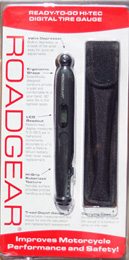
Lightweight; accurate; lifetime battery; 5-year warranty; comes with belt carrying case.
The original Roadgear “Hi-Tec” tire pressure gauge was (and still is) a popular “must have” item for motorcyclists.
Roadgear has probably sold a zillion of them to motorcyclists around the world.
Its light weight and unique shape make it an ideal accessory that can be carried under the smallest of seats.
But time marches on…
Roadgear’s newest iteration of the device is so small and light that it brings to mind comparisons like Chihuahua vs. Bulldog, finishing nail vs. railroad spike or Ford Ka vs. Excursion.
You get the idea…
Roadgear Digital Tire Pressure Gauge
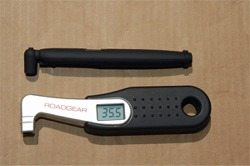
The original version of the gauge is 155mm (6-3/32″) long, and the handle was 18mm (~11/16″) thick and 37mm (~1-1/2″) wide. It weighed in at 46 grams, or 1-5/8 oz.
Certainly not a heavyweight, by any stretch of the imagination. But the slim new model really does make the old one seem quaint.
The new design weighs in at less than half the original, at 21 grams (3/4 oz.).
It’s 139mm long, and the thin oval shape is only 17mm (~11/16″) wide and 15mm (~9/16″) thick.
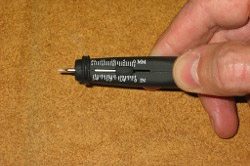
Not only is it lighter and smaller, it has more features — it includes a tire tread depth gauge! The and opposite the valve has a retractable tread depth gauge, calibrated in millimeters and inches. It will measure from 0 to 20mm or 0 to 3/4″.
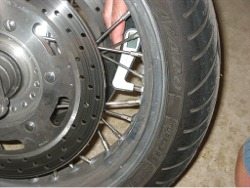
The older design had a bend in the body near the head, which made it easier to fit under a motorcycle wheel’s brake rotor on many different tire/wheel/disk brake configurations.
It was a breakthrough design in tire air pressure gauges because of this shape. The new design is so much thinner that this really isn’t an issue.
If you can’t fit this gauge on a tire’s valve stem, there’s probably no way you’re going to fit an air compressor valve stem fitting on it anyway.
The shape of the valve stem adapter has also been revised on the new design.
We never really had any problems with the old design, and we found that it was relatively easy to fit it over a tire valve stem, enabling the user to get a pressure reading without losing much air from the tire.
The new design has a round head with what seems to be much closer tolerances, and it fits very easily and snugly on to the tire’s valve stem, making it easy to get a reading without losing any excess air at all.
It does seem to require just the right angle and pressure to get a reading though, but it doesn’t take long to find the best approach.
Using the Roadgear Digital Tire Pressure Gauge
To bring a motorcycle tire up to the correct pressure, it’s usually best to add a few pounds more than is required, and then bleed off the excess until the desired reading is attained.
Some users complained about the older style gauge, because it didn’t provide the ability to bleed off the excess air.
But I found that it was easy to bleed off air using the old style simply by pressing it lightly on the valve stem, just like taking a reading but without pressing all the way down.
It doesn’t take much time at all to lose a pound or two from a (relatively) narrow motorcycle tire, so this method worked for me.
The new gauge has a valve depressor nub on the back of the head, which is the recommended method to relieve the pressure.
I still find it easier and quicker to apply light pressure without flipping the gauge over, but the choice is yours.
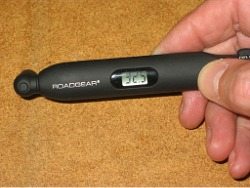
The only downside of the new gauge is that the digital readout ends up being located on the back side, which is then 90 degrees from the line of sight if the tire valve stem is perpendicular from the ground.
The old gauge has the readout on the left side, so if you’re right handed, you could take the reading and see the results without having to flip the gauge.
This was helpful, especially if the gauge wasn’t precisely centered on the valve stem, which can result in an erroneous reading, usually designated by “0.00” on the readout.
If the tire is rotated until the valve stem is at the bottom of the tire, pointing straight up, the new style gauge can be positioned so that the digital readout will be pointing straight up, making it easier to see.
Otherwise, the new gauge requires that you take the reading, take the gauge off the stem, flip it sideways to view the smaller readout, then put it back on the valve stem.
It gets a bit more complicated if you have to flip the gauge over to use the valve depressor nub to bleed out some air.
In any case, it’s much easier than it sounds, and it’s probably not a big deal unless you’re very used to using the old system.
We occasionally run into some balkiness if the second reading is taken too soon after the first, where the gauge will give the “0.00” error reading.
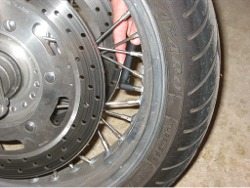
Accuracy and Display
The newly revised Roadgear digital tire pressure gauge will read from 5.0 to 99.5 psi in half-pound increments.
Roadgear claims that it’s accurate to ±1% (e.g., ±0.4 psi on a 40 psi tire), and they offer a nifty five-year warranty.
The new gauge (like the old one) has a lifetime battery. Isn’t modern technology wonderful?
Remember that having the correct motorcycle tire air pressure is extremely important.
As we mentioned in the original review of the Roadgear tire pressure gauge, motorcycle tires are very sensitive about correct tire pressures, partly because there is a correlation between the contact patch and the tire’s pressure.
Other reasons involve the way the tire’s internal reinforcement will cause heating and cooling cycles that may be affected by internal pressures.
The bottom line is that changes in tire pressure can have dramatic effects on handling, braking and traction.
Check Pressures Before Every Ride!
Improper tire pressures can also affect tire wear. Roadgear’s website has some numbers that indicate a 30% reduction in tire pressure can reduce tire life by 48%.
Although a 30% reduction is pretty dramatic, and I would guess that webBikeWorld visitors would never ride their bikes with such under-inflated rubber, the point is still valid, especially considering the cost of motorcycle tires.
Even a few PSI less than required can change the wear characteristics of tires.
The lesson here is that it’s really important to check your bike’s tire pressures before every ride.
The valve stems on some motorcycle wheels can be hard to access, and it’s easy to tell yourself you’ll do it next time. But tire pressures should be checked before every ride.
The Roadgear Digital “Hi-Tech” tire pressure gauge costs about twice as much as a good quality pencil type gauge, but its light weight, stealth black grippy finish, accuracy and cool nylon carrying case make this one accessory that’s too cool to ignore.
More webBikeWorld:
| wBW Review: Roadgear “Hi-Tec” Digital Tire Pressure Gauge | |
|---|---|
| Manufacturer: Roadgear | List Price: $19.90 |
| Colors: Black high-grip coating | Made In: China |
| Review Date: June 2004 | |
Note: Item provided by a retailer, distributor or manufacturer with these Terms and Conditions.
Owner Comments and Feedback
See details on submitting comments.
From “D.H.” (October 2010): “I’m on my 2nd and agree with the observations and opinions in the review.
However, the “lifetime” battery in both of mine expired within a couple of years (the second one occurred just yesterday, prompting my visit to this old review).
The battery resides underneath the printed circuit board (one end of which appears to function as one half of an “air chamber”) inside the case, and the act of removing either the PCB or battery throws the unit out of calibration, rendering it useless.
No instructions for battery replacement or recalibration accompany the gauge so I’m guessing Roadgear discourages the practice and would rather owners send the unit in for battery replacement.
Of course, if I’d saved the paperwork from the purchases I might have made warranty claims.
This is a tough, easy to use unit that takes up very little space in my tank bag, so I’ll be ordering another.”