By Jerry “Motorman” Palladino
DVD ($34.95) and VHS ($29.95), 52 minutes
Filmed and edited by Jim Miller
Available From: Ride Like a Pro
Although every single motorcycle rider starts out as a beginner, no one wants to admit it.
Maybe it’s the image promoted in the press, or maybe it’s our own egos, but apparently every rider has to become a black-leathered rebel or a junior Rossi the first time they swing a leg over a bike.
But image will never take the place of experience, and experience comes one step at a time.
I read the “Motorcycles for Sale” section in the newspaper every day, and I’m always surprised to see how many brand-new bikes are put up for sale within the first year of ownership and usually with less than 2,000 miles on the clock.
Most of the bikes are heavy cruisers or sportbikes. I wonder if the owners bought into the image without thinking about the consequences or the nature of their responsibility, and decided it wasn’t for them.
When you think about it, you have to give them credit for coming to this logical conclusion rather than ending up as another statistic.
Some riders continue through the years on sheer luck. But their luck eventually runs out.
There are only a tiny minority who go on to become skilled and knowledgeable motorcyclists. They get this way only because they develop a deep understanding of the basics, they manage the risks, they keep safety foremost in mind and they’re continuously working on skill improvement.
I recently came across an email thread on a motorcycle discussion site where some riders were dismissing a basic training course as unworthy of effort. They reasoned that riding around cones in a parking lot isn’t valid for street riding.
Maybe they were all expert riders, but from what I’ve seen on the road, the majority of motorcycle riders honestly don’t know what they’re doing. Most riders seem stiff, they don’t look where they’re going, and they don’t know how to turn a motorcycle.
I saw one the other day, a guy on a big cruiser, wearing a T-shirt and beanie helmet. He overshot a left hand turn on a clear country road with miles of visibility because he wasn’t looking where he was going.
He actually put his left foot out and scraped his boot along the pavement like it was going to help him make the corner.
This type of behavior is very dangerous, and probably accounts for the reasons why a large percentage of motorcycle accidents are due to rider error.
The seminal Hurt Study reported that fully 25% of motorcycle accidents were “single vehicle accidents involving the motorcycle colliding with the roadway or some fixed object in the environment”.
The Hurt Study goes on to say “in the single vehicle accidents, motorcycle rider error was present as the accident precipitating factor in about two-thirds of the cases, with the typical error being a slideout and fall due to overbraking or running wide on a curve due to excess speed or under-cornering”.
A case could certainly be made from this data that many riders are lacking in basic skills.
They freeze when they should be taking action because they don’t really know their motorcycle and how it handles.
The “Motorman”
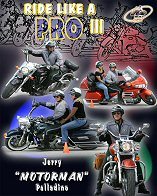
Jerry Palladino has been on a mission to change that, and he’s created a series of videos and training courses to teach new and experienced riders the basics.
Jerry apparently went through an epiphany of sorts after successfully completing his initial motorcycle police rider’s training (hence the “Motorman” nickname).
He realized that the training finally taught him how to ride a motorcycle, even after years of prior experience. So he decided to use the concepts from the police course to help the rest of us become better riders.
It’s important to note that the Ride Like a Pro III video is designed to be used as a lesson guide. It’s not meant to be something to watch and then put on the shelf. Follow each lesson, go to an empty parking lot and practice what you’ve learned.
Better yet, bring a portable DVD player or your laptop computer out to the parking lot so that each lesson can be viewed and then immediately put into practice.
The 15 exercises (13 if you don’t count the lesson on picking up a downed bike and Jerry’s Q&A session) build on each other and take the rider back through the basics about how a motorcycle steers and handles at slow speeds.
The idea is that once a rider becomes very comfortable at slow speeds, those lessons will carry over to all other motorcycle riding.
The concept of learning the basics through slow, repetitive exercises is not something unique to motorcycle training.
New and experienced equestrians use this technique, and it’s quite natural to see highly skilled riders who still seek out training and will spend hours in the ring practicing very basic maneuvers.
The idea is that you can’t put it all together at speed unless each individual piece is broken down, analyzed and perfected.
Some of the exercises in the Ride Like a Pro III video are extrapolated from the MSF Basic Rider Course.
And anyone who has taken the MSF training will recognize concepts like the “friction zone”, turning from a stop, the slow cone weave, overcoming the fear of leaning, making U-turns in the width of a city street, counter steering and braking.
These are good, solid, basic concepts that every motorcycle rider should be able to accomplish without breaking a sweat.
We went through each lesson in an empty parking lot on a Sunday morning and were humbled by what we thought would be a cakewalk.
Our opinion is that the exercises will help new riders become more comfortable with riding a motorcycle and they can also help more experienced riders improve their skills.
From what I’ve seen on the roads, I’ll bet there aren’t 1 in 10 riders who can successfully perform these lessons the first time through.
The offset cone weave and the U-turn practice are especially useful and probably the most difficult, but all of the exercises are designed to give the rider more confidence and a better understanding of the motorcycle’s dynamics.
Most riders could benefit by going through the video at least once a year, perhaps at the beginning of the riding season to brush up on the basics.
Motorcycle clubs might be interested in obtaining a copy and running an organized practice session a few times a year for new members or anyone who wants to improve their skills. It’s almost like an MSF Basic Rider Course in a box!
Motorman’s series of videos are available in DVD and VHS format, and include the Motorcycle Endorsement video to help new riders pass state licensing exams; the Ride Like a Pro series and (Ride Like a Pro for the Ladies (review), which covers most of the concepts in Ride Like a Pro III, but is focused on women motorcycle riders.
Conclusion
Ride Like a Pro III takes new and experienced riders back to the basics through a series of exercises that demonstrate how a motorcycle handles at slow speeds.
Our feeling is that a large majority of motorcycle riders could benefit by going through the exercises demonstrated by Jerry and his crew.
The production quality is very good and the empty parking lot surrounded by trees makes an excellent and non-intrusive backdrop to keep the focus on the important points.
Jerry lightens it up here and there with a few jokes, but the dialog is kept to a minimum and it’s focused on the content.
Jerry explains the purpose of each lesson and walks through the exercise. Each lesson is then practiced by Jerry’s crew of riders, while Jerry provides commentary and reinforcement.
The riders make it look much easier than it really is. Our opinion is that executing all of the exercises on the video can help to develop new skills and reinvigorate basic skills that may have been forgotten.
Owner Comments and Feedback
See details on submitting comments.