
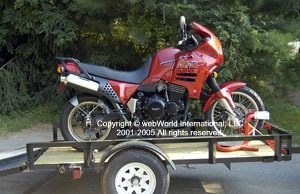
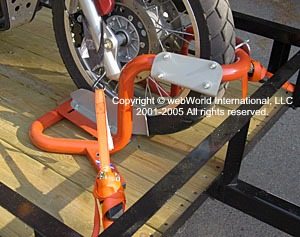
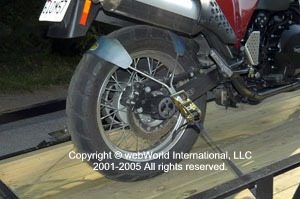
The Tire Down motorcycle tie-down strap is easy to use and installs fast and secure.
It is a brilliant idea for trailering a motorcycle.
This is one of the all-time great products ever invented for motorcycle use and something we can’t live without!
We’ve picked up quite a few tips for trailering a motorcycle since we bought the “official” webBikeWorld Top Brand motorcycle trailer for use around the shop.
That flatbed trailer has been on the road many times over the last few months, picking up and dropping off motorcycles for repair and hauling bikes to track days and bike shows.
It also does duty as a “brush and stumps to the dump” hauler.
I usually end up driving the pickup truck tow vehicle, and trailering always makes me a bit nervous.
I’m either way too cautious or I just need a few more decades of towing experience under my belt.
Or maybe a healthy dose of anxiety is a good thing when trailering, to keep from getting too wild and crazy.
I’ve watched other motorcyclists load ’em up and strap ’em down, and it’s easy to tell who has the most experience.
You can tell by the way the hands move around the straps, knowing exactly what to do, how much tension to put on the ratchet and where the best tie-down points are.
The experts also know exactly how to balance the load — and they also know how to drive the tow vehicle without getting in trouble.
My biggest fear isn’t that the trailer will develop a catastrophic blowout, or a weave that high-sides the bike, or even that the trailer hitch will disintegrate.
My anxieties are all about strapping the bike down so that it won’t fall over in a turn or after hitting a bump.
How to Tie Down a Motorcycle on a Trailer
Every motorcycle is different, and it’s hard to know how the various road surfaces and imperfections (to put it mildly) will affect the trailer tie-down strap arrangement.
The Bike Grab front wheel chock (review) has been a fantastic help, and I can’t imagine trailering a motorcycle without it.
It definitely keeps the front of the bike secure, and a couple of straps routed around the forks keep everything nice and steady.
It’s the rear end that usually gets me.
The motorcycle is supposed to be pulled forward into the Bike Grab wheel chock, but I’ve never been able to find a tie-down point that works at keeping the rear of the bike as steady as the front end sitting in the Bike Grab.
The best tie-down points seem to be low on the chassis, but they don’t offer very good leverage, and the upper part of the bike seems to sway back and forth a bit too much for my liking.
Although I will say that (knock wood) I have not experienced any problems so far with any of the various shapes and sizes of motorcycles that have been on the trailer.
The other problem with the rear tie-down points is that it requires walking back and forth to each side of the trailer to ratchet the tie-downs to get the bike upright and the load evenly placed.
The front tie-down straps are easy — I slide one around each fork leg, just above the axle (see photo).
I can stand right in front of the bike while it’s on the trailer and adjust each strap so they’re nice and even without having to walk back and forth around each side.
As we gain experience in motorcycle trailering, I’ve also started to notice the good and bad trailering habits of others. I saw a big cruiser on a flatbed trailer on the Interstate the other day, and the bike was tilted to the left.
At first I thought it was on its side stand — but it wasn’t.
The front wheel was laid over and four chintzy straps were located high up on the chassis and tied to the trailer’s top rails.
There was no way that bike was going to stay there and I didn’t want to witness the carnage, so I gassed it up the road to get it out of my line of sight.
All of this is mostly a moot point if the trailer is one of the dedicated motorcycle trailer types with built-in tire channels, a built-in front wheel chock and plenty of tie-down points.
But flatbed trailers serve double and triple duty for hauling yard waste, riding lawnmowers and everything else that it’s hard to justify a motorcycle-only trailer.
In any case, my trailering anxieties are over.
The Tyre Down tie-down system is, as far as we’re concerned, the only way to go. It’s an amazingly simple concept and just about everyone who has seen it has the same reaction.
Their eyes open wide and they usually hold their head, roll their eyes and exclaim something like “why didn’t I think of that”?
Too bad — it’s too late! KYA Racing (who, by the way, also makes a great-looking motorcycle trailer) has the pending patent.
I’m not sure how many of those big, honkin’ Foster cans, cocktail napkins and sleepless nights it took to work out the design, but I, for one, sure am thankful.
Tire Down Motorcycle Tie Down System
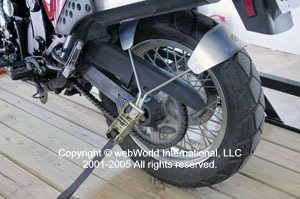
The Tyre Down is designed to fit over the top of the rear motorcycle tire.
The 1/8″ thick formed plates are spread 90 degrees apart, and they site on top of the tire, helped by a couple of heavy-duty friction pads that grip the tire.
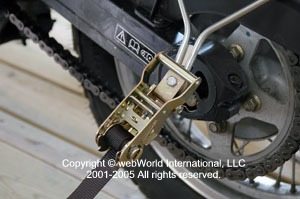
Four 1/4″ steel rods are welded to the plates (two on each side), and the rods end at a swiveling boss that connects to the very heavy-duty ratchets.
The other end of the ratchets have a typical 1″ wide Ancra webbed strap with a 400 kg rating.
At the end of each strap sits a big 3/8″ diameter vinyl coated hook.
Throw the Tyre Down over the rear tire, locate the hooks and tighten each ratchet just enough to snug things up and you’re done. KYA Racing recommends locating the hooks about 50 mm (2″) ahead of the rear axle.
This worked out perfectly on our Top Brand trailer — there are a couple of uprights on each side that seem to work perfectly for placing the hooks on most of the bikes we’ve trailered.
We’re going to drill a series of holes in a piece of 90 degree angle iron and bolt it to the trailer floor (another good feature of a flat-bed trailer) on either side of the rear wheel location so that we’ll always have a choice of holes to use on any size bike.
KYA Racing has several videos and many photos on their website that illustrate how easy it is to install the Tyre Down. The videos also show the trailer in motion, which give an idea of how sturdy this setup is.
I feel much more comfortable with the Tyre Down holding the rear of the bike than with any system of tie-down straps that I can conjure up.
There’s simply no way the rear tire is going anywhere once it’s held down by the Tyre Down system. It can’t bounce up and down and the bike can move sideways.
The other great feature is that the bike’s suspension remains uncompressed, so there’s no wear and tear on the shocks and no paint scratches on the frame, which are caused by securing the bike with traditional ratcheting straps.
You’ll probably have the same question I did: what about fenders and huggers?
I posed that question to KYA Racing, and their response is that the Tyre Down will fit under most huggers.
The Tyre Down fits tightly over the top of the tire, so my feeling is that any rear wheel hugger with the correct clearance (to let dirt and mud slide through) should have enough clearance for the Tyre Down.
The Tyre Down is available in the street version shown here and also in a special off-road version.
The off-road version eliminates the sheet metal across the top and uses one-piece 1/4″ rod instead, which grips in between some of the knobs on a dirt bike’s tires.
KYA Racing is in the process of setting up a distribution system in the U.S.A., Canada, Europe, UK, South Africa and New Zealand and other countries.
Conclusion
As far as I’m concerned, I’ve found the perfect trailering setup: a nice flatbed trailer with a floor made from 2×4″ treated lumber, a Bike Grab front wheel chock and the Tyre Down on the rear.
It’s fast, easy and about as secure as you’ll ever get.
Owner Comments and Feedback
See details on submitting comments.