






Motorcycles, motorcycle accessories, motorcycle clothing, helmets, reviews and more!
Loading
Bookmark and Share

Sena SMH10 Owner Report

Sena SMH-10 Owner Report

5,000 Miles With the Sena SMH-10

by Chris B. for webBikeWorld.com

More: 
▪  wBW
Reviews Home
▪  Owner Comments (Below)
▪  wBW Motorcycle Intercom Reviews
▪  Sena SMH10 Review

Editor's Note

I lent Chris a pair of the "Version 1" Sena SMH10 intercoms for his Trans-Labrador trip.

Sena now has an updated version of the SMH10 available; the SMH10 intercoms currently for sale at the various retailers are the updated version.

There is also an upgrade available for Version 1 owners as noted below.

We're currently in the process of evaluating the latest SMH10 intercom and we'll report back to determine if VOX performance has improved.

Summary

Audio quality and volume were first class. Battery life is impressive.

But the delay in the VOX is a problem.

A Long-Distance Trip

When my friend Glen and I began planning our (now completed) 5,000 mile, two-week motorcycle trip from Maryland to Labrador and Nova Scotia, we never thought about intercoms.

The plan was to ride from Maryland up the East Coast of the U.S., through Vermont and into Quebec.

The goal was to riding through Labrador on the Trans-Labrador Highway. Then Newfoundland, Nova Scotia and home again.

But, when Rick offered me the use of a Sena SMH10 Dual Bluetooth Headset and Intercom system (Version 1). How could I say no?

What’s that saying? "You don’t look a gift horse in the mouth!"

Upon returning the loaned equipment and discussing how it performed, Rick asked me to report on our findings.

I won’t go over the installation in each helmet other than to say we used the base mounting plates with the double-sided tape on both helmets because the "clamping" style bracket wouldn’t fit our flip-ups.

Also, I can’t comment on the various MP3, GPS or other Bluetooth capabilities since we used the SMH10 solely for bike-to-bike communication.

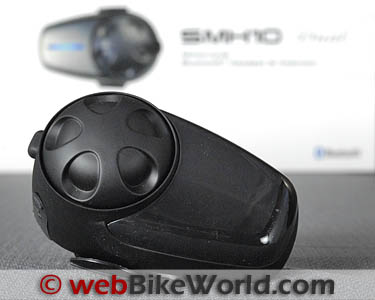
Sena SMH-10 Intercom Module
What Are They?

I had not used the Sena SMH10 intercoms before and wasn't very familiar with them. But following the instructions, pairing up the two units and activating the VOX was a breeze.

I also ensured both batteries were fully charged before our departure. I owned a battery-powered intercom system some time ago, so I was curious to see if battery technology had advanced since then.

Since we would be camping quite often during the trip, we would not have access to an electrical outlet for recharging every night, so each bike was equipped with either a cigar lighter style outlet and we installed the Burns Moto USB powered outlet (review) from the webBikeWorld review.

This ensured we could keep the batteries charged, regardless of where we stayed in the evenings. Having two choices for charging also worked to our advantage during the trip.

I must say, having bike-to-bike communications made the trip far more enjoyable and was a tremendous help throughout our entire journey, whether we were trying to find our way into or out of Old Quebec City or warning one another of the constantly changing hazards while navigating the Trans-Labrador Highway.

We also had many hilarious moments which were made possible solely because of the ability to communicate while traveling.

Being able to converse while riding made it easy to coordinate stops to eat, camp, use the bathroom, etc., as this could be discussed prior to approaching a town or refueling stop. It was also helpful in providing moral support when one of us was having a "moment" on the unpaved Trans-Labrador Highway.

Temperatures on our trip ranged from a low of 41º F (5º C) to a high of 90º F (32º C). The only real rain we encountered was on the way back to the States, through New Brunswick, Canada; otherwise the conditions were dry.

There was a LOT of dust on the Trans-Labrador Highway to the point of a total "dust out" at times whenever a truck would pass us. With few exceptions a "day’s ride" usually lasted from 6 or 7 in the morning until anywhere from 6 to 8 in the evening. We never rode after dark because of the even higher risk of a moose or animal strike at night.

With those operating conditions in mind there are four topics I would like to comment on regarding the Sena SMH10: Battery life; VOX operation; operating range; and other limitations.

Sena SMH-10 Helmet Clamp Kits
Sena now has three different helmet clamp kits available for the SMH10. The SMH-AO302 has an attachable boom mike on a removable extension (L). The SMH-AO304 (at BMG) has the attachable boom mic on the extension plus it allows the use of earbud speakers (Center). On the right, the SMH-AO303 (at BMG) is the standard boom mic but with a long extension cord that allows the use of earbud speakers.
BUY YOUR
Motorcycle Intercoms
Bluetooth Adapters, Earbuds, Radios and More
at the
wBW Amazon.com Store!
Sena SMH10 Battery Life

As I mentioned, the intercom units were fully charged prior to our departure and no power cords were used on day one. It took approximately 2 ½ hours to completely charge one intercom module.

I expected the intercom to begin alerting us of a low charge about 2/3 through the first day, but low and behold, the charge held, despite a pretty constant flow of chatter between us, due to the excitement of day one of our big adventure ride.

I should also mention that one of us was more diligent about turning off their headset during a stop than the other throughout the entire trip! The intercoms received a full charge that night (free lodging at a relative's house!) and the following night because of the availability of an outlet. After that we were camping most of the time.

The plans were to camp on the third night, so I was charging my SMH10 (or so I thought) via the USB port on the motorcycle, only to discover the port wasn't working due to a broken ground wire in my auxiliary fuse box, probably due to vibrations.

Even without the charge, the intercom unit held a charge for far longer than I would have imagined -- nearly two days of steady use. Until I solved the USB issue we simply swapped control units since Glen’s outlet was working.

These units saw a LOT of use since Glen and I discussed about every subject under the sun throughout the entire trip. Because of this I was really impressed with the battery life of the Sena SHM10 Bluetooth Intercoms. As with most rechargeable batteries, they seemed to gain in run time with each recharging.

VOX Operation
Sena SMH10 VOX Implementation

From Sena: Here's how VOX is implemented in the SMH10 intercoms.

VOX converts a converts a voice or sound signal into an electrical signal that then must connect with the Bluetooth intercom connection, so there is a time delay.

The time delay is not from VOX itself, rather it is from the intercom connection. From the SMH10 v3.0 release on wards (it is v3.2 now), we have improved this response time considerably to less than 25% compared with the original SMH10 used by Chris and Glen.

However, still it has slower than 2-way radio broadcasting, since Bluetooth is a peer-to-peer connection-oriented technology, different from 2-way radio technology use in broadcasting.

So, you may compare the connection speed with the Bluetooth-based intercom technology used by others.

Because of the potential technology difference, we recommend using the duplex real-time communication system in the SMH10 rather than VOX while riding. VOX is not recommended for connecting the intercoms during a time when you might need an emergency alert.

We are still putting much effort into improving VOX and the system to better support riders, including VOX sensitivity and temporarily disabling/enabling the function and more. We will try to reflect K.G.'s comments (below) in the next release.

To briefly review: there are only two ways to initiate or end an intercom conversation with the Sena SMH10 intercoms (read the full webBikeWorld.com Sena SMH10 review for more details).

Either the "Jog Dial" has to be tapped once or the communication can start by using the VOX function.

The VOX default from the factory is "disabled", but I chose to enable it on both units, because I did not want to have to take my left hand off of the handlebars to start or end a conversation which, in my opinion, is nonsensical.

After about 150,000 miles of experience riding two-up, a vital element to me in having a communication system is the ability to give warnings quickly to another rider or to the other person on your bike.

But in actual use, I found the VOX operation on the SENA SMH-10 system to be unacceptable.

The time between the moment I spoke that first loud word (or blew on the microphone as they suggest in the operator’s manual) until Glen heard me was incredibly long -- too long for practical use.

For example, I spoke the following verse with the first word spoken loudly and asked Glen to tell me what the first word he heard:

"Mary had a little lamb, Its fleece was white as snow. And everywhere that Mary went, the lamb was sure to go".

The first word that Glen heard was "snow". Now, had we seen a moose or other hazard and needed to instantly inform each other, neither of us would have heard the warning in time.

Another problem we encountered was that the VOX frequently ended a conversation in mid-sentence.

This I found extremely annoying, since it’s designed to wait 20 seconds after detecting no noise/speech before muting.

I found that at speeds over 55 MPH, the system seldom muted on its own, but that didn’t surprise me much.

I was riding my BMW R1150GS and Glen was on his Suzuki DL-650 V-Strom, both with stock windscreens. It was probably the amount of wind noise on the microphone.

In these instances I would simply reach up and end the conversation by depressing the "Jog Dial" or otherwise listen to the wind and Glen’s breathing in my speakers!

Broken Helmet Clamp
The rubber flex joint on one of the headsets broke during the trip but the mic was unaffected.
Posi-Tap
Buy Posi-Lock Connectors!
So popular, they're now on their own
Posi-Lock Sale Page
Many new and different designs available!
Posi-Taps
Sena SMH10 Operating Range

The claimed bike-to-bike range for the Sena SMH10 is 900 meters (0.559 miles) and I believe this is an accurate estimate. We didn’t measure it other than by eyeball, but we found the range, for a Bluetooth system, to be more than adequate, seldom riding beyond its limits.

We did find that the range is pretty much line of sight though. When one of us would drop over a rise in the road or around a hill the sound would get very scratchy and then the connection would be lost, but they would reconnect shortly after we were back in range or in sight.

Other Limitations

Despite cleaning both helmets thoroughly, the adhesive tape on the optional mounting brackets failed on both helmets. After 4 days, Glen’s fell off and mine was barely attached when I went to remove it upon completion of our trip.

[UPDATE: Both helmets mating surfaces were cleaned thoroughly with rubbing alcohol prior to assembly. Temperatures were between 70-80 degrees. My helmet was allowed to sit over 24 hours and Glen's approximately 12 hours before use. I wasn't aware of the use of the 3M Adhesion Promoter and the system was on loan only for the two week trip. The adhesive failure was a minor concern.]

Tape from my First Aid kit was used along with some silver tape later on the way home to keep his from falling completely off. We simply told curious bystanders that that was where a bear took a swipe at him after running off the road to avoid a giant moose!

We also noticed on one headset that the flex joint on the mike boom where it is attached to the bracket had split and pulled away.

BUY YOUR
Motorcycle Books, GPS, Electronics,
Training Videos, Clothing and More at the
wBW Amazon.com Store!
(UK Visitors: wBW Amazon UK Store!)
Conclusion

I have to say that the Sena SMH10 audio quality and volume were first class. No matter what speed we were running at, I could always hear what was being said -- even with my Hearos Extreme earplugs in place.

The battery life was impressive too, but the VOX operation is a deal-killer for me. I had hopes that this would be the answer for the wired intercom system I currently have on my BMW K1200LTC, but until Sena can work the bugs out of the VOX operation, I’ll stick with what I have.

Editor's Note: Sena has announced an upgrade path for Version 1 owners. The SMH10 Upgrade Kit includes an updated SMH10 module, a Micro-USB power cable and a cigarette-style charger. For more information, visit this page on the Sena website.

Note: For informational use only. All material and photographs are Copyright © webWorld International, LLC - 2000-2012. All rights reserved. See the webBikeWorld© Site Info page. Product specifications, features and details may change or differ from our descriptions. Always check before purchasing. Read the Terms and Conditions!

Your Comments and Feedback

Please send comments to
Comments are ordered from most recent to oldest.
Not all comments will be published (details).  Comments may be edited for clarity prior to publication.

From "D.Y." (October 2011):  "4 of us purchased the Sena (intercoms) about a year ago, shortly after the Sena reviews appeared on your site. The overriding factor was the ability to talk among a group of 4 riders, even though it is only 1-to-1, and not 1-to-many.

After several multi-day trips with 3 and 4 riders, we are rather frustrated with the interface (that is the closest way to describe it). On your 5,000 mi ride report there were only 2 riders, and even other comments posted are with 2 or sometimes 3 riders. As you know, the pairing sequence for every person assigns each of the other devices a number from 1-3. So every rider can reach the other 3, but it is done with a series of button pushes (1, 2, or 3 rapid presses).

With only 2 riders, only 1 button press is ever required. This pairing works well - 1 is not a problem. However, with 3 or 4 riders, then one often needs to press twice or three times to reach another rider. Reaching rider 2 sometimes is tricky to get the cadence just right (too slow and you end up getting rider 1, and too fast can also summon up rider 1 if one of the presses was missed).

Reaching rider 3 is more than tricky… it is a crap shoot! It is probably about a 50% hit rate, if you're good.

Unfortunately, (the Cardo Wireless) Scala Rider offering does not even support 4 bikes… they support 4 riders only when 2 of them are passengers. So Sena is sort of the only game in town.

It is unfortunate because Sena is close to being an excellent product, and one would think that the timing could be tweaked… why can't it allow the button press interval to be longer? It seems to time out quite quickly.

I recently learned about the USB upgrade, but only found out after the deadline. That may be something the manufacturer could modify on a future software release. Or even allow the user to adjust it to suit?"


From "K.G." (September 2011):  "About 12 months ago I purchased a pair of Sena SMH-10's based largely on the recommendation of this site. They worked flawlessly, and like you I loved their VOX functionality.

Last month I accepted Sena's offer to upgrade to their new micro port units at a reasonable price. They advertised small firmware improvements and the ability to upload future firmware updates through a home PC.

Unfortunately, one of the "improvements" was to remove the ability to temporarily disable VOX by tapping the jog dial. At the same time they appear to have increased the sensitivity of VOX so that wind noise now connects the units at about 50 mph - full face helmets and a sports screen.

Tapping the jog dial only turns the unit off for a few seconds after which the wind noise reconnects the intercoms. This has made the VOX function worse than useless -- unless you always ride below 50 mph or perhaps behind a barn door touring screen.

If others are having the same issue I suggest we all email Sena accordingly as it appears the change was made in response to "overwhelming" feedback."

Editor's Note: As Chris discussed in his "5,000 Miles With the Sena SMH-10" article (above), he had problems with the VOX on the old units also.

To be honest, VOX is very, very difficult to implement on any motorcycle intercom, due to the background noise inherent when riding a motorcycle. It's nearly impossible for the intercom to distinguish a human voice over the wind and engine noise that is typical when riding a motorcycle. For this reason (and the delay issues), I never use VOX actually; I just turn the units on full duplex.

Also, microphone placement is critical. If the mic is placed near a helmet air intake vent, the wind noise can overwhelm the system.

This is also greatly affected by the type of motorcycle. If the windscreen is directing air on to the helmet or the base of the helmet and increasing the background noise level, it can overwhelm the VOX or the intercom system. On the other hand, an intercom system or VOX may work perfectly when riding a touring bike with a big fairing and windscreen that blocks all the air.

UPDATE: Sena said they will work on this issue in the next release; see the "Sena SMH10 VOX Implementation" sidebar above.


From "T.A." (September 2011):  "I have a couple of observations for the Sena, which I've owned for almost 1.5 years and recently received the upgrade package.

I am very happy with the units, and Sena replaced my boom setup free of charge when one of the speakers started intermittently dying.

The Sena bracket/headset unit tends to cause a lot more helmet noise at all speeds on my half-faired FZ1 and HJC helmet. At first I thought it was the seals on my HJC breaking down, but I realized one day after putting my hand over the unit, it's the thing attached to the outside of the helmet making all the noise! I use the clamp, so I don't know if the adhesive would make a difference.

Can one of the editors comment if the Cardo unit is any quieter from this perspective, or is this just an issue with all helmet-mounted comm systems?

It would be great if the priorities could be changed. The stock priority is intercom, phone, stereo BT, wired stereo. I'd much rather be able to make the intercom the lowest priority so I could get alerts for radar or GPS turns coming up while gabbing to another rider about something.

Or at least get alerts when in intercom mode that something else wants attention. Several times when 3 of us had the units, 2 of us would be talking and the third rider could not initiate a conversation until we were done."

Editor's Note: Anything added to the outside of a helmet can potentially cause turbulence and noise. The Scala Rider G4 is larger and more irregularly shaped than the Sena SMH10, so it has the potential for creating turbulence and/or noise. The volume and pitch will depend on the motorcycle type, helmet type, windscreen, etc. 


From "T.G." (August 2011):  "The issue with the boom cracking and coming apart is common of all helmet units like this. My Scala Rider did the same thing within 2500 miles and the Chatterbox before it did the exact same thing. Just wait for the next 5000 miles for the boom to get loose and flop around.

Luckily the Scala has dirt cheap replacement audio shoes with the boom unlike the Chatterbox unit I had. it looks like the Sena also has a cheap replacement that can fix the issue as well to make the life of the unit far longer than the older units that were all in one."


From "L.E." (August 2011):  "Sena uses 3M VHB (Very High Bond) on their mounting plate. My company utilizes a lot of 3M VHB adhesive tapes in our products as well, and there are some tricks to get good performance.

I am not certain which grade Sena is using, but there are come important keys to maximize the adhesive strength for any of these grades:

  1. Adhesive selection - let's assume that Sena has selected the proper grade for ABS, PC and/or painted surfaces. There is quite a broad range.
  2. Cleanliness - alcohol prep pads, such as they use at the doctor's office are generally good to use. Try the prep pad on a hidden spot to make sure the plastic and paint don't adversely react with the alcohol.
  3. Surface Prep - Most plastics and many painted surfaces are "low surface energy". It can be hard to get strong bonds. This includes Polypropylene, ABS, Polycarbonate, and smooth painted surfaces like our helmets. If so, the 3M Scotch Adhesion Promoter mentioned by another reader can be a good idea. Use it after the surface has been cleaned. As with the alcohol prep pad, check first in a hidden spot to make sure it doesn't attack the surface to which you will mount the Sena baseplate.
  4. Curing Temperature - room temp 50-75 degrees F is typically good for most grades. Very hot and very cold are to be avoided.
  5. Curing Pressure - clamp the part if you can while it cures for 1-3 days. If you cannot easily clamp it, position and secure the helmet with the baseplate facing up and apply books, sandbags, etc to the mounting plate to apply the pressure.
  6. Curing Time - The most frequent mistake that I see - VHB (and many other pressure sensitive adhesives) do not reach their ultimate strength for a long time. Even though VHB is initially very tacky, it's actually not very strong just yet.
    • Time 20 min - Bond Strength 50%
    • Time 60 min - Bond Strength 75%
    • Time 24 hrs - Bond Strength 90%
    • Time 3 days - Bond Strength 100%

Moral of the story: Apply the adhesive correctly to a cleaned surface. Then clamp it and let it sit for at least 24 hrs or longer (if you can wait), before using it. Some 3M VHB info can be obtained in the VHB Tapes Design Guide .pdf from 3M.


From "M.P." (August 2011):  "I just read Chris' trip report and would like to offer a few comments of my own. We've had our set for a year (~5,000 miles of 2 up riding). My wife & I have this model installed on our Bell Mag8 helmets via the clamp. No problems. They work great on these lids. Sound is crystal clear.

However, we had problems with the VOX feature also. Returned them to Sena after a few back and forth emails with their Customer Service Representative and a NIB replacement set was promptly shipped to me.

The tech cautioned that using them in VOX mode with out a full face helmet and a wind screen could pose problems. He's right. Good and responsive customer service I must say.

We disabled the VOX feature on the replacement units and now run them in the "on" mode, where the mics are always live and active. For us, this works perfectly and we get a full 8+ hours talk time between charges. No lags, delays, or talking over one another.

If you're not camping where there's no juice, it makes it a non-issue. Plug 'em in overnight and you're good to go the next morning. We really like these and would recommend them. I think they're the best ones on the market right now... Keep up the great work."


From "D.Y." (August 2011):  "You mention in your review the failure of the double-sided adhesive on the backing plate. I found in the Sena website that they recommend using 3M Adhesive Promoter first before adhering the plate to the helmet. After doing so I’ve had no problems with the Sena unit on my Schuberth C3 helmet. I found single-use packets of the 3M product at a local auto paint supply shop." 


Reviews
wBW Motorcycle Intercom Info

wBW Bluetooth Intercom Reviews

wBW Bluetooth Helmet Reviews

wBW Bluetooth Adapter and Accessory Reviews

wBW Motorcycle Intercom Reviews

Text and Photographs Copyright © webWorld International, LLC - 2000-2012. All rights reserved.