

J&M “Integratr” Motorcycle Intercom
If you are considering a portable motorcycle audio system, this would be my first choice of what is available on the market today (2006).
There’s a considerable amount of flexibility and options for the unit, and functionally it is considerably better than most of the units I’ve ridden with.
J&M Corporation of Tucson, Arizona has taken the reliable design incorporated on most BMW motorbikes and created the Integratr IV Audio System.
And no, that’s not a typo.
The Integratr IV (JMSR-4010) is a relatively new portable “Motorcycle Audio System” which has been on sale since May of 2006.
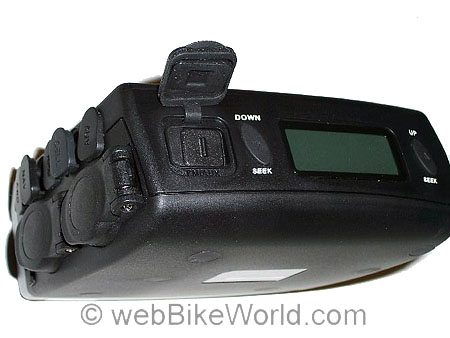
It features an FM stereo radio tuner, a driver-to-passenger voice operated transmit and receive (VOX) intercom, an auxiliary stereo input for an MP3 or iPod-type music devices or satellite radio units.
It also comes with a belt mounted leather pouch for easy access while riding.
The Integratr IV incorporates some unique features, including the ability to integrate devices such as a cell phone, a 40-channel Citizen’s Band (CB), a Family Radio Service or a General Mobile Radio Service FRS/GMRS two-way radio.
GPS devices that use audio commands and other accessory warning devices can also be incorporated.
The J&M Integratr IV Intercom System
The Integratr IV is powered by 8 AAA alkaline batteries, which provide approximately 16 hours of continuous operation and a rechargeable polymer lithium ion power pack is also available as an option.
The retail price of the unit by itself is $269.99, but J&M Corp’s authorized resellers usually offer the unit for less than the full retail prices listed on the J&M website. It is important to note that some of the retailers have recently started offering special pricing during the holiday season, lowering the unit price to $169.99.
As this unit is new, there is a certain amount of learning curve necessary for all parties involved – including J&M Corp.
I have to admit, at first I was a little skeptical once I started adding up the costs associated with changing out my intercom system and headsets. John Lazzeroni, the company President, said in an email to me that he was “so confident in the unit and its performance that I’m willing to buy it back if you’re unhappy.”
Enough said. I’ll give it a try.
 J&M Integratr IV Intercom Details
First, the Integratr IV requires the use of a “dual mode” headset, available from J&M. There are two options here – but basically any of the J&M dual mode headsets that include the “CD” prefix in their part number will work; i.e., any of the J&M headsets with the letters ECD, ICD, BCD, CD.
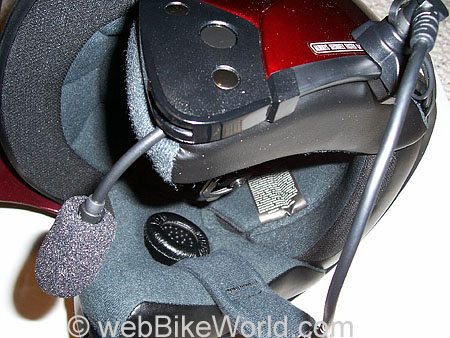
I chose to go with the more moderately priced Universal 257 series headsets (Part # HS-BCD257-UN). Headset installation is, without a doubt, the most un-enjoyable activity I’ve engaged in.
It pays to read the instructions carefully, perhaps twice, before attempting to install the headset. My helmet is a “flip front” style HJC CL-Max. The second paragraph in the installations instructions state “some three-quarter style helmets, Shoei and HJC, for example, have ear pockets that are a bit too small for the speaker to be properly placed.”
Wouldn’t you know it – the two helmets I’m using for this report are an HJC and a Shoei! Fantastic… The factory offers installation services if you don’t feel you’re up to the task. The cost is approximately $50 per helmet, but it’s best to call and see if your helmet is a candidate first. Installation into my HJC required an “Exacto” knife and some patience, as well as a lot of guts being that I was making permanent modifications to my helmet.
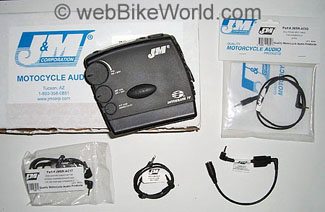
The headsets include an “upper cord” and must be paired with a “lower cord” for the Integratr. There are some known anomalies when using certain lowers with certain uppers from the J&M BCD series of headsets.
Basically, if you’re planning on using a BCD series headset on the Integratr IV and a CB Radio, you’ll need to get the J&M “HC-PWY” lower cord section to avoid some severe feedback issues, according to the manufacturer. Alternatively, the “HC-ZWY” lower and an “HC-ZAL” upper can be used to end up with the same result, although the out-of-pocket expense will increase.
Almost every item I wanted to test required the purchase of an additional cord. For instance, I ordered cords for cell phone and CB integration. My cell phone, a Samsung, is a four pin type so I also ordered the 3 pin to 4 pin adapter cable.
Ultimately, it didn’t work with my Samsung but a spare Nokia 6010 proved to be 100% functional. The volume control on the phone didn’t keep my ears from bleeding, but that comes later in the story.
After spending two hours installing the headset into the HJC, it was time for the Shoei and a similar amount of effort, although the time was shortened by half thanks to the learning curve. The quality of the installed product, once complete, is fantastic but be prepared to spend time redoing your efforts until the earpieces fit comfortably without any slack around them to ensure the best performance.
JΜ Integratr IV Functionality
That’s it with regards to the technical description; how does it function?
The headsets provide clear audio at almost every level. Switching between the FM tuner and the auxiliary input requires the manual switch on a toggle button located below a protective cover. Operation of the switch is straightforward; the problem is controlling the level.
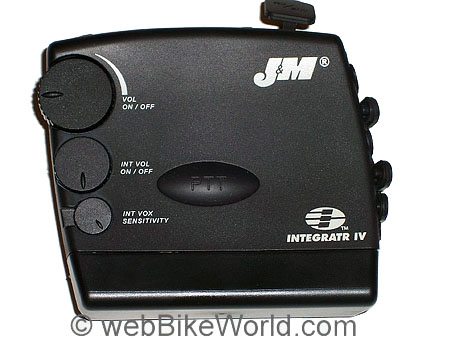
There are two adjustments for audio levels, one for the intercom and the other for other devices, such as the FM radio, auxiliary input, cell phone and external two ways radios. Each of the auxiliary input devices is reliant upon their own volume level for regulation.
The challenge is presented by trying to gain some consistency between them. Further, any audio “alert beeps” from devices tends to be a little hotter than, let’s say, the music from an iPod. Much hotter. Painful in fact.
There’s apparently no way to adjust this cleanly, leaving you susceptible to long term ringing in your ears if you don’t carefully monitor the headset level. I’d suggest bringing the optional accessory inputs on line at the lowest level first, and then gradually working their volumes up until they reach your comfort level.
The intercom from rider to pillion is outstanding. There’s little doubt that the bulk of the “brains” in this unit is around this feature. The adjustment knob is small, but highly effective and there appears to be a larger adjustment range than some other models I’ve demoed. The microphones provide crisp and clear communications, whether between the rider and pillion or with an outside party when calling via a cell phone.
Using a separate CB radio is a sketchy proposition at best. Although I ordered the JMSR-AC17 cable, it doesn’t work with all CB radios. While I would have preferred to test this with the Midland 75-822 handheld CB radio, they are unfortunately unavailable at every single supplier I attempted to source one from.
So I was left with trying to use the old Radio Shack TRC-241 used in all the other road tests. Sadly, it is possible to hear clearly from this unit but there appears to be a transmit issue. Depressing the PTT button apparently “keys” transmit on the handheld, but the microphone input doesn’t make it through leaving you broadcasting dead air. It’s unclear if this is an issue with the CB cable, or perhaps the headset upper and lower cords.
Enough negatives. Fact is, the unit has superb build quality and the headsets and cords are some of the highest quality manufacturing I have seen in a long time. The audio from my iPod and satellite radio is clear as a bell, and the helmet to helmet intercom is superb. The FM tuner is crisp and clean, and pulls in distant stations far better than I expected, although without an aerial antenna there’s only so much you can expect.
Honestly, those are the most important items to me. I’m sure that if I were able to acquire the Midland model handheld CB J&M tested with, the CB would work perfectly too.
The unit is significantly larger than I expected, but it isn’t uncomfortable to wear on a belt. The customer support from J&M Corporation has been outstanding. They are extremely responsive in their technical support and the company appears to be taking the best features of the system previously used on BMW touring class audio system and placing them into a portable package.
Conclusion
If you are considering a portable motorcycle audio system, this would be my first choice of what is available on the market today. There’s a considerable amount of flexibility and options for the unit, and functionally it is considerably better than most of the units I’ve ridden with.
J&M has produced a fairly solid unit in the Integratr IV and once they’ve produced additional cables for more CB and cell phone choices, this will quickly become the industry standard for motorcycle communications.
UPDATE: June 2007 – I did purchase and install the Midland 75-822 handheld CB unit that J&M suggested and it works flawlessly with the Integratr IV system. A huge plus: the 3 pin cell phone adapter works with my Blackberry Pearl, which has voice activated dialing. It will search either my address book or dial the numbers I tell it to.
This allows me to have hands-free operation of my cell phone as well as all of the other features the unit delivers. Hands down, it’s the best portable unit on the market today – and probably better than some “permanent mount” units!
Owner Comments and Feedback
See details on submitting comments.
From “H.J.W.” (November 2013): “I read your “J&M Integratr IV Motorcycle Intercom” article from 2006 with interest. I found the article interesting, and the honest opinions on what worked and didn’t work (including the positive & negative user comments) was very valuable.
I wanted to let you know that 7 years later, J&M now has an Integratr V audio system. It does away with the bulky control box that kept me from adopting the Integratr IV system and uses small wired modules that can be mounted on the handlebar or fairing to control VOX sensitivity/Intercom Volume and music volume/PTT.
The web page doesn’t provide very much information, but there is a PDF install manual that can be downloaded that provides a useful schematic.
It is a direct power system (no batteries!), and utilizes a hidden control box and cabling that must be routed/installed into the bike. This makes for a cleaner system, though of course it’s a wired system, so you’d still have to plug in the various audio components that aren’t permanently affixed to the bike.
There are Bluetooth A2DP modules from J&M that can be integrated into your system to allow you to connect Bluetooth devices (JMBT-DGCH-GL18 and JMBT-DGCH-16GTL).
The loss of an integrated FM radio isn’t a concern for me, but I don’t like the idea of having to set my cell phone to “auto answer”. I’m wondering how well it would work to have the Integratr V connected to my cell phone and my Garmin Zumo 660 GPS through one of these J&M Bluetooth modules.
My thought (and hope) is that I could then see incoming calls displayed on the GPS, and choose to accept or ignore the call from the Zumo’s touchscreen interface (as well as hear turn prompts from navigation directed through the Bluetooth pairing rather than running yet another cable to the Garmin).
In any case, I’m sure I’m not the only motorcycle rider that would love to see a write up in WebBikeWorld on the new Integratr V audio system. Do you have any plans to review this system?”
Editor’s Reply: No current plans to review the J&M system.
From “D.S.” (7/09): “I read your review of the Integratr IV. It sounded like just what I was after. I bought an Integratr IV, the headset, and all the cables required to make it work with a CB, GPS, Hand held Radio, cell phone, and MP3 player . Their technical support people helped me figure out which cables I needed.
When it works, it works pretty well. Usually that is not the case. You never know when any one or several of the cables will let you down. The only thing for sure is that you will not have to wait long for one of them to give you problems.

What a disappointment it has been. I thought they would stand behind their products after the quote you put in your review.
I have to admit, at first I was a little skeptical once I started adding up the costs associated with changing out my intercom system and headsets. (The J&M representative) said in an email to me that he was “so confident in the unit and its performance that I’m willing to buy it back if you’re unhappy.”
I’m not happy and I would like (them) to buy mine back, but (they) won’t. It turns out now that (J&M) does not agree with the cable recommendations that the technical support people that work for (them) gave me. Now (they) think I should buy more cables!
I don’t think J&M will be able to get this Integratr IV and all the cables to work reliably before I die of old age. My patience is gone.”
From “T.R.” (11/08): “I wanted to submit my owner comments on the J&M Integratr IV Motorcycle Intercom. A good deal of my purchase decision was based upon your review and I am happy to give back information where I can.
I purchased the Integratr IV this spring and while I have not used it as much as I would have liked to due to poor riding conditions in the Calgary, Alberta area this summer, I do feel I have given it a good test drive for the season.
Verify your external devices before you decide upon this device. One of my devices would not work with the standard cables available and one will never likely work.
The first device is my Magellan CrossOver GPS. It seems that even after changing the connectors on the cable to fit my CrossOver, the signal output from the CrossOver is not enough. Since I have an electronic and professional sound background, the only reason left for this is the GPS/NAV & AWD inputs on the Integratr IV are designed to accept speaker level inputs, not headphone level.
My friend who has a Garmin Quest GPS and an Integratr should experience perfect operation as the Quest can output both headphone and speaker level output.
The second is my Nokia E90 Communicator cell phone. The standard 2.5 mm 3 conductor cable is not compatible at all, nor is the available 2.5 mm 4 conductor ‘Nokia’ adapter. Initially I wound up using an older compatible cell phone with my SIM card until I uncovered the pin-out for the newer Nokia AV jack and manually wired up a working cable. To increase my frustration, technical support at J&M was of no help.
From what I understand, if you have a Zumo 550 and a Bluetooth cell phone, the available cable works well and provides you with everything on one simple connection – music, cell phone, and navigation instructions. All that and a nice touch screen interface for your cell phone as well. For me, the Zumo is a bit too expensive and not off-road oriented enough.
Without those hurdles, the experience would have been much more positive. I opted for the J&M for my KLR650 as permanent installation options are somewhat limited on my bike, plus the price was reasonable and the performance on par with more expensive solutions. I use the Integratr IV in a Lowe Pro Utility case that I can easily fit into my tank bag and remove quickly for security. I have the 12v accessory adapter wired in to eliminate the need for a set of AAA batteries every day. My iPod and cell phone fit conveniently in my tank bag window pocket allowing easy operation as needed.
I have a HJC CL-Max flip face helmet and went with the ‘Universal’ headset kit. The only difference in Spring 2008 in the headset kits are the helmet speakers.
My friend purchased the full face ‘Performance’ headset for his Arai which had better speakers and a non-boom style mic. I noticed very little difference while testing the speakers in a quiet room, perhaps the ‘Elite’ series would have better base at highway speeds.
Regardless, I am not even using the speakers as I have a set of Shure noise blocking headphones that I use instead. The concept of using ear plugs, as I always do, and blasting sound above the wind and bike noise is counter-intuitive to me. The Shure ear buds block over 20 dB of sound like standard ear plugs and provide me with great sound quality.
To facilitate the Shure headphones, I cut off the speaker connectors on the headset and spliced in a volume control headphone jack. This had the added benefit of allowing me easy master volume control without digging into my tank bag. Yes, you would have to be an electronics technician to feel comfortable with my modifications.
Now that everything has been adapted to my equipment choices, the unit operates as desired. My music comes through well with good quality. The microphone works well, conversations on the cell phone with friends have worked well with the other party hearing me clearly.
The driver/passenger intercom VOX level requires me to shout, even when it is set to maximum. I need to be able to adjust the VOX to ’11’ or even ’12’, but cannot. I have only been able to test the bike to bike intercom with GMRS radios in the comfort of my house. My experience with cell phone communication indicates that this will operate as expected especially with my use of the external PTT/Mute switches.
My Integratr IV experience has cost me over 500 CAD and I am mostly happy with the result. Part of my motivation was to have gear that I could move easily to any other bike. This solution provides that. Just provide an appropriately sized tank bag and 12V Acc. or batteries.
No matter what solution I went with, I was in need of customization. It would have been nice if J&M had provided me with some technical information, but as with any technology these days, once the product is out the door, the brains behind the product usually have moved on to other projects.”
From “J.B.”: “As a recording engineer, and as someone who deals specifically with High Definition audio strictly for broadcast, I understand what a toll listening can be on any set of ears. With lots of wind noise and with other audible distractions, it is first and foremost nothing less than distracting to have to deal with complicated or convoluted entertainment systems on a motorcycle for fear of missing something important like someone cutting you off in traffic or an EMS vehicle approaching on your six at a high rate of speed, all the while trying to update riders in your group about those occurrences.
This is where the ease of use of the Integrator IV comes in handy. Once you have it connected, its fool proof, water proof, and damn near indestructible. My system after all went thru a 70 mph collision with an embankment and still functions flawlessly to this day. I’ll save that story for a later day.
The cell phone connection on this unit is so clear. I had the opportunity to have a conversation with John Lazzeroni while riding at interstate speed. He did not even realize that I was talking to him on his own system until I told him. He was blown away. Absolutely amazed!
I felt good that I had installed this system on my bike, with pretty much every jack on the thing full. Instead of wearing it on my belt, or putting it in a tank bag, I opted to mount it on a RAM bar, using the leather case and a few cable ties. This makes for a much more friendly riding experience, and certainly allows for all hook-ups to be safely secured in place.
PS…If you use the Midland Radio as mentioned in the article, a good license plate antenna is suggested. The short antenna included with the CB is not effective for more than about 1/8 of a mile. A 3 foot antenna will give you drastically more range; just make sure you only use the radio in “Low” mode. You don’t want to burn up your buddy’s radio when you comment about the babe in the convertible you just left at the light…..”