


The AKE Stealth Intercom Set 200 is not a heavyweight — figuratively or literally — but it is fully functional, easy to use and it stands up well against newer systems.
Upside: Simple, clean design; small component size. The intercoms have a low profile when mounted externally, and they can also be hidden inside the helmet. The intercoms are efficient and have strong Bluetooth pairing and sound quality.
Downside: Low-power intercom with range limitations. One half of the system (the 201i module) has limited functionality. The controls can be difficult to access depending on location. Price is relatively high.
If classic styling, simplicity, reliability and a discrete installation really counts, then the AKE Stealth Intercom Set 200 Bluetooth system is worth a look.
Ever since completing the original AKE communications system articles (see links above and in right column) over the winter of 2007/2008 with publication in April 2008, I have wanted to get my hands on some of the newer Bluetooth components produced by the company.
With an early-winter offer from the AKE representative in Germany to provide their AKE BT Multi-Interphone Intercom (review) for an evaluation, the opportunity to get an updated version of the Bluetooth Helmet Set 200 system was seized. The original Helmet Set 101 reviewed in April 2008 had been very impressive, but it did not provide A2DP compatibility, a feature now found in the 200 version.
So late last year (yes, it has been that long), a package was received by the Editor and after a photo session, he sent everything down to Florida where I was: a.) Getting away from a (very mild) winter in the Ottawa Valley and; b.) Shivering in the cold along with everyone else in the southern U.S. at that time.
I didn’t get everything hoped for — in theory leaving something for future reviews — but the components provided are the minimum many users would be looking for in a basic helmet system, including a basic communications capability.
In the Box
The AKE Stealth 200 kit consists of a pair of very small, very lightweight and very modular Bluetooth helmet communication systems for a single rider, arider with a passenger or for bike-to-bike communications.
As mentioned above, the Stealth Intercom Set 200 is actually comprised of two physically identical but functionally different Bluetooth modules: the Bluetooth Stealth Helmet Set 201 and the Bluetooth Helmet Set 201i, where the ‘I’ identifies the Intercom module.
In summary, the 201 module is the primary unit useable as a stand-alone Bluetooth helmet system while the 201i is a dedicate intercom for the passenger or second rider. Besides the modules, the AKE Stealth Bluetooth Intercom 200 set is also packaged with the following:
- Helmet loudspeakers (standard).
- Helmet microphone (boom or thin-wire assembly).
- Miniature lithium-ion/polymer battery.
- Protective cases for modules.
- Accessory bag with spiral cables and mounting items.
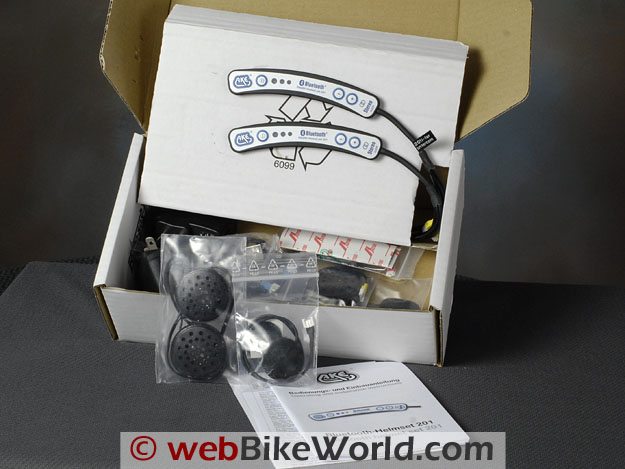
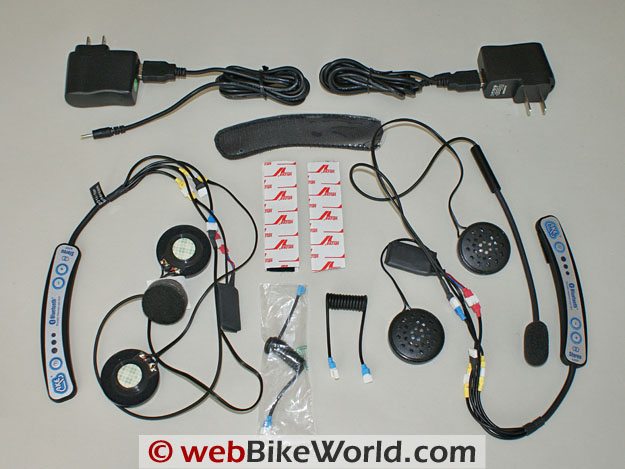
Contents of the AKE Stealth Bluetooth Intercom Set 200The package I received only had one protective bag, so a second one found its way to me via Bundespost from Germany. The AKE representative also coordinated the shipment of additional spiral (flex) extender cables, along with two North American style battery chargers, from Cohesive Technology, their U.S. partner.
Like the original AKE Powercom (review) the updated Bluetooth module is slightly curved (to match the typical curve of a helmet shell) and measure 19 mm wide x 116 mm long and 5 mm thick. The actual weight is 20 grams. The battery is really diminutive, measuring 20 mm x 40 mm x 5 mm and just barely tipping the scales at five grams.
Helmet Installation
The small size and modularity of the system makes installation in — or on — most helmets a relatively simple effort. The unique feature of the AKE Stealth Bluetooth Intercom 200 set is that the units can also be installed inside the helmet for the “Stealth” effect.
Mounting the AKE 200 intercoms in the usual location on the outside of the helmet is accomplished by using the supplied hook-and-loop fasteners. Plastic casings are provided with the kit, which can be used to protect the externally mounted intercom units from the elements. The casings are then secured to the outside of the helmet with the provided fasteners.
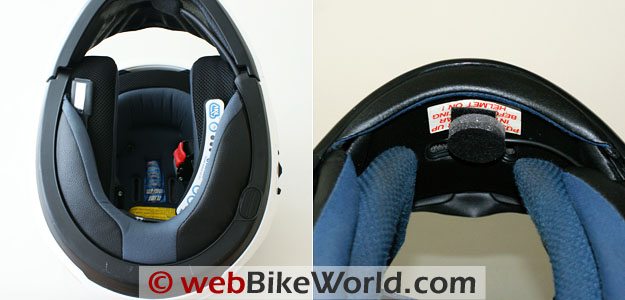
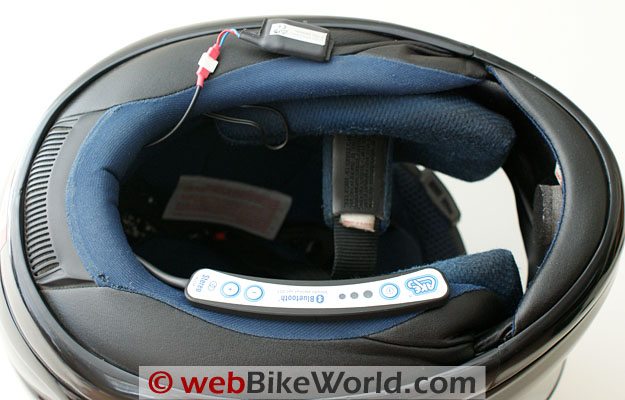
But here’s an unusual twist: the intercom units can also be installed inside the helmet, thus the “Stealth” name. In fact, the AKE 200 Bluetooth modules are really meant to be installed under the neck roll of the helmet if possible.
Space permitting, the system really does then become “stealthy” and in fact, totally invisible, as I discovered with my Arai Corsair (review) and Arai XD3 (review) helmet installations. A weekend show-and-tell at a local dealer event proved the attractiveness of this approach over and over again with much interest from local motorcyclists.
The AKE 200 speakers can also be easily mounted in the designated speaker locations of theNolan N103 (review) helmet, resulting in optimal placement. The thin wire of the microphone can be mounted to the chin section of the rotating visor on the N103 with a mini spiral cable bridging the gap between the open and closed visor. Alternatively, the boom microphone of the AKE 200 intercom sits securely in the boom mic pocket that is molded into the N103 as part of the Nolan N-Com system.
I put the AKE 200 module into one of the protective bags (a tight fit) and used the supplied hook-and-loop tabs to secure the bag to the bottom plastic trim of the helmet. The buttons on the intercom are still easily manipulated through the clear plastic face of the bag. Both the wiring and the AKE 2000 battery can then be tucked inside the helmet shell.
System Overview
A few changes have taken place since I originally reported on the AKE Powercom system; maybe some of our constructive criticisms were taken to heart?
The tactile pressure (membrane) controls on the AKE 200 units have a deeper recess, while the charging port and charger connector are now coaxial, making them sturdier and more positive to use than the original snap-button connector.
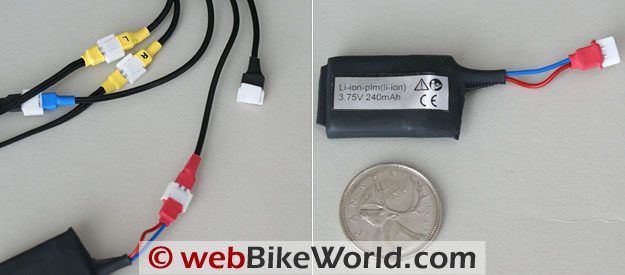
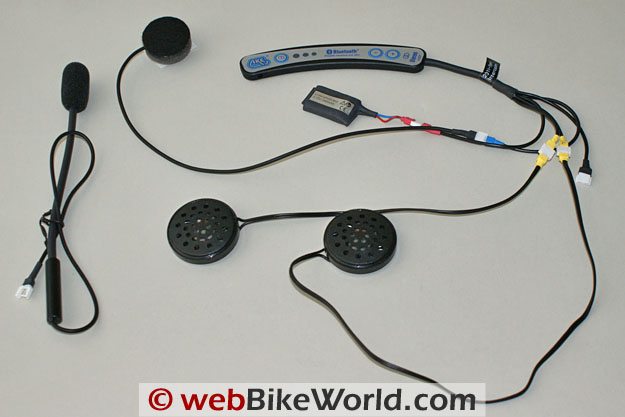
The whole is truly a sum of the modular parts. The main module harness has five mini-connector leads, all clearly marked and colour coded. Yellow for Left and Right speakers; Red for the battery; Blue for the microphone (either thin wire or boom style); and Black for an optional remote control connection.
My positive commentary on this design approach is that it makes replacement or upgrading of components simple and, equally important, allows a system to be properly mounted in virtually any type of helmet. In markets where dual speakers or the use of stereo devices is not allowed or desired, then only one speaker need be connected to the AKE 200 intercom module.
Differences Between the AKE 201 and 201i Intercom Modules
Each Stealth Bluetooth 201 Helmet Set module is multi-functional and meant to be paired with compatible Bluetooth devices such as mobile phones, navigation devices and audio players. They support the Headset, Hands-free and A2DP Bluetooth profiles.
The Stealth Bluetooth 201i module is more singular of purpose. It supports the Headset profile and in theory can be paired with all (AKE) Bluetooth headsets or Bluetooth helmet sets that use the standard headset profile.
Intercom Range
AKE Claims the application of some innovative technology has resulted in significantly increased operating ranges for this system which is only rated as a Bluetooth Class Two power device. So how well does this technology work – quite well actually.
With the nominal range of Class Two devices (between the headset and paired devices) normally in the order of 10 to 15 metres (33 to 49 feet), the Helmet Set 200 actually works up to 100 metres or 328 feet — spectacular performance from such a low-powered system and thus making it viable for use as a rider-to-rider communications system.
AKE Stealth Intercom 200 wiring harness (L). Small battery (R).Pairing the AKE Stealth Bluetooth Intercom 200 Modules
For the most part, all of the newer motorcycle Bluetooth intercom systems are absolutely stone simple to operate and ultra reliable.
As expected, the AKE Bluetooth does not disappoint. Pairing the 201 module with anything is done “right now” and it never seems to forget its pairing partners, unlike certain other major systems evaluated recently.
My basic test suite of Bluetooth-enabled devices or peripherals that I use for all my communications system evaluations and for daily use is as follows:
- Bluetooth Adapters (BTA): AKE BTD-302 Audio Adapter, iCombi AG 12, iCombi AP 21, Camos BH-200M (stereo and mono), Alan BPA 100 (mono), wiREVO D1000 and Rocket Fish MBT30.
- Mobile Phones: Multi-function HTC Touch and Kyocera X-tc devices and the more basic LG500, LG LX165 and Motorola i335 mobile phones..
- Navigation Devices: Garmin zumo 550, zumo 660, zumo 665 and the venerable BMW Navigator III+ .
This collection is a good cross-section of devices, old and new, that helps to put a specific motorcycle intercom or communications system through its paces
For me, communications is key, so the two modules got paired up first. From Off, hold the 201 Multifunction button eight seconds until the Red/Blue LEDs begin to flash alternatively. Now power up the 201i module the same way; its Red/Blue sequence will be a bit faster.
The two AKE modules communicate almost instantly, where they negotiate and form a partnership and, as indicated by a single tone in the 201 headset, the intercom connection becomes live.
Pairing the AKE 200 Intercom System: Cell Phones, MP3 Players, GPS
For navigation devices, put the 201i in pairing mode from Off and initiate pairing mode on the navigation device. The first device up was my new zumo 665. Discovery is seemingly instantaneous and three seconds later the zumo found the “AKE Stealth HS201”.
Tapping “OK” on the zumo’s screen provides the final incentive for the two devices to pair and the consequence being an audio stream pushed to the headset.
The zumo 660 and 665 devices stream mono navigation audio to the headset and stereo audio when the onboard media player is activated. The zumo 550 works just as well, but in mono of course, as does the Navigator III+ although it is limited to navigation audio.
Even my aging and cranky HTC Touch was no match for the 201 headset; the two devices paired up on a quick first pass and from here it was a simple matter to verify that both Wireless Stereo and Hands-free profiles were being supported (they were).
This done, activating the media player resulted in John Denver’s Rocky Mountain High being streamed into the hi-fi headset in perfect stereo, with more than a hint of bass. I had forgotten just how good the standard 40 mm AKE headsets are. The optional High-Sound items would be even better.
For optimum configuration efficiency it is good to spend a few minutes thinking of how the system and peripherals will be used. In my case, pairing a multi-function device like the HTC Touch directly to the headset is both efficient and effective; the two devices will negotiate which profile is available (used) depending on the active function — phone, music, etc.
If a basic mobile phone is used along with a navigation device like the zumo 660 or 665, that device hosts the phone with control provided by the phone application on the navigation device. This allows the multi-function navigation device to be the principle peripheral for navigation, music and phone audio.
So like most good modern Bluetooth headset systems, the 201 headset supports two simultaneous pairings with different protocols and switches between them based on system priority — phone/navigation device, (intercom) and media player.
Bluetooth Adapters for Non-Bluetooth Devices
Bluetooth adapters or BTAs are great little devices that increase connection options. For Apple device users, the Rocket Fish MBT30 and the Chatterbox iCombi AP21 Bluetooth adapter (review)both work fine with the iPod Classic.
For what it’s worth, I removed the thin plastic frame from the top of the AP21 housing: this exposes the multi-pin connector fully making it useable with more iPod devices.
The AKE BTD 302 Bluetooth Music Transmitter, Chatterbox iCombi AG 12 (review) and Camos BH-200M (review) all paired up and pushed stereo audio to the headset without intervention.
Surprisingly, the Alan (Albrecht) BPA 100 (review), which has been reluctant to work with other newer systems, worked fine with the 201 module — albeit in mono only and activated via the Multifunction button.
Finally, the 200 module and the wiREVO D1000 Bluetooth Adapter that I use with the wiREVO S300 Bluetooth stereo headset (review) discover each other and seemingly connect, but no audio stream is initiated.
“Stealth” means hiding the intercom unit inside the helmet (L). Speaker (R).AKE Stealth Bluetooth Intercom 200 – Intercom Functions
Given the low power output, the intercom works extremely well. Just remember that signal optimization (range and quality) is gained by mounting the module under or on the side of the helmet rather than the back.
With power output and antenna efficiency being two critical issues with wireless systems, heeding manufacturer recommendations regarding installation is typically a good thing.
A short press of the 201 Multifunction button initiates a session in two seconds. Audio is crystal clear thanks to the excellent speakers and the booster circuitry. The noise-compensating microphone works extremely well in removing ambient noise during sessions.
Unfortunately, the individual wearing the 201i equipped helmet is limited to intercom audio only. Only the main 201 unit can initiate or terminate an intercom session and the 201i, as the add-on module cannot pair with or support any other Bluetooth devices.
The intercom is best used at separations of less than 100 metres (328 feet) and as with most Bluetooth systems range is highly dependent on surroundings. Riding through built-up areas and residential streets brings effective reliable range down to 60 to 75 metres (196 to 246 feet) maximum. For many users and based on prudent rider-to-rider separation, this is likely more than adequate.
If intercom range is exceeded, the module (201) searches for and then re-connects to the 201i when the devices are within range of each other. This works seamlessly with only the usual very low and unobtrusive white noise typically announcing restoral.
Very small battery can be hidden inside the helmet, while the thin intercom unit hides under the neck roll.The Functional View
True to its “Stealth” design (low profile and minimal interaction), the system is really simple to use: turn it on, wait for a pairing connection and adjust the volume as needed.
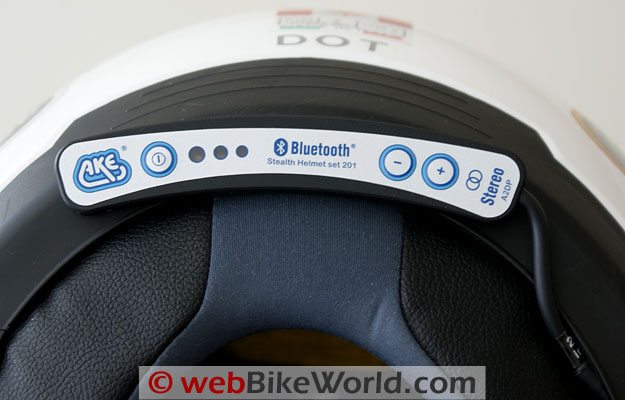
Only the basic controls are provided; ; large Multifunction button sits on the left side of the face with the Volume Down and Volume Up buttons oriented to the right side.
Everything is recessed (counter-sunk), including the three small status LEDs positioned to the right of the Multifunction button. The three user buttons are just slightly higher than the surface for tactile purposes. By the same token, when wearing any type of gloves other than thin rubber, the controls are difficult to manipulate.
This is fine when the module is stashed away under the back/side-guard of the helmet or encased in the protective housing, but it really detracts from (any) required interaction. So unless the controls can be accessed directly, manipulation of the system is best left for those times when the bike is not moving.
This is one reason why AKE offers the optional remote control component, which in fact is a feature that webBikeWorld has previously identified as desirable for functional and safety reasons
Volume control is good and unless I’m riding in an extremely noisy environment, audio remains clear. Neither module has the output that the Sena SMH10 (review), the Scala Rider G4 (review) or the F4 Interphone (review) units are capable of, but this is not totally unexpected given overall design, power output, etc.
With the HTC Touch or Kyocera connected and music streamed, the quality of the stereo headset is very evident. I mounted the headset into my Nolan N-103 (review) for some ad-hoc audio comparison purposes and I got what I expected; that is, superb audio that rivals the Sena SMH10 headset.
As configured from the mobile device, all standard functions are supported by the headset including automatic answering. If manual intervention is needed, a quick push of the Multifunction button will instantly transfer the audio to the helmet, with any ongoing stereo music streaming interrupted.
Another quick push ends the call, although it is still better to let the other party end the call. A longer push (two seconds) of the button rejects incoming calls. The 201 headset never fails to resume the stereo stream either from the HTC Touch, the Kyocera or the zumo devices.
Battery Life and Charging
Efficiency of the system is demonstrated by very good battery life. I get about 3.5 hours of use when streaming music with the odd interruption from the navigation goddess and about 5-6 hours if I’m just using the intercom intermittently and using audio navigation audio.
Recharging the AKE 200 intercom units is simple, using the coaxial to USB cable and/or the AC/DC adapter. Although not documented in any of the Operating and User Instructions, the systems do trickle charge when using only the USB connection. Faster charging is accomplished by using the AC/DC adapter module.
Two complete intercoms: The contents of the AKE Stealth Bluetooth Intercom 200 set. AKE Stealth 200 intercom, battery, speakers, microphone and boom microphone.| AKE Stealth Bluetooth Intercom 200 Bottom Line Ratings | ||
|---|---|---|
| Feature | Rating | Comments |
| Packaging | Not Rated | Small components and cables are individually sealed in small plastic bags. |
| Design | Excellent | Simple design successfully executed to create a small, low profile system requiring minimal user interaction. |
| Execution | Excellent | Ditto. |
| Features and Performance | Excellent | This is very tough and very subjective call. Achieving the range and performance demonstrated by the low-power intercom is remarkable and everything works as advertised, but the excitement is not here.What really limits the potential of this system is the single-function 201i headset. This is a very real and very important limitation when compared to virtually all other systems on the market. |
| Intercom | Excellent | Despite its low power output, the intercom is extremely effective. Overall this approach reduces radiation (a good thing) and increases use time (another good thing) |
| Multi-User Configuration | Very Good | As the base system, the 201 and 201i modules do just what they are supposed to do. The intercom capability is just between the two headsets. Multi-user requirements would need to be addressed via optional/additional components. |
| Audio Input & Control | Excellent | Audio connections made via Bluetooth are seamless and work as advertised. Lacking an auxiliary audio connection, all audio is via supported Bluetooth profiles, limiting multiple-device connectivity to an extent. The AVRCP profile is also missing in action. |
| Audio Sharing | N/A | This feature is not available, but should be. Although achievable when using the optional external Bluetooth audio distribution module, this would be a simple but attractive feature to add to the basic 201 and 201i combination. |
| Audio Priority | Not Rated | Audio priority, highest to lowest is: mobile phone, navigation, intercom and music. |
| Audio Quality | Excellent to Outstanding | No matter which helmets the systems were installed in, audio was crisp, virtually noise free and maintained at useable levels thanks to the booster circuitry. In the Nolan N-103 ear chamber, quality of the standard AKE headset is on par with the Sena SMH10 system. |
| Device Compatibility | Outstanding | While the sleek 201 module does not have all the multi-channel bells and whistles found in newer-to-market systems, its performance in this category is on par with anything evaluated to date. Once paired and even with lapses of two to three weeks, it would always find and pair with a previous connection. I can’t say the same about some of the newer brands of other intercom systems we’ve reviewed. |
| Options | Not Rated | There is no provision for the use of in-ear (i.e., earbud) headsets. AKE does have many options (alternate modules, higher quality headsets and Bluetooth-based components) that may be applicable to meet consumer requirements. |
| Fit | Very Good to Excellent | Between its small size and modularity, the system is very easy to install either internally or externally and shaping the module into a slight curve is a great design feature. But when installed internally in the Arai helmets, back or side, the module is obtrusive, requiring a slow and uncomfortable removal of the helmet. I know that many other helmets will be more accommodating. |
| Setup and Configuration | Outstanding | Single multifunction control and the LEDs make getting up, running and off to the races simple and fast. The operating and installation instructions (note the ordering in the title) are easy to understand. Some difficult phrasing is evident in both the German and English sections. |
| Ease of Use | Very Good to Excellent | Simple controls = easy to use. Its “Stealth” features are both facilitative and detractive. If mounted externally, the module is readily accessed but the recessed controls can be hard to feel. When tucked away, the modules needs to be pulled out slightly and activated, then tucked away again. With practice it can be done while wearing the helmet, before moving off, of course! |
| Power | Excellent | The battery is lightweight in size and capacity. System efficiencies are obviously very good based on a typical duty cycle for the supplied and replaceable 250mAh battery. My averages identified earlier are a bit less than claimed, but still acceptable. I wouldn’t mind a longer duty cycle, without having to spring for the optional 1000mAh battery (although it would make a great back-up). |
| Reliability | Excellent | When fully charged, the headsets perform as advertised. Other than one intercom unit that had a short microphone flex cable with a weak mini-connector (evident when checking everything initially), nothing has broken during use, including after moving them between multiple helmets. |
| Maintenance and Support | Excellent | Replacement of a defective cable was done within a week and support from the AKE representative and Cohesive Technology has been timely and very helpful. For North American consumers, having an active U.S. partner is good. |
| Cost | Poor | Unless more aggressive pricing is available, at a converted price of $466 USD, the AKE Helmet Set 200 is not inexpensive, particularly when compared to newer generation twin-set Bluetooth intercom bundles that can be had for around $380.00 USD or less. |
| Value | Neutral | The premium for AKE products can often be justified, especially for their upper-tier systems, but in this instance, it’s a hard sell. Even though the intercom components have a unique “Stealth” size and the system provides discrete fitment options not available for most Bluetooth helmet products, only the 201 module has any versatility and the secondary 201i module is nothing more than one half of an intercom. On the flip side however, if size and a discrete installation are important, then value can be realized. |
AKE Stealth Bluetooth Intercom 200: Specifications, Ratings and Conformity
Technical Information
- Module: Release 1.3.
- Bluetooth: Version 2.0 +EDR.
- Profiles: The 201 Headset has the Hands-Free and A2DP profiles. The 201i has the Headset and Hands-Free profiles..
- Range: 250 meters under open field conditions (claimed)..
- Battery: Lithium-Ion/Polymer 3.75V, Capacity is 240 mAh. Charging time is a claimed two hours. Continuous Duty Music Transmission is claimed up to six hours. Navigation voice announcement claimed eight hours. Standby claimed up to 72 hours. Note: Operating times are dependent upon the system operating mode..
- Power: Charger is 5V DC, 300mA.
- Helmet Microphone: Noise compensated “Electret” close-talking capsule..
- Helmet Loudspeaker: Two 32 Ohm. Output power is 0.2W (for each speaker). Frequency range is 100 Hz to 10 Khz (standard).
- Booster: Maximum output power is 8 Ohm. Frequency range is 20 Hz to 20 Khz. Signal-to-Noise is 105 dB .
- Warranty: Two years .
Conformity and Standards
- FCC Compliance Statement: Not identified..
- RF: Not identified. .
- CE Declaration of Conformity: CE marked and declared compliant..
- The equipment complies with the new European ROHS guidelines..
Conclusion
I still have a soft spot for AKE products and I still feel that their upper-tier offerings are among the best on the market. But the basic Helmet Set 200 system doesn’t do everything I hoped.
It is unique in many positive ways and based on stated features, performance is not lacking overall, especially from the intercom. While supporting A2DP and thus stereo audio streaming, it is a simple system but the other half of the system is nothing more than an intercom module.
Bringing this already expensive Helmet Set 200 up to the same level or beyond that of many other lower-priced systems is totally viable, but the owner would have to purchase some expensive optional components.
The chance to evaluate this type of product is always appreciated, especially those that don’t have a significant North American presence, but being able to configure, assess and evaluate just how good a system can really be is only possible if we have access to the entire range of standard and optional components.
In this instance, the optional pieces from AKE were unfortunately not provided, but they may have the potential to add some great capabilities and therefore even more value to the overall system. My thought is that the opportunity to evaluate the full range of AKE products would be a good thing for everyone.
Related Reviews: AKE BT Multi-Interphone | AKE Powercom | AKE PowerCom INNOVA | AKE Roger One
More: wBW Motorcycle Intercom Reviews | wBW Reviews Home
2010 Motorcycle Bluetooth Intercom Comparison and Final Report
Owner Comments and Feedback
See details on submitting comments.