

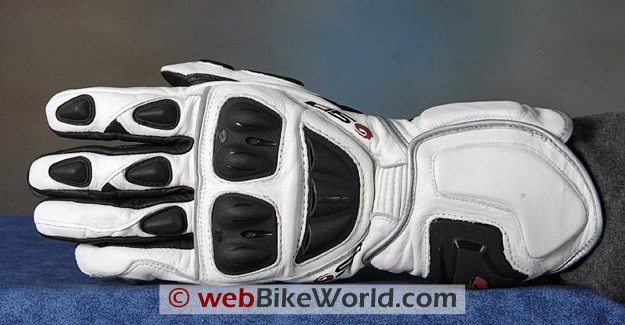
Race gloves made from goat skin with functional air scoops and all the bells and whistles. The split main knuckle protector is interesting and adds some comfort to the gloves. But the price is a bit steep and the gloves aren’t that different from other similar imports. Note: As of 2013, Sidi is no longer selling gloves or other clothing and concentrating on boots, which is probably a good idea…
The Sidi Power Glove is now available as part of the new Sidi Design Series. The Design Series is a new line of motorcycle clothing being offered by Sidi in 2009. The Sidi Power Glove currently sits at the top of the product line. It’s a motorcycle racing inspired glove and it includes all of the expected features, making it competitive with other high-end motorcycle race gloves of this type. And yes, they’re officially called the Sidi Power Glove.
That is fine, except that it makes for a difficult writing assignment, because I suppose I should technically refer to them as the Sidi Power Glove gloves, which seems redundant and probably a bit silly!
Goats Again…
The Power Glove (Power Gloves?), like the Sidi Coibuss gloves reviewed previously, are made from goat leather.
Goat leather is claimed to be lighter, thinner and more abrasion resistant than cow leather, and it also seems softer that cow hide and quicker to break in.
After about one or two rides, the Sidi Power Glove gloves (Power Glove gloves?) feel soft and comfy. The goat leather feels a bit like suede and almost like it has a touch of built-in elasticity.
The goat leather does feel thinner than comparable cow leather, and this does give the Power Glove a different feel. Sidi uses the word “supple” to describe the Power Glove and I think that’s probably an apt description.
Like the Sidi Coibuss summer gloves, the Power Glove feels just at the minimum size for its range.
These are size large, and they fit slightly snug, which in this case is fine because of the properties of the goat leather.
But if you’re on the borderline between large and extra-large, you may want to move one size up, because the fingers are very slightly narrow and also slightly short.
What’s interesting is that the Power Glove(s) feel like they might be too tight and short when I wear them without a jacket.
But when worn over a sleeve cuff and when I’m in the riding tuck holding the handlebars, the gloves seem to loosen up just a touch in the fingers, making for a perfect fit.
The goat hide on the palms does feel slightly thinner, and this gives me a noticeably good feel for the controls.
Probably still not the equal of good quality kangaroo leather, but better than most of the cow hide leather gloves I’ve worn.
Base Knuckle Protection
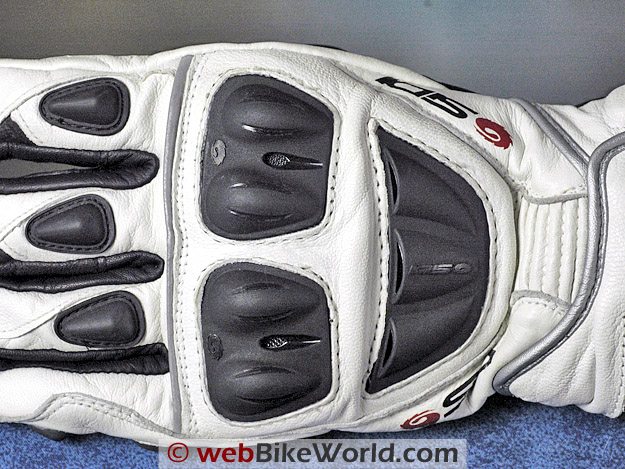
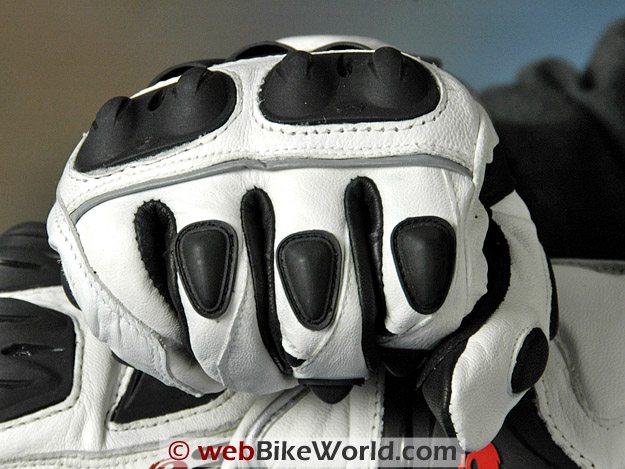
The other most noticeable feature of the Power Glove are the thermoplastic split base knuckle protectors, also found on the Sidi Coibuss gloves (the base knuckle is the main knuckle that connects the finger to the hand).
It’s a simple but elegant design solution to what can sometimes be a problem area.
Some one-piece knuckle protectors feel tight across the top of the hand, or the molding on the underside of the protector has to be just right to fit correctly.
Also, the padding has to be correct to keep the gloves feeling comfortable.
To help overcome these issues, some manufacturers sew the knuckle protector on a separate section of “floating” leather over the back of the glove, which allows the hand to flex underneath without binding.
The split base knuckle protector design used on the Sidi Coibuss and the Power Glove is not mounted on a separate floating section, and it isn’t missed.
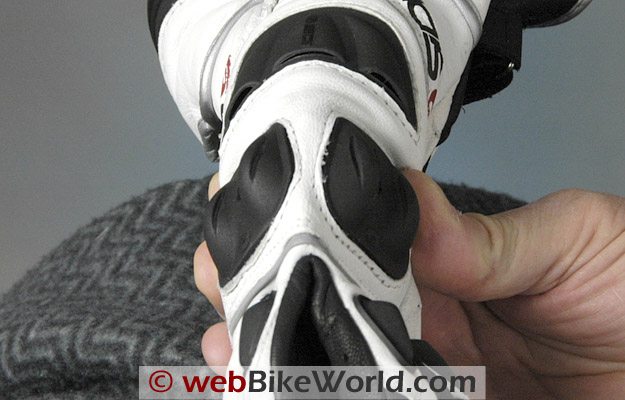
The separate protectors are hardly noticeable and the gloves have nearly unlimited flex across the top; here’s a photo:

Split base knuckle protectors provide a large range of flexibility across the top of the glove.Now the split base knuckle protector isn’t unique to the Sidi Power Glove; other gloves feature this design to varying degrees.
For example, the British Motorcycle Gear “Rapido” gloves use a split design mounted on a separate section of leather over the back of the hand, with three knuckles covered by one protector and the fourth knuckle by a separate, smaller protector.
This adds some flexibility to those gloves, but not quite as much as the Sidi Power Glove
Carpal Protector
The Sidi design also adds a second protector in back of the knuckles to protect the back of the hand, which I guess are the proximal and distal carpal bones?
This protector also serves as an air scoop; it has three separate openings along the top, which, either by coincidence or by design, end up just at the right spot when the hand is bent around the hand grips.
I can blow in to the vents on the knuckle protectors and this second hand protector and feel the hot air inside the glove, although the glove lining does prevent direct air flow from hitting my hand.
But I can definitely feel a surprising amount of air flow even in 80 degree F or so (27 C) weather we’ve been experiencing.
In fact, I’d have to say that for this type of glove, the Sidi Power Glove provides probably the best air flow this side of a fully perforated leather glove, and surely it provides the most air flow of any race-style motorcycle glove I can recall.
Just to be clear, I’m not saying that the Power Glove is the equal of the Coibuss or other textile/mesh or perforated gloves specifically designed for warm weather riding.
I am saying though that for a leather motorcycle race glove, the Power Glove has good ventilation and I think it feels surprisingly cool in a temperature range that I normally would not consider appropriate for this type of glove.
Sidi Power Glove, protectors on fingers, knuckles and back of hand. Note air intakes on hand protectors. Sidi Power Glove phalange protectors.Phalange Protectors
I’m really getting in over my head with regard to these anatomical descriptions, so feel free to correct me if I’m wrong.
Sidi says that the smaller protectors that cover what I guess are the middle and distal phalanges (i.e., the bones between the base knuckle and middle knuckle and the bone between the middle and tip knuckles) are also made from thermoplastic.
But they feel different than the material used in the base knuckle and carpal protectors.
The material protecting the fingers feels a bit more “rubbery”; perhaps its just a different type of thermoplastic.
These protectors are single-stitched on to the glove fingers, but the stitching is semi-concealed in a channel that runs around the perimeter of each protector.
So there’s probably no way the stitching would be touched in a crash, unless the entire protector was ground down to nothing.
By the way, I’m not sure if thermoplastic is any better or worse as a protector than carbon fiber or other materials (I have a sneaking suspicion that carbon fiber is more for show than go).
I can tell you that I feel more protected wearing the Icon TiMax gloves (review) or the Velocity Gear SS Metalwear gloves (review) with their big, honkin’ Mad Max style metal protectors and sliders than I do with any other type of motorcycle glove armor.
But who knows?
I don’t see Valentino Rossi wearing metal knuckle protectors, although he probably gets a new pair of gloves for every race.
The fourth finger (aka baby or pinky finger) is covered on the outside by an extra section of double-stitched leather with three separate plastic protectors attached.
The thumbs of the Sidi Power Glove have two separate sections of padded leather and no hard armor.
 Sidi Power Glove, top view.
Glove Construction
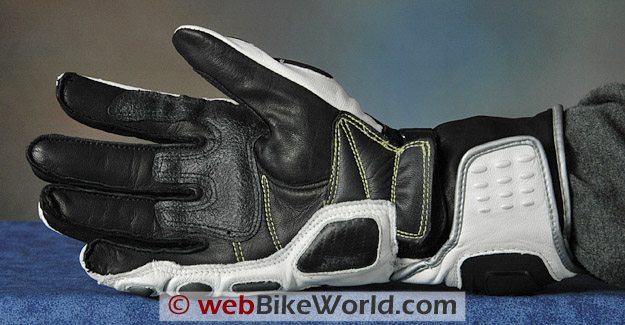
The palms have extra sections of what I assume is goat leather and a section of rubberized material for grip.
These are all double-stitched — in fact, the gloves use extensive double-stitching in most areas except for where some of the protectors are attached.
Sidi says the stitching in the palms is Kevlar. The heel of the hand has a carbon-fiber-look material backed by padding for protection.
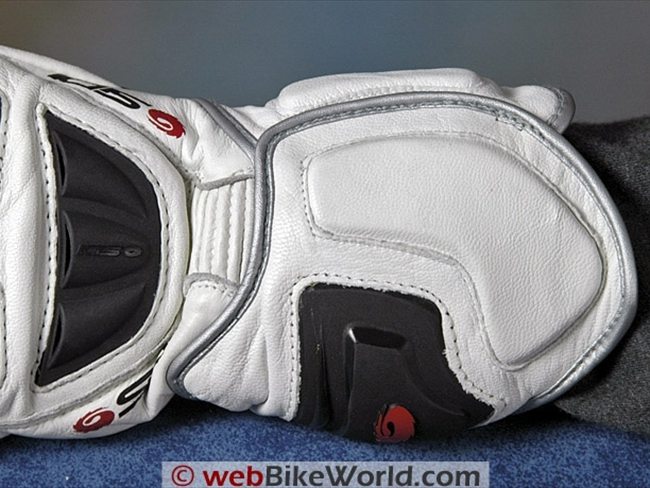
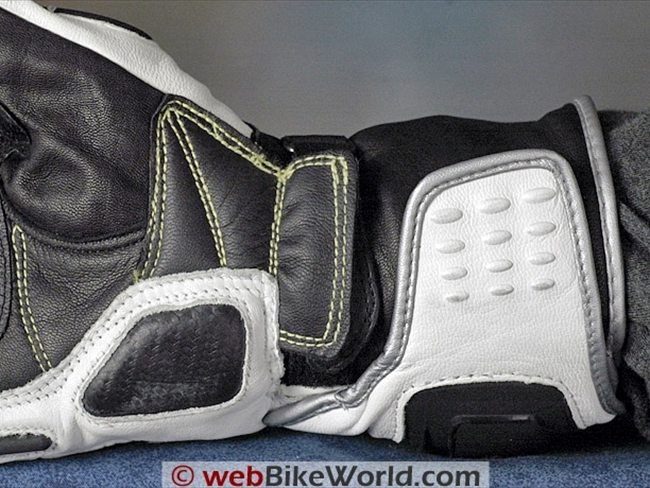
The gauntlet of the Sidi Power Glove is relatively generous. A separate section is sewn on the top, and it comes half-way around the outside wrist portion of the glove to secure on the bottom.
This outer portion of the gauntlet includes padding on top, a large piece of thermoplastic on the outside and a set of 12 dimples on the bottom of the gauntlet (the piece that serves as the attachment) with what feels like hard plastic underneath.
The plastic, if that’s what it is, is molded under the leather.
The wrist of each glove is narrow, so it takes some push to get my hands inside, as it should for a race glove.
The gloves also feature a hook-and-loop wrist attachment and there’s a rather short leather flap to cover that covers the center portion of the strap.
The fingers use the external seam construction, which is often found on race gloves. There are pros and cons to both the hidden, or “blind” stitching and external stitching when used on glove fingers.
External stitching does usually allow for more finger comfort, because the seams and stitches are not touching the sensitive fingers and fingertips.
I think the external seams and stitching also allows keeps the glove fingers slimmer, which keeps the leather closer to the skin. Again, there are pros and cons, because if this isn’t done correctly, the fingers can become too tight.
The size large gloves shown here are, like the Coibuss gloves we reviewed, at the minimum size for what I’d consider a large.
My hands fit and everything feels fine, although the very tips of my fingers run up against the inside of the gloves and I can feel the leather against my fingernails.
This is due to the tapered fingertips on the Power Glove. It would probably have been better had the gloves used a “box” construction right out to the end of the fingers, without the taper, because this would probably provide more room for my fingers — which, by the way, are probably on the thin side to begin with.
I’d say that if you are on the borderline between a large and extra-large, you may want to move up rather than down and go for the XL. But like all motorcycle gear, it’s best to try before you buy.
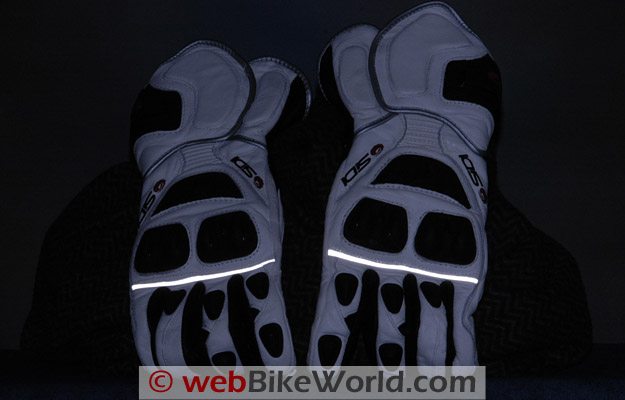
Reflective strips across the top of the gloves.Conclusion
The Sidi Power Glove motorcycle gloves check off most of the boxes to play with the Big Boys.
Both the Coibuss and Power Glove are a bit conservative in terms of design; i.e., there isn’t a lot of high tech or innovation here, but this is probably a safe and deliberate bet for Sidi, considering the Design Series is a brand-new venture.
I think the list prices may be a bit ambitious though; if I was in charge, I probably would have set the price a bit lower for the introduction to try and develop a customer base in what is a very crowded motorcycle glove market.
The Power Glove lists for $185.00, which is at or near the top end for this type of motorcycle glove, but the Sidi name probably counts for a lot with the intended customer.
Overall though, these are very nice gloves and the combination of goat leather and the split knuckle protector do make a difference, and the Sidi Power Glove may just become my new favorite.
Owner Comments and Feedback
See details on submitting comments.