

Shorai vs. Ballistic Motorcycle Battery Comparison Review
Lithium Iron Phosphate (LFP) type motorcycle batteries have started appearing recently and everyone wants to know more.
An LFP battery definitely weighs less than a lead-acid type but the potential benefits — and possible disadvantages — are yet to be determined.
Our prediction is that it may take some time yet for this new technology to surpass the 150-year old proven track record of lead-acid batteries.
One thing is certain though — Li-Ion and LFP technology (or its successor) will evolve and improve and, perhaps, replace lead-acid batteries as the electrical power source of choice.
In the meantime, a couple of players are rapidly making inroads into the motorcycle market: Ballistic and Shorai.
We compared their products with an old-fashioned lead-acid battery and our conclusion is that there is no clear winner at this point in time.
Each has an advantage and each has a disadvantage and both represent a major cost increase over the classic lead-acid type.
This story remains to be completed, no doubt. In the meantime, here’s our report.
A sharp-eyed webBikeWorld reader informed us that these are Lithium Iron Phosphate batteries and not Lithium-Ion batteries.
Each manufacturer has different claims (and different names!) for how they are implementing this new technology.
The article has been updated to reflect this new information, but calling these “Li-Ion” batteries may still be correct.
As webBikeWorld reader “Y.R.” (comments below) also wrote “LiFePO4 is a subtype of li-ion battery, so it’s not actually incorrect. Li-ion is more like a class, not a specific (battery) type.”
The lesson here is that there’s still a lot to learn about this new battery technology!
 Ballistic Li-Ion battery on the left; Shorai on the right.
Introduction
Lithium-Iron-type (LFP) motorcycle batteries have become all the rage in 2011 and motorcyclists are wondering if the old lead-acid bricks are now as out of date as incandescent light bulbs.
It’s a bit puzzling actually when you think about it, because there doesn’t seem to be all that much wrong with good ol’ lead and acid…other than the fact that they’re made from lead. And acid.
Both of us must be pretty lucky, because with 5 motorcycles total currently in two garages, and 6 more counting Burn’s collection, we have experienced no lead-acid battery problems in as many years as any of us can recall.
Of course, this may be due in part to our mania about battery maintenance, including keeping a close watch over water levels and running Battery Tenders around the clock, 24/7/365.
That will make a difference and as an example, I give you the lead-acid battery in the 1984 BMW R65 (info). A new battery was installed in 2002 and the vintage BMW is only lightly used in good weather.
It’s the only motorcycle to get winterized, and it sits in the cold garage on a Battery Tender from Fall until Spring.
But the Westco battery has never failed. The bike always starts right up and I never had a single problem with the bike or the battery (knock wood!).
I did replace it with an identical Westco in 2002; a lead-acid battery of exactly the same type, and I did that only because it seemed like 8 years was a long time to go on a battery.
But there were absolutely no battery problems to report with the Westco and probably no real reason to replace it other than my feeling that “Could this battery really be 8 years old and still cranking?”
And this with a bike that runs an electrical deficit; in typical Airhead fashion, it drains the battery until the revs reach 2,000 or so. I guess I must be riding it pretty fast (or as fast as an R65 can go!).
Regarding the possible lead and the acid environmental issues — are they really issues? Old lead-acid batteries are recycled. What happens to Lithium-Ion batteries? Does anyone know? Are local recycling centers ready for an influx of Li-Ion batteries?
So when you get right down to it, what are the benefits of going to an LFP battery?
Probably the most significant and certainly the most tangible benefit is the weight savings.
But really — is a few pounds going to make that much of a difference in a street bike? Let’s take a look and see if there’s anything else that justifies the 300% to 400% cost increase of a Li-Ion motorcycle battery.
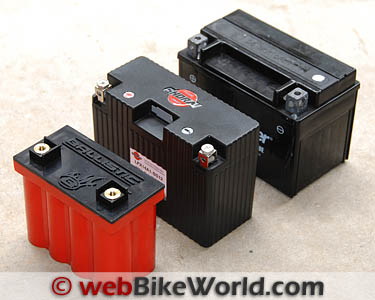
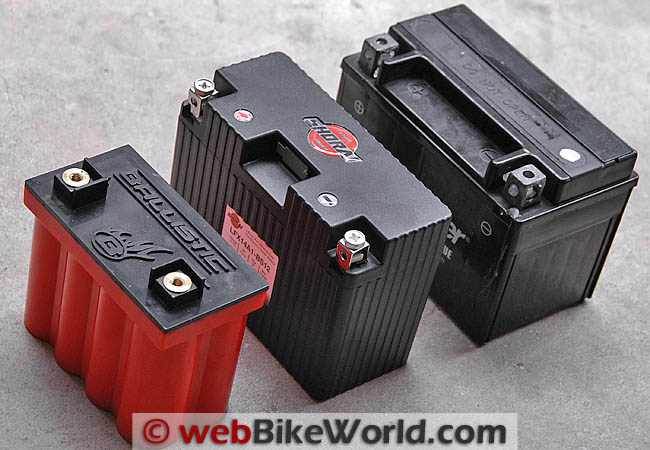 Size Comparison: Ballistic (L); Shorai (Center); BikeMaster OE Battery (R).
Li-Ion and Li-Iron (LFP) Motorcycle Batteries – Advantages?
Neither of us are electrical engineers, but Chris has over 40 years of experience as a highly trained automotive technician, specializing in Mercedes-Benz.
He has also ridden hundreds of thousands of miles on motorcycles all over the U.S. he services his motorcycles and he has as many tools and electronic diagnostic gear as most dealerships, including a professional table lift.
Me? Well, I’ve been around motorcycles since Bultaco was still making the Metralla and cars since Oldsmobile was making tri-power intakes with Rochesters, but in reality, I’m simply a garage kibitzer.
Unfortunately, neither of us can give you the full skinny on the differences between Lithium-Ion and Lithium Iron Phosphate and why these batteries are better or worse than the lead-acid types.
This is very new technology for motorcycles and Shorai, for one, doesn’t even make batteries (yet) for cars. We can, however, paraphrase some of the info from the Shorai website and others.
A Li-Ion or LFP type battery doesn’t use lead or acid, although the environmental equivalent impact of using lithium, ions and whatever else goes into these new types of batteries is a mystery to us.
Is one environmentally better than the other? Who knows…
[UPDATE: A tip from a webBikeWorld visitor informed us that the Shorai battery actually isn’t Lithium-Ion; Shorai calls it “Lithium-Iron” and their description says that the battery uses “Shorai-proprietary eXtreme-Rate Lithium Iron prismatic cells (chemistry LiFePO4).”So the Shorai is actually an LFP battery, which is the acronym for Lithium Iron Phosphate (LiFePO4). Here’s the Wikipedia entry for LFP batteries. LFP has advantages and disadvantages, just like Li-Ion.]
The weight savings is there, obviously. We’re talking major weight differences, with the stock BikeMaster battery weighing in at over 3 kilograms (3.068, to be exact), which is 6 lbs., 12-1/4 oz. in old money.
That’s over 2 kilos (2,245 grams actually, or 4.95 pounds) heavier than the Shorai battery.
The Li-Ion and LFP batteries are also much smaller than the lead-acid type, and size is somewhat critical on a motorcycle, at least during the design stage, due to space limitations.
We’re not aware of any motorcycle manufacturer currently installing Li-Ion batteries as standard equipment, but surely they are undergoing testing and we’ll see one soon.
The Li-Ion and LFP battery manufacturers make other claims; for example, that their batteries have a very long shelf life and will remain charged for a longer period than a lead-acid battery (as long as there are no parasitic drains from the motorcycle for alarms, clocks, etc.).
They also say that the Li-Ion batteries do not sulfate or degrade when not being used.
Other, less obvious claims include lower internal resistance; more available power more quickly during startup; more usable battery capacity and probably more claims. We’re counting on webBikeWorld readers who are more knowledgeable about this technology to let us know.
Regarding battery maintenance, apparently Li-Ion and LFP batteries only need charging if they drop below each manufacturer’s specified Voltage.
“Smart” battery chargers that do not have a desulfate mode, or which allow the owner to turn off the desulfate mode, are recommended by Shorai.
The Battery Tender does not have a desulfate mode, according to Battery Tender and Shorai, and they are claimed to be acceptable for these batteries.
We picked Ballistic and Shorai because these two brands seem to be aggressively marketing to motorcycle owners.
There are other Li-Ion motorcycle batteries available and over time, surely there will be many more options (and hopefully lower prices).
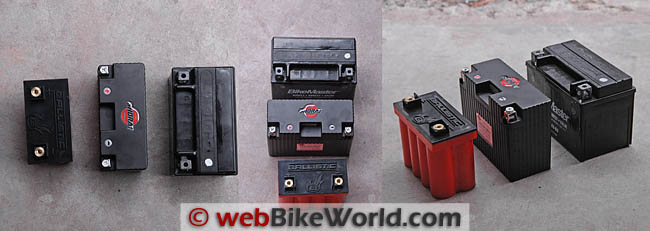 Ballistic and Shorai LFP battery sizes vs. OE BikeMaster lead-acid battery.
Shorai vs. Ballistic Battery Comparison – Background
The bike we used for this comparison is a 2009 Suzuki DR650SE. It was chosen mostly because it takes a lot of juice to turn over that big 650 cc “Thumper” single-cylinder, especially in 40-degree F weather.
Not to “spill the beans”, but there will be lots more about this motorcycle coming soon…
The stock battery in the DR650SE is/was a BikeMaster BTX9-BS sealed type that can be had for as little as $34.00.
We bought the bike used, with only 400 miles showing on the odometer, so I’m assuming that the BikeMaster is the standard OE battery supplied by Suzuki for this bike.
There is one word to describe the battery: wimpy. Sorry — make that two words: Very Wimpy.
In fact, after starting the bike a couple of times at the dealer and running for a total of maybe 30 seconds or so, then sitting in the garage for a couple of weeks, the battery was as flat as the sounds that screech out of Squidward’s clarinet.
The only caveat here is that I don’t know how long the bike was sitting on the dealer’s floor, nor do I know the previous history of the battery.
The BikeMaster charged up fast enough on the Battery Tender, but after three 5-second start tests, detailed in the matrix below, it was noticeably weak and on the 4th try, it did not have enough muscle to turn over the bike, and this was in a 54 degree F garage.
The Li-Ion batteries do a lot better than that…but, compared to what?
We didn’t try a different brand/type of lead-acid battery to compare, and perhaps a good Westco or Odyssey or something would have more guts than the BikeMaster.
In any case, first let’s take a look at the Shorai and Ballistic Li-Ion battery specs:
Ballistic “Evo 2” LFP Battery
- Dimensions: 113 mm x 60 mm x 100 mm.
- Specifications: Weight (Actual, measured on the webBikeWorld scale): 748 grams (1 lb., 10-3/8 oz.). Claimed weight: 730 grams.
- Claims: Voltage (Charged) 13.6V. Amperage 4.6Ah. Cold Cranking Amps 240A pulse. Operating Environment -30°C (-22°F) to 60°C (140°F). List Price: $159.99. Warranty: 3 years.
Shorai LFX14A1-BS12 LFP Battery
- Dimensions: 66 mm x 148 mm x 145 mm.
- Specifications: Weight (Actual): 823 grams (1 lb., 13 oz.). Claimed weight: 700 grams.
- Claims: Voltage: 12. A/Hr PbEq: 12. Cranking Amps: 155. Max Charge (Amps): 10. List Price: $153.95
BikeMaster BTX9-BS (Lead-Acid)
- Dimensions: 148 mm x 83 mm x 108 mm.
- Specifications: Lead-acid type. Weight: 3,068 grams (6 lbs., 12-1/4 oz.). List Price: $48.95.
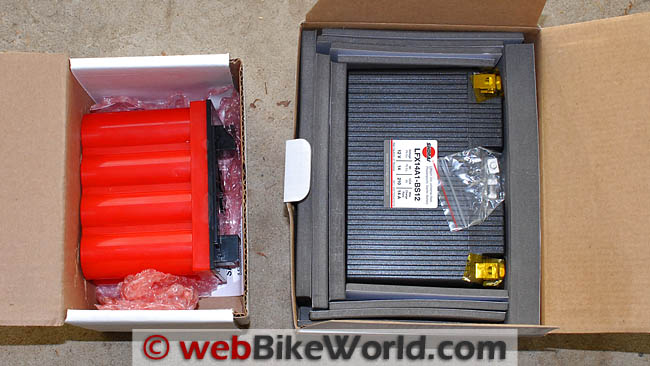
Ballistic battery on the left; Shorai on the right. Both in the boxes as received. Shorai LFP vs. Ballistic Li-Ion Battery Comparison – Evaluation
We obviously don’t have an electrical laboratory or testing facility at our disposal, nor would we know what to do with it if we had one.
But thinking it over, we developed at least a type of “real world” objective test for these batteries.
We measured the standing Voltage with two different very high quality professional multimeters from Chris’ Mercedes toolbox.
Chris disconnected the electrics from the spark coil on the Suzuki so we could turn over the bike without fear of harming the starting system. The temperature in the garage was 54 F and the engine temperature was 51.6 F.
We then turned the key and pressed the starter switch for 5-second intervals, with 30 seconds between attempts. Here are the results; the readings are in Volts. The numbers 1, 2 and 3 represent the start attempts:
| webBikeWorld Score Sheet: LFP Battery Comparison | ||||
|---|---|---|---|---|
| Ambient Temperature: 54 F. Engine Temperature: 51.6 F. The numbers 1, 2 and 3 represent the start attempts. |
||||
| Static Volts | Ignition On V. | Cranking Volts | Min Volts* | |
| OE Battery 1 | 12.9 | 12.1 | 10.1 | 7.8 |
| OE Battery 2 | 12.7 | 12.1 | 9.2 | 7.6 |
| OE Battery 3 | 12.5 | 12.0 | 7.5 | 5.0** |
| Shorai 1 | 13.5 | 13.1 | 11.1 | 10.0 |
| Shorai 2 | 13.3 | 13.10 | 11.2 | 10.0 |
| Shorai 3 | 13.3 | 13.0 | 11.3 | 9.8 |
| Ballistic 1 | 13.4 | 13.1 | 10.0 | 10.0 |
| Ballistic 2 | 13.1 | 12.9 | 10.4 | 10.1 |
| Ballistic 3 | 13.2 | 13.0 | 10.1 | 10.0 |
| NOTES: * Minimum Volts indicated during cranking. ** Battery dead, won’t start. | ||||
You can see from the chart that the subjective experience with the OE BikeMaster battery was verified. The BikeMaster battery, which had been on a Battery Tender, started out at 12.86 Volts and then completely died after the third starting attempt.
In comparison, both the Ballistic and Shorai batteries started at a higher Voltage (this was their charge as delivered) and maintained a much higher capacity, barely changing after the 3 start attempts.
The Shorai did sound like it had a bit more “ooomph” to turn over the big 650 cc Thumper, especially on the second and third attempt.
This, and the Shorai package, which made it easier to install in the Suzuki’s battery compartment, was why we ended up installing the Shorai for a longer-term evaluation in the bike.
UPDATE: Long-Term Voltage Drop Test
May 14, 2011 – It’s now approximately 8 weeks since this review was posted and I ran a battery voltage check. The DR650 has been used many times since the Shorai battery was installed, but the bike was not put on the Battery Tender charger.
The Ballistic battery sat it its box in the garage, unused. And the original equipment lead-acid battery in the Multistrada 620 has been on a Battery Tender since then.
Just for kicks, I checked the voltage on each.
The Shorai registered 13.32 Volts; the Ballistic was 13.21 and the Multistrada battery (in the bike) was 13.18 Volts.
The Bikemaster OE lead-acid battery, which has been sitting on a shelf since the Shorai was installed, registered a wimpy 12.37 Volts, which probably wouldn’t be enough to turn the DR650’s engine over.
So not much of a difference at all between the lead-acid battery that has been on a Battery Tender the entire time and the Li-Iron batteries, even though one LFP battery is in regular use and the other hasn’t been used at all.
I’m not sure what this all means, but it adds to my confidence at least that the Shorai LFP battery is holding its charge and the DR650’s charging mechanism is working correctly to keep the battery in good shape.
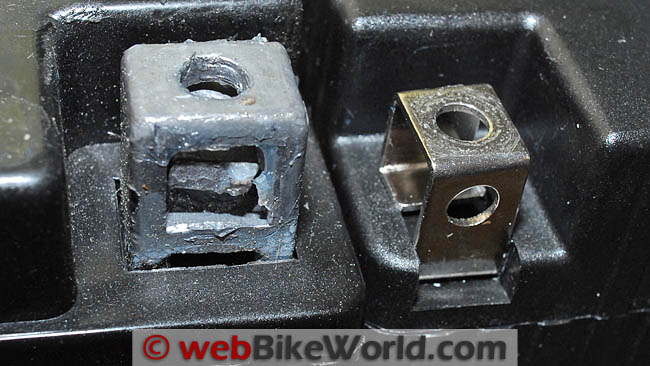 Stock battery terminal vs. Shorai battery terminal. The Shorai terminal is relatively flimsy formed sheet metal. UPDATE (January 2012): Shorai has apparently revised the terminals; see the comment from “K.Y.” below.
Installation Differences
The Shorai battery is slightly larger and heavier than the Ballistic battery and it comes with several foam pads to make up the difference in the standard motorcycle battery compartment.
These are very useful and are missed in the Ballistic package.
The Ballistic battery is smaller even than the Shorai and it uses circular cells. Shorai goes into some detail explaining why they use square cells instead; you can read more about that on the FAQ on their website.
But the bottom line is that the Ballistic battery needs more fudging to get it to fit in the battery compartment, while the Shorai kit includes a large variety of foam pads that can be used to fill in the gaps.
However, the single biggest problem with the Shorai battery is the terminals. They are very weak and, frankly, nearly unacceptable on a motorcycle battery. They have a very flimsy feel and they can be easily moved back and forth using the fingertips.
[UPDATE (January 2012): Shorai has apparently revised the terminals; see the comment from “K.Y.” below.]The problem arises when attaching the battery cables and/or other battery-operated gear.
Tightening the bolts puts a strain on the terminals on the Shorai battery and they move back and forth and feel like they’re going to break off, or perhaps break loose from the cells and wiring inside the battery.
Shorai really needs to resolve this problem if they’re going to reach acceptance with motorcycle owners, in my opinion.
Caution must be used when attaching the battery cables to the terminals on the Shorai battery.
After that is completed, it’s important to make sure the battery cables are secured and that they won’t move, twist or turn when the bike is being ridden, because it seems very possible that any movement of the cables could eventually weaken and snap the terminals.
The terminals on the Ballistic are flush with the top of the battery, a different style but posing no problems other than the different type of mounting arrangement for the battery cables.
Compare the very heavy terminal on the OE battery with the thin terminal of the Shorai battery in this photo below; you can see that the Shorai terminal is a thin piece of sheet metal bent to form a square.
You can also see the gap at the bottom where it enters the battery, which doesn’t support the terminal:
Fitting these small LFP batteries in the Suzuki battery compartment was straightforward with no problems to report.
Some modifications may be necessary to make up for the smaller size of the LFP battery and this is where the foam pads provided by Shorai come in handy.
In the end, we settled on the Shorai and installed it in the Suzuki. The bike seems to start up quicker and the engine initially turns over faster with a stronger sound.
We will report back on any issues, but so far, operating the bike is just like it always was, with no real differences to report at this point.
While we were at it, we installed a fused Battery Tender cable with the standard SAE Battery Tender type end, just in case.
Here are photos comparing the OE battery with the Shorai and Ballistic batteries in the DR650SE battery compartment:
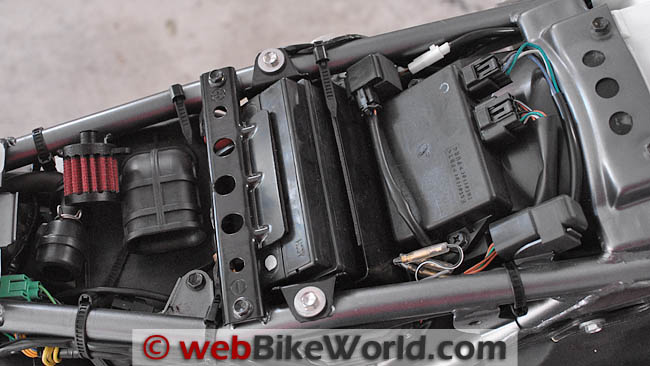 Original Equipment BikeMaster lead-acid battery as installed in the 2009 Suzuki DR650SE.
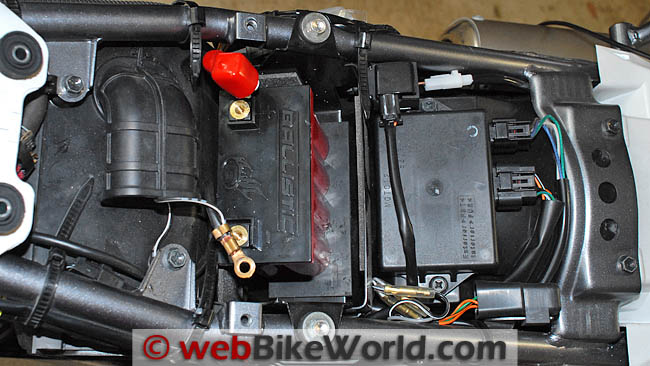 Ballistic battery leaves plenty of room in the battery compartment.
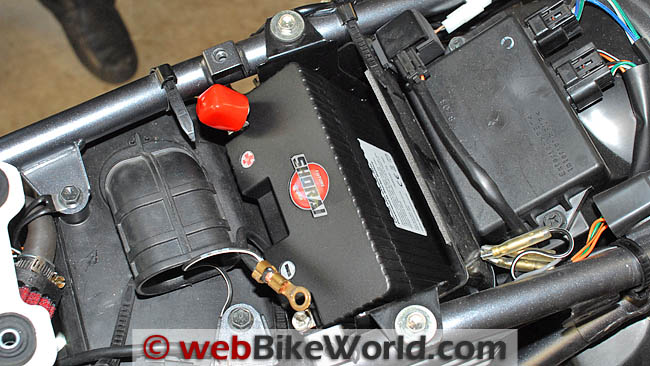 Shorai battery installed in the Suzuki.
Conclusion
It’s difficult to determine a winner in this comparison. Yes, the LFP batteries are lighter, and they do seem to provide more starting power for the bike, at least more than the OE BikeMaster battery.
Are the LFP batteries worth nearly 4 times as much as the BikeMaster lead-acid battery? Probably not.
The more energetic starting performance as illustrated in the chart above is an advantage, but the unknown here is how the LFP types would compare to a lead-acid battery with more “Cold-Cranking Amps” than the BikeMaster.
Given the problems reported above for the OE battery, the fact remains that when the BikeMaster was kept on the same maintenance routine as the other bikes in the garage, the Suzuki started with no problems and runs fine.
The bottom line here is that there just isn’t enough data, information or experience available to determine anything like a winner.
And there are many questions remaining about the life expectancy, use over time, long-term reliability, ruggedness (considering the very flimsy terminals on the Shorai) and performance when electrical gear is in use on the bike.
LFP was apparently discovered relatively recently, in 1996, and the manufacturers are still working out the details of implementation.
We would very much like to hear from other motorcyclists who have installed these types of batteries in their rides.
Yes, it’s fun and cool to have a tiny little <1kg battery in the bike. It’s an amazing piece of technology, no doubt. But the real-world benefits just aren’t that clear. The bike starts and runs just as expected.
There’s no “Aha” moment here — but there is somewhat of a jolt when the credit card bill arrives.
LFP and Li-Ion battery technology for motorcycle use is so new that there isn’t a lot of information to use for comparison, while lead-acid batteries have been around for 152 years and counting.
Thus, it may be some time before Li-Ion technology evolves and stabilizes, experience is gained and prices drop, which will possibly help make the decision easier.
We need to use the bike with this battery for at least one year, and we’ll have to see how the Shorai performs over time. The weight loss is impressive, but not noticeable in the reality of street riding.
More wBW: Shorai BMS01 Battery Charger Review
wBW Motorcycle Battery & Charger Reviews | Maintenance & Repair Articles
wBW Review: LFP Motorcycle Batteries
Owner Comments and Feedback
See details on submitting comments.
From “M.P.” (April 2016): “Hi, I was searching the web for some answers on retro fit Rectifiers for my Suzuki 2001 SV650S and found your write up and comments on the Shorai batteries.
My story starts with a ride from Auckland New Zealand to Wellington some 600 kilometers, plus or minus a few if you want to be exact.
However uneventful for approx. 2/3 of the way then through an area which is fairly hilly and lots of twists and turns in the road my speedo and Tacho start to go AWOL very erratic, until the bike finally dies.
Did a search on the web and most of the forums pointer to a power supply problem. So I started with the battery (which was a standard Lead Acid) removed it.
Did a no load voltage test it read 12.5V. Did a load test and it just collapsed something like 0.5V. Good — found the problem and an easy fix I thought.
Just to check I supply the bike with battery power from my car battery everything lit up and bike started easy, again problem solved just get a new battery.
Someone suggested I look at a lithium battery due to the weight difference with the Lead Acids did some forum checking and reviews seemed all positive, and cost difference was not a lot between the Lead Acid and lithium.
So why not, went ahead and bought one, duly fitted it, started in the garage no problems straight out of the box which the brochure says it’s about 80% of full charge.
I also bought the recommended Lithium charger from Shorai, which has a store mode for parking the bike up for extended periods.
All good it seemed, arranged for a meetup with about 10 other bike riders for a Saturday ride.
Bike started fine rode approx. 3 km to garage for fuel-up, then another 5 km to motorway. On the motorway, accelerated up to 100 km/h and was riding at this speed for about 1 minute. Then 2 explosions and tacho goes straight to zero and complete loss of power.
Removed the Shorai battery and it looks like it has had a total melt down internally.
Took it back to the supplier and they felt sorry for the experience; it was not covered under warranty but they did give me a good deal on another one.
Also, talking with their expert, it appears the original problem may not of being the battery but the rectifier.
After some research, it looks like the earlier rectifiers on some of the older bikes were / are a bit unstable in the voltage control department and could go overvoltage in charge mode. Apparently Lithium batteries don’t like being overcharged.
Well, I have yet to remove the old rectifier and test it.
But has anyone else had this sort of thing and which is the better rectifier to use?
It looks like from other comments on forums that a mosfet rectifier is the better type as they control voltage output better.”
Editor’s Note: Modern bikes (~20 years old or less) should be fine. Checking both the rectifier and voltage regulator is always a good idea, especially if you’re adding capacity to the alternator, like we did with the replacement upgraded stator in the DR650 Project Bike (report).
From “M.W.” (August 2014): “I recently installed a Shorai battery in my 2002 Ducati ST4s and it has changed my world. My bike was always a bugger to start in even cool weather.
Below only about 15°C I was never sure if it would before fattening the battery; not very confidence inspiring. Now it starts every time.
I do find the Shorai needs warming up with a few starting attempts, even if I have the headlight on for a minute before trying. What some enterprising inventor or manufacturer needs to make is a warming box for these batteries.
Flicking a switch when its cold would simultaneously put a load on the battery, and physically warm it. Then, when full discharge power was reached, it would cut out and, maybe, show a green “ready” light. Simple! :-)”
From “J.S.” (March 2013): “I have a couple things to add about LFP batteries that I didn’t see here.
When cold, turn on the ignition for a few seconds, don’t start the bike. Just let the headlight burn a bit. The battery needs to be “warmed up” a bit when cold to provide normal starting power.
Another thing that seems to be important to these batteries is charging voltage. Lead-acid is pretty robust and very forgiving for the most part. They can handle voltage fluctuations pretty well. LFP batteries do not take this as well.
LFP batteries should be fine in newer bikes, however; older bikes may want to update their regulators to newer electronic units, especially those with mechanical regulators.
I know a couple guys who batteries started on fire and after the research I have done online about how to charge LFPs, my suspicion is that mechanical regulators to not control voltage well enough to protect LFP batteries.
This may or may not be the case anymore but I thought it might be worth mentioning.”
From “T” (February 2013): “I have been reading some of the comments from fellow riders about the new lith-ion batteries for motorcycles. I currently have a ’05 Triumph tiger 955i that has a ballistic EV02 (8 cell) in it. I placed the battery in the bike October 10, 2011.
A couple of things I have noticed is that when riding at night the lights in the instrument panel seem to pulse rapidly (as in 3to4 time a sec). At first I thought my eyes were deceiving me, so I put a lead-acid battery back in the bike and the problem disappeared.
I put the ballistic back in and the pulsing started again. I called ballistic and they never heard of such a thing, and had no idea what would cause it, or how to fix it.
I now have about 10,000 miles on this ballistic battery and so far there have been no problems with it, or the charging system on the bike. Any ideas on this? There is one other thing that I would like to bring up about this battery.
When it is warm outside (as in the 70’s or 80’s) the Ballistic battery turns the starter over better than any battery I have ever had. But, when it is around the freezing mark, nothing. Barely a groan.
Now, in all fairness, I purchased the 8 cell battery, which is what the chart in the catalog listed for the Tiger. When I read the instruction manual that came with the battery, it called for using the next size up (12 cell) in cold weather.
So, a word to the wise, get the bigger ballistic battery if you plan to start your bike in cold weather.”
Editor’s Note: Never heard of the pulsating instrument problem, I’d guess it’s related to the incorrect size of your battery or other electrical issues with your bike.
From “D.F.” (January 2013): “Now almost 3 years later. The Shorai (smaller than manufacturer recommends for my bike) started my bike 1 month ago in 45 degree F ambient temperature.
The bike had sat with Shorai battery in it for a few weeks without any charger in a unheated garage. The bike required 3 attempts and it backfired 2 times during cranking. The second backfire was a pretty good one but the engine started.
This is at 45K miles with original plugs still in and throttle bodies never synced. I did not have the battery on a charger for 2 months before installing it.
I have used a Shorai charger (review) for winter storage during each of the two winters that battery has been in the bike. The specs provided by Shorai are identical to those of the OEM (Yuasa) battery.
The Shorai performs very similar to the OEM battery to my recollection. The OEM battery lasted 3 years before it died with only a few warning signs. Hope the Shorai lives longer but if not, I will buy another because of the outstanding weight reduction.
Here is a link to a thread I made on Shorai installation. It is not hard to safely install a tiny battery in any bike that has a battery tray.
Yes the older terminals were light gauge metal but really, how much stress is applied while connecting a battery cable. Anyone should be fine if they use common sense. After connected, there is no stress on the terminals if the battery is properly installed.
Shorai is all about weight reduction so it makes a lot of sense to use light weight materials.
I have heard several other owners complain that the terminals seem flimsy though. Also hear this has now been beefed up as indicated in the other reports in your article.”
From “V.” (December 2012): “I read your review and feel there is another aspect left out. I run Ballistic LFP in my CBR954RR, Hayabusa and Triumph speed triple. I’ve had no issues.
The Ballistics come with a foam fitting insert that you just trim to battery tray size. IDK if yours were missing it.
According to Ballistic they are more environmentally friendly than lead/acid. The benefit I found from a fellow rider that has a Ballistic in his ’91 GSX-R 1100 that had a rectifier short that damaged his igniter box and 2 cells of the battery.
The Ballistic battery was able to be disassembled and repaired. I am building a streetfighter that will get a Ballistic, for the smaller size will fit in the customized smaller tail section.”
Editor’s Note: The review does mention that both the Ballistic and Shorai batteries come with foam pads to fill out the size for old-style battery compartments.
From “Universal Power Group” (December 2012): “Shorai private labels batteries for us. It’s difficult teaching people the technology behind LFP batteries because there are so many benefits.
They key benefits are, however:
- Safer than traditional lithium ion (because there is no cobalt).
- Lighter.
- Lower impedance.
- Environmentally safe (lithium, iron, and phosphate are all naturally occurring in the human body).
- Very low self discharge.
- Very fast recharge (up to 80% in 20-30 minutes).
- Very high number of cycles.
From “S.G.” (December 2012): “I stumbled across your comparison whilst I was looking for other information about the batteries. I fly the Pitts S1D unlimited aerobatic aircraft, where weight really does matter.
The saving of approximately 5 kg in a 500 kg aeroplane is a very important thing particularly when you look at weight distribution and centre of gravity.
Rather more importantly my engine is 360 cubic inch, four-cylinder pancake Lycoming. I was using an Odyssey battery, P6 80 from memory.
The difference in the ability to turn over the engine is remarkable. There is daylight between the two batteries, Shorai is vastly better.
I have only depleted the battery once by leaving the master relay on, and it charged up very well, in a matter of 12 hours.
I would guess there is not a motorbike around, or at least a street bike that has an engine this big, so that comparisons for cranking, (and given that my airport runs down to about 0 degrees on a regular basis or below), is definitely in favour of the Shorai.”
From “K.F.” (November 2012): “Since this is an unscientific comparison, I’ll offer my own experience/opinion for what it’s worth. I have a 2011 GSX-R750. I bought it a couple of days after the first shipment came in from Japan.
About a month later I took the perfectly healthy, barely used lead-acid battery out and replaced it with an 8-cell Ballistic.
In my careful product research, it seemed (at the time) that Shorai had poor customer service and some slightly lower quality (as example, the terminals you show even though they are now ‘improved’) parts (made in China).
I chose Ballistic. Made in USA (ok, assembled).
Their 8-cell battery shaved 6 lbs, off of stock (about a 3% reduction). I’m probably the exact target demographic for these batteries. I don’t ride every day. I don’t winterize, preferring to ride a few times over the winter as my maintenance. I don’t have ready access to a power source where I park the bike, so a tender was never an option. I care about weight. A lot. Lithium seemed a no brainer.
On a price per pound reduced basis, it’s been the cheapest upgrade I’ve made. Performance and weight are important to me, but so is reliability.
I like leading-edge products and I’m willing to pay a premium for them. But I expect a premium product to improve my bike. On that basis, it’s a success.
As an added bonus, Ballistic’s customer service has a good reputation. They replied quickly to the few inquiries I made:
1. About mounting the battery other than right side up (have at it). I used foam from another package to give the battery a snug fit, right side up. And
2. Whether HID headlights would hurt the battery because of their added power draw at start-up (no). And they haven’t.
The only negative thing I can say is they changed their logo. The old one was obviously the wrong choice for selling lithium batteries (it featured flames predominantly!). But the new one is boring.
In addition to the DDM HID lights, I have one low voltage accessory (Lunasee), and I’m planning on installing wiring for heated clothing. I bought the Ballistic battery, installed it, and forgot about it. That’s the way I like it.”
From “J.R.” (October 2012): (Note: J.R.’s Shorai battery was not fully charged when it arrived. After several emails to Shorai, J.R. purchased a Shorai BMS01 charger, which solved the problem):
“…I just happened to stop at a cycle dealer in Weatherford, Texas thinking there was zero chance they would have (a Shorai charger), but they did!
It was stated that it could take 30 minutes to 4 hrs. to reach a full charge, but I was beginning to think it was a faulty battery as it kept charging and charging.
I placed the charger on the Battery at 2:46 PM. The green light kept blinking, but I checked one last time and it was finally charged! It was 9:48 PM when I made the last check and shows 14.42v so should be perfect.
I feel much better with the BMSO1 charger and feel anybody purchasing a Shorai battery should get that charger.
13.15v — Battery at rest before charging (60% charged).
2:46 PM Wed. 10/17/12 — Started BMSO1 charger — green light blinking.
3:24 PM — 13.53v – charger on (more than 90% charged).
3:36 PM — 13.71v – charger on (more than 90% charged).
3:44 PM — 14.39v – charger on (more than 90%).
4:00 PM — 14.43v – charger on (over 14.4v max volts?).
4:12 PM — 14.43v – charger on (green light still blinking).
5:16 PM — 14.43v – charger on (green light still blinking).
8:24 PM — 14.43v – charger on (green light still blinking).
Follow-up from “J.R.” (October 2012): “I just installed the Shindegen Mosfet R/R and think it is going to be wonderful ! Now I can evaluate the Shorai properly, but think it will be fine. It shows 14.35 Volts at 1,600 RPM tonight with headlight on high beam.
I had a problem at first in that the headlight did not work. Found this on the web and is perfect now.
The only thing you have to do in addition is run a lead from the stator connection at the R&R (Any one of the three) and route it to the yellow wire in the junction box. (It’s all yellow, No Stripes).
This yellow wire is the lead from the original wire harness that triggers the head light relay.
I am thinking this is what a lot of folks need to solve an old problem and Jack Fleming is really a nice fellow.
I also thought I might have to send the Shorai battery in to have it checked, but bet it will be OK now. I ordered a Big Crank battery and charge from Battery Mart who said they would ship the day they received my money order.
I have sent two e-mails asking when it was shipped and have gotten zero response. Should have been here and am hoping there will not be a problem with them!!!”
From “G.E.” (August 2012): “Based on the review I decided to go ahead and buy a Shorai battery for my 2003 Buell XB9R (LFX21 series battery), this has a 1050cc big bore on it and has been a little harder on the stock Harley battery since I finished.
I also have modded headlights where I have dual 65 watt lamps on all the time in Hella high/low housings (Bi-Halogen).
The stock battery was also having issues from age and possible mistreatment from improper storage last winter during the middle of the rebuild, the extra headlight draw at start certainly doesn’t help. I ordered from one of the big dealers on Sunday, installed it on Tuesday (today).
Fit is really good, only needed a small pad under the battery to hold it tightly in the battery box. Newer terminals are decent.
Seems to start the cycle well enough, headlights no longer cut out during starting like the old stock type battery. My voltmeter hits down to about 8 or 9 volts when I hit the start button, it used to reset with the stock type battery.
This is after running around on it for 20 to 30 minutes so it should have been charged to normal level by that time, volt meter says around 14 volts during normal riding and the regulator is new.
Now what I don’t like came straight from the instructions that came with the battery:
- #1 do not charge/operate at a higher voltage than around 14 volts
- #2 do not crank for longer than 10 seconds
- #3 do not crank at more than 2/3 the rated CCA
Any of these three conditions void your two year pro-rated warranty. #1 should have been fixed with an over voltage/over charge protection circuit, all it takes is a slightly under performing regulator to wreck the cells by their statement.
It really should also have some sort of balance circuit built in to prevent the cells from getting out of balance.
I’m not sure what to say about #2 and #3 other than I guess the batteries are not really performing up to their claimed equivalent rating.
Also now that I’ve had it two days, when I start my cycle I am now getting a flashing low voltage warning on my meter which says voltage went lower than 8-10 volts. (I’m using) a Kuryakan (volt meter).
Starting to wonder if this battery is going to last. Worked great yesterday. I’ll have to check the instructions again, some of the warnings may have been on the back of the battery.
Editor’s Reply: Thanks for the feedback. I don’t recall reading anything about the 10 second cranking warning, or the 2/3 CCA warning, nor is there anything in the FAQ on the Shorai website, so I’m wondering if this is some type of generic “cover their butt” warning only?
The instructions specifically state that the warranty will be voided if you do the above? That’s kind of weird, definitely not in any of the literature that came with ours. I wonder how they would know anyway?
Perhaps the combination of your big-bore kit, the headlights and/or the Buell’s charging system are too much for the battery. Ours has been in continuous use in the DR650 since the winter with no problems at all to report…
Update From “G.E.” (September 2012): “I’m still not happy with these batteries, Shorai sent me a replacement and it is slightly better, but I still have problems even when the temperature is 80 degrees F.
The largest problem is when the cycle is ridden far enough to get fully up to temperature, this causes the fan to run when you turn the ignition off at the end of the trip. The fan seems to deplete the battery and causes a low crank voltage when you go to start it again.
I’ve contacted Shorai several times, they don’t reply so I’m left with a $200 thing that I can’t use. Gave up and ordered a new AGM battery and hope it will work better.
Checked my charging system, it puts out 14.15 volts at idle and very slightly above that when running.
With a clamp on ammeter I show around 10 amps of charging just after a start so I know I have enough overhead to properly charge the battery on a 45 minute commute.
Come out after work and the battery cranks down to 8 volts and some days looks like it is just shy of resetting the clock.
The weight reduction is great, but it is just not working for me and now I’m stuck with it. The retailer I bought it from can not take back electronic/electrical items so not much they can do for me, but at least they respond to my messages.”
From “T.V.” (February 2012): “I recently picked-up a mint 2003 F650 GS Dakar to replace my KLR. I wanted a bike with a little less weight for off-road riding and thought I could further improve the handling by replacing the battery which resides up high under faux gas tank.
Once unpackaged I checked the Ballistic EVO2 LFP battery voltage which showed a charge of 13.45 volts, fully charged and ready to rock and roll.
The size and weight compared to the OEM unit makes this battery a worthwhile purchase in my opinion if it stands the test of time?
This morning I’ll take the battery of the dining room table where it was the center piece of conversation at lasts nights dinner with friends and install it the bike!”
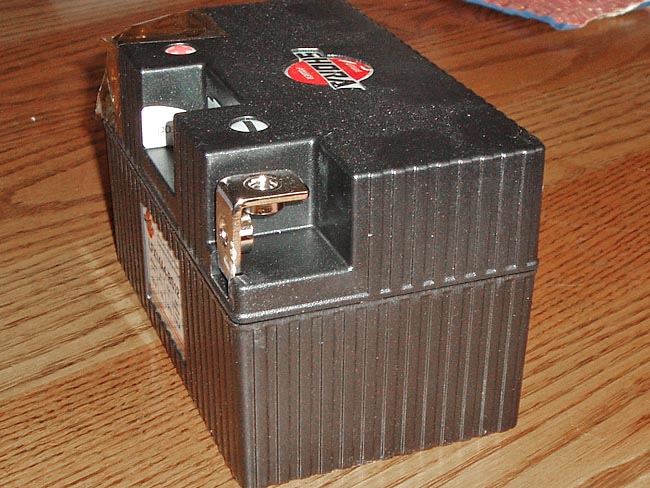
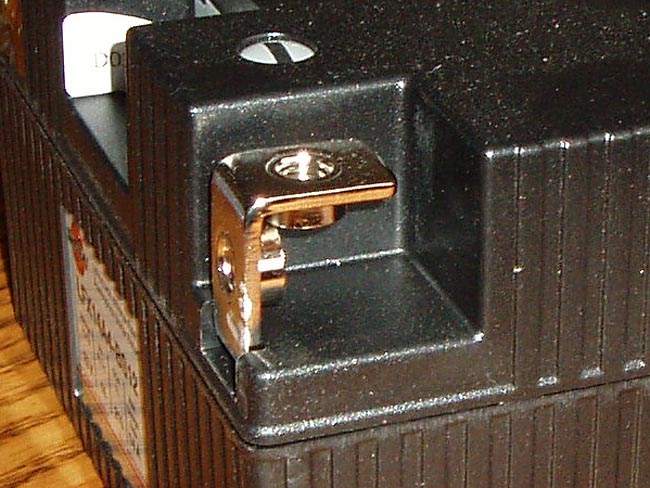
From “K.Y.” (January 2012): “I purchased a Shorai battery, model LFX14A4-BS12 for my KTM 690 Enduro. I found that, since your review, they have made substantial improvement to the battery terminals.
hen considering the Shorai, I asked the dealer about the concerns regarding the flimsy terminals as mentioned in your review.
According to him (and I have not been able to verify this from the Shorai web site), the manufacturer recalled the batteries and fixed the problem.
Whether they were recalled or not, they are much better.
They are made of thicker steel, and are very rigidly attached. In addition, at least on the model I purchased, the terminals are drilled and tapped for the attaching bolts, an innovation I think is a long time coming for motorcycle batteries.
I have often been frustrated when trying to attach a too short bolt through several terminals (electric vest, battery charger hookup, etc.) into a nut that slips cockeyed in a difficult to access location.
I have attached a photo of the revised terminal design.
I have several motorcycles of my own, and do the maintenance for 14 more at a motorcycle riding school that I manage (V-Twin Motorcycle Riding School, Okanagan and Kamloops, Canada), so I intend to track the use of this battery to determine if it is a cost effective solution.
I have found that the Yuasa batteries have declined in quality of late, and their live span has not been what it was. If these last as long as claimed, they will be a useful alternative.”
From “J.F.” (January 2012): “It started to become apparent that my ’08 WR250R was in need of a new battery. I bought it in 2010 new a two year old non current. It was not turning over as friskily and needed more revolutions before it caught.
Voltage after sitting for a couple of days was 12.39 and it would only charge to 12.62.

After reading webBikeWorld’s very inclusive battery article including some of the links to other sources of information I started looking for a replacement. What I found is that the price difference between lithium and AGM lead acid batteries has shrunk.
A 5ah AGM was priced at $36 but I wasn’t confident that this was enough starting power much less reserve for the electric vest and GPS that I sometimes use.
Moving up to a 7ah boosted the price to $84 at the same online merchant, one I have purchased from before with great prices and great service.
A little more surfing and I turned up a Shorai 9ah from a reputable online retailer for $89.95 to my door. It didn’t take too much thought to PayPal that!
The battery should be here in a couple of days, once it is installed I’ll let you know what I think.”
UPDATE from “J.F.” (January 2012): “Hi, My Shorai battery arrive a couple of days ago and I have installed it. The ’08 WR250R spins over much quicker now and fires on the second or third power stroke from cold. An improvement from the OEM battery that came with the bike.
It seems the LED lights on the bikes multi-meter are brighter at key on than before. In the box besides the battery as noted elsewhere an assortment of self adhesive foam, plus an assortment of stickers (I like stickers!) and four bolts and nuts, all the same length?
Gotta wonder about that.
One nice touch was that the nuts had a little tuft of foam attached so that when inserted into the battery terminal they stayed put and were forced up against the terminal hole so that the bolt would easily get purchase on the threads.
No searching for that just right something or other to stuff in back of the nut to hold it in place while fumbling with the battery cable, added accessory wires and the bolt.
Most of us know that trying to get three things lined up is and order of magnitude harder than two.
The box flap stated that the battery was at about 70% charge, voltmeter said 13.25. I thought that since I was on another project I would just top it off with my 1.5 amp trickle charger.
A check again with the voltmeter after connecting showed that it wasn’t up to the task, putting out just 12.9 volts. Maximum charge rate listed on the battery is 9 amps, my bigger charger has a 5 or 10 amp rate of charge setting so if I need to charge it I have to see if it will work.
The battery was not as tall as the original but the width and length were the same so with the addition of one of the foam pieces cut to match and stuck on the bottom of the battery it was a perfectly snug fit.
No rattling around when I do my Cyril Dupres, Marc Coma riding.
In regards to the terminals, I thought they were robust enough.
Tightening the terminal bolts with a 1/4 drive socket via my torque calibrated wrist yielded no movement of the terminals. I don’t have any concerns about their durability.
Maybe they have been upgraded since the original review batteries production.
Curious to see what the bike charging system put out I checked the voltage after starting the bike and found that right after start up the little bike was cranking out 13.9 volts at the slightly elevated idle that the fuel injection system produces for a cold start.
Overall I’m happy with the battery especially because it was only a $6.00 premium over the Yuasa Motorcross AGM, offers more cranking power and a possible longer life and less weight.
Would I just go right out and buy one to replace a perfectly good AGM, probably not, but if you are in need of a new battery it is definitely worth a look.”
From “T.G.” (04/11): “One thing I would like to see is a comparison to AGM batteries.
Lead based batteries get recycled heavily, I do not know of any Lithium Ion battery recycling program as aggressive as the Lead industry, as you are required in most states to turn in a old lead battery when you buy a new one or pay a $20.00 fee.
But I recently switched from a Regular old lead acid battery to a AGM lead battery and saw the gains that are seen with the Lithium Ion except for weight loss.
I upgraded to a Yuasa YxT24HL-bs and gained nearly 2X the CCA rating and 2 extra amps of capacity that made a huge difference in starting in cold and hot weather on my bike.
Yamaha for some reason thinks that starter cables need to be undersized and therefore suffer from significant heat fade, switching from a NEW lead acid to a new Lead AGM battery was dramatic, and it cost me less than 1/2 of what a Lithium ion battery did.
AGM batteries can also be mounted in any location and orientation.
I cant wait to hear how the longevity of the Motorcycle Lithium Ions turn out, as this may be the real added value if they last 6+ years.
I would love to not have to worry about my battery instead of eyeballing it with suspicious looks every spring and replacing it every 2.”
From “B.S.” (04/11): “I have a 2007 Aprilia RSV1000R V-twin sportbike. I installed a battery made by a gentleman on the wera/13x board. His company he started is called Mavrik and he is an electrical engineer grad student.
His batteries utilized A123 LiPo batteries, shrink wrapped in heavy gauge white plastic and utilize QD terminals. I bought it in the summer of 2010, just when people were making these on a small scale basis.
My OEM battery had froze over the winter (Unheated garage in Western New York) and a new Wal-Mart equivalent battery was $50.
Being a sportbike guy, I saw that these were much lighter and wanted one. He sold them in 4 cell, 8 cell, 12 cell, and 16 cell models, with 4 cell being race only and 8 cell being the minimum for a 1000cc in warm weather.
I went with the 12 cell for a extra assurance of there being a reserve.
It has proven to be a great battery. It weighs approx. 7 lbs less than my old one, is smaller, and has about 50% more CCA than the lead acid. My V-twin jumps to life now (important on the Rotax V-twin to not do-in the starter sprag).
Even better, it came standard with Quick Disconnect cables making anything after the initial install a 5 second job.
Being on the cutting edge of batteries cost me $245 shipped for the battery but I would do it again if need be. Just thought you’d want to hear from someone who has used one for a while now and is very satisfied.
Also, the owner of the company that made my battery has a YouTube vid of him (here) starting a small block Chevy with either the 8 or 12 cell model…
(Here) are a (three) pics I had saved (on Image Shack): Photo 1 | Photo 2 | Photo 3
You can see how small it is when compared overall to the size of the typical sportbike seat. Thanks and keep up the great work. Your reviews and site content are among the best available.”
From “M.S.” (04/11): “One detail that you left out was that these LFP batteries can be mounted at any angle: upright, 45 degrees, laid flat or even upside down. One advantage would obviously be for people who like modifying their bikes.
Often times the battery compartment needs to be moved or modified in a way that makes it impossible to use a conventional lead-acid battery.
The other advantage would be for the weekend track racer who wants to also modify where the battery is located, but also to save weight wherever possible. Thanks!”
From “L” (04/11): “I would be shocked if those batteries didn’t have some form of charging management built in. LiION and Li Poly batteries do not take kindly to being abused and will vent with flame.
The way around that is to build in charge management/safety chip.
As to the value? Well if you are dropping money for Ti bolts and rear sets this is a a no brainer. For most people it isn’t worth the money.”
From “J.B.” (04/11): “I have had a Turn Tech LFP battery in my KLR for a little less than 1 year. Allow me to recommend you to the Turn Tech site as they have pretty good background information on the technology under “FAQ”.
A couple of notes: This technology does not recover from going too low in voltage.
Also, the battery capacity, typically listed in Ah is lower than a lead acid of similar engine starting capability.
For that reason, cars (with lots of computers and remote controls staying awake and waiting for you to come back) are not a good application for this battery technology because they have a high current drain when sitting parked.
It would be easy for an LFP battery to be drained by the car’s computers to a level where you would have to replace the battery.
Alternatively, if you made the battery big enough to have the required Ah, then the cost of the battery would go through the roof. For most motorcycles, this is no problem. My KLR is dead as a doornail when the key is off.
Since the LFP battery doesn’t drain itself very quickly, the battery can survive for long periods of inactivity.
If I had a fancy motorcycle, with lots of clocks and other gadgets, I would be a little more careful of using an LFP battery. You might need to check the key off amp drain and decide if you have enough amp hours (Ah).
On the plus side, in addition to it’s significantly lighter weight, the LFP battery is very robust against vibration (good for your thumper).
My experience with thumpers is that the flooded lead acid battery typically only last 2 years, sometimes 3, even with good maintenance. This may be due to the vibration, I really don’t know.
Using the curve on the Turn Tech site, I extrapolate the curve and project that I should get 6 years or more from the LFP. If I hit 6 years, that is my break even point with a flooded lead acid battery.
More than that, there is less watering and other maintenance, so I consider myself ahead, if I get that far.”
From “J” (04/11): “From my understanding Lithium Iron Phosphate is a lithium-ion battery, and uses Lithium Iron Phosphate as the cathode (there are several types of cathode of lithium ion batteries…which makes it confusing).
My main concern regarding Lithium-ion batteries are the potential safety risks caused by over discharging and over charging. I’ve read over charging/discharging lithium-ion batteries can cause internal damages.
Another concern is the voltage charge. From my understanding, there is supposed to be a different kind of battery charger for recharging lithium ion chemistry. Perhaps this charging circuitry is built into the battery union, or perhaps into a specialized charger.
Other safety issues is overheating or shorting can cause a fire or explode.
Supposedly a lot of these safety concerns have been reduced (or eliminated) by Lithium Iron Phosphate. But it is confusing for the consumer because of all the chemical choices available.
For me, the cost and safety concerns do not warrant me to change my battery chemistry. I hope future articles from safety experts can help reassure the public. Great article. Thank you.”
Editor’s Note: We found some of the articles about Li-Ion battery problems also in our research, but supposedly this has been resolved in production versions of the batteries made for vehicle use.
Believe me, if anything happens, webBikeWorld readers will be the first to know! So we’re acting as the “guinea pigs” here, as we do with much of the gear.
Regarding the charging issues, supposedly (there’s that word again!), a Battery Tender is advised because it does not have a desfulfate mode. Both companies are coming out with their own battery chargers and we’ll be reviewing those also as soon as we can.
Lots more on this battery issue I’m sure, so we’ll keep on top of it.
Response from “Y.R.” (Below): “LiFePO4 (batteries) are incredibly tolerant to abuse. More than lead batteries actually.
On purpose I individually shorted A123 cells (probably the most famous manufacturer of LFP batteries).
The only result was that after some period of shorting some kind of smoke was slowly liberated. After that I dumped them on water with salt added (including some that were not shorted), besides obviously damaging the cells, nothing happened.
In both tests, no cells were burst is any kind of way. My only concern, as I previously mentioned, is that without a BMS and discharge protection it’s life span will almost certainly be compromised, in my opinion, severely. Safety is not a concern for this kind of batteries.”
From “J.L.W.” (04/11): “Actually, I liked the perspective better than the test which I thought was helpful as well. Basically, what I hear you saying is that if it ain’t broke don’t fix it.
I’ve been using Westco batteries for years in various bikes and never had to replace them. As far as the weak terminal on the Shorai goes, one of my bikes id a H-D that vibrates somewhat at idle (ahem!) and the terminal breaking off is a concern.
As far as the weight issue, a few pounds up or down on a Harley is like a drop in the bucket although for sport bike designers it might be a consideration.
Additionally, both Westco and Odyssey provide free shipping. Thanks for a real informative website.”
From “L” (04/11): “I believe I can offer some insight to your battery comparison. First your 8 year old battery on BMW R65. Since this battery sits on a battery tender most all the time it is always fully charged, this is ideal for long battery life.
Since it is only started once in a while this again is idea for long battery life.
A lead acid battery is good for a limited number of charge discharge cycles. When used every day this life is used up in small discharges and charges. If you don’t use the battery and keep it charged they will last a long time.
Station class lead acid batteries that are used as backups for telephone companies or power companies often last 20 years or more as they spend most of their life not used sitting on a float charger.
The OEM battery in the Suzuki DS650SE does not represent a good comparison since you have no idea of it’s previous life. Given the fact you said is went flat in a week I suspect the battery was damaged.
If a battery was left in a discharged condition for some period of time the acid will attack the plates and cause sulfated plates.
The battery can be charged after this but will never have the same storage capacity as a new or well maintained battery.
The only way to have a valid comparison is starting with a new fully charged lead acid battery.
Looking at your chart it is obvious the internal resistance of the OEM battery exceeded the internal resistance of the Li-ion batteries since it’s cranking voltage was so much lower.
Whether all this was due to the OEM batteries condition or the inherent differences between a lead acid battery and a Li-ion battery I do not know but I could guess.
Even comparing Li-ion batteries may be difficult. It appears there are nearly 20 different kinds of Li-ion battery technologies.
They still seem to be very much in the development phase, and there are differences in the internals that exhibit different characteristics.
It is probably safe to say the same battery used in your laptop is not the one you would scale up for your starter battery. It could be the two Li-ion batteries you selected have slightly different internals.
How about the impact on the environment? Who knows? Lead acid battery technology is pretty well developed. I would guess the majority of lead acid batteries are recycled so new batteries do not start with raw materials.
I do not know about recycling of Li-ion batteries but I would guess that industry is not yet so advanced.
Given the cost difference I would be hard pressed to select a Li-ion over a gel cell lead acid battery. A gel lead acid battery should last 5 years or so if reasonably well maintained. By that time most people will probably want a new bike.
I have been out of the electrical engineering field for some years now so if there are some young engineers who could give a more up to date analysis it would be interesting to read.”
From “T.D.” (04/11): “I put a Shorai battery in my CBR1000F. I have no car and depend on my bike to start when I go out and it is 21 degrees.
There is no question that the Shorai has started my bike this winter when the old one would have given up. I am sold on Lithium.”
From “D.H.” (04/11): “I read your post on the battery comparison; well done. I have a 2005 Benelli Tornado and I opted for the Shorai as the battery is high in the tail. I have never had a battery issue with the bike and I do not use a battery tender in my bikes.
I installed the battery in January and I live in the Northeast. The battery seems to prefer colder weather and this is a nice feature, as the old-tech battery had a tougher time with a cold engine.
My bike seems to crank faster with the new battery, even though I went for a size smaller than recommended.
Comparison of the data:
The recommended battery from Shorai, the LFX18A1-BS12, has the following:
- Chemistry: Lithium-Iron
- Voltage (V): 12
- A/Hr PbEq:18
- Cranking CCA (A): 270
- Max Charge (A):18
I went for the LFX14A1-BS12 which has a bit less capacity in terms of Ah and CCA:
- Chemistry: Lithium-Iron
- Voltage (V):12
- A/Hr PbEq:14
- Cranking CCA (A):210
- Max Charge (A):14
But this still blows away the Yuasa that came with the bike:
- Chemistry: Lead Acid
- Voltage: 12.0 V
- Capacity: 10 Ah
- Rating: 120 Whr
- CCA: 130
I have had no issues with the battery since the install. I was worried about the terminals, but they took the install with no issues and I have them tied down pretty well so I think they should be okay for now. Links to installation pictures.
From “Y.R.” (04/11): “How are the batteries constructed? Do they come with an integrated BMS?
LiFePO4 packs that are charged without a balancer, like these, should have it or the life span will be severely affected as the individual cells becomes unbalanced over time.
Also this type of battery is also affected by over discharging – even more than lead batteries, so there should be a circuit capable of stopping further discharging when a specific voltage is hit.
The charging balancing circuit is more complex, but even a discharging protection would be costly because of the amperage drawn from these batteries, judging by their cost I don’t think they offer any of these.
Although over-discharging is also very bad for then, the voltage provided by a charging system made for 12V lead batteries should offer no risk.
I checked the ballistic site and its said “Do not allow the battery to be completely drained, this will damage the cells.”
So it doesn’t have a discharge protection, I’m quite sure from that that it also don’t have a circuit capable of balancing. By the cost alone I also doubt the Shorai would offer either. I just think people should know that.”
Other WebBikeWorld Articles Posts