

Very nicely made and a real conversation piece.
Also very handy and by the way — it throws a nice, wide and powerful beam.
I’m not sure when I first became aware of the Tripod flashlight, but as soon as I saw it I knew I had to have one.
We bought one of the first units to hit the store shelves and used it for a couple of weeks and then it just sort of disappeared and was forgotten.
I remembered it again when just the other day I saw the funny “War of the Worlds” Tripod commercial on TV.
This is the one where the Martians have some engine trouble in their spaceship, crash land on Earth and use a Tripod flashlight to help get the engine started.
If you haven’t seen it, it’s worth a look because it’s funny. I searched around to see if there’s a link to it on one of the video download websites but couldn’t find it.
I wonder why Stanley doesn’t run it from their own website?
Anyway, I started wondering where our Tripod was off to and discovered that a friend had borrowed it, conveniently forgetting to return it.
The Stanley Tripod Flashlight
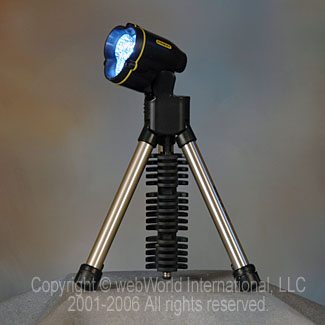
The MaxLife 369 Tripod flashlight, as it is officially known, is a great device for the motorcycle garage.
It’s probably just slightly oversize and maybe a bit heavy for touring, but it sure would come in handy during a breakdown on the side of the road at night.
But if the MaxLife 369 Tripod is too big for touring, I just discovered that Stanley makes a cute little MiniTripod that stands only 3.5″ high and comes with an attached keychain! I’ll have to get one of those also…
I’m not sure why no one thought of the idea before; attach a flashlight to a tripod and presto — the flashlight becomes about 10x more useful around the shop!
But the Stanley version is much more.
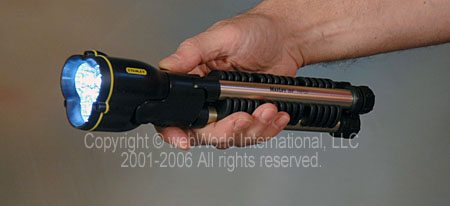
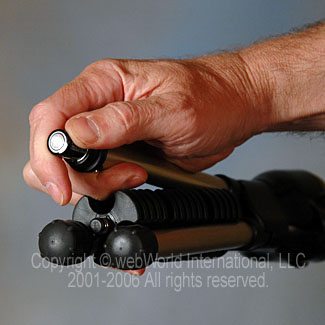
The legs fold in and stick together via a little magnet that holds the bottom of the legs together.
In this configuration, the Tripod is the same shape as a regular hand-held flashlight (aka “torch”).
As a hand-held flashlight, the Tripod is actually pretty comfortable, with rubber-like “donuts” protecting all three legs and providing a very grippy surface.
The head pivots a bit over 90 degrees and snaps back into place, whether or not the legs are extended.
There are three detents to hold the flashlight head in position, but there also seems to be enough friction to also hold it in the in-between positions.
The legs pop open when a button near the top of the body is pressed and the magnet releases the spring-loaded legs. The Tripod’s legs open up, ready for placement on a level surface.
The legs don’t telescope, and the Tripod stands about 10-1/4″ high with the legs extended. The batteries are inserted into the legs, which are actually aluminum tubes.
Another interesting feature of the Tripod is that it can take 3, 6 or 9 AA size batteries. Three batteries can be installed in each leg, so if you’re only using three batteries, only one leg is filled.
The Tripod weighs 9-7/8 oz. empty (280 grams) and three AA Duracell batteries weigh 2-5/8 oz. (73 grams).
So a fully loaded Tripod with full complement of nine AA batteries weighs 1 lb., 1-3/4 oz. or just a touch over half a kilo at 503 grams.
Stanley calls this their “parallel energy cell technology”. The LED lights put out the same amount of light whether 3, 6 or 9 batteries are used; the only difference is that the light will last longer with more batteries.
Stanley claims over 200 hours of continuous light when the Tripod is filled with its full complement of 9 AA batteries. They say that a traditional incandescent flashlight could use up to 10 sets of batteries for the same output.
�Parallel energy cell technology refers to the manner in which each aluminum cell or battery compartment operates in conjunction with the electronic circuitry in the light� said Randy Marzicola, product marketing manager for Stanley Illumination Tools. The circuitry controls the flow of the current, maximizing the load to the system receiving the energy; in this case the LEDs.�
He continued: “In most traditional flashlights, if one battery has low voltage, it can draw energy from the other batteries, and the overall performance of the product will suffer. Parallel energy cell technology controls the flow of the current between the aluminum cells to maximize run-time performance.”
Stanley claims that the Tripod will burn for about 75 hours when using 3 batteries in one leg.
The flashlight switch is four-way: low, medium, high and off.
The flashlight head contains six LED lights, in — you guessed it — the shape of a tripod. The low beam turns on one LED, medium is 3 and high turns on all 6 LEDs.
It’s a very interesting design; the clear flashlight lens is molded into a focusing shape over each LED, which provides maximum focus and very good coverage.
The head is shatter resistant and Stanley claims it can withstand a “severe” impact.
The on/off button and the button that releases the legs are covered with a rubberized membrane. There’s also a tiny red LED just above the on/off switch that blinks when the batteries are low.
Conclusion
The Tripod is a very handy tool for working on motorcycles. Its bright light (on the high setting) makes it very useful as a general flashlight, but the legs give it an added dimension because they free up an extra hand.
The Tripod seems to be made with high-quality components with a combination of style, high-tech, precision and robust build that should stand up to abuse in the shop or on the road.
The Tripod flashlight is becoming very popular; although the list price is $34.99 and I’ve seen it as low as $16.95, I’ve also seen it listed for as much as $36.99. The Tripod is definitely worth a look for garage or touring use.
| wBW Review: Stanley Tripod Flashlight | |
|---|---|
| Available From: Stanley Tools | Suggested Retail Price: $34.99 |
| Colors: N/A | Made In: China |
| Review Date: October 2006 | |
Owner Comments and Feedback
See details on submitting comments.