

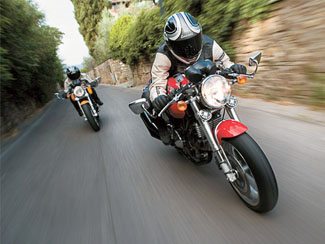
Ducati SportClassics Technical Features
Chassis
The SportClassic models all take advantage of the signature Ducati ALS 450 steel tubular trellis frame, specifically engineered to give the bikes precise and confident handling.
The frame’s high torsional rigidity ensures gratifying, sure-footed road manners even when pushed to the limit.
This trellis frame is used on all Ducati motorcycles, but lends itself especially well to the style of the SportClassics, and in particular with Sea Green finish of the Paul Smart 1000 Limited Edition linking it by way of colour to the original 1974 Super Sport 750.
On the Sport 1000, the frame has a black paint finish and is essentially the same as the one used on the Paul Smart, except for the exclusion of the steering damper mount and the position of the steering lock and ignition switch mounting.
Both the Paul Smart and the Sport have clip-on handlebars. The decision to use these race-inspired parts underlines the sporting spirit of these new twin-cylinders and the style of the originals. On the Sport version the handlebars are positioned 20 mm higher than on the Paul Smart.
The Ducati SportClassic models have a wheelbase of 1425 mm and trail of 103 mm, which is achieved by moving the fork legs forward by 25 mm with respect to the steering axis (front wheel hub offset) and setting fork rake at 24°. The slightly longer wheelbase compared with most Ducati sport bikes (the wheelbase of the Supersport 1000 DS, for example, is 1395mm) accentuates the typical styling of the 1970s, when bikes tended to be longer. (The 750 GT, Sport and Super Sport built between 1971 and 1978, for example, had a wheelbase from 1500 to 1530mm)
Swingarm
The Paul Smart and the Sport use a welded steel tube swingarm with an outer diameter of 60 mm and wall thickness of 2 mm. Both feature an elliptical right arm to accommodate the new exhaust system with stacked twin silencers, and a robust cross-member that joins the elliptical arm with the round one (on the chain side), where the rear shock absorber mount is located.
The use of the cross-member, together with the gusset between the cross-member and the arched tube, ensures a high level of rigidity, which has a positive effect on ride precision.
The two swingarm legs are made from extruded, bent tubing, while the distinctive shape of the cross-member is created by hydroforming technology.
This new swingarm features a simple, rational system for adjusting drive chain tension.
The chain is tensioned by tightening the nuts on the plugs on the end of the swingarm on stud-bolts rigidly connected to a sliding element inside the swingarm legs. The rear wheel assembly is tightened by means of an external nut, which acts by locking the sliders inside and outside the legs.
Although this system is reminiscent of systems used on bikes from the 1970s, a closer look shows that the swingarm, wheel hub and all the other components of the wheel set are much larger and robust than on the motorcycles from that era.
Suspension
In the suspension department, the whole family mounts quality componentry.
The Paul Smart 1000 Limited Edition is a contemporary interpretation of Paul Smart’s 750 “Imola” and the Super Sport 750 of 1974, which were the sport bikes par excellence at the time, so nothing but the best will do. In fact, the bike is fitted both front and rear with fully adjustable Öhlins suspension.
At the rear, the suspension stands out with its single shock mounted on the left-hand side, highlighting the new exhaust system with stacked twin silencers on the right-hand side.
The rear shock and Öhlins fork belong to a range normally assigned to racing use and thus feature a wide range of adjustments. The rear shock, like the 43 mm upside down forks, can be adjusted for spring pre-load, compression and rebound damping, to ensure the ability to perfectly tune the suspension for all riding conditions.
The search for perfection in every detail continues with the use of a polished Sachs steering damper with chromed rod, which enhances the bike’s stability and ride precision.
On the Sport 1000, suspension duties are handled by a 43 mm Marzocchi upside-down fork up front and by a Sachs shock at the back, with adjustable spring pre-load, compression and rebound damping. The Sport 1000’s suspension is tuned for sporting use plus reasonable comfort as required for road use.
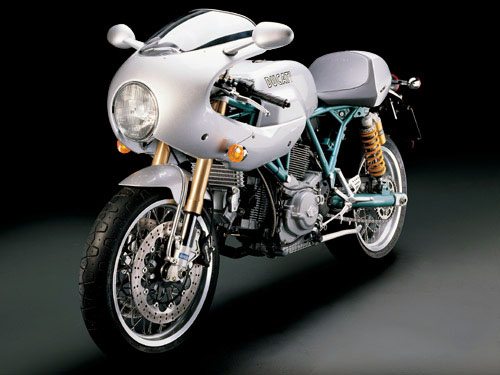 Final production version of the Paul Smart 1000 Limited Edition.
Wheels
The Paul Smart and Sport 1000 mount classic wire-spoke wheels. The lightweight Excel 17” aluminum alloy rims keep the overall weight of the front wheel assembly down to a minimum.
The 36 chromed steel dehydrogenated spokes are equal length and are variable diameter tapering from 5mm at the hub to 4.4 mm at the rim. The technical choice to use 36 spokes keeps un-sprung weight down to a minimum. The wheel hub is made from paint-finished, die-cast aluminum.
In keeping with the SportClassics traditional styling and appeal, the wheels chosen are classic centre-spoke drilled rims, and therefore utilize tube-type tyres.
The tyres themselves, produced specifically for the Ducati SportClassics feature a tread design reflecting that of the 1970’s motorcycles. However, they are made with modern construction techniques and advanced rubber compounds.
Brakes
The front brake system on the Ducati SportClassics consist of two Brembo floating calipers with 30 and 32 mm diameter pistons which are thermally insulated. The discs are semi-floating with a diameter of 320 mm and thickness of 4 mm.
The spoke wheels made it necessary to use this type of calipers, which is more compact on the side facing the wheel. Unlike the majority of top-end braking systems, which use organic pads, the calipers mounted on this new family of motorcycles use sintered pads that ensure high braking performance in line with Ducati standards.
The rear brake system consists of a floating single piston Brembo brake caliper and a 245 mm disc.
Exhaust System
The Paul Smart and Sport use a new black-finish stainless steel exhaust system. The system features distinctive stacked twin silencers on the right-hand side of the bike.
The lines and colors of the silencers take their styling cue from the exhausts used on race bikes of the 60’s and 70’s.
The two manifolds, which are joined by a compensation tube on which the lambda probe is mounted, are connected to the stacked twin silencers, which are fixed to the frame by means of a trellis support in chromed steel.
These two motorcycles are the first Ducati models to comply with EURO 3 anti-pollution standards: the lambda probe inside the compensation tube of the two exhaust manifolds combines with two trivalent catalyzers housed in the two silencers. The function of the lambda probe is to measure the oxygen in the exhaust gases and then, via the engine control unit, calibrate the mixture ratio during specific engine operating conditions. The two trivalent catalysers oxidize the unburnt hydrocarbons and carbon monoxide, and reduce the nitrogen oxide.
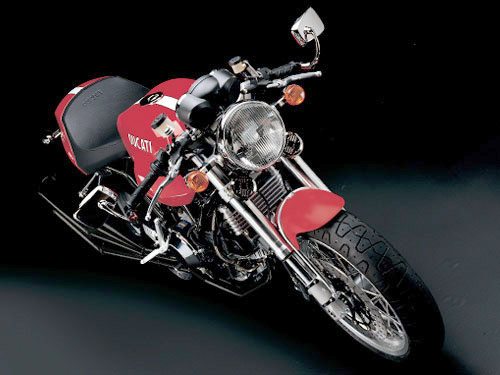 Final production version of the Ducati Sport 1000.
Electronics
The three SportClassic have a new layout for the electrical system, which helps to conceal the wiring while giving users easy access to all the main components of the system.
The main components of the system, i.e. the ECU, fuses and voltage regulator, are located beneath the seat, in the bottom of which there is a spacious storage compartment.
A Magneti Marelli 5AM engine control unit manages the fuel injection and ignition of the 1000 DS engine. The control unit, which is housed under the rear of the seat, is very compact and features a re-programmable Flash EPROM. It also contains the power circuits for the two ignition coils with a double output (each coil is connected to the two spark plugs of each cylinder) and the two very compact PICO series fuel injectors (one per cylinder).
An innovative feature is the use of a Stepper Motor for automatic control of idling speed, as already fitted on the Ducati Multistrada. This method of control ensures perfect adjustment of idling speed in the many varied ambient conditions and after extensive service life. This means that the throttle body can dispense with the cold start mechanism, thus considerably simplifying the system that operates the throttles.
The idling regulator has a shutter with a horizontal action driven by a lead screw/nut system connected to an electric stepper motor. It is housed in an aluminum casting with which the by-pass circuit on the throttles is made, by means of rubber hoses. The system is directly controlled by the ECU, which applies special strategies for automatic control of idling speed.
Style and Finish
Although technologically state-of-the-art, the Paul Smart 1000 L.E. and Sport 1000 introduce an array of features that profoundly reflect the style of the past.
The unmistakable style of the Paul Smart 1000 L.E. is accentuated by the rounded lines of the fairing and fuel tank, the unique shape of the seat, exhaust system and wire wheels.
Astride the bike you are immediately aware of the attention to detail: after your eyes settle briefly on the shiny chromed fuel cap, you are soon drawn to the distinctive, polished and anodized steering head. Then you spot the fully polished steering damper with chromed rod fixed to the steering head with an aluminum clamp.
A tapered mount on the top crown, and aluminum tubing going side to side supports the fairing assembly. Your gaze then falls on the instrument panel with white instrument faces bearing the classic Ducati logo as used on the fuel tank. The instruments are further embellished by chromed trim rings and control buttons.
The exclusive character of the Paul Smart 1000 Limited Edition is underlined by the engraving on the top of the tapered fairing mount, declaring the bikes limited edition status and its tribute to Paul Smart.
The minimalist approach of the original Café Racers is embodied in the Sport 1000, which its simple single large headlamp and bar-end chromed mirrors. The yellow, black and red colors, enhanced by the contrasting racing stripes down the centre of the fuel tank and tailpiece, accentuate the eccentricity of this “sport naked” beauty.
The bike is characterized by the elegant finishes of polished aluminum, chrome and monochromatic paint.
The front end of the bike is characterized by the finishes of the instrument panel and the distinctive top clamp with its two hallmark fork caps in polished, anodized aluminum alloy.
And countless details enhance the looks of the two new Ducati SportClassics. The distinctive shape of the seat is emphasized by its double-stitched cover, which accentuates the lines of the seat, and features an embossed Ducati logo.
The attention to detail is applied to normally mundane components like foot-peg brackets and foot pegs, gear shifter, rear brake lever and side stand which in the case of the SportClassics are finished in polished aluminum.
The 90° twin cylinder itself is embellished with special details such as a chromed clutch and crank shaft timing inspection covers, polished valve covers and black timing belt covers.
The rounded shapes of the new tail light and chromed turn signals are also details with strong 1970’s styling.
Another elegant reflection on the past is the housing and mounting of the battery. Its molded plastic case, embossed with the traditional Ducati logo, is enveloped by a steel base “drilled” for lightening, which for battery removal, pivots on two pins on the frame.
Engine
When choosing the power for the SportClassic family, the ideal solution was the muscular Desmodue 992cc air-cooled twin-cylinder, Ducati 1000 Dual Spark engine, known and appreciated for its abundant torque and excellent reliability.
Compact, powerful and acknowledged as the ultimate expression of the Ducati philosophy of air-cooled twin design, the 1000 Dual Spark Desmo – already used on the Monster, Multistrada and Super Sport families – represents the result of decades of experience and a whole series of innovations that extend from the combustion chambers to the crankshaft.
The end result is a powerful engine that is particularly exuberant in the mid-range and generally acknowledged as the most advanced air-cooled L-twin ever designed. In addition to offering the significant advantages of an air-cooled power plant, the 1000 DS also draws inspiration from the advanced Testastretta racing engine, including the special casting techniques used to make the cylinder heads, the use of oil-pressurized plain bearings to support the camshafts, and the angles and configuration of the valves.
All this, plus the exclusive Dual Spark ignition, with its “double flame front”, offers more complete combustion, while simultaneously boosting mid-range power and reducing emission levels.
A closer look at the 1000 DS engine reveals a reduced angle between the intake and exhaust valves, one of the basic principles with which the renowned Testastretta engine was designed, which allows for a more compact combustion chamber, reducing the volume and thus obtaining improved combustion. The improved efficiency of the combustion chamber allows the engine to run on a leaner air/fuel mixture without compromising performance at high temperatures and significantly reduces emissions of hydrocarbons (HC).
The camshafts are supported on oil pressurized plain bearings, which reduce the overall dimensions, the weight, and the number of moving parts, while also improving heat dispersal. The new configuration also puts the camshafts in a more direct relationship with the valves, reducing friction and stress on valve components and thus increasing reliability. In fact, although the cylinder head is more compact, it allows more space for the intake and exhaust valves, these being 45 mm and 40 mm in diameter respectively.
Further innovations include valve seats made of beryllium bronze, a technologically advanced material that affords better heat dispersal and wear-resistance and thus maintains valve clearances more accurately over a longer period of time.
The 1000 DS engine uses an over-square 94mm bore and 71.5mm piston stroke. The pistons are now fitted with nitrided steel rings, which afford improved sealing and significantly reduce oil consumption. The 94 mm pistons are linked to the crankshaft with new connecting rods, made from a new material composition (30NiCrMo4) that has exceptional flow characteristics during forging. In cross section, the new rods are thinner side-to-side, but wider fore to aft, increasing strength and lowering weight for increased reliability and performance.
The new crankshaft is of a more compact design and the oil passages have been strategically repositioned in areas less critical for its structural strength. The result is a crankshaft that is more rigid and with less flex, making for less vibration and improved reliability.
Finally, both the clutch housing and the clutch plates are now made from a special aluminum alloy. Thanks to this new material, the clutch has a significantly longer service life due to the more balanced wear factor of the alloy. The clutch also now runs quieter due to improved tolerances and the lower resonance value of aluminum compared to steel.
Note: For informational use only. All material and photographs are Copyright © webWorld International, LLC – 2000-2011. All rights reserved. See the webBikeWorld® Site Info page. NOTE: Product specifications, features and details may change or differ from our descriptions. Always check before purchasing. Read the Terms and Conditions!