

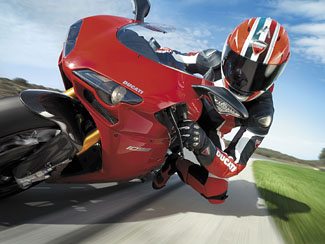
The Ducati 1098 Superbike!
More: Graves Motorsports 1098 Exhaust | Ducati announces the 1098-based Desmosedici RR MotoGP replica! | March 15, 2007 – Ducati 1098 Voted Best Design of 2006 by the Motorcycle Design Association
Ducati’s 916 was a tough act to follow. The 999 bravely broke away from being just a facelift, although while a better bike in most respects, some of the earlier magic was perhaps missing.
The 1098 promises to give Ducatisti the best of both worlds, by combining the practical improvements of the 999 with the looks and presence of the 916.
The members of the the Motorcycle Design Association, made up of the majority of designers active in the motorcycle industry worldwide, clearly agree. They have voted the Ducati 1098 not only the best in its class within the Supersport category, but also the overall best design of 2006, winning this year’s Motorcycle Design Trophy.
This is the second year in a row that Ducati has won the award. Last year, the Association voted theHypermotard as the best overall motorcycle design trophy winner for 2005.
This award followed the “Best of Show” award that was given by MDA to the Hypermotard during the Eicma Show in Milan in November 2005, one of the most important shows worldwide for the motorcycle sector.
The Design Trophy was awarded for the first time in September 2001; since then, every year, over 70 top professionals from the worldwide design sector are called upon to vote for the best motorcycle design. The jury, made up of designers as well as representatives of the press and the main motorcycle manufacturers, gather to chose the winners in five categories, and then nominate the Motorcycle Design Trophy for the best overall motorbike design.
The 1098 Superbike was launched to the world at the EICMA Motorcycle Show in Milan in November 2006 and, with the 1098 S Tricolore winning the “Most Beautiful Motorcycle in Show” award, was an immediate success.
The 1098 is the lightest, fastest stopping, quickest lapping Ducati in history. For the first time Ducati MotoGP and World Superbike technology have been combined to create a premier street bike. The results are stunning.
The look and stance of the 1098 were designed by the combination of race track technology, track-derived components and Ducati heritage. The 1098’s striking aerodynamic shape naturally embraces its riding position, configured by our racers and test riders for optimum speed and agility. The racing spirit takes form. Thanks to the forward thinking design and changeability of most components, the 1098 can quickly be transformed into a real race bike.
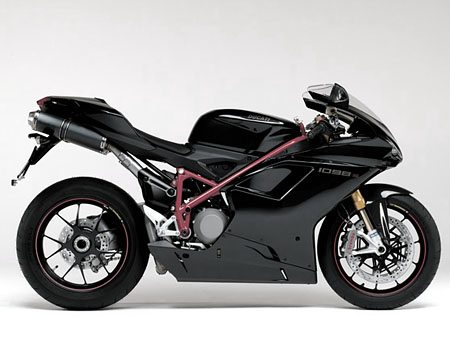
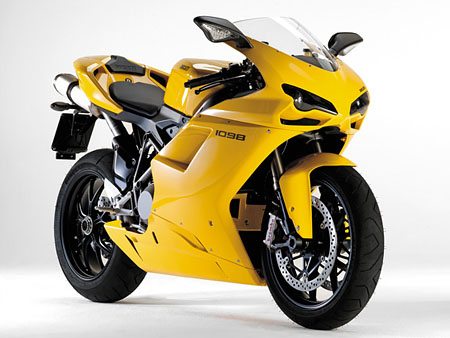
Finally, it has been confirmed that the 1098 Superbike will be available in two additional colors: midnight black and yellow.
The 1098 will get the striking yellow scheme, matched with black wheels and a grey frame. The vibrant midnight black color is available for the 1098 S, paired with a red frame and red-trimmed black wheels. Dark aluminum badging will adorn both color schemes. Both colors will be available starting in March 2007.
Ducati has announced the successor to the controversial 999, the new 1098. The styling of the 1098 has been toned down from the radical 999 treatment, although the bike does have a touch of 999 here and there.
Ducati’s press information for the 1098 claims that the priority during the development of the 1098 was performance first.
Each system, detail and component was studied and pared down to its essence and performance increased to the maximum. If it didn’t make the 1098 lighter, faster or deliver quicker lap times, it wasn’t considered.
The motorcycle was designed and built in Borgo Panigale and produces 160hp and 12.5kgm of torque. The result is that the 1098 is now claimed to be the most powerful twin-cylinder motorcycle in the world with the highest torque-to-weight ratio of any sport bike.
Ducati also says that the 1098 is the lightest, fastest stopping, quickest lapping Ducati in history (notwithstanding Ducati’s race bikes!). For the first time Ducati MotoGP and World Superbike technology have been combined to create a premier street bike.
The Ducati press release continues “The look and stance of the 1098 were designed by the combination of race track technology, track-derived components and Ducati heritage. The 1098’s striking aerodynamic shape naturally embraces its riding position, configured by our racers and test riders for optimum speed and agility. Thanks to the forward thinking design and changeability of most components, the 1098 can quickly be transformed into a real race bike.
Trademark Ducati features like the high tail section and compact front-end meld with twin under-seat silencers and single-sided swingarm to express its aerodynamics and agility. Add the new Testastretta Evoluzione engine at the heart of the machine and you get an all-out performance Ducati Superbike that seems to be moving fast, even when at rest.
The 1098 introduces a number of ‘firsts’ for Ducati and production sport bike design. The 1098 is the first production motorcycle to have the amazing stopping power of Brembo Monobloc brakes, the first to have a data acquisition system integrated as standard equipment and the first to use an ingenious construction method for its weight-saving single-sided swingarm.
More ‘firsts’ for a road-going Ducati include the direct application of MotoGP technology, like the power producing GP6-derived elliptical throttle bodies and the use of the information-rich instrumentation originally developed for the new Desmosedici GP7.
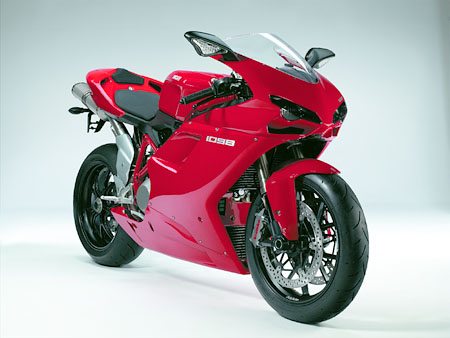
The 1098 has the soul of a race bike, pure and simple. The riding position encourages the rider to mould to the sleek lines of the tank and seat: man and machine are made one. It transmits the quality and character of contact between road surface and tire, it signals the way the chassis will react next and responds instinctively to rider commands.
Satisfying all the senses, the throaty roar of the twin under-seat exhausts are synchronized with the howl of the elliptical throttle bodies providing a fitting fanfare for the new 1098 Testastretta Evoluzione engine. The huge 104mm bore and all-new cylinder head design unite to produce an awesome 160hp and an arm-wrenching 90+ lb-fts of torque. Developed together with Ducati Corse, the 1098 is a masterpiece of incredible performance and innovation.
The Superbike is available in two versions: the awesome 1098, and for those who demand the ultimate in performance with the very best suspension, lightweight wheels and components, the 1098 S.
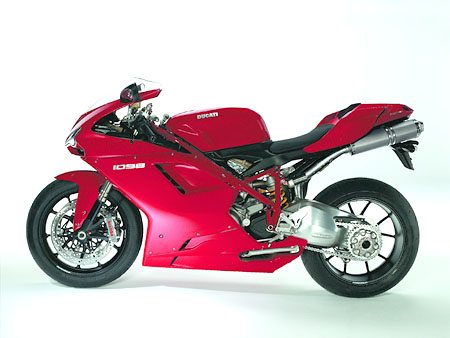
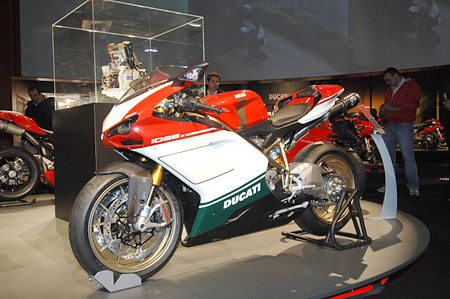 The 1098 will also be available in Tricolore livery.
Ducati Superbikes, designed, engineered and built in our Bologna, Italy factory, have always represented the pinnacle of Ducati motorcycle technology and racing success. For Ducati, racing and winning are a way of life and a way of thinking for our designers, engineers and everyone at the factory. The unique engineering solutions they embrace are proven on the race track, where the only way to the winner’s circle is with technical superiority and dependable performance.
Motorcycles are the only thing that Ducati designs, develops and manufactures – they are our single motivation – the new 1098 and 1098 S Superbikes crystallize the essence of Ducati. They are in form and function the culture and product of a company dedicated to engineering excellence and winning performance.
Simply claiming superior performance and technical innovation is not enough. Ducati backs it up with results. Ducati has dominated World Superbike racing, winning 12 of the last 16 World Championships and taking the Manufacturers’ Trophy 14 times since 1990. Furthermore, Ducati has won more individual World Superbike races than all other manufacturers combined. The results speak for themselves.
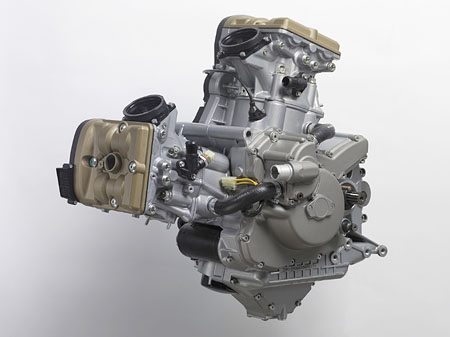
Engine
The new Testastretta Evoluzione engine is the crowning glory of Ducati’s development and perfection of the L-Twin engine. World Superbike dominance for the last 15 years is the result of continual commitment to twin-cylinder technology and the 1098 Testastretta Evoluzione, the most powerful twin-cylinder production engine in history, is a fitting reward to our engineers’ continued ingenuity.
The 1098 engine is immediately recognizable by its completely new compact cylinders and cylinder heads. Other 1098 innovations and revisions are less obvious as they reside inside the Evoluzione’s engine cases, but whether external or internal, every new development was conceived to create a lighter, more efficient, more powerful and ultra-compact engine for the new generation of Ducati Superbikes.
The 1098 capacity is a result of a significant increase in the bore and stroke of the Evoluzione motor. Highly ‘over-square’, it now sports a big 104mm bore and a relatively short 64.7mm stroke. To optimize the benefits of the new, big Ducati Twin, the cylinder heads have been completely redesigned and, when combined with advanced MotoGP induction technology, enable even the standard specification 1098 to produce more power than the previous extreme Testastretta ‘R’ engine.
The Evoluzione features a reduction in the angle between intake and exhaust valves allowing highly efficient, straight intake ducts and newly shaped combustion chambers that contain racing size ‘R’ valves (42mm inlet, 34mm exhaust), operated by radical ‘R’ derived camshafts. The new cylinder heads also benefit from fewer components and include magnesium covers to achieve a staggering weight-saving of over 3kg (6.5+lbs).
After optimizing the Evoluzione cylinder heads, engineers then focused upon releasing the potential of the new design by feeding them with MotoGP-derived elliptical throttle bodies. With a 30% increase in air flow over conventional throttle bodies, the new elliptical shape contributes an incredible 5hp increase to the record-breaking motor.
The Testastretta Evoluzione is the lightest Ducati Superbike engine ever, thanks to close scrutiny of every engine component. A total of 5kg (11.1lbs) has been saved by reducing the weight of many components, including transmission gears and the gear selector drum as well as the oil pump and primary gears.
The Testastretta Evoluzione’s increase in power is protected by a highly efficient oil cooler with increased surface area and an advanced coolant radiator assisted by lightweight, high flow electric fan assemblies. The compact and intricate design of the cooling system integrates perfectly with the 1098’s wind-cheating aerodynamics and sleek lines.
Finally, the 1098 is complemented by an all-new exhaust system. Significantly lighter, it has been engineered with a power-increasing symmetrical 2-1-2 layout that uses 52mm-57mm diameter tubing with wall thickness reduced by 30% to 0.8mm (.030in). The system terminates with Ducati’s trademark twin under-seat silencers, delivering that unmistakable signature sound of the big bore 90° L-Twin.
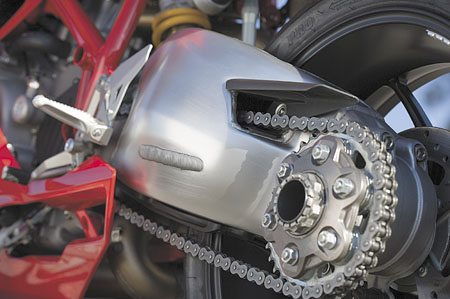
Chassis
The 1098 chassis and suspension have received the same detailed study and performance first priority approach. The goal was to achieve considerable weight saving while building-in strength and rigidity to manage the new high-powered Testastretta Evoluzione engine. Each and every component not only contributes to achieving superior road holding and stability, but when assembled, become a system with value far greater than the sum of all its parts.
Trellis Frame
Developed in cooperation with Ducati Corse, the 1098 Trellis frame has been designed with a simplified tube layout featuring main section tubes increased in diameter from 28mm to 32mm, while being reduced in thickness from 2mm to 1.5mm. The result is a 14% increase in rigidity and a weight saving of 1.5kg (3.3lbs).
Single-sided Swingarm
Our engineers were encouraged to re-think the construction technique of the 1098’s unique single-sided swingarm. The solution was to produce the main operational components using individual aluminum castings so as to ensure strength around the pivot points, wheel hub and suspension links, with fabricated aluminum sections used to complete the construction into a single, beautifully engineered component.
Rear Suspension
Highlighting the way in which individual components are influenced by each other, the new lightweight Trellis frame and single-sided swingarm have enabled a more compact and further weight-saving rear suspension linkage system that features separate lower pick-up points for the push-rod and suspension unit.
This ‘tandem’ design effectively reduces stress around the linkage pick-up area of the Trellis frame. Working together with this highly efficient linkage is a fully adjustable Showa single shock for the 1098 and an incredible Öhlins shock for the 1098 S. A vitally important feature of the 1098’s rear suspension system is the ability to adjust rear ride height independent of spring pre-load and other suspension settings, critical when seeking the perfect set-up for personal riding style or track conditions.
Front Suspension
The fully adjustable 43mm Showa forks with a special low friction Titanium Oxide-treated sliders on the 1098, and spectacular 43mm Öhlins with low friction Titanium Nitride sliders on the 1098 S, both feature radial Monobloc caliper mountings. The unique look of these mountings further underlines the no-compromise racing specification of the 1098. Both front suspension solutions are professionally track-tuned and offer superior road holding, deliver superior feedback, and help every rider to be more confident and in control.
Brakes – Monobloc Calipers
With a Superbike as capable as the 1098, superior stopping power is fundamental. The 1098 is the first production street bike to use Brembo’s Monobloc caliper racing technology. The M4-34 calipers are machined from a single piece of alloy, vs. the bolt-together construction of conventional calipers. The Monobloc design has much higher rigidity and resistance to distortion during extreme braking, and therefore gives a much more precise feel at the brake lever.
The 1098 also introduces for the first time on a Ducati, big 330mm discs which, when matched to the Monobloc calipers, achieve spectacular braking power. Despite the larger diameter, their weight has not increased due to the use of racing-style narrow braking surfaces. The use of Monobloc technology combined with the legendary stability of Ducati’s Trellis frame and the 1098’s overall weight savings has made world championship level brake performance available for the road.
Super Lightweight Wheels
The weight saving of 250g achieved on the front wheel substantially reduces the moment of inertia and enhances the 1098’s change of direction and braking performance. The rear wheel is just as impressive with a complete redesign for its single-sided swingarm application that has resulted in a reduction of over 1kg compared with traditional Ducati single-sided swingarm fitments.
Both the 1098 and 1098 S benefit from the lightweight Marchesini Y-shaped spoke wheels, but the ‘S’ goes even further by using machine finished forged-aluminum, a special process normally reserved for the production of race wheels. Another first for Ducati is the mounting of 190/55 rear tires, our widest ever, and the new standard for traction and control.
Aerodynamic Bodywork
Carefully designed not only for aerodynamic efficiency but also to hug the sleek lines of the chassis, the 1098 enables the rider to blend effortlessly into the race-oriented riding position. Great care has been taken in the design of the air supply ducts so to ensure efficient air-flow through radiator and oil coolers as well as provide ample air delivery to the airbox feeding the powerful new Testastretta Evoluzione engine.
Moulded in lightweight Terblend, the bodywork’s form becomes a considerable contributing factor to the overall performance of the machine by helping reduce weight even further while allowing the rider to effortlessly ‘tuck in’ from the wind stream and turbulence to achieve maximum straight-line track speed.
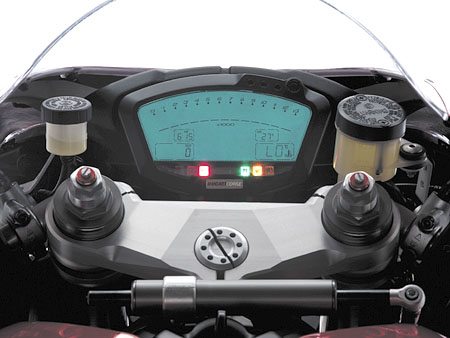
Electronics and Innovation
Desmosedici-style digital instrumentation is taken from Ducati’s MotoGP GP7 project. This pure racing, minimalist solution by Digitek has no switches or buttons to compromise its clean lines.
Instead, information additional to the default read-outs is managed by handlebar-mounted switch gear, allowing the rider to scroll through and select from various menus. The default read-out presents rpm and speed, with the former displayed across the screen in a progressive bar graph. Optionally, the rpm and speed can be displayed in numeric values. The instrument display also doubles as a control panel for the activation of the data acquisition system as well as listing lap times recorded by using the high-beam flash button as a stopwatch.
Data Acquisition
With the purchase of the Ducati Data Analyser (DDA), which includes PC software, a USB-ready data retrieval card and instructions, owners are ready to review and analyze the performance of the 1098 and its rider, and make comparisons between various channels of information. The DDA is available from Ducati Accessories, and is supplied as standard equipment on the 1098 S.
Normally used on race bikes only, the system records numerous channels of data including throttle opening, vehicle speed, engine rpm, engine temperature, distance traveled, laps and lap times. The system also automatically calculates engine rpm and vehicle speed data so as to also display gear selection as an additional channel of information. At the end of a ride or track session, up to 2mb (approximately 3.5 hours) of data can be downloaded to your PC ready to compare, analyze and get an inside view of you and your 1098’s performance.
Data can be analyzed in graphic form with options to zoom into detail of specific sections. Dragging a trace along a timeline to reveal individual values of the above listed channels enables the user to analyze performance in the same way that data technicians are able in factory teams.
DUCATI 1098 S
The most powerful, lightest L-Twin Superbike in history
The new 1098 S has achieved the status of the highest performance Ducati street bike ever by reducing weight to the max and adding world-class components to an already record-breaking design. If owning the ultimate Superbike is your dream, the ‘S’ is ready to deliver.
Suspension is of the very highest performance standard. The fully adjustable 43mm Öhlins FG511 forks, which sport low friction Titanium Nitride fork sliders, respond effortlessly to every imperfection in the tarmac.
Beyond their advanced engineering solutions, one of the most important characteristics of Öhlins forks is their ability to communicate the condition and quality of the tire-to-road contact patch, a feature that puts every rider in superior control.
The suspension system is completed and perfectly balanced by using a fully adjustable Öhlins 46PRC rear shock with a ride enhancing top-out spring, controlling the single-sided swingarm for outstanding drive, traction and steering precision. The Öhlins package is completed with a control-enhancing adjustable steering damper.
The ‘S’ also sets a new standard for lightweight performance. On any sport or race bike, the most effective area to reduce weight is its “unsprung weight”. These are components like tires, brakes and wheels. Lighter wheels have a lower ‘moment of inertia’ that is beneficial with every direction change and application of the brakes.
The 1098 addresses this important area by mounting Marchesini forged and machined wheels, reducing weight by 1.9kg (4lbs). Both front and rear are super lightweight and their benefit is immediately apparent. A red pin-stripe around the front and rear rime denotes their high-tech ‘S’ status. The weight saving is further enhanced with the application of a carbon fiber front fender.
The 1098 S is also supplied with the Ducati Data Analysis system as standard equipment. The DDA package supplied with the ‘S’ version enables the retrieval of data and analysis of data collected from your previous track session or road trip. The DDA package includes software for your personal computer on CD, a data retrieval USB key and instructions.
COLOR SCHEMES
Fairing Frame Wheels – 1098 Red Red Black
1098 S – Red Red Black
Technical Specifications
| DUCATI 1098 TESTASTRETTA EVOLUZIONE |
DUCATI 1098 S TESTASTRETTA EVOLUZIONE |
|
| Engine: Type |
L-Twin cylinder, 4 valve per cylinder Desmodromic, liquid cooled | L-Twin cylinder, 4 valve per cylinder Desmodromic, liquid cooled |
| Displacement | 1099cc | 1099cc |
| Compression Ratio | 12.5:1 | 12.5:1 |
| Power* | 160hp (119.3kw) @ 9750rpm | 160hp (119.3kw) @ 9750rpm |
| Torque* | 90.4 lb-ft @ 8000rpm | 90.4 lb-ft @ 8000rpm |
| Fuel injection | Marelli electronic fuel injection, elliptical throttle bodies. | Marelli electronic fuel injection, elliptical throttle bodies. |
| Exhaust | Lightweight 2-1-2 system with catalytic converter and lambda probe. Twin stainless steel mufflers | Lightweight 2-1-2 system with catalytic converter and lambda probe. Twin stainless steel mufflers |
| Emissions | Euro 3 | Euro 3 |
| Transmission | ||
| Gearbox | 6 speed | 6 speed |
| Ratio | 1a 37/15, 2a 30/17, 3a 28/20, 4a 26/22, 5a 24/23, 6a 23/24 / 1st 37/15, 2nd 30/17, 3rd 28/20, 4th 26/22, 5th 24/23, 6th 23/24 | 1a 37/15, 2a 30/17, 3a 28/20, 4a 26/22, 5a 24/23, 6a 23/24 / 1st 37/15, 2nd 30/17, 3rd 28/20, 4th 26/22, 5th 24/23, 6th 23/24 |
| Primary drive | Straight cut gears, Ratio 1.84:1 | Straight cut gears, Ratio 1.84:1 |
| Final drive | Front sprocket 15; Rear sprocket 38 | Front sprocket 15; Rear sprocket 38 |
| Clutch | Dry multiplate with hydraulic control | Dry multiplate with hydraulic control |
| Chassis | ||
| Frame | Tubular steel Trellis frame in ALS 450 | Tubular steel Trellis frame in ALS 450 |
| Wheelbase | 1430mm / 56.3 in | 1430mm / 56.3 in |
| Rake | 24°30′ / 24,5° | 24°30′ / 24,5° |
| Steering angle | 28°30′ / 28,5° | 28°30′ / 28,5° |
| Front suspension | Showa 43mm with TiO fully adjustable upside-down fork | Öhlins 43mm fully adjustable upside-down fork with TiN |
| Front wheel travel | 127mm / 5in | 120mm / 4.7in |
| Front wheel | 5-spoke in light alloy 3.50 x 17 | 5-spoke in forged light alloy 3.50 x 17 |
| Front tyre | 120/70 ZR17 | 120/70 ZR17 |
| Rear suspension | Progressive linkage with fully adjustable Showa monoshock. Aluminium single-sided swingarm | Progressive linkage with fully adjustable Öhlins monoshock with top-out spring. Aluminium single-sided swingarm |
| Rear wheel travel | 127mm / 5in | 127mm / 5in |
| Rear wheel | 5-spoke light alloy 6.00 x 17 | 5-spoke forged light alloy 6.00 x 17 |
| Rear tyre | 190/55 ZR17 | 190/55 ZR17 |
| Front brake | 2 x 330mm semi-floating discs, radially mounted Brembo Monobloc calipers 4-piston, 2-pad. | 2 x 330mm semi-floating discs, radially mounted Brembo Monobloc calipers 4-piston, 2-pad. |
| Rear brake | 245mm disc, 2-piston caliper | 245mm disc, 2-piston caliper |
| Fuel tank capacity | 15.5L (of which 4L reserve) / 4.1 US gal (of which 1 US gal reserve) | 15.5L (of which 4L reserve) / 4.1 US gal (of which 1 US gal reserve) |
| Dry weight** | 173kg / 381lbs | 171kg / 377lbs |
| Seat height | 820mm / 32.2in | 820mm / 32.2in |
| Max height | 1100mm / 43.3in | 1100mm / 43.3in |
| Max length | 2100mm / 82.6in | 2100mm / 82.6in |
| Instruments | Digital MotoGP derived unit displaying: Speedometer, rev counter, clock, scheduled maintenance warning, warning light for low oil pressure, fuel level, oil temperature, fuel reserve, trip fuel, neutral, turn signals, average speed, average fuel consumption, remaining fuel metre, immobilizer. Ready for DDA system. | Digital MotoGP derived unit displaying: Speedometer, rev counter, clock, scheduled maintenance warning, warning light for low oil pressure, fuel level, oil temperature, fuel reserve, trip fuel, neutral, turn signals, average speed, average fuel consumption, remaining fuel metre, immobilizer. DDA system enabled. |
| Warranty | 2 years unlimited mileage | 2 years unlimited mileage |
| Versions | Dual seat | Dual seat |
| * Data calculated using an inertia dynamometer. | ||
| ** The weight excludes battery, lubricants and coolant for liquid cooled models. | ||
Ducati 1098 Parts and Accessories: Shift Tech has some nice-looking carbon fiber parts for the 1098
The History of the Ducati Superbike
1986: If we wanted to name the first year for the Ducati Superbike project, it would be the one in which the first Ducati was fitted with a four valve twin-cylinder engine, the prototype named 748 Bol d’Or that made its debut in the race of the same name.
1987: In July, the first images of the Ducati 851 prototype road version were released. In the same year, Marco Lucchinelli took the racing version of this bike to victory in the ‘Battle of the Twins’.
1988: Production of the Ducati 851 began with ‘KIT’ versions for racing use and ‘ROAD’ versions for customers. The following year, a ‘biposto’ two-seater version in a classic red livery was added to the range.
1990: Raymond Roche won his first World Superbike Championship riding a Ducati 851 Racing.
1991: Second World Superbike Championship title won by Doug Polen and first Manufacturers’ World title for the Ducati 888 Racing. Production of the 888 road version began the following year.
1993: This year marked a turning point in Ducati Superbike history. The Ducati 916 prototype was first presented at the Milan Motorcycle show. This bike was to earn a place in the history of motorcycling as the most beautiful sports bike of all times – as acknowledged by a multitude of international prizes and awards.
1994: Carl Fogarty won the first of his four Superbike World Championship titles riding the Ducati 916 Racing. In the same year, production of this bike’s road version began.
1995: A smaller capacity version was built, the Ducati 748.
1999: The Texas Pacific Group took over from the Cagiva Group as the owners of Ducati and the SBK family success story continued with the market launch of the Ducati 996. The following year arrived on the market the Ducati 996R version, equipped for the first time with the brand new Testastretta engine.
2001: The larger-capacity Ducati 998 was born, equipped with the ‘Testastretta’ engine.
2002: This year was another turning point for the Superbike family: the new Ducati 999 Testastretta was created, a revolutionary bike with a highly innovative design which made a clean break with the past. In 2003 and 2004, this bike won both the Riders’ and the Manufacturers’ World Superbike Championships, with riders Neil Hodgson and James Toseland, respectively.
2006: Troy Bayliss rode the 999F06 to win the 12th Riders’ World title and 14th Manufacturers’ World title in the Superbike World Championship.
2006: The Superbike capacity has grown steadily to finally exceed a three digit figure:
the Ducati 1098 was created, equipped with the Testastretta Evoluzione
engine.
Ducati Riders’ Championships (12)
2006 Troy Bayliss 999R ; 2004 James Toseland 999R ; 2003 Neil Hodgson 999R;
2001 Troy Bayliss 996R ; 1999 Carl Fogarty 996 ; 1998 Carl Fogarty 996;
1996 Troy Corser 916 ; 1995 Carl Fogarty 916 ; 1994 Carl Fogarty 916;
1992 Doug Polen 888 ; 1991 Doug Polen 888 ; 1990 Raymond Roche 851.
Ducati Manufacturers’ Championships (14)
2006 999R ; 2004 999R ; 2003 999R ; 2002 998R ; 2001 996R ; 2000 996 ; 1999 996
1998 996 ; 1996 916 ; 1995 916 ; 1994 916 ; 1993 888 ; 1992 888 ; 1991 888.
Note: For informational use only. All material and photographs are Copyright © webWorld International, LLC – 2000-2011. All rights reserved. See the webBikeWorld® Site Info page. NOTE: Product specifications, features and details may change or differ from our descriptions. Always check before purchasing. Read the Terms and Conditions!