

Summary
“The best bang for the buck! Well worth every penny. The balancer oozes quality, and the adjustability is second to none.” K.R. from Minnesota (More Owner Comments below)
Editor’s Note: This product is no longer in production.
See our other motorcycle tire balancer reviews: Tachyon Balancer | Portable Tire Balancer | Changing and Balancing Wheels and Tires
Introduction
I couldn’t believe what I heard — I kept repeating it: “35 dollars? Did you say 35 dollars? 35 dollars EACH??!!”
I had just purchased a new set of tires over the Internet, and had brought them along with the wheels down to the local motorcycle shop to have them mounted and balanced.
Maybe I’ve been living on a different planet or something, but I just couldn’t believe how much it was going to cost me to get a simple motorcycle tire mounted and balanced.
After all, it only cost $12.00 at the local auto repair shop to get a tire on the cage mounted and balanced. For some silly reason, I thought that balancing a motorcycle tire would be even cheaper.
But here I was, the bill staring me in the face. At that point, I had no choice, so I forked over the 70 bucks to get the job done. But I also vowed that I’d never pay that much again, so I started to investigate “do it yourself” mounting and balancing.
Many of the links and the information that I found useful are available on the webBikeWorld “Motorcycle Tires” page.
Now, don’t get me wrong — I like to support my local dealers whenever possible. But this was a bit much; the dealer wanted just about twice the Internet price for each tire, and I didn’t ask, but I’m pretty sure that even if I purchased the tires from them, they’d charge me for the mounting and balancing.
I don’t mind paying a bit more to keep the local guys in business, but I don’t want to feel like I’m really getting ripped, either. In fact, I have purchased tires and had them mounted and balanced at another dealer, so I’m not entirely mercenary!
Anyway, I can’t remember if he read one of the questions I posted on an email list, or how it happened, but the manufacturer of this balancer sent me a note, asking if I’d like to review one of his balancers.
I’d heard many good things about the balancer through the “underground” of email lists I subscribe to, and after visiting the site to check out this unique product, I said “sure!”.
The owner is a welding inspector in real life and a hobby machinist and motorcyclist in his spare time. He’s been making these balancers for some time, after experiencing pretty much the same feeling I had of getting your pockets picked by the local shop.
But where I grudgingly forked over the bucks, his ingenuity led him to develop and evolve this very well thought out balancing stand.
When I pulled it out of the packaging and started to look it over, I realized that if I sat there and thought about it for, oh, maybe about 362 years, I still wouldn’t have been able to design and manufacture a device as well designed as this one is.
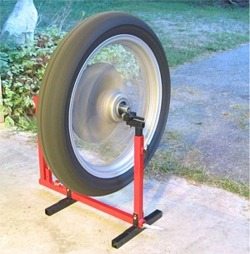
The unit measures about 21″ wide by 17″ high by 1″ wide unassembled, which makes it very easy to store if you don’t have much room.
You can tell that a great deal of thinking has gone into this balancer.
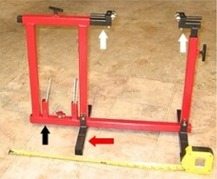
For example, the legs (red arrow in photo 2 below) are removable for storage, so the frame has little welded-on pylons (black arrow, photo 2 below) to hold the legs upright and locked in place when not in use, with the bolts and wing nuts doing double-duty.
He gives you a strip of 1/4 oz. (7 gram) weights when you buy the balancer, and the weights are stored inside those same pylons, where they’ll be readily available when you need them while balancing, but not forgotten otherwise.
He has even marked the removable feet so that you know which side to install them on, and they’re marked so that you know how to stack them when removed for storage. He’s really thought of everything!
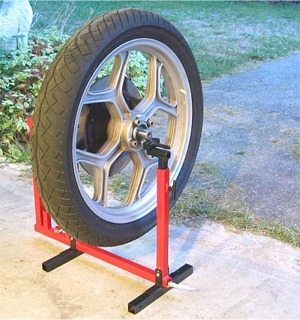
(L)Photo 1 – The balancer “out of the box”. (R) Photo 2 – Features of the balancer.
What’s nice about this balancer is that in most cases, the wheel’s axle is used for balancing, so there’s no need to make or buy separate balancing equipment to hold the wheel.
It adjusts horizontally for various wheel widths, and the vertical adjustment allows this balancer to work with axles of two diameters.
For example, some axles have one size diameter that fits the wheel, and a larger diameter to fit into the forks.
The vertical adjustment can also be used to ensure the axle is perfectly level, which not only ensures a proper balancing job, but prevents the wheel from “walking” one way or the other while it’s spinning.
Using the balancer is easy. I had never removed, mounted or balanced a motorcycle tire before, but now that I’ve done it, I realize it isn’t really that hard. It takes more muscle than anything else, to be honest.
I won’t get into the details here, but the hardest part of the whole mounting process seems to be breaking the bead for removal, and seating the bead when remounting.
I used a piece of 2″ by 4″ lumber, wedged it underneath the door sill of my car, and used it as a lever to bear down on an 8″ long piece of the 2×4 to break the bead.
It took more effort than I thought it would, but you’ll know when it breaks — it kind of pops off. Once that’s done (without damaging the brake rotors, of course!), it’s simply a matter of using a set of tire irons to lever the tire off the rim, again without damage.
Getting things back together is a reverse of this process.
There are plenty of links to information on how to do this on the webBikeWorld Motorcycle Tirepage, but the thing to remember is that I think pretty much anyone with a modicum of mechanical ability can do it.
That’s the hard part.
The fun part is the actual balancing, using the balancing stand. Apparently, the automatic spin balancers you see in the motorcycle shop don’t do the job any better, just faster.
This balancer is extremely accurate — there’s even a photo of a crankshaft being balanced on this stand (it was out of balance!) and apparently this is the only balancer that can do this.
The balancer is very popular with motorcyclists who put on a lot of miles in the course of a year, or run some track days (where balance is very important), and frugal riders like me and you.
I’m sure I’m like many other motorcyclists who just like to do the work themselves, both for the feeling of satisfaction that it gives, but also to make sure the job is done right!
Other customers include independent motorcycle repair shops, collectors, restorers and just about any other hard core biker who loathe taking their bike to a shop.
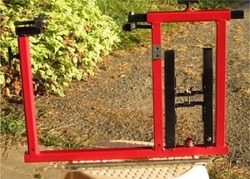
Photo 3 – Vertical height adjustment.The first time I used it, I lined up the stand’s vertical bearing assembly by eye so that it looked even with the other side. The axle on the wheel I was balancing had a long diameter that fit nicely on the bearings.
I was told that the correct way to get everything even is to first place the axle on the bearings and then place a small level on the axle, then adjust vertically if necessary.
It’s really easy to make the vertical adjustments to get everything nice and level. This helps not only to obtain the proper balance, but also to prevent the wheel from “walking” one way or the other while it’s spinning.
All you have to do is loosen the friction screw (white arrow, photo 3, left) and move the vertical assembly up and down to the correct position.
A good method is to get it lined up first by measuring the height, then make the final adjustment with a small level.
Now comes the fun part! There’s a bit of a trick to spinning the wheel — it’s not necessary to spin it too fast; you run the risk of walking it off of the balancer’s bearing assemblies, and you’ll also waste a lot of time waiting for the wheel to stop spinning.
It’s easy to get the feel for spinning the wheel so it just turns maybe 2-3 times. The bearings are pretty sensitive, so it doesn’t take much to get the wheel going.
When the wheel stops spinning, mark the wheel at the bottom low spot. I used a tiny piece of Teflon tape, which is used for sealing pipe fittings. It’s extremely lightweight and sticks to the metal part of the wheel, and since it’s easy on, easy off, you don’t have to worry about removing any grease pencil marks later on.
Spin again and see if the heavy side still stops on the bottom. If not, place another mark at the bottom and spin once more. The idea is that if the wheel stops at random locations, then the wheel is balanced.
If the same spot ends up at the bottom, then an equal amount of weight at the top will even things out. The instructions are easy to follow, and the whole process doesn’t really take that long.
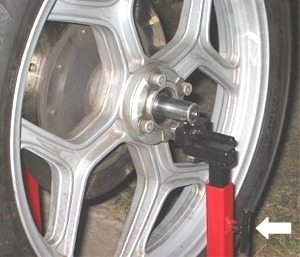
Photo 4 – The test tire, a Bridgestone BT45By the way, while you have the wheel off, and before you start the balancing procedure, it’s a good idea to clean the wheel.
The balancer is sensitive enough that a small stone caught in the treads can affect the balance.
The balancer is probably way more sensitive than you really need — tires that are spin balanced are usually within 5 grams or so.
Check out any motorcycle you see and look at the wheels; you’ll probably see 1/4 oz. (7 gram) weights, which is about the tolerance that most shops use.
This balancer will register down to a couple of grams, and don’t forget, there are 28 grams to an ounce! When you start getting down to less than 5 grams or so, you’re probably not going to feel the difference in a motorcycle tire.
But if you’re really persnickety, there’s also the option of ABEC-5 bearings, which are good down to 0.5 gram!
A 4.5″ long piece of masking tape weighs about that much, so we’re really talking microscopic (and probably unnecessary) differences here.
The tire I used for this review is an almost brand-new Bridgestone BT45 (photo 4, left). I had recently mounted it and had it spin balanced at the local Harley shop.

I didn’t have a good feeling that the person that did the work really knew his stuff; when I got the tire back, it had two 1/4 oz. weights installed opposite the valve stem — too predictable!
When I put the wheel back on the bike and went for a ride, it seemed like the tire was bouncing up and down at certain speeds. So when I tried it on this balancer, guess what — the weighted side dropped right to the bottom.
I first took off one weight, then the other, and found that the wheel was perfectly balanced with no weights at all.
My guess is that the repair shop couldn’t believe that a tire/wheel assembly could be balanced without weights, so they simply stuck a couple on opposite the tire valve.
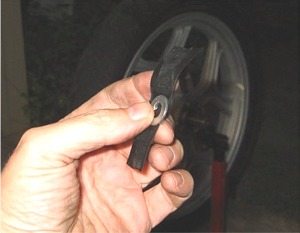
Photo 5 – This washer made a difference in balance.Just for kicks, I found a thin, small washer (photo 5, left) and taped it on the wheel with a piece of electrical tape. I don’t have a small scale, but I estimate that the washer and the tape together weighed maybe 3 grams.
Again, remember that there are 28 grams to an ounce. I taped the washer to the wheel, gave the tire a spin, and sure enough, the weight ended up on the bottom!
This balancer is certainly more sensitive than you’ll ever need on a motorcycle tire, but it’s also really nice to know that using his balancer is going to give you the most precisely balanced wheels possible.
When I remounted the tire on the bike, the bouncing sensation was completely gone, and the front end felt really planted.
There is also an optional magnetically mounted alignment pointer offered with the balancer, which allows you to make sure your wheels are true. You can also use the pointer to true up spoked wheels. I think it’s a good idea to get the pointer when you order the balancer so that you have it, just in case.
The balancer requires no special maintenance or handling, although you’ll want to be careful not to drop the stand or accidentally hit the bearings. I wrapped the bearing assemblies in aluminum foil to keep out any dirt or dust while the unit is in storage.
Note: “D.H.” writes: “Since, I’m going to assume, that the bearings are made of hardened steel (any steel, for that matter), it might be better to wrap them lightly in a ply bag, but not sealed too tightly, so as to allow for some ventilation.
The problem with aluminum foil is, that over an extended period of time, some galvanic reaction will occur between the steel bearing surfaces, and the foil. This will result in some etching of the bearing surfaces.
Certainly, a bit of light oil (if the kit allows this) on the surface will also have benefit.” Thanks for the tip, D.H.!
There are several reasons for making an investment in a balancer. Motorcycle tires wear out very rapidly compared to automobiles, so if you ride, say, 8,000 to 12,000 miles per year (or less if you have a sport bike with soft tires), you can count on needing a new set of tires almost once per year.
A balancer will pay for itself by time a few tires are mounted and balanced.
Also, since tires seem to be much less expensive when purchased online (although make sure you watch out for shipping and handling charges), you’ll only fully realize the savings if you balance them yourself, rather than bring them to a shop.
You also know the job is done right, as I’ve found out!
The only downside is that once people find out you have a balancer, you’ll find that all of a sudden you have a bunch of new friends!
Editor’s Note: This product is no longer in production. See our other motorcycle tire balancer reviews: Tachyon Balancer | Portable Tire Balancer | Changing and Balancing Wheels and Tires
Master Listing of All wBW Motorcycle Product Reviews
Owner Comments and Feedback
See details on submitting comments.
From “M.L.”: “He was great to deal with. He put up with my questions before the purchase. Delivered what he promised and the Product has worked out great for me. Thank you – I highly recommend it and his Products to others.”
From “K.T.”: “I purchased the wheel balancer because of the review on your site. I, too, felt a type of vibe and attributed it to the tires being out of balance. Sure enough, my front rim was 21 grams out of balance (3 7-gram weights)! This was somewhat substantial. The rim was balanced by a local shop and they deemed it needed no weights.
Also important to note – the shop explicitly had me remove the brake rotors. I was under the impression that any rotating mass should be left on the wheel to provide an accurate balance. He confirmed my thoughts and I left them on when I balanced the rim myself. Thank you for the great product info!”
From “D.E.”: “Rick, I came across the review of this wheel balancer on your site. I purchased it a few months ago and I have absolutely no regrets.
I have 5 bikes between myself and my wife. I have always changed my own tires but usually took them to my local dealer to have them balanced. (When I did balance them.) Even given the fact that they sponsor me on the motocross side of the world it was still pretty expensive.
Even though I have only had the thing for a few months it has already paid for itself. And it makes a big difference having the tires balanced correctly.
The balancer is one of the best tools in the garage now. It is easy to use, and balances everything from a small front tire on my wife’s GS500E, to the big meat on the back of the GSXR 1000. I bought the ABEC-5 bearings since I wanted things to be in the best shape possible for track days. Very accurate!!!
I would recommend the balancer to anyone. Also noteworthy is the fact that he answered all my questions very quickly, and had the thing shipped within a day or two.”