
BMW S 1000 RR SuperSports Street Motorcycle – Part 2: Drivetrain
BMW S1000RR SuperSports Street Bike Report:
- Part 1 Overall Concept and Features
- Part 2 Drivetrain
- Part 3 Suspension and Running Gear
- Part 4 Page 4 Includes:
BMW S1000RR Part 2: Drivetrain
High-Output Four-Cylinder Inline Power Unit for Maximum Performance
As an absolutely new development from the ground up, the straight-four power unit featured in the S 1000 RR comes with displacement of 999 cc, with cylinder bore of 80 millimeters or 3.15″ and stroke measuring 49.7 millimeters or 1.96″.
The particularly short stroke/bore ratio of just 0.621 provides the foundation for an absolutely outstanding high-output power unit with supreme performance at all times. Maximum output is 142 kW (193 hp) at 13,000 rpm, peak torque is 112 Nm (82.5 lb-ft) at 9,750 rpm.
So again, the power unit of the S 1000 RR sets new record standards in the supersports 1000-cc class also in this respect. Optimum riding dynamics and supersports features combined with optimum rideability and compact dimensions together with minimum weight were the primary targets in developing the new drivetrain. And with its engine weighing just 59.8 kg or 131.8 lb, the S 1000 RR boasts the lightest 1000-cc four-cylinder in its entire segment.
Like all engines from BMW Motorrad, the power unit featured in the S 1000 RR excels through its supreme overall concept as well as the space-saving arrangement of all ancillaries and the integrated six-speed gearbox with its dog-type gearshift.
Following the brief to build a thoroughbred supersports power unit, the engineers at BMW Motorrad have created a particularly compact engine with ideal concentration of masses around the machine’s overall centre of gravity. Despite the large cylinder bore of 80 millimeters or 3.15″, engine width at crankshaft level is only 463 millimeters or 18.23″. And at 558 millimeters or 22.0″, the engine is also very low in terms of its overall height.
The cylinder axis on the S 1000 RR power unit is tilted 32° to the front, providing an optimum centre of gravity as well as the front wheel-oriented weight distribution so essential on a supersports machine, with absolutely precise riding control and maximum clarity in terms of feedback from the front section.
The new straight-four on the S 1000 RR again lives up to the consistent principle of BMW Motorrad maintained over a period of no less than 85 years and applied throughout 25 years of four-cylinder development to provide superior and unique technical standards going far beyond the usual level of technology.
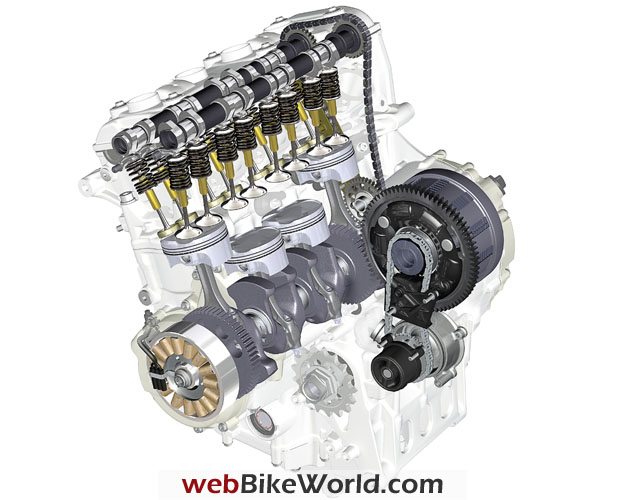
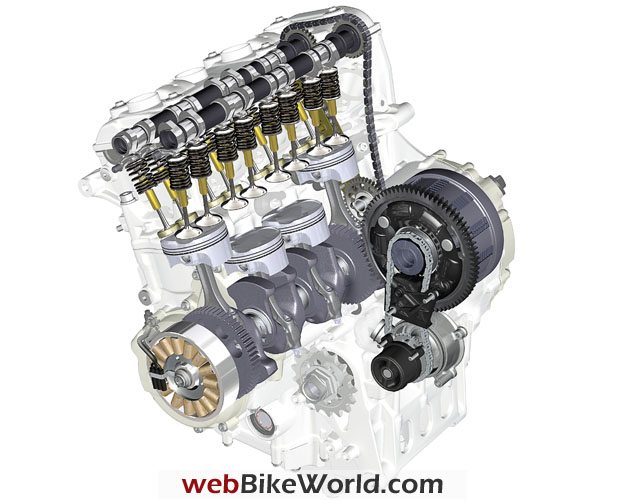
Largest cylinder bore in the segment measuring 80 millimeters or 3.15″. The crankshaft on the S 1000 RR is forged out of one single piece of heat-treated steel, runs in anti-friction bearings and comes with the traditional crank angle of 180° for a consistent fi ring distance at all times.
Both the main and the conrod bearing journals measure 34 millimeters or 1.34″ in diameter. Running in anti-friction bearings, the connecting rods are forged out of extra-light heat-treated steel. Measuring 103 millimeters or 4.06″ in length, they help to keep the engine low and compact, saving space and lowering the centre of gravity even further, with lateral forces on the pistons remaining within reasonable limits and the engine running smoothly and consistently under all conditions.
Together with their anti-friction bearings, the connecting rods weigh just 334 grams. The upper conrod opening comes without a bearing bush and measures 17 millimeters or 0.67″ in diameter. Two lubrication openings in the upper eye of the conrod and positioned at an angle of 45° to the vertical axis of the rod ensure a reliable supply of oil to the piston pin bearings at all times.
The connecting rods are split horizontally by the proven cracking method, with the large conrod opening being cracked exactly as required on its centre level by a sudden pulling force applied hydraulically. The fracture formed in this way ensures extremely precise subsequent assembly without any further centering of the components being required.
The cylinder liners with their Nikasil coating incorporate forged lightweight box pistons measuring 80 millimeters or 3.15″ in diameter and featuring a very short piston skirt. Further highlights are the two narrow piston rings optimized for minimum friction and a three-piece oil scavenger ring.
Through their low and dynamic design and configuration, the combustion chambers, piston base and valve pockets make the entire combustion process very smooth and efficient in thermodynamic terms, with the contours of the piston base being optimized for minimum weight. The pistons themselves, together with their bolts and rings, weigh just 253 grams each.
To remove and dissipate heat, the pistons are cooled at the bottom under high thermal loads by oil injection nozzles in the crankcase. This ensures supreme reliability even under extreme running conditions and extends the overall running life of the pistons.
Ultra-Compact, Extra-Stiff Cylinder Crankcase
Split horizontally down the middle of the crankshaft, the cylinder crankcase is made of extra-strong aluminum alloys. The compact die-cast upper section forms an extra-stiff combination with the four cylinders and the upper bearing mounts for the crankshaft.
The upper half of the crankcase also takes up the light and compact six-speed gearbox. Together with its all-round coolant shell, the cylinder block is designed for maximum stiffness in closed-deck configuration and the cylinder liners come with a wear-proof, low-friction Nikasil coating.
The lower section likewise die-cast forms the counter-piece for the main crankshaft bearing as well as the bearing on the gearbox drive shaft.
Cylinder Head And Cam Follower Valve Drive Based On BMW Formula 1 Technology
Overall output, performance characteristics, the quality of the combustion process and fuel consumption depend largely on the cylinder head and valve drive. In its design and overall configuration, the four-valve cylinder head featured on the S 1000 RR thus offers ideal duct geometry, compact dimensions, optimum thermodynamics, and an efficient heat balance.
The narrow valve angles help to provide ideal intake ducts as well as a compact combustion chamber for high compression and optimum all-round efficiency. Seeking to achieve maximum power and supreme running smoothness even at very high speeds while at the same time offering a very stiff structure, keeping moving masses to a minimum and optimising the timing overlap on the valves, the S 1000 RR comes with cam follower control on all moving valve components, with the cylinder head very compact in design, particularly in terms of its height.
Valve play is compensated by means of very small and light adjustment platelets running on the spring plates. On the intake side the spring plates are made of an extra-light aluminum fibre material.
The moving masses of the cam followers featured on the S 1000 RR are approximately 50 per cent lower than with comparable cup tappets. Such reduction of oscillating masses to an absolute minimum allows fast valve acceleration for a power-oriented cam profile and a high level of free valve cross-sections. This is also why the cam followers on the S 1000 RR are extremely short and light in their structure and configuration.
A further particular highlight in the design of the cylinder head is the arrangement of the cam follower axes, with both the intake and the exhaust cam followers facing to the rear in the direction of travel. This keeps the cylinder head even more slender as on the usual arrangement with the bearing shafts at the outside.
Tight Valve Angle and Lightweight Titanium Valves
The valve angle is 11.2° on the intake side and 13.3° on the exhaust. The two camshafts made of heat-treated steel and arranged directly above the valves are driven by a toothed chain running on a secondary gear shaft just above the crankshaft.
The intermediate gear used in this configuration helps to keep the toothed chain driving the camshafts shorter than would otherwise be the case, ensuring even greater precision in valve timing and keeping the engine slimmer on the level of the crankshaft.
The intermediate gear transmission also helps to keep the two drive wheels on the crankshafts very short, with the overall layout of the cylinder head remaining very compact. Optimized valve springs as well as a hydraulic tightening mechanism for minimum friction serve, finally, to minimize both running and drag forces, enhancing the standard of power and performance once again.
Made of extra-light titanium, the intake and exhaust valves are operated by very small and light individual cam followers. The overall geometric layout of the cylinder head allows an ideal transmission ratio on the cam followers of approximately 1:1, reducing flexural forces and bending to an absolute minimum and therefore serving to keep the arms very light and almost filigree in their construction.
Use of such extremely small and light cam followers offers utmost freedom in choosing the optimum valve lift curves and, therefore, the very best power and performance characteristics both for the road and the race track.
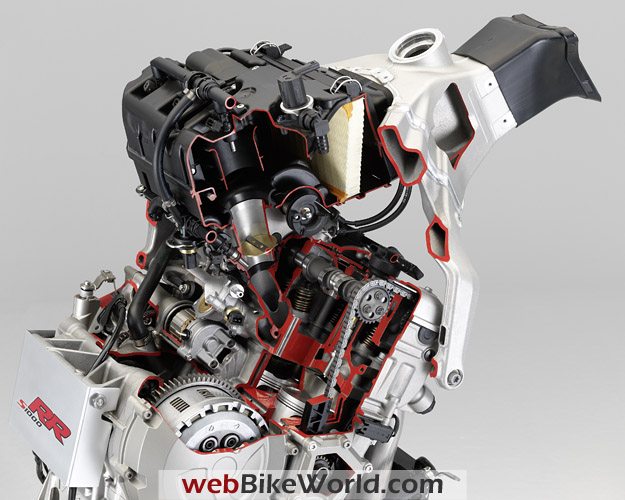 BMW S1000RR Engine and Valve Train Cutaway
Largest Valve Plate Diameter in this Segment
The rev limit on the production version of the S 1000 RR is 14,200 rpm, while in purely mechanical terms the engine could run much faster.
Thanks to the large cylinder bore of 80 millimeters or 3.15″, valve plate diameter is larger than on all other engines in this segment, providing the ideal basis for maximum output and performance: Valve plate diameter on the intake side is 33.5 millimeters or 1.32″ and 27.2 millimeters or 1.07″ on the exhaust side, setting a new record in the supersports 1000-cc segment in the interest of a maximum cylinder charge and an optimum charge cycle.
The valve shafts, in turn, measure 5 millimeters or 0.197″ in diameter. The intake ducts are machined asymmetrically at the transition point leading to the valve seat rings in order to improve the flow of gas and optimize the cylinder charge for even more power at high engine speeds.
The low and fl at design of the combustion chamber guarantees a very high level of geometric compression with a thermodynamically optimized cylinder base largely smooth from one side to the other. With its compression ratio of 13:1, the power unit of the S 1000 RR comes right at the top in terms of production engines, offering an ideal combustion process for optimum power yield and maximum efficiency.
Proven and Compact Wet Sump Lubrication
The lubricating system on the S 1000 RR is a proven wet sump system using an Eaton oil pump. Oil is cooled not by a heat exchanger, but rather by a separate oil cooler integrated beneath the radiator in the lower section of the fairing for superior flow conditions and aerodynamic qualities.
Use of an oil cooler prevents any undesired, additional thermal exposure of the coolant and therefore allows the use of a smaller and lighter radiator reducing the amount of coolant required. The oil level is checked in a very practical and simple manner by means of an inspection glass on the left side of the engine beneath the alternator cover. Engine oil capacity is 3.9 litres or 0.86 imp gals including the filter.
Perfect Cooling Concept For Optimum Flow Conditions, Good Thermal Balance And Low Weight
An innovative cooling concept gives the power unit of the S 1000 RR an optimum thermal balance at all times: The coolant flows through the cylinder head in crosswise direction, the appropriately cooled coolant fl owing into the cylinder head on the right-hand side, that is on the hotter exhaust section.
So precisely where the temperatures are highest, intense cooling on the cylinder head ensures a fast flow of coolant and, accordingly, an optimum temperature balance for optimum power and performance. Fitted on the right-hand side of the engine, the coolant pump, like the oil pump, is driven by a single roller chain running on the gearbox drive shaft.
The amount of coolant (50 per cent water, 50 per cent anti-freeze) required is only 2.9 litres or 0.64 imp gals. The radiator is in bent trapezoidal design and is fitted upfront of the engine beneath the cylinder head to provide optimum balance and superior aerodynamic flow conditions.
Thanks to its high standard of efficiency as well as elaborate tests in the wind tunnel to optimize the fairing and flow conditions in terms of aerodynamics, the cooling surface required is relatively small at just 955 sq cm, sufficient to ensure reliable dissipation of heat under all conditions.
To provide an optimum flow of air to the radiator, BMW Motorrad has developed a patented air guidance concept ensuring maximum efficiency in the removal and dissipation of heat. In all, therefore, an elaborately calculated aerodynamic concept developed in the wind tunnel interacts perfectly with optimum removal of outgoing air from the fairing. The engine spoiler helps to provide a sophisticated, highly aerodynamic flow of air effectively cooling both the oil sump and the manifolds.
Light and Compact Ancillary Units
Minimum width, compact and, above all, light structures were the essential points also in the design and arrangement of the electrical ancillaries on the engine and their drive systems. The alternator featuring a permanent magnet, for example, is fitted on the left end of the crankshaft, generating 434 W at 6,000 rpm and configured for a maximum speed of 16,000 rpm.
The layshaft starter arranged on the left of the upper half of the engine block behind the cylinders generates maximum output of 800 W and weighs 1,050 grams. The starter is connected to the engine by a free-wheel and acts
at a transmission ratio of 1:24.61 on the outer left crank web designed as a spur gear.
To keep weight to a minimum, the left-hand side cover on the alternator and starter is made of extra-light magnesium.
Multi-Disc Anti-Hopping Oil Bath Clutch, Six-Speed Gearbox And Optional HP Gearshift Assistant
Torque is transmitted from the crankshaft via a straight-toothed primary drive at a ratio of 1:1.652 to the anti-hopping wet clutch with a total of ten friction plates (diameter 132.4 mm or 5.22″).
Applying the anti-hopping principle, BMW Motorrad meets all the requirements of supersports riding, particularly on the race track. The braking power of the engine in overrun is transmitted to the rear wheel by the clutch only in part, that is only to a limited extent.
When braking hard and shifting down at the same time, this prevents the rear wheel suddenly running under much less load due to the dynamic distribution of wheel loads from abruptly locking and juddering, keeping the motorcycle smooth, stable, and easy to handle also when applying the brakes.
The clutch is disengaged in overrun mechanically by a ramp mechanism, with clutch operation via a hand lever and with maximum manual forces limited to 80 Newton. The operating forces generated are transmitted via a cable to the
disengagement lever on the left side of the engine and from there through a thrust rod to the clutch pressure plate.
This saves substantial weight compared with hydraulic operation of the clutch, just as the clutch cover made of extra-light magnesium serves to reduce weight to a minimum, again reflecting one of the most significant objectives in the design process.
The dog-shift six-speed gearbox is very compact and light. The individual gears are shifted by a light, composite steel shift cylinder and shift forks resting on three points. To keep the gearbox and transmission system as compact and short as possible, the primary and secondary shafts are positioned on top of one another, thus saving a lot of space. Again, this reduces the overall length of the engine and allows the use of a long rear-wheel swing arm in the interest of optimum traction.
Kept hollow in its structure again in the interest of minimum weight, the gearshift cylinder runs in anti-friction bearings. The shift forks are made of steel and are lubricated by compressed oil. The gears themselves come with straight teeth, the gear claws and pockets being cut back within to ensure optimum gear mesh.
The transmission of power to the rear wheel, finally, is ensured by a 525 O-ring roller chain on the left side of the engine. The S 1000 RR offers the customer the option to choose the HP Gearshift Assistant featured for the first time on the HP2 Sport, thus enabling him to shift up without operating the clutch and therefore with hardly the slightest interruption of power and pulling force.
In the process the ignition and fuel supply are interrupted for fractions of a second in order to keep the gearshift absolutely smooth and even very soft. The advantage, obviously, is even faster acceleration, with the rider gaining valuable fractions of a second. The optional HP Gearshift Assistant may be combied with sports footrests available as special equipment.
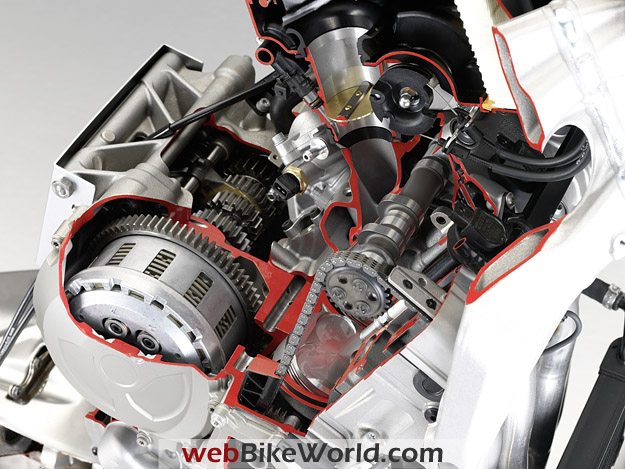 BMW S1000RR Engine and Transmission Cutaway
Engine Management With Cylinder-Specific Anti-Knock Control For Maximum Power And Performance
The S 1000 RR comes with the most advanced and sophisticated digital motor electronics currently available on a motorcycle. The software incorporated in this sophisticated BMS-KP (short for BMW Engine Management with Anti-Knock Control) is an in-house development by BMW Motorrad specifically for motorcycle applications.
Fully sequential, cylinder-specific fuel injection, integrated anti-knock control, ultra-fast processing of a wide range of sensor signals by the most advanced microelectronics, a compact layout, low weight and self diagnosis are the most important features of this sophisticated system.
And to meet the requirements of a supersports machine, the engine management unit comes on the S 1000 RR with an even faster central computer developed to an even higher standard and fully adapted to this unique machine.
Torque-based engine management takes a wide range of different parameters and criteria into account. The supply of torque and the sensitive adjustment of engine running conditions, for example, follow all kinds of requirements tailored to the rider’s needs.
The main parameter in controlling the engine is the amount of air drawn in determined indirectly through the throttle butterfly angle and the running speed of the engine. Taking additional engine and ambient parameters (including
engine temperature, air temperature, ambient air pressure) into account, the engine control unit, together with control maps integrated in the system and appropriate correction functions, determines the ideal injection volume and
ignition timing.
Fuel grade is premium unleaded, that is at least 95 octane. And thanks to cylinder-specific anti-knock control, the power and performance of the engine may be raised to an even higher standard when running on higher-octane fuel.
Variable Intake Manifold Length For An Optimum Torque Curve And Maximum Power
Fuel injection is fully sequential, meaning that fuel is injected individually in accordance with the intake stroke of the respective cylinder into the intake duct. To improve the torque curve, the S 1000 RR comes with highly elaborate intake manifolds varying in length according to current requirements: Depending on engine speed an adjuster motor fitted on the airbox varies the length of the intake manifolds through map control in two stages.
Serving to provide an optimum cylinder charge, the appropriate amount of fuel is fed into the engine at all times through four injection jets each on the throttle butterfly rail and above the intake manifold. Depending on engine speed and the power required, the injection jets are controlled either separately or together in one process.
Variable Pressure Control For An Ideal Supply Of Fuel.
Instead of a reflow pipe, the fuel supply system uses variable pressure control to deliver only as much fuel as the engine really requires at any given point in time. This sophisticated fuel supply management allows virtually any change or modification of fuel supply pressure for optimum fuel/air mixture formation ensured by operating the electrical and, for the first time, fully controlled fuel pump at a high pressure of 3–5 bar.
Such adjustment of fuel pressure as a function of current operating conditions is quite unique in the supersports segment. The fuel/air mixture is controlled for environmental purposes by means of two oxygen sensors fitted at the junction points on the exhaust manifolds to precisely monitor the composition of exhaust gas.
The BMS-KP (BMW Engine Management with Anti-Knock Control) management unit on the S 1000 RR integrates the automatic idle control and cold start enrichment functions by way of electronically controlled throttle butterflies.
Idle speed is automatically raised whenever required while warming up by increasing the level of engine speed by way of the engine management.
E-Gas for Optimum Response and Precise Fuel Metering
The throttle butterflies measuring 48 millimeters or 1.89″ in diameter are controlled by an electric motor forming an E-gas or ride-by-wire system. In this process the rider’s commands are transmitted to a sensor from the cable on the gas handle. All-electronic engine management then converts the rider’s commands into an appropriate torque signal, with the throttle butterfly controlled electronically.
With all torque factors being taken into account in this way, the system ensures optimum rideability under virtually all conditions until the traction control intervenes. The E-gas system uses the three-level monitoring concept already proven in its qualities on BMW cars.
As an additional feature, the S 1000 RR comes with a mechanical link connecting the cable to the electronic control unit and enabling the rider to close the throttle butterfly under all conditions. Intake manifold with optimum air supply for the best cylinder charge.
The engineers at BMW Motorrad have used virtually every millimetre on the S 1000 RR to make the intake system as large as possible, giving it maximum volume. The airbox with its pure air capacity of 7.9 litres, for example, is directly above the engine and is likewise designed for maximum power and torque all in one.
Air intake is at the central point with maximum ram pressure on the upper section of the fairing between the two headlights. From there intake air flows on an ideal straight path through an air duct to the steering head shaft right and left, past the steering head, directly into the airbox and from there to the vertically arranged plate air filter.
While other manufacturers in the supersports segment all use a lying or horizontal plate air filter, the disadvantage in that case is that the flow of air has to be diverted. The S 1000 RR avoids such unfavourable diversion of intake air,
with the air duct leading from the air intake opening to the steering head shaft serving at the same time as the support for the instrument cluster, rear-view mirrors, headlights and horn. And made of extra-light pressure-cast magnesium, this component not only saves the need for separate supports, but also reduces weight to a minimum.
The air inlet in the upper section of the fairing uses the ram-air effect almost perfectly through its position, supporting the air supply process very efficiently at high speeds, with up to 30 mbar overpressure in the airbox, depending on the current speed of the machine.
At a speed of 250 km/h or 155 mph, for example, this means an extra 4 kW engine output. This is superior to all competitors in this segment and again clearly underlines the quality of airflow in and from the airbox and, quite generally, the supply of air to the engine in the S 1000 RR.
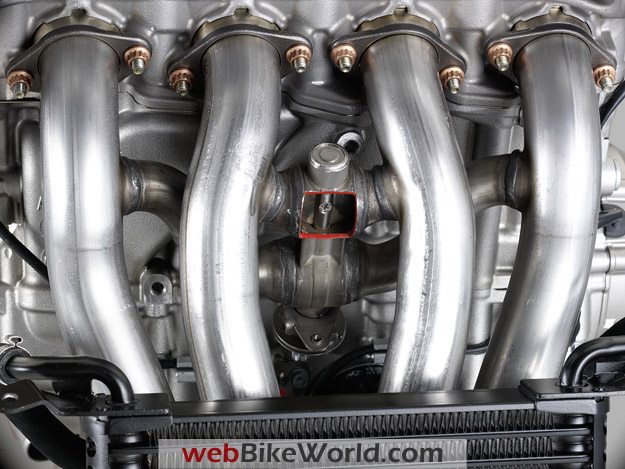
Innovative High-Performance Exhaust System With Interference Pipe Butterflies
The exhaust system on the S 1000 RR is likewise built for maximum performance. For this reason, to save weight and to centralize all masses, the development engineers at BMW Motorrad decided to fit the exhaust system beneath the engine, instead of choosing an under-seat solution.
The four individual manifolds of equal length first merge beneath the engine block into two pipes (4-in-2-in-1 principle) and then come together in an extra-large pre-silencer with three chambers working according to the reflection principle.
From there the flow of exhaust gas goes out through a short, light and very dynamic absorption rear muffler. Both the outer skin and the interior of the complete system are made of top-quality stainless steel.
To achieve optimum rideability as the prerequisite for sporting and dynamic performance on the road and fast laps on the track, a homogeneous power and torque curve is absolutely essential. The exhaust system on the S 1000 RR therefore comes with two interference- type butterflies within two connection tubes linking the two outer and the two inner manifolds in the immediate vicinity of the exhaust ducts.
Depending on various engine map parameters such as engine speed and the position of the throttle butterfly, an actuator opens and closes both of these flaps, opening or, respectively, interrupting the connection between the two manifolds.
This coordinates oscillations in the flow of exhaust masses in order to reduce exhaust gas counter-pressure at exactly the right point (like in a racing muffler) and increase the cylinder charge accordingly.
This technology never seen before on a production motorcycle makes a significant contribution to the homogenous and “beefy” power and performance characteristics of the engine, ensuring very good torque and boosting the overall performance of the S 1000 RR to an even higher level.
The two metal-based catalytic converters with cell density of 100 cells/sq inch are fitted in the pre-silencers upfront of the manifold entry point. They come complete with a rhodium/palladium coating combining high temperature resistance with a long running life.
Small and Light Muffler
Maintenance of the strictest noise and emission limits despite supreme engine power is ensured on the S 1000 RR by features such as an electronically controlled exhaust flap positioned upstream of the rear-end muffler, opening up the exhaust pipe to its optimum cross-section as a function of increasing engine speed.
Varied in this way, the exhaust pipe cross-section provides a deep engine rumble at lower to medium engine speeds, while the larger cross-section opening up at higher speeds ensures maximum output and a very sporting sound.
The very small and compact rear-end silencer accentuates the slender look of the S 1000 RR and enables the rider to lean over to a very low angle in bends. So here again, the rear silencer helps to ensure not only a sporting and powerful sound, but also truly impressive output and performance on road and track.
Made of top-quality stainless steel, the complete exhaust system weighs a mere 10.7 kg or 23.6 lb. At the same time this is the most compact exhaust system with fully controlled emission management in this entire segment. As an option the S 1000 RR is available with a very light slip-on muffler made of titanium and with a carbon trim cover at the rear. The supplier of this special muffler in its very sporting and dynamic design is Akrapović.
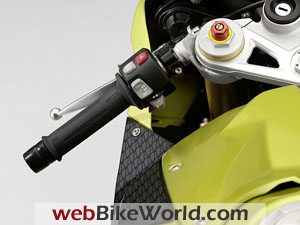
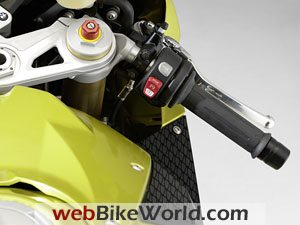
“Rain”, “Sport”, “Race” And “Slick” Modes For Optimum Adjustment To Road And Track Conditions.
At the simple touch of a button at the end of the right handlebar, the rider is able to choose among various riding modes for all kinds of different conditions and requirements such as riding on the road, on a wet surface, or the race track.
To make a choice, all the rider has to do is press the Mode Switch on the right handlebar control unit until the display in the instrument cluster reaches the mode desired. Then, pulling the clutch lever and turning the gas handle to idle, the driver is able to confirm his request also while riding and the mode is switched accordingly. The mode last chosen is always retained when re-starting the motorcycle.
When riding on a wet surface with reduced grip, the Rain Mode automatically reduces maximum output to 110 kW (150 hp). This mode also provides a particularly homogenous power and torque curve, with engine response and power build-up by the engine being extra-smooth and soft.
When riding on a dry surface the Sport Mode provides full engine output of 142 kW (193 hp) in combination with even more spontaneous and direct response to the gas lever. This mode is intended above all for use on country roads.
The Race Mode has been developed specifically for racing the S 1000 RR on race tracks using street-legal supersports tires. Here again the rider benefits from the full power of the engine, with an even more direct and significantly more dynamic response at all speeds.
The Slick Mode is intended exclusively for racing on the track using slick tires. Like the Race Mode, this mode not only provides full engine power, but also ensures maximum engine response for racing or riding under race-like conditions.
Contrary to the Race Mode, the Slick Mode allows DTC Dynamic Traction Control to cut in permanently only from a side angle of 200. This, in turn, allows the rider to wheelie for up to five seconds when leaning over to an angle of less than 200, ensuring optimum acceleration and pulling force when accelerating out of a bend.
While the three modes Rain, Sport, and Race are activated by the rider directly from the end of the handlebar, the Slick Mode comes with an activation lock function provided by a code plug for the control unit beneath the rider’s seat of the S 1000 RR.
The rider is therefore required to first insert this plug before activating the Slick Mode, since apart from activating the even more dynamic engine set-up he also in this way activates different ABS and Traction Control settings for driving
to the absolute limit on slick tires. In this setting DTC is no longer suitable for surfaces with an extremely low frictional coefficient such as wet cobblestone or loose gravel.
Race ABS and DTC Dynamic Traction Control are combined individually with the various riding modes, thus harmonizing perfectly with one another for maximum riding safety. When required, the rider is able to deactivate the Race ABS and DTC Dynamic Traction Control functions separately from one another.
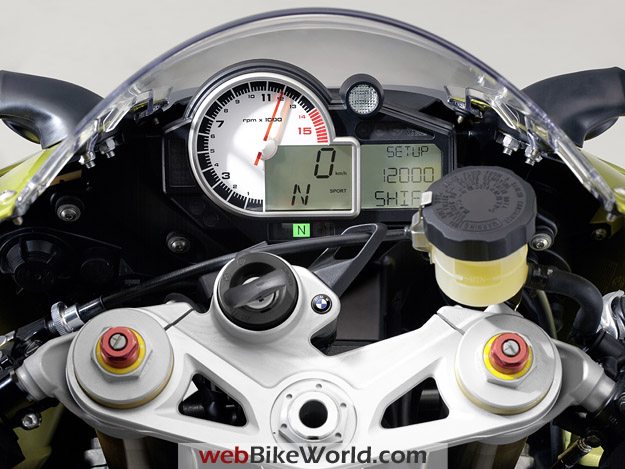
DTC Dynamic Traction Control For Even Safe Acceleration
As an option available straight from the factory, the S 1000 RR comes with DTC Dynamic Traction Control reflecting the truly outstanding performance, riding dynamics, and supersports character of this new machine.
DTC Dynamic Traction Control is a development from motorsport featured, for example, on the Superbike racing version of the S 1000 RR in the World Superbike Championship. This important feature makes a significant contribution to the truly impressive overall performance and outstanding riding safety of the S 1000 RR.
Particularly under changing riding conditions, on slippery surfaces and with sudden changes in the frictional coefficient on the surface, BMW Motorrad’s new DTC Dynamic Traction Control offers the rider significant support and assistance.
This advanced system largely suppresses any undesired slip on the rear wheel when accelerating and, therefore, avoids the otherwise inevitable loss of lateral stability causing the rear wheel to break loose and, should the worst come to the worst, leading to an accident.
Using the ABS sensors to compare the running speed of the front and rear wheels as well as data supplied by the side angle sensor, the electronic control unit recognizes whether the rear wheel is spinning and reduces engine power accordingly by taking back the ignition angle and intervening in the throttle butterfly position by way of engine management.
Unlike the former ASC systems used by BMW Motorrad, DTC Dynamic Traction Control therefore also determines the side angle of the motorcycle by way of an elaborate system of sensors, taking also this data into account whenever active.
Like BMW Motorrad Race ABS also available as a new feature, DTC Dynamic Traction Control is combined in each case individually with the engine management modes available. In the Rain Mode for riding on a wet surface, traction control cuts in at a very early point before reaching the friction limit on the tires, thus offering the rider maximum riding safety combined with significant riding pleasure even under difficult conditions.
In the Sport Mode, that is when riding on a dry road and, in particular, on cross-country routes, traction control cuts in a lot later, since here the tires have a much better frictional coefficient on the surface. Under these conditions, DTC Dynamic Traction Control therefore allows the rider to accelerate safely but dynamically out of a bend, enjoying maximum riding pleasure on public roads.
In the Race Mode DTC Dynamic Traction Control goes much further to the extreme, allowing a very sporting style of riding on the race track with street legal sports tires.
In the Slick Mode DTC Dynamic Traction Control is again set up perfectly for the race track, but now considers the much greater grip provided by slicks and enables the rider to choose all-out racing performance.
Although DTC Dynamic Traction Control offers the rider valuable support and therefore represents a very significant safety factor when accelerating, it is obviously not able – just like Race ABS – to re-define, let alone change, the limits and laws of riding physics.
In other words, the rider may still exceed these limits on account of misjudgment or a riding error, which in an extreme case may lead to an accident. DTC Dynamic Traction Control does however help the rider to capitalize on the dynamic performance of the S 1000 RR much more safely and much closer to the limits of riding physics. And last but not least, the rider may also switch off DTC Dynamic Traction Control via a separate button if he wishes.
Innovative Suspension Technology For Supersports Performance Of The Highest Standard
Through its consistent concept, the S 1000 RR, as a genuine supersports machine, offers not only the most outstanding drive train technology for optimum performance at all times, but also comes with truly exceptional riding precision ensuring unparalleled riding dynamics and almost playful agility.
So the suspension and running gear of the S 1000 RR likewise offers the highest standard of excellence and sporting performance. The “heart” of the suspension is the aluminum bridge frame weighing just 11.98 kg or 26.42 lb, tilting the engine to the front at an angle of 32° as a load-bearing element.
While this type of frame is already state-of-the-art in large sectors of the supersports segment, the engineers at BMW Motorrad, in developing the S 1000 RR, focused consistently throughout the entire process on the need for maximum riding dynamics.
And particularly through their close communication and cooperation with the departments responsible for drivetrain development and design, they ultimately created a suspension and running gear setting new standards in many respects.
Lightest ABS-Equipped Superbike in the 1000cc Class
Weighing just 206.5 kg or 455.3 lb in road trim and with a full tank, the new S 1000 RR is the lightest supersports with an engine capacity of 999 cc and Race ABS. But this alone is not sufficient to explain the outstanding handling qualities of the S 1000 RR quite in every respect.
Rather, it is particularly the machine’s ideal centre of gravity carefully set-up in elaborate tests as well as the geometry of the running gear that makes handling of this kind possible in the first place.
The steering head angle of 66.1°, for example, is very steep, wheel castor of 95.9 millimeters or 3.776″ is appropriately short. In the process of determining the ideal stiffness of the frame combined with minimum weight, BMW Motorrad – like in nearly all calculations and developments for the new S 1000 RR – focused consistently on computer models, simulations, CAD technology, and countless riding tests.
BMW S1000RR SuperSports Street Bike Report:
- Part 1 Overall Concept and Features
- Part 2 Drivetrain
- Part 3 Suspension and Running Gear
- Part 4 Page 4 Includes:
Note: For informational use only. All material and photographs are Copyright © webWorld International, LLC – 2000-2013. All rights reserved. See the webBikeWorld® Site Info page. NOTE: Product specifications, features and details may change or differ from our descriptions. Always check before purchasing. Read the Terms and Conditions!