

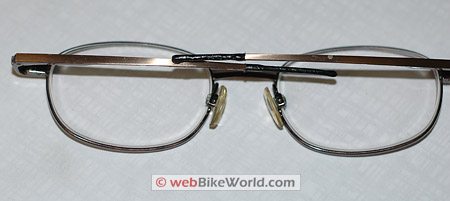
A simple modification allows the use of prescription eyeglasses with full-face motorcycle helmets.
This is an article that I am hesitant to post, because it seems like such a simple idea — surely others have thought of it too?
Then again, maybe not… I’ve been meaning to write about this for some time, because we’ve referred to it in a couple of reviews, and I was finally persuaded by a some recent email asking about it.
So although it may seem too simple, I guess if even a single motorcycle rider benefits from this information, then the effort will be worthwhile.
After all, not every article has to be about a fantastic new motorcycle concept or ground-breaking new product to make it interesting, right?
OK, so here we go:
A long time ago, I thought I’d never be able to wear a full-face helmet because my glasses would not fit underneath.
I remember way back in the ’70’s, actually trying to pull a full-face helmet over my head while I was wearing my glasses.
Maybe it was the shape of the helmets back then, or maybe I was just dumb, but, believe it or not, and I am loathe to admit this — I never thought to put the helmet on first and then try and stick my glasses on through the eye port!
But hey — I used to ride with sneakers and a T-shirt back then, too, so what did I know?!
Sounds silly, doesn’t it? Eventually I tried squeezing the glasses — the thick plastic-framed goggles with huge glass lenses that were worn back then — between the helmet padding and my noggin, but it was impossible to get the ear pieces hooked over my ears and the large lenses interfered with the small eye ports.
I eventually gave up and rode my motorcycles with an open-faced helmet covered by a large clear polycarbonate clip-on visor. I didn’t like it or the way it looked, but I had no choice — and it fit over my glasses.
Then flip-up, or “modular” helmets arrived in the 80’s. Heaven! I could finally ride a motorcycle while wearing my glasses and have some semblance of protection. So I rode with various flip-up helmets for many years, still longing for the protection and coolness factor that a full-face helmet would offer.
I thought about this for some time, and call me slow on the uptake, but one day, as I was cleaning out an old junk drawer, I came upon a couple of pair of old eyeglasses and it hit me: why not cut the ear pieces off and try it? I should be able to clip them off, sand down the plastic a bit and squeeze them between my head and the helmet padding.
And guess what? It worked, the very first time! I couldn’t believe this simple solution was right there all the while. I discovered that with a properly fitted helmet, there is enough friction between the padding and the head to hold a pair of eyeglass frames without falling out. It works, and I’ve been using this method ever since.
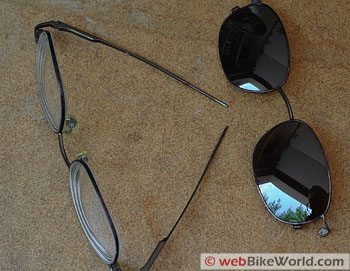
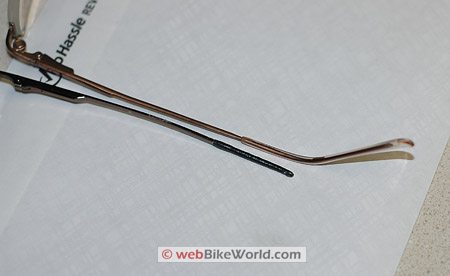
I’ve since moved to wire-framed glasses, which make the modifications even easier. Modern wire frames use thin and flexible metal for the arms; I can cut the ear pieces off with a pair of side cutters, sand down the tips so they don’t gouge my skin on a tight-fitting helmet, and that’s all it takes. In fact, the wire frames are even better, because the side arms are so thin, I hardly know I’m wearing them.
Even better — the wire frame glasses I use have built-in magnets along the top, which match small magnets on the pair of clip-on sunglasses that come with the eyeglasses. I can easily snap my clip-ons on and off using the magnets while I’m wearing a motorcycle helmet.
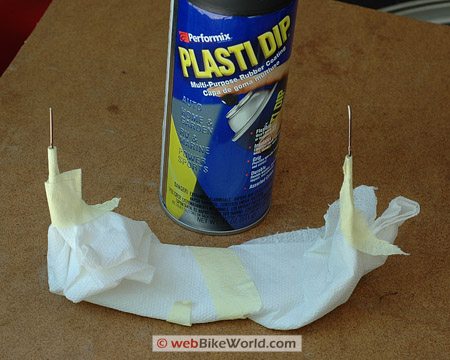
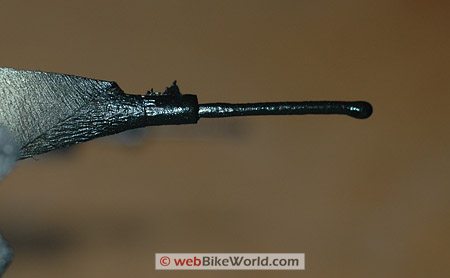
Un-modified motorcycle glasses (top); modified (bottom). I covered the glasses with a paper towel before spraying on the Plasti-Dip. My advice? Buy the dip can instead of the spray. It takes several coats of the Plasti-Dip spray to coat the end. The finished product; cut down and dipped!The only occasional problem I may have is with a helmet that is either very, very tight or if it has padding that is strangely shaped along the temples (very rare). This may push the sides of the glasses in on my nose, and the solution is to slide them down on my nose slightly to allow the hinges to do their thing.
But in the past, oh, about 15 years, I have never found a helmet that doesn’t allow me to wear a pair of cut-down glasses, and believe me, we try many, many helmets of every shape and size imaginable each year.
The only other modification I tried recently was to coat the tips of the cut-down frames with some “Plasti-Dip”, a rubbery concoction designed for coating tool handles. On some very tight helmets, the cut-down metal at the tips of the side arms is so thin that it can scrape my skin a little bit as I force the frames between the padding and my head, so I thought I could coat the tips to make them a bit softer.
It works, after a fashion, but I bought the spray can of Plasti-Dip rather than the dip can, because the spray was about $4.00 cheaper. I should have gotten the dip… This modification is totally unnecessary, in my opinion though, because it actually makes the tips of the frames thicker, which makes them harder to wedge in between the helmet padding and my head.
Conclusion
All I can say is this: try it; it works for me. I now wear full-face motorcycle helmets all the time, unless, of course, we’re evaluating other types for a webBikeWorld review. I feel safer and I really like the huge variety of helmets I can now choose from. Will somebody please try this and tell me if it works for you? I’m embarrassed at how long it took me to think of this modification!
See Also: Randolph Engineering Aviator Eyeglasses Review
Publication Date: August 2007
Owner Comments and Feedback
See details on submitting comments.
From “P.K.” (September 2014): “I recently lost my everyday glasses I had been wearing with my helmet and was forced to buy a new pair. I went to several franchise eyeglass shops with helmet in tow and every pair I liked would flip up when worn with my helmet.
Of course no franchise employed sales person has the slightest interest in Proper Fit or Customer Service, so I received no help what so ever. I finally gave up and ended up at Walmart. If I was going to buy a pair of new glasses and cut them up to fit in my helmet they had better be cheap.
It was the end of the day and the 2 employees left took the time to help me figure out where my helmet was interfering with my eyeglass fit and spent time bending and shaping all sorts of frames to find a solution. In the end the frames that fit the best with my helmet on were children’s frames and huge frames (My cheek pads are what pushes my glasses out of place).
Simply cutting the backs off would not correct my fit issues. They needed to fit snug to my nose and the sides needed to be attached high enough on the frame to fit in the cheek pad groove.
I bought the biggest, ugliest pair of glasses I have ever seen in my life. They fit perfectly with my helmet. They don’t fog up, tip up, or jiggle around when I hit a bump. Good thing I’m entirely too old to care how I look.
When I get a new helmet I am certain the fit will be different yet again and I will go back to Walmart, helmet in hand, to find another new pair, because I will never be to old to care about what I can, or can’t see on a motorcycle.”
From “A.H.” (November 2012): “Great idea, cutting down the arms on your glasses. Try heat shrink tubing as a sub for the plastic dip.”
From “R.W.” (November 2011): “I bought a full face helmet on the onset of autumn only to find a problem putting on my glasses, read your article great news and advice. Found my previous prescription glasses and removed the ear protectors, sniped the ends of the glasses to give a straight arm, cut the protectors and glued them on problem solved. They just slip in when helmets on and I carry my main pair and change when I’m not ridding. Thanks for the article.”
From “I.D.” (August 2011): “Thanks for your idea, works great, also you can use heat shrink tubing over the cut off end. Can get at any place that sells electrical parts.”
Editor’s Reply: Good tip! And be sure to read our review of the Steinel Heat Gun, which is perfect to shrink the tubing!
From “R” (01/11): “Just a brief note to say that, as a glasses wearer, I was about to give up on my full-face helmet. Then I snipped the ends of an old pair of metal frames as you suggested and, presto, easy fit and comfortable. Believe me, this is a big deal. Many thanks.”
From “H.S.J.” (9/10): “Enjoy your site. It’s full of great reviews and recommendations as I am a new rider. Just took the MSF course and bought a new bike this past May.
Just read your glasses section and the other people’s comments. Here’s my 2 cents.
I’ve been wearing Silhouette frameless glasses for the last few years now and they are the lightest glasses ever. Slipping them on after putting on my helmet (I wear the AFX Magnus XXXXL and it fits great) is a cinch and I can’t feel the earpieces at all. They are stiff enough to push and adjust between the helmet cushion and my temples but thin enough that I can’t feel them.
My optician has clip-ons for them as well but I will wait since I may be getting a new pair soon.
Keep up the great work!”
From “B.C.” (6/10): “I may have written about this before, but your comment about glasses reminded of the project I took on last summer. I went to my optometrist with my helmet and kept trying on glasses frames until I found some that were comfortable with the helmet on. I’m sure I created quite the attraction inside the store, but they were very supportive of my process.
I ended up with a pair of Oakley’s with straight, flexible bows. A more expensive solution than yours, but the comfort level is such that I need to double check that I put my glasses on after my helmet! For the record, I wear progressive bifocals with significant astigmatism correction.”
From “L.H.”: “I have been wearing glasses under full face helmets since I got back into riding in 1982. I have only had problems a couple of times with getting the ear pieces on my ears. If you are feeling pressure on your ear from them you could always remove a small amount of padding from that area.
I also wear contacts and sun glasses and seldom have any problem with them either. That said, when I pick out a new helmet, I always try on my glasses to see how they frame fit through the padding. I am currently using a Shoei RF-900 and will probably get a HJC CL-Max soon.”
From “T.Z.”: “I’m always puzzled by the whole premise that it’s somehow harder to wear glasses with a full-face than with a flip-up. I have a typical head, a typical HJC helmet, and a collection of typical sunglasses which I wear regularly with no problem under the helmet.
Put on helmet, put on sunglasses, close visor, ride. I simply have to angle the glasses up a bit as I put them on to get the bows over my ears. I fail to see how a flip-up modular helmet would make any difference to me at all.
But, if I’m just weird and there is something different about other people’s heads and ears that precludes this, check out Oakley’s huge line of sunglasses and prescription frames, all with straight bows which make it even easier to put them on under a helmet.
Since they are designed this way, they stay on your head even without a helmet holding them in place. Seems to me that lopping the ends off of a regular pair of glasses might leave them prone to falling off your face when you’re not riding.”
Rick’s Reply: I forgot to mention that I only use the cut-down glasses for riding and if I’m going somewhere I’ll carry along my regular pair.
By the way — another thing that always bothered me about “normal” glasses with the ear pieces attached is the soreness I get from the ear pieces being squeezed behind my ears with a correctly fitted (i.e., tight-fitting) helmet. Cutting the ear pieces off solves this problem.
From “D.J.”: “There is perhaps a simpler solution yet to glasses under a full face helmet which works, at least for me.
Just leave your glasses on and put the helmet on, not over the top of your head first, but over your face first. In detail, hold the helmet in front of you, head and helmet at the same altitude, and with helmet tipped up so you are looking into the inside of the helmet.
Pull the helmet over your face first, and then rotate the back of the helmet down to the back of your head. Viola.
More detail: When you first offer the helmet to your head, the helmet is tipped forward, with chin bar down. As you bring the helmet to your head, your eyes should be looking through the view port, and then as you stick your face into the bottom of the helmet, begin to rotate the helmet back over your head.
The helmet can be removed leaving the glasses on using a reverse procedure, but this technique is too advanced for folks who put their pants on one leg at a time. I too take my glasses off before removing the helmet.”
From “P.N.”: “Like the author, I don’t want to sound too stupid, but the same trick works for sunglasses. Instead of having to carry two visors with me, I just carry a night visor and a pair of sunglasses with the straight temples.”
From “K.R.”: “Hey, Rick, sometimes the best solution is either a simple or accidental one. I arrived at your solution by accident. After struggling (to) put my “off the shelf” sunglasses on with my full face the sun solved the problem for me. I left them on the dash of my vehicle in Florida for a couple of hours and when I tried to put them on – after the ouch – the rubber ends on the arms peeled off.
Needless to say, I was upset, but that didn’t stop me from wearing them anyway. The next time I put them on with the helmet the just slipped into place. Hurrah! Not only that, the residual glue/rubber served as a contact patch preventing slippage.”
From “L.S.”: “…Here’s another spin on the sunglasses part for those who don’t use the magnetic clip-on type you mentioned… There is a product that I have grown to love and its called Polar Optics (review). It’s a polarized “half shield” that is Velcroed onto your helmet’s face shield. It works great! They provide enough of the hook n loop stuff to use on two helmets so you can switch the shield around. They also make them for Arai’s with the notches cut out for the vents.
The shield comes in gray or an amber although the amber is not severe like on shooting glasses. One of the features I like is that it comes off when its dark out and can be store in a pouch they provide but I also have placed it in a tank bag, in my jacket inside the slot for the back protector, etc.
So there’s no issue of having to change from say a mirrored or smoke shield to a clear one before the sun goes down. I also like the fact that its polarized. I have literally driven into the sun at day’s end without the hint of a squint 🙂 Check it out!”
From “M.B.”: “Hard to believe you’ve never heard of eyeglass frames with spring hinges. The springs allow the earpieces to be opened beyond 90 degrees, so that it’s easy to slip one side into the helmet, then the other. My last few frames have had this feature, making it easy to put on glasses when wearing a full-face helmet.”
Rick’s Reply: Actually, I have been using glasses with springs on the arms for many years (the glasses shown in the photos above have springs), but I haven’t found that they work any better in allowing me to hook the ear pieces over my ears.
When a helmet fits correctly (i.e., tight), my ears are pressed too close to my head and I can’t get the ear pieces over my ears, so the cut down arms work better for me. Perhaps my ears are closer to my head than normal?
From “G.S.”: “Your solution is simple and effective. However, back when I still wore glasses (Lasik fixed that), I always used Aviator/Pilot style glasses. I first saw these worn by helicopter pilots while I was in the Army.
Some “transition lenses” and I was good to go. Never had an issue getting them on through a full face eyeport.
Rick’s Reply: I should have mentioned in the article — I did try these but I find the arms to be too long for me, they seem to put too much pressure on the sides of my head towards the back. I found that cutting off the arms just before the ear seems to give enough to holding power.
I also used the “Transition” lenses for a while, but found that they didn’t change back and forth quick enough when needed, plus they don’t transition behind some visors, I think they need UV light to do that.”