

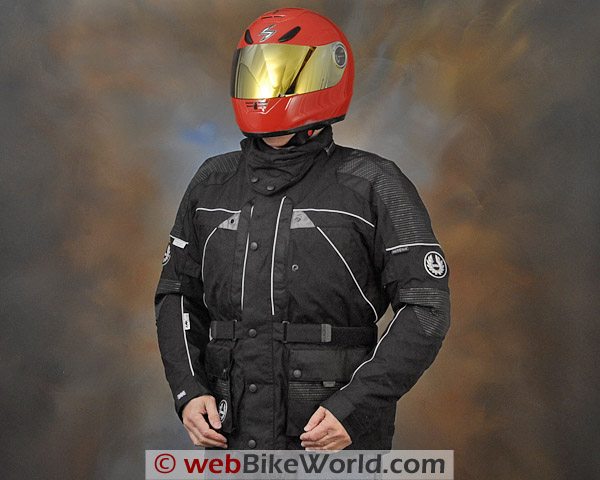
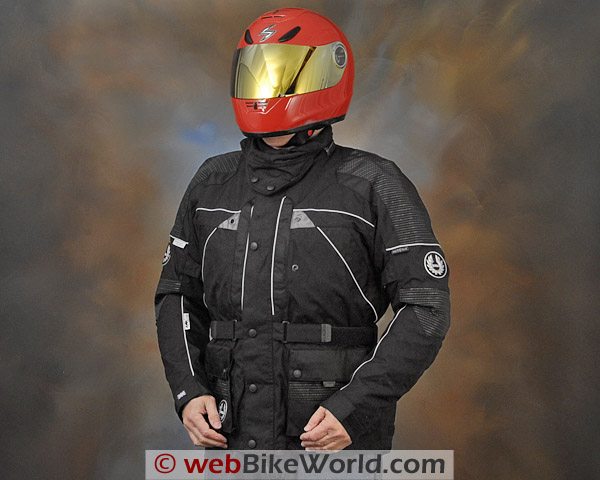
The Discovery jacket is designed for riding in harsh weather. It’s a waterproof, no-nonsense touring jacket with many features, including a wrap-around skirt under the hem with a unique attachment strap to block cold air, all at a bargain price for this type of jacket.
If you didn’t know any better, you might think that the British Motorcycle Gear (aka “BMG”) Discovery is just another 3/4-length motorcycle jacket with the expected array of “me too” features.
But this jacket has a few surprises in store. After wearing the Discovery recently in our suddenly wet and chilly fall weather, I now see it for what it really is: a no-compromises jacket designed for riding in the worst types of winter and wet-weather riding conditions.
I did a little research and found that while the BMG Discovery jacket may not be a familiar choice with the general motorcycle population, riders “in the know” swear by it. These are the types who ride through a Scottish winter, a Canadian spring, an Alaskan snowstorm — or even the wilds of Brooklyn, for that matter. Yeah, Brooklyn. Ever try riding the Gowanus Expressway in January sleet? During rush hour? After the sun’s gone down? Brutal…
For all of the above, and for many other reasons, this is the jacket to have.
Even though BMG would probably tell you that the Discovery is designed for all seasons, my feeling is that the jacket is instead very much biased towards the cold and wet. But there’s nothing wrong with that; too many motorcycle garments try to be too many things at once and end up failing at them all. We’ve very much resigned ourselves to the fact that serious motorcycle riders will need a wide variety of clothing types to match the conditions. There is no single “do it all” garment — not yet, anyway.
So what makes this 3/4-length jacket so different? Let’s take a look…
Outer Shell
Let’s start with the outer shell, which is made from Hitena nylon. Hitena is a brand name often found in motorcycle clothing, and the polyamide textile is used by many well-known motorcycle clothing manufacturers.
The material is known for its toughness and abrasion and wear resistance.
The Discovery jacket’s shell meets the basic standards of modern 3/4-length, or full-length motorcycle jackets. The material is relatively soft and certainly not as stiff as, for example, the Aerostich Darien.
The fabric feels like it has some type of coating or surface finish that repels water, but this may simply be due to the dense weave. The shell is lined with a full-length soft taffeta.
The Discovery jacket is only available in black, which I think is a bit odd, especially considering the jacket is meant to be used in rain and harsh weather. I’m not sure why it isn’t available in brighter, safer colors, like orange or yellow.
Also, the black Hitena fabric easily attracts lint and dog hair, although it can be cleaned with a damp sponge or brush. But those are really the only two nits I have to pick with the jacket.
Fleece-lined, removable neck warmer.Removable Neck Warmer
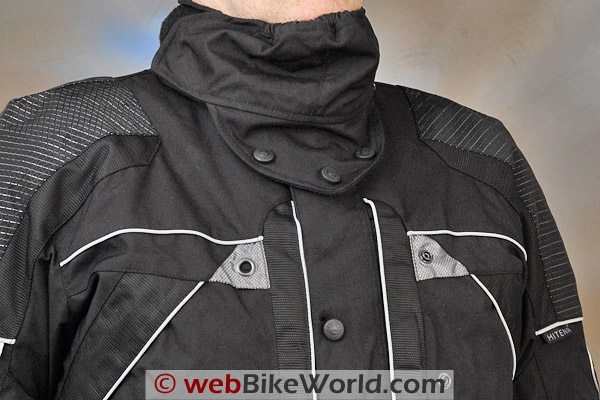
Starting at the top, one of the most interesting features of the jacket is the removable “turtleneck” style neck warmer.
This is a large section of nylon material, backed by a soft fleece, that completely surrounds the neck and does a great job at blocking the wind and keeping this vital area warm.
The neck warmer zips to the jacket neck in the back and has three large rubberized snaps in front that secure it to the upper chest area of the jacket. It also uses a section of hook-and-loop on the right side for adjustment and to secure it to the outside of the jacket neck.
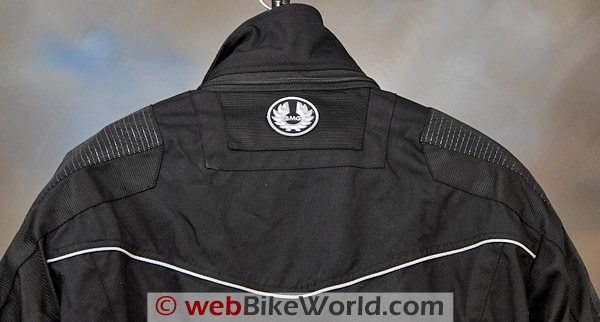
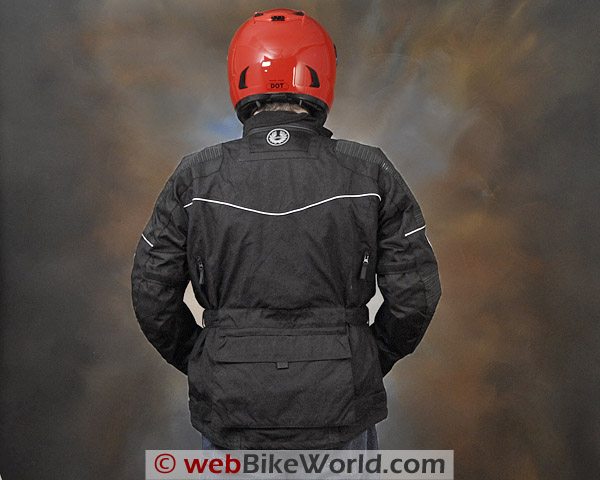
The neck warmer can be stowed in the removable square pocket located at the lower back of the jacket.
Underneath the neck warmer lies a short collar lined with a checkerboard black and silver fabric that seems to be designed to have just enough of a texture to allow air to circulate around the neck so the material doesn’t get sticky.
Whether the neck warmer is attached or not, the short inner collar only has a single snap and no method for adjustment. However, it does fit my 17″ neck with enough room to spare — but it may be looser or tighter on other neck sizes.
Zippers, Adjustments and Attachments
The front of the jacket closes with a large YKK zipper and large button snaps on front. Wide and thick sections of material form the plackets that close over the top of the zipper and seal the front.
The plackets come together with a single piece of hook-and-loop, intersected by the metal snaps. The snaps also have rubberized covers to help prevent damage to the paint on the motorcycle’s fuel tank.
The right side placket has an additional section of nylon material that folds back over the “hook” part of the hook-and-loop fastener on the right placket.
I’m not sure why this is, other than perhaps to allow the jacket to be zippered shut only. I guess this allows the rider to zipper the jacket closed and leave the plackets, or “flaps” open, but I’m not sure why you’d want to do this.
An extra short section of fleece-backed material is sewn to the top of the neck, and this folds underneath the top part of the zipper as added wind protection for the neck.
The Discovery jacket’s shell also has a large and widely adjustable external waist cinch on either side to pinch the waist and keep the cold air at bay.
The adjusters have a plastic cinch and the belt has a full-length hook-and-loop fastener. The system provides a wide range of adjustment. The jacket also has an internal zipper attachment for pants.
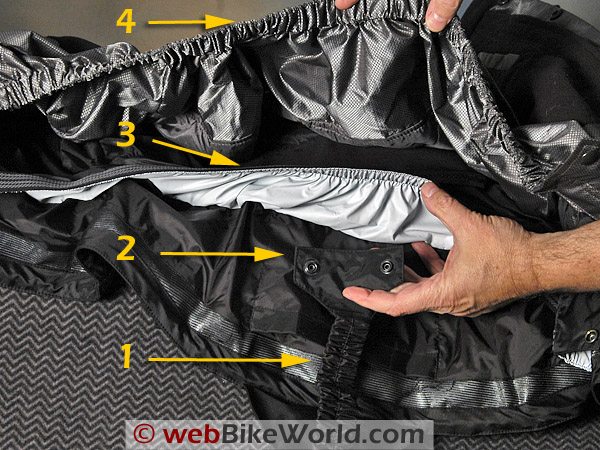
Unique Features of the British Motorcycle Gear Discovery Jacket:(Looking up from the bottom at the hem of the jacket). 1. Internal mesh drain at hem of jacket. 2. Strap from hidden rear pocket comes out the back and passes through the legs to snap into the front of the jacket. 3. Permanently attached wind-blocking skirt with elastic snaps together in front to attach completely around rider. 4. Second elastic hem on removable insulating liner.The Discovery Jacket’s Most Unique Feature: The Skirt
Here’s the most unique feature of the BMG Discovery Jacket: it has an attached elastic skirt at the bottom of the jacket on the inside of the hem that seals the lower part of the jacket and prevents air and moisture from entering.
The skirt pulls around the front of the rider, below the waist, and it attaches to itself at the front of the jacket with two snaps, forming a good seal.
But that’s not all: hidden in the back of the jacket, on the outside, just above the rear hem is a pocket. Inside this pocket is an attached length of elastic material.
Open the pocket and pull the material out and it can be dropped down and brought under the crotch, up to the front of the jacket, where it snaps to the front of the elastic skirt (see photo above).
This strap keeps the jacket from riding up and the elastic skirt keeps out the cold air and moisture from intruding from below. This is a unique feature that we haven’t seen on any other motorcycle jacket and it’s one of the reasons why the Discovery is a sought-after harsh weather riding jacket by riders planning trips in the worst conditions.
It may not be obvious where the Discovery jacket gets its waterproof ability, because it doesn’t have a removable wind- and water-proof liner like other jackets of this type.
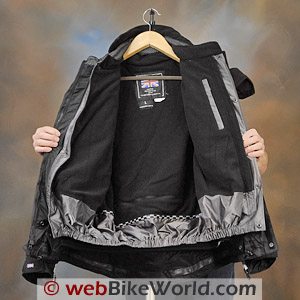
But the shell has a permanently attached drop liner between the inner taffeta lining and the shell that I assume does the job.
Note that the underarm vents do not open through the permanently attached waterproof liner into the body of the jacket, and this design provides better waterproof integrity.
Insulating Liner
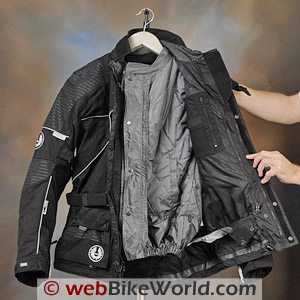
The Discovery jacket has a removable quilted Thermolite insulating liner. It is covered with soft fleece on the inside, which makes it very comfortable.
The insulating liner features two outer open hand pockets and one zipper pocket on the inside.
The liner could probably be worn as a light jacket around the campfire or in the evening, but it doesn’t have the outer shell or styling that would make look like anything other than a jacket liner.
The Thermolite insulation is on the thick side and it does a very good job at keeping the rider warm — at least down to the upper 40’s (F) damp weather we’ve had recently.
The liner also has an elastic waistband, which increases the Discovery jacket’s capabilities regarding air ingress from below.
The liner uses snaps to secure the front, instead of a zipper or hook-and-loop.
This is a bit surprising because of the gaps in between the snaps where cold air can enter. The weather hasn’t been cold enough to make this a problem though.
The liner attaches inside the sleeve cuffs with twin snaps over looped material.
Venting and Temperature Range
The shell has no external vents in the front and no vents that open up through the waterproof liner. As mentioned above, the liner integrity is probably what gives the jacket a higher level of water-resisting capabilities.
In 5 to 16 C (40 to 60 degree F) weather, the jacket keeps me warm with only a cotton T-shirt and thin cotton turtleneck underneath.
At the lower end of that range, if I’m riding an unfaired bike, the chest and shoulders can start to feel cool, so a thicker, windproof under garment is in order (see our Wind Blocking and Windproof Clothing review links on the Motorcycle Clothing Reviews page).
At the upper end of that range, the jacket feels comfortable at cruising speed, but it can get warm at slow speeds, at the gas pump or in traffic.
In general, I’d recommend the Discovery jacket for temperatures ranging from about as cold as you’d dare to ride up to a maximum of 18 degrees C (65 F) with the liner or maybe 21 C (70 F) without.
Note that at temperatures below about 4 C (4 F) though, you’ll probably need additional insulating underwear or a heated vest or other heated clothing. There’s no magic here.
The jacket has two 20 cm (8″) zippered underarm vents, backed by mesh fabric.
These will open from an area that starts at the inside of my armpit and continues down the side of the jacket. The rear of the jacket also has two short exhaust vents that open with zippers.
But note that neither of these vents allows air to flow through the permanently attached inner liners, so their effect is minimal. They are also hard to reach when wearing gloves or riding, so the rider must be stopped to fasten or unfasten the zippers.
Pockets
What appear to be slash vents on the front of the jacket at the upper chest are instead waterproof pockets.
A section of jacket material covers the zipper underneath each of these pockets, and the zipper opens to reveal a horizontal pocket cavity that runs from the middle of the upper chest out under the arm.
These are perfectly suited to hold a pair of gloves, one on each side. I also use the left-hand pocket to stow my wallet.
Just to the right and left of each upper placket, lying inboard of the slash pockets as the front of the jacket is viewed, are additional vertical pockets, one on each side.
These are located behind the vertical length of reflective piping you can see in the photos, on each side of the zipper along the front of the jacket.
The piping forms the edge of a pocket cover that attaches with hook-and-loop. Underneath the cover is a zipper that reveals another large pocket.
The left pocket features a fold-out cell phone holder that remains attached via a section of material to the inside of the pocket, while it attaches to the front of the jacket on the two snaps that can also be seen on the left-hand upper chest.
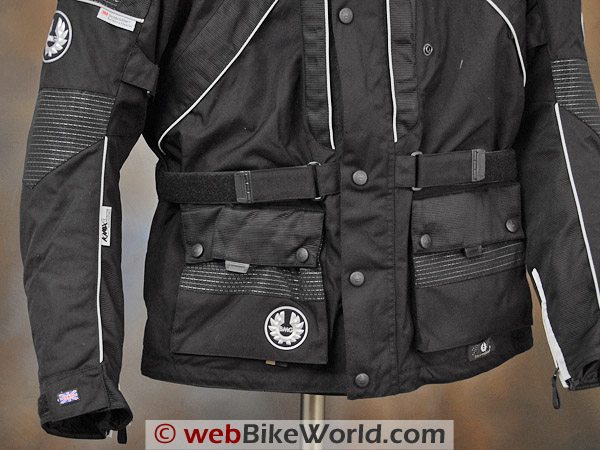
The jacket has large cargo pockets at the lower front. These have a fabric cover that closes over a zipper with full-length sections of hook-and-loop. The outer sides of each pocket can be pulled open to reveal hand warmer pockets underneath.
The rear lower cargo pocket attaches to the jacket with a zipper and two plastic clips underneath.
Inside the shell are a zipper covered pocket on the left hand chest and a pouch pocket with elastic along the top on the right.
Sleeves
The sleeve cuffs close with a hook-and-loop adjuster on one side and a zipper backed by a gusset on the other. All of the zippers have a fabric zipper pull, making it easy to find and use the zippers.
The zipper on each cuff has a very large zipper pull, and it hangs down from the sleeve, which is slightly annoying.
The zipper pulls disappear inside of the glove gauntlets, but they can tend to pull the zipper open if a tight-fitting gauntlet is pushed over the cuff.
The sleeve cuffs are probably the only place you don’t really need a zipper pull, and there’s an easy solution here: cut them off.
The sleeves feel narrow inside, right around the bend of the arm.
I think the combination of the inner taffeta liner, the waterproof liner and the insulating liner bind up just slightly at the bend point, even with the sleeve adjusters on the upper arm opened up as far as possible.
British Motorcycle Gear BMG Discovery Jacket Reflective Material and PipingReflective Material and Piping
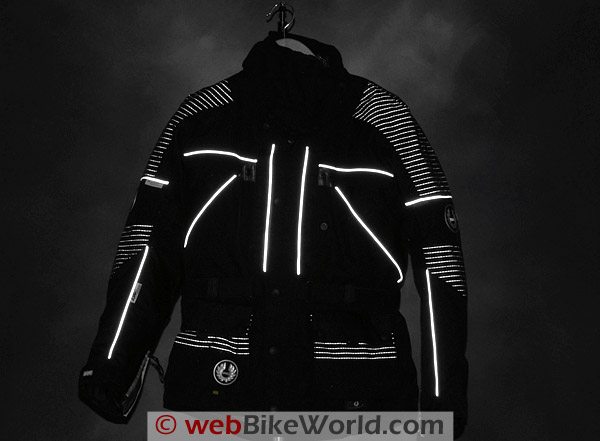
The outside of the jacket has Duratec abrasion resistant material sewn over the elbows and shoulders. This material is reflective (see photo), along with the many sections of 3M reflective piping used all over the jacket.
I hope it’s obvious from the photos that the reflective material on the Discovery jacket does an excellent job at keeping the rider visible at night.
Padding and Protectors
The Discovery jacket includes removable Knox padding, including a back pad along with thick Knox shoulder and elbow padding.
The jacket sleeves have hook-and-loop adjusters in the upper region to keep the arms snug. These are not the typical 2-3 snaps used on many jackets; they have full tightening abilities.
Sizing
The Discovery jacket is available in sizes ranging from XS (32″ to 35″ U.S. chest size) to 4XL (53″ to 55″ U.S. chest size).
The jacket shown here is a size large, and it fits a 44″ chest, 5’11” male exactly as expected in the chest and body measurements with the liner installed.
With the liner removed, the waist and arm straps provide enough adjustment to keep things snug, although the body of the jacket jumps up about one size.
The sleeves are just a touch longer than expected, even by longish motorcycle sleeve standards, by maybe 12 mm (1/2″).
This gives enough room for stretching to the handlebars, but with the liner removed, the arms do seem slightly too long for me; I’d say they’re about 35″ to 36″.
Conclusion
The British Motorcycle Gear Discovery jacket is designed to function in some of the harshest conditions in which you’d ever want to ride a motorcycle. It has many interesting features and the neck warmer, skirt and lower attachment are welcome additions for cold-weather riding.
The list price of $379.00 makes this one a bargain — we’ve seen similar jackets costing twice as much without the Discovery’s unique features.

Owner Comments and Feedback
See details on submitting comments.
From “e” (11/08): “Like you I have gone through MANY jackets over the years.
I had the original Kilimanjaro, the Kilimanjaro II and briefly the Kilimanjaro 4 along with the Olympia AST, the Olympia Voyager and a half dozen others by Marsee, Fieldsheer, Rukka, BMW e.t.c.
The Discovery ups the ante tenfold, do I wish it had some of the little features of the others?
Of course, but you can’t have everything. Even though the current Discovery is only available in black, it has enough reflective panels and piping that it really does not matter in the dead of night. It will stand out more than a hi viz Olympia.
The removable neck gaiter is great, much nicer than forcing another gaiter or neck warmer over your head and you can pull it off when the temps begin to rise which is very nice.
The use of YKK zippers is great and should be standard on all jackets in this price range, the zipper is on the “wrong” side though but it’s no big deal.
More pockets than pool hall or any other jacket I had. I didn’t even realize I had pockets on the top until days after wearing it. The Discovery offers 8, EIGHT!, exterior pocket and two interior pockets with smaller pockets inside those.
Add that to the rear pocket and you have 13 pockets, heck you can leave your tank bag at home. The small pocket inside the outer right napoleon pocket is very small and I cannot figure out what this is for. Perhaps change or a Zippo.
This jacket is just as waterproof as any other I have worn, it trumps many of the lesser jackets I have owned and trumps them all in warmth.
Some say that it kept them warm down to 40-50 degrees, it kept me warm at 4 degrees while traveling at 60 with nothing but a t-shirt and thin poly sweater underneath.
The Discovery is an excellent winter jacket, it is not however an all season jacket. I myself cannot wear the jacket at anything above 40 degrees, and that’s without the liner, perhaps I’m warm blooded.
The liner does fantastic job of keeping the rider warm, and will serve nicely around the campfire.
However it doesn’t have the looks of a day jacket like some other riding jackets provide, this can be helped by using your own liner like a Northface microfleece jacket as a liner or bringing a day jacket along with you.
The rain skirt is ingenious, but then again this is a jacket designed to handle harsh English weather. If you live in Seattle, this should be your top choice.
A few changes in case BMG is reading this. The cell phone pocket that comes out of the left Napoleon pocket and snaps to the front is secured to the jacket with some nylon webbing.
The webbing is sewed to the inside of the pocket (palm side if putting your hand in the pocket). If it were sewn at the other side (back of hand when putting it into the pocket) then it would allow access to the pocket otherwise inhibited by the strap, a small change but would allow you to use the pocket.
Second, the hand warmer pockets open via Velcro, this should be changed to a zipper. Forcing frigid fingers through hard and rough Velcro can be painful when it’s below 0 (F).”
From “S.M.” (11/08): “First of all can I thank you for a very interesting, and informative website. Concerning your review of the BMG ‘Discovery’ Jacket. I have had the Belstaff ‘Discovery’ Jacket for FIVE years.
I’m a motorcycle training instructor, so it has been used most days during the cold English winter season, and on a regular basis during our ‘warm’ Summer Months!
I have found the jacket to be very warm in extremely low temperatures, and I have NEVER get wet whilst wearing it (Pity I can’t say the same for my bottom half in a different make of pants).
It took me weeks to find all of the extra pockets within pockets ( very handy for splitting change for tollbooths). These may have been discontinued by the new brand owners, but it’s worth checking.
The sleeves are just starting to fray on the edges where they rub against the inside of my winter gloves.
I have found that during warmer days of bike travel, I have left one or two pop studs open at the top of the jacket with the internal zip down slightly, and unzipped the under sleeve vents, this allows excellent ‘flow through’ of cooling air, without the jacket ballooning.
And the extra flap on the main flap…I reckon it’s to make a nice draught proof joint at the top of the internal zipper!
The small ring loop top right front on the silver triangle? I eventually worked out that it’s to hang a pair of spectacles through the hole!
On my jacket the rear poacher pocket is removable, but I always find a use for it, be it a drink, shopping, or training aids whilst working as a bike instructor.
All in all, the best textile bike jacket I have owned, and I will be getting another when this one finally wears out. . . . If I ever manage to wear it out!”
Editor’s Note: Note that the “original” Belstaff Discovery may not have the same features, construction or fabrics as the new British Motorcycle Gear Discovery jacket that is the subject of our review.
From Doug H. (Tilted Horizons) (11/08): “I’ve owned a Belstaff/BMG (made in England, before Belstaff’s acquisition by an Italian firm) Discovery jacket for a couple of years of winter-time commuting and sport-touring.
Mine is silver and black; I understand that DuPont is no longer supplying the silver and khaki/green color formerly available.
This jacket is my favorite “serious cold” jacket and I’ve ridden in it in temps as low as 8F with no assist from electrical heat.
The neck warmer, wind/rain skirt, the CE armor and the “poacher pockets” are my favorite features.
However, the design that makes it so great in the cold means that above about 50F I switch to my Aerostich Darien for its better venting and wider temp range.
Other than some fraying of the fabric around the sleeve gussets, perhaps caused by contact with Velcro on my gloves, my Discovery is holding up great.
Your review is very thorough and comports well with my experience with the Discovery. I’ve also found the sleeve length a bit long, the sleeve zippers a bit prone to unzip, and the thin liner surprisingly warm (even warmer than my Aerostich fleece liner).
Figuring out all the features of this jacket is like solving a Rubik’s Cube. Note to BMG: publish an owner’s manual ala Aerostich.
Oh yeah — about the “extra” fabric flap and Velcro on the main flap; I couldn’t determine its purpose, either, so I emailed Belstaff.
The reply was essentially, and surprisingly, “We don’t know, either”. I’ve decided it’s a “rain gutter”. Or maybe it’s like that “33” on a Rolling Rock bottle…