

After my recent Jensen JHD-910 radio article was posted on webBikeWorld, an astute reader commented about the importance of the antenna.
He and radio pioneer Marconi were absolutely correct, in that any radio depends on how well the antenna works.
Because this article could be used for more than the Jensen radio recently featured, it will be treated as a separate review.
To try to help readers choose an antenna, we decided to try several and to compare them with the AM/FM radios in a car and a minivan. But first, we had to come up with an objective means of comparison.
We initially thought that we might contract with a nearby state-of-the-art electronics testing lab that has an anechoic room with all sorts of cones attached to the walls and ceiling.
They do a lot of testing for military products, certifications for cell phones, and other high tech gadgets. But this idea died a horrible death as soon as we realized how much it would cost to rent the laboratory. Time for plan B.
Plan B was simple. Rather than get all techie and use specialized radio equipment, we wanted this in terms that anybody could understand. Our area is rich in radio stations, so we just used what we had by comparing how many stations each antenna could pull in. After all — relative performance is what counts in day-to-day use.
Editor’s Note: Many webBikeWorld readers inquired about motorcycle radio antennas after our recentreview of the Jensen JHD910 radio, so here’s a follow-up from Bob.
The Comparison
The criterion was to simply count legibly received AM and FM radio stations, even if some had miserable quality, then to add notes about signal strength. We manually stepped through the range of frequencies on each test. The test was performed on two separate days and the results were repeatable. There was a lot of button pushing…
First we started with a Ford Escape and a Chrysler minivan, because the car companies employ people to optimize the performance of the installed sound systems. We wanted a baseline and the two vehicles were so similar that we used the Escape for convenience. It was able to receive a total of 114 stations. Using the SEEK button, the Ford radio found 73% of the same FM stations and 43% of the AM stations.
The Jensen radio on the Yamaha FJR1300 was then tested with three automotive antennas. All had been made by Metra and purchased from a local auto parts chain store.
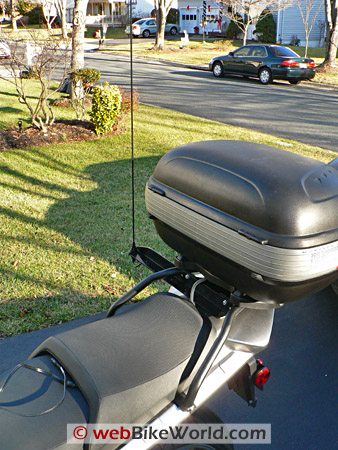
The first antenna was a typical inexpensive 31-inch whip antenna that was the most plain-Jane basic $9.99 universal antenna on the rack (photo above). The antenna was a clone of the antenna that Ford had installed on the Escape and the Jensen gave the performance closest to that of the Ford Escape with this antenna.
The whip was able to pull in almost 92% of the FM stations that the Ford found and 81% of the AM stations — not bad for an aftermarket installation, but about 10% of the AM stations had less strength.
Further, the whip picked up four Weather band broadcasts with solid reception. The whip did have one odd characteristic, though; when using the SEEK button, it found one more station than was on the Ford’s radio. However, the whip also stopped seeking at 11 frequencies that did not have a station and at times it was a small nuisance.
The second antenna was a Universal Rubber Antenna with a 14-inch (37 cm) rubber mast that was also purchased for $9.99 (Model AT-UT03R).
Affectionately known as a “rubber ducky” antenna, this one had the same auto-fender base that was on the whip antenna. It pulled in 90% of the FM stations that the Ford found and the same 81% of AM stations that the whip received.
While the rubber ducky found almost as many FM stations as the whip in SEEK mode, it only found 60% of what the Ford found in AM stations. The reduction in AM strength was similar to that exhibited by the whip antenna. The rubber ducky pulled in three of the weather bands with solid reception and a fourth faded in and out.
Where to Buy Motorcycle Radio Antenna
Check Reviews & Prices on Amazon
See More: Motorcycle Accessories, Motorcycle Tire, Motorcycle Helmets
Antenna Length
The reason that AM/FM antennas are all about 31 inches is because it is a proportion of the average radio frequencies that the radios are intended to receive.
A common trick in making rubber antennas perform is to use the optimal length of wire and coil it within the rubber. While the station counts were comparable, notes about FM station reception strength were downgraded for 11% of what the rubber antenna found, as compared with the whip.
It would be easier to make the rubber antenna mounting less conspicuous and it would work well for commuters. We tried taping it inside of the Givi top-case and the performance changed very little (loss of several AM stations that had been very weak), which could provide a way to conceal the antenna. But the rubber antenna would not be able to perform as well as the whip when on the open highway.
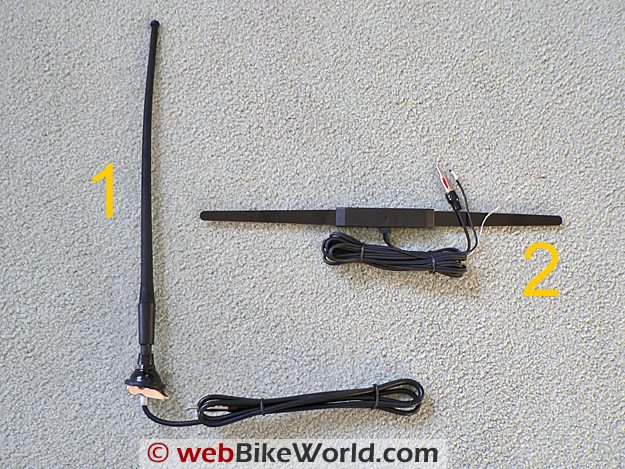 1. “Rubber Ducky” antenna. 2. Metra Deluxe antenna.
The third antenna was what we informally called the concealed antenna. It was labeled as the Metra Deluxe Universal Amplified Antenna (Model CK-UA200) and it was purchased for $19.99.
The packaging for this dipole-looking antenna (wires attach to the middle) said that it had been designed to hide at the top of a car window, just below the headliner and our hope was that if it performed well enough, we could hide the antenna inside of the FJR’s fairing.
This antenna had double-stick adhesive for mounting and came with an alcohol wipe. However, the concealed antenna was not only the most expensive; it was the worst performer, despite its built-in amplifier.
Because the concealed antenna was amplified, it needed a source of power and a ground connection. A small red LED would signal when power was available and we tried it both with and without the LED illuminated. The power did make a significant improvement.
To have the best shot at functioning well and to remove any influence that the engine or frame might create, the concealed antenna was simply taped to the top of the bike’s windshield. The antenna was also rotated and tried vertically to change orientation. Orientation did affect the results, but not by as much as we anticipated.
However, the bottom line was that the best we could do with the amplified concealed antenna was still significantly worse than the original 31-inch whip.
How much? The boosted hidden antenna got 73% of the FM stations found by the Ford Escape and 60% of the AM stations. It barely got only one of the weather band channels. Further, our list of signal strengths for the stations showed that many of the stations that it did receive were substantially inferior to the performance of the whip and the rubber ducky.
Here’s a table that illustrates the comparative results in relative terms:
| 31” Whip Antenna | Rubber Ducky* | Concealed Antenna | |
| Percentage of FM stations that the Ford radio found: | 91.7 % | 90.0 % | 73 % |
| Percentage of AM stations that the Ford radio found: | 81.5 % | 81.5 % | 60 % |
| Percentage of FM stations found by the SEEK button, as compared to the Ford radio: | 102 % (plus numerous empty frequencies) | 89.0 % | 46 % |
| Percentage of AM stations found by the SEEK button, as compared to the Ford radio: | 39.1 % | 25.9 % | 27 % |
|
*Numbers do not convey reduction in reception strength |
|||
Conclusion
[asa2 tplid=”6″]B000O8WIS0[/asa2]
The automakers know what they are doing and there is a reason for the 31-inch whip antenna to be a de facto standard for car antennas. It works and would be our choice for a mixture of commuting and use when not near a city.
However, for commuters who stay near their favorite radio stations, the rubber ducky gave good performance and might not be as conspicuous. The Metra Deluxe Universal Amplified Antenna did not perform well and was last seen in the trashcan.
See Also:Review of the Jensen JHD910 radio
Note: For informational use only. All material and photographs are Copyright © webWorld International, LLC – 2000-2011. All rights reserved. See the webBikeWorld® Site Info page. NOTE: Product specifications, features and details may change or differ from our descriptions. Always check before purchasing. Read the Terms and Conditions!
Where to Buy Motorcycle Radio Antenna
Check Reviews & Prices on Amazon
See More: Motorcycle Accessories, Motorcycle Tire, Motorcycle Helmets
Owner Comments and Feedback
Not all comments will be published (details). Comments may be edited for clarity prior to publication.
From “J.S.” (1/09): “Radio hams would probably refer to the hidden amplified “Metra” antenna as a “coiled” or “folded dipole”. A dipole, folded or not, is always going to be very directional and by nature is a poor choice for mobile use. You’ll see dipoles on some vehicles, but only dipoles that can be rotated for max. signal strength (usually hams, emergency mobile comm. vehicles, etc.). That antenna’s design is inherently weaker and so that’s why they amplify it.
A regular vehicle antenna is much less directional than a dipole. Also, radio signals are almost always polarized vertically to match vertical reception antennas like on a car. Also, the part of your antenna that sticks up is only electrically half the antenna; the other half is your vehicle. Ergo, cars fare better than bikes because of the expanse of metal making up the vehicle half of the antenna.
To compensate, some bikers use two antennas at the rear (theory being, to double signal capture. The theory also is that placing them aft makes reception (or in antenna lingo, “gain”) somewhat better toward the front in the direction you’re heading.”
From “J.K.” (1/09): “(Here) is a link to the TuneTrapper hidden antenna that sells quite well, mostly to Harley owners that hide them under their front fairings. The next time you folks do a comparison, you might check this out as well.”