

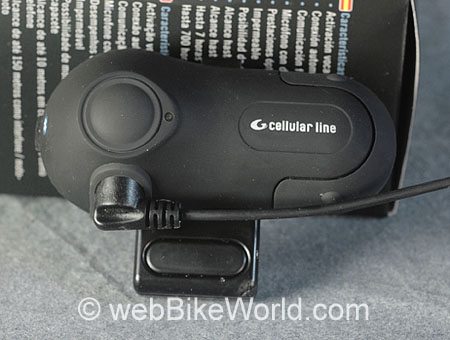
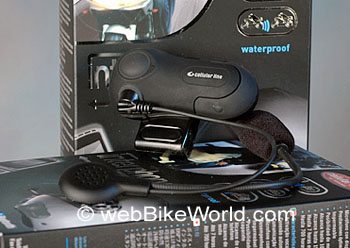

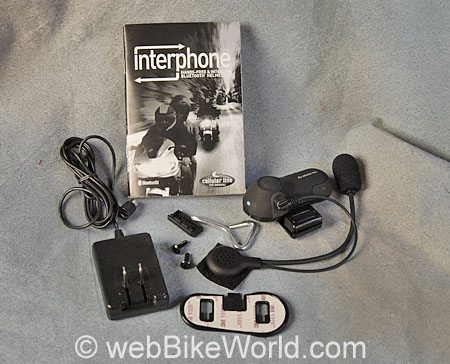
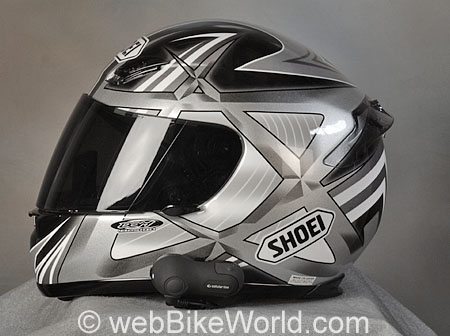
The Interphone Bluetooth intercom was developed by a European consortium and the product was just officially launched in Europe about two weeks ago. It’s made in Italy by Cellular Italia S.p.A.
The set shown here is known as the Cellular Line Interphone and it was kindly sent to us for evaluation by GiMoto Canada Ltd., the approved Canadian distributor for the Cellular Line Interphone Bluetooth intercom system.
Moto Comp Ltd. is the distributor for the Interphone Bluetooth intercom in the UK. webBikeWorld visitors may also remember Moto Comp as the parent organization that distributes OGK and Nitro Helmets in the UK (we reviewed the OGK FF-3 and OGK FF-4 and also the Nitro N1200-VX).
Note: See the table at the end of this article for more information on retailers, pricing and ordering.
So first things first: What’s the difference between the Midland-Scala Bluetooth intercom systemwe reviewed last month and the Interphone Bluetooth intercom system shown here? After all, they look nearly identical, right?
We thought so too. If you recall, we were less than awestruck with the Midland-Scala Rider system and, to be honest, this left us skeptical of Bluetooth intercom systems in general. Why should the Interphone system work any better — after all, Bluetooth is Bluetooth, right? And since the systems appear to be so similar, how much difference could there really be in their performance?
In fact, before we got the Interphone intercoms we were even thinking that maybe the Interphone was simply a re-branded Midland-Scala product. It wouldn’t be the first time something like that happened…
But I’m happy to report that the Interphone Bluetooth intercom is definitely different and it works brilliantly, just like we hoped a motorcycle Bluetooth intercom system would, could and should.
The instructions are relatively easy to understand (just make sure you read them carefully for best results) and the system worked perfectly — just like it’s supposed to — the first time we fired it up.
Now that may sound like a simple request, but we are still struggling with trying to get the, uh, competitor’s Bluetooth intercom system to work at all. So apparently it’s not as easy as it seems.
The Interphone F3 Intercom System
The sound quality on the Interphone Bluetooth intercom is crystal clear, with only the very slightest amount of Bluetooth hiss in the background, noticeable only in a quiet room. The volume at the Interphone’s lowest setting is about as loud as the Midland-Scala system is at its highest, but the Interphone’s volume can be raised by using a special “High Volume” setting beyond the basic “loud”.
This procedure is rather cumbersome; the “+” volume button must be held down as the intercom is turned on, a series of beeps is heard, and then the LED is supposed to flash red/blue, but ours doesn’t seem to blink red/blue, although the volume does increase.
Raising the volume is useful for situations where the intercom speaker is farther away from the wearer’s head, when wearing ear plugs or in situations where the background noise is unusually loud.
Besides the excellent sound quality, there are three features that differentiate the Midland-Scala Bluetooth intercom from the Interphone Bluetooth intercoms.
1) The Interphone system that is currently being sold has only one speaker, because it’s actually designed as a boom mike system for open-face helmets. This hasn’t made a difference in our use, because the clarity of sound and the ability to raise the volume makes the Interphone intercoms much easier to hear anyway and there hasn’t been any problem installing the Interphone intercom in any of the full-face helmets we’ve tried.
Interphone released the boom microphone and single speaker version first because this design will work in either an open-face or full-face helmet, whereas a system with longer wires and two speakers is really only designed to work with a full-face helmet (Note: See updated comments below on problems with the boom mic).
2) Another difference between the two brands is that the Interphone system does not have voice activation for the rider-to-passenger intercom, although it does have voice activation for connecting with a cell phone. And don’t forget – the Interphone system is also a bike-to-bike intercom (see below)!
Riding With the Interphone F3
We don’t miss the lack of rider-to-passenger voice activation one bit, as it seems to be the most problematic feature of the Midland-Scala intercom and we’ve had miserable luck with any intercom voice activation system we’ve tried, so we’d just as soon do without it.
Moto Comp Ltd. has announced that Takaisha Fujinami, who finished 3rd in the 2007 World Trials Championship, will now be using INTERPHONE by Cellular Line during the official competitions as well as in practice.
In Trials, the connection between the rider and his assistant on the track is critical. The two are constantly talking to get and give information about how to approach the various points of the track.
Fujinami and his assistant are using INTERPHONE Bluetooth intercoms to talk each other, because the system acts as a private communications channel over as much as 500 meters (depending on terrain). The system works in full-duplex, which allows natural conversation.
The INTERPHONE system has also been used successfully on extreme enduro rally raids – such as the Touareg Rally and Red Bull Romaniacs by Nick Plumb (amongst others).
Other uses include training and coaching for off-road riding, as well as keeping in touch when trail riding, track days, road riding, touring, etc. Moto Comp Ltd are the exclusive UK distributors.
Riding With the Interphone Intercom
When riding with the Interphone intercom there’s no noticeable static or noise in the background anyway, even with its “always on” mode. So who needs voice activation? In fact, I wonder if the Midland-Scala system would be better off if the manufacturer simply eliminated the troublesome voice activation on their system.
3) The Interphone Bluetooth intercom has a claimed range of 10 meters for rider to cell phone conversation and an amazing 150 meters (UPDATE: Rumor has it that the new units are now rated at 500 meters) for rider-to-passenger or bike-to-bike communication.
That’s right — a pair of Interphone Bluetooth intercoms can be used together as a mini-broadcasting network so you can chat up your buddy while riding!
Sure, it isn’t a half-kilometer or so that you might get from FRS radio range, but it doesn’t pretend to be. And, by the way, a couple of Interphone units weigh less, they’re wireless and they’re much easier to use than a clumsy FRS radio system for bike-to-bike communication.
Although we didn’t get out the yardstick (make that the meterstick) to take an exact measurement, the claimed transmission distances do seem realistic.
For example, I had to run back in to the house for a pit stop just before taking off for a ride, and I discovered that I could continue to carry on a conversation with my wife using the system through the steel garage door, across several rooms and way upstairs in the back of the house.
Burn and I also mounted up a pair and went for a ride and it definitely works, out to about 1/10 of a mile, even on the Interstate at around 70MPH.
The Interphone system’s clear sound probably is helped by the full duplex transmission between units. Full duplex is a good thing; it’s defined as “Sending data in both directions at the same time. Usually higher quality but requires more bandwidth.
In videoconferencing, full duplex will be much more natural and useable. Cheap speakerphones are half duplex, whereas more expensive ones are full duplex.” according to this East Carolina State University definition).
Talking on the Interphone intercoms sounds pretty much like you’d expect a conversation to go. None of that walkie-talkie, I talk – you talk, voice activated jilted conversation like you get on most motorcycle intercom systems (and digital cell phone systems — remember the good old days of analog cell phones?).
The system also uses DSP, or Digital Signal Processing. Interphone also claims that the system will increase or decrease the volume (Automatic Gain Control), based on background noise, but I can’t tell if that’s working or not.
The Interphone system is claimed waterproof and carries a (recently upgraded to 2 year) warranty. They also have a claimed 7 hour talk time once the batteries are fully charged and a claimed (and phenomenal) 700 hours of standby per battery charge. I assume that “standby” means that the intercoms are turned on but not being used.
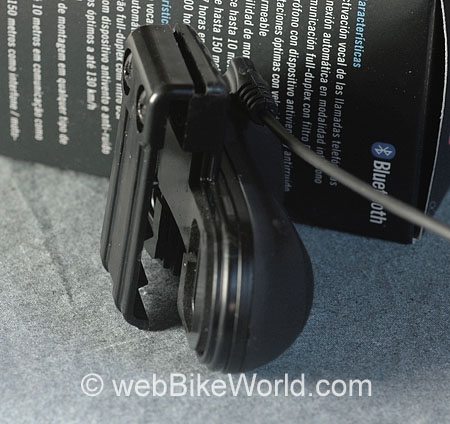
Mounting the intercoms on full-face helmets is easy. The battery/Bluetooth module clips on to a plastic bracket and the bracket has a clip that slips up between the liner and the helmet shell. The clip is a very tight fit on some helmets and you really have to yarn on the liner to move it away from the shell, but eventually it works.
An el Cheapo Phillips head screwdriver is included with the kit and the two Phillips head screws on the clip can be tightened down to make everything secure. The female screw threads on the clip are brass inserts, but be careful.
The screws do not have to be over-tightened, especially if the clip is pushed up against a tight helmet liner. Interphone also provide a small spacer in case the screw-on bracket needs more room, like for a thick helmet shell.
Addendum
A set of longer screws is included in the package to allow extra length if the clip spacer is used for very thick helmet liners. We found that the standard clip has an adequate amount of spread to fit several commonly available helmets as long as the clip is placed between the shell and the outer part of the liner.
Interphone also provides a bracket that can be permanently mounted on the helmet if desired. The bracket has a peel-off label over some sticky tape for this purpose and the Bluetooth module clips on the bracket once it’s mounted on the helmet.
It’s slightly problematic getting the relatively short (about 7″ or 180mm) speaker wire placed under the helmet liner; again, the unit shown here can also be used on an open-face helmet, so the wire is slightly shorter than optimal for installation on a full-face helmet.
Our unit works nicely on helmets with removable cheek pads because the cheek pad can be removed and the wire can be routed underneath. Other helmets may require that the speaker wire is routed between the liner and the rider’s head, but most liners seem to be soft enough to cushion the wire from chafing the rider. This problem should resolve itself when Interphone releases the full-face helmet design with thin and long speaker wires.
The back of the speaker is covered with the “hook” part of a hook-and-loop fastener (i.e., Velcro) system and Interphone includes a mating patch with tape that can be attached to the inside of the helmet in the ear pocket. All told, we had no problems quickly installing, removing and re-installing the units in a variety of helmets during our evaluation.
Pairing the Intercoms
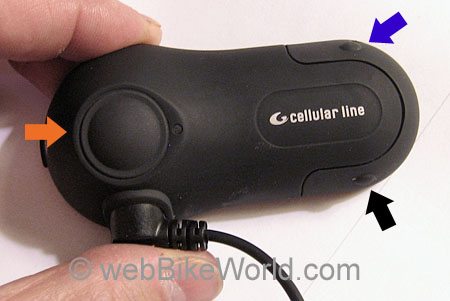
Like any Bluetooth devices, the intercoms must be paired, and they must go through the pairing procedure the first time they’re used. After the units are paired, the intercom is turned on by pressing the big “Multifunction” button (orange arrow in photo below) for approximately 1 second and waiting for the second beep. The instructions must be read carefully, but they are relatively easy to follow and it worked the first time.
Once they’re paired, pressing on the big button will create a tone in the paired intercom, and you’re ready to talk. The blue arrow points to the button that raises the volume and the black arrow illustrates the button that lowers the volume. The intercoms seem easy to use when wearing gloves, but once the volume is set, you pretty much don’t have to touch them again.
The wire shown sticking out the bottom of the unit in the photo below goes to the speaker and microphone. The wire must be removed from the module to plug in the recharging unit during charging. It took us between 3 and 4 hours to charge the units when new, but it doesn’t take as long on subsequent recharges, depending upon the remaining charge in the batteries.
We’ve heard some comments from long-distance riders who say they want their intercoms plugged in to the motorcycle’s electrical system so they don’t have to worry about the Bluetooth battery going flat during a ride, but really now, how many people are out there riding and talking for more than 7 hours at a clip? You can charge the thing back up in the hotel room at night. And if you’re camping, you’re too much of a rugged individualist anyway to be using an intercom!
We paired one of the Interphone units with a Motorola Razr cell phone, which took a bit of finagling. I’ve had trouble pairing this particular phone with the Bluetooth system in my car, so I’m not sure if it was the phone or the intercom, but it took about 3 “Searching for New Devices” before it found the Interphone.
We tried several calls and answering calls from the cell phone and it worked perfectly, but we do not recommend using a cell phone while riding a motorcycle, so the majority of our evaluation was conducted only using the intercom function.
Let’s see — what else? Interphone says they sold more than 4,000 intercoms in the first month of production, so these things are hot. Don’t forget, you need two (2) units to talk to each other; you can use one unit for taking cell phone calls if you’d like, but who wants to talk on the phone while you’re riding a motorcycle?
Conclusion
The Interphone Bluetooth intercom equals the Midland-Scala Rider TeamSet in its ease of installation. But the Interphone intercom has really impressed us with its simplicity and functionality. We didn’t have to struggle with it to get it up and running — we were literally talking over the system within 5 minutes of opening the box.
But what matters most is the sound, and the Interphone system is about as clear and loud as you can get, considering the small, think speaker. Don’t get me wrong — this isn’t Bose quality sound by any means, but it works, it’s loud enough to hear the conversation, it doesn’t seem to be affected by ambient noise and the full duplex DSP system really does seem to make a difference.
| wBW Review: Interphone F3 Bluetooth Motorcycle Intercom | |
|---|---|
| Available From: Cellular Line (Italy) | List Price (2007): N/A |
| Review Date: January 2007 | Made In: Italy |
NOTE: The webBikeWorld evaluators wear properly fitted ear plugs for intercom evaluations. This is reflected in the opinions on sound quality and speaker volume. Your experience may differ. Always protect your hearing when riding a motorcycle (more).
Owner Comments and Feedback
See details on submitting comments.
From “S.E.” (9/09): “Update on your post (R.H. below) on the BlueAnt Interphone review in which RH believed they are out of production.
The Interphone is not and never has been out of production. However, BlueAnt (an Australian company with bases in Melbourne, London, and Los Angeles) no longer distributes the Interphone and tells customers it’s not available any more. It is made by the Italian company Cellular and still in production, branded as the Cellular Line Interphone (just like the unit in your photo). It is 100% one and the same product as the BlueAnt Interphone.”
From “R.H.” (Australia) (4/09): Interphone intercoms no longer in production? This email from reader “R.H.” in Australia indicates that is so: “I’m presently trying to evaluate a suitable headset combination for B2B communication and I’ve noticed that various retailers here are now quitting the InterPhone Bluetooth Intercom.
I contacted BlueAnt Wireless, for clarification that the InterPhone was in-fact being discontinued and their reply was quote “ unfortunately there is no definitive reason for this, I have been simply advised that the product has reached its end of life, in a sales sense”.
When asked if there was a replacement model available, their response was “hopefully in the near or distant future” which to me is a useless response but they do say they would be honouring all new and outstanding warranty claims.
One supplier did tell me that there was a problem sourcing chip sets but if the manufacturer has been building a successful product for the last couple of years then I can’t believe this to be a bona fide reason to discontinue manufacture, the other possibility is that BlueAnt are no longer the distributors here and possibly other countries as well.
The InterPhone looks to be the better performer from the reviews I have read so far but it would be an expensive exercise if they are not supported after the 24 month warranty period has expired.
Can you shed any light on this situation for me?”
Editor’s Reply: I wasn’t aware of this situation, which is possibly due to the current global economic situation. If anyone has more information about this, please let me know. See note from S.E. above.
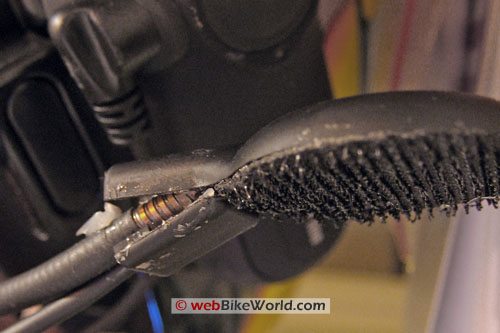
October, 2007 – After removing and reinstalling our Interphone intercom about 4 times, the microphone boom broke where it meets the speaker (photo above). We sent an email to GiMoto Canada, where we purchased our units, with a copy to BlueAnt in the U.S.A. and Moto Comp Ltd. in the UK. We received the following responses from GiMoto Canada and Moto Comp:
GiMoto Canada: “(We) fully support the product. The issue you have mentioned has been corrected in the current design and there have been no further issues. Any party who has purchased from GiMoto Canada and addresses this issue will receive new boom and mic which is shipped the next working day. Note that this return policy is in relation to purchases from GiMoto Canada only; we are unaware of how BlueAnt or Moto Comp address the defective item. Our only requirement is you ship the defective unit back in the included envelope by surface mail.
Sorry to hear of the problem you had with the headset.”
Moto Comp: “I can only endorse what (GiMoto Canada) said. There was a small problem with the first batch of headsets – the design has been changed in later production, with an additional sleeve moulding added to hold the earpiece together under stress, rather than relying only on the integrity of the ultrasonic weld. Even then, it was only usually a problem for people who were repeatedly removing and re-fitting it to their helmet, or in very close-fitting full-face helmets. The design mod seems to overcome this problem, and the alternative ‘comfort headset’ also improves on this still further in the latter case.
In the UK we operate a clear ‘no-quibble’ warranty with Interphones supplied by or through us. If anyone has a problem with any aspect of the product, we simply ask them to mail it to us and will will repair or replace as necessary to give them a fully functional system.
We have replaced a small number of headsets from early production for exactly the problem you had, but not had any repeat failures from these customers which gives us some confidence that:
a) it was only a small (fractional) percentage problem (perhaps a combination of less than perfect weld and type of use/user); b) that the design mod addresses both these issues; c) users are very happy with the product and our service.
In fact we are pleased to note that in spite of the inevitable (but low level) field failures we have experienced, (unavoidable with a new ‘technical’ product in this environment) nobody has asked for their money back as a result, only wanting it fixed as soon as possible, with plenty of praise for our warranty policy and customer service.
Please don’t hesitate to contact me if you want any further information.”
BlueAnt Wireless: (They concurred with GiMoto Canada and Moto Comp). In addition, I can confirm that our technical support center has not reported this as being an issue with recent stock hence it does appear to have now been resolved. If I can assist with any specific help for US based customers, please let me know.”
We plan on returning our units to GiMoto Canada in exchange for the new “comfort” intercoms and will report back.
March 2007 – Both GiMoto and BlueAnt now offer a two-year warranty on the Interphone intercom. Also, the manufacturer now rates the bike-to-bike communication distance at 500 meters!
Finally, the units only weigh 3 oz. (86 grams), including the mounting bracket with clip, the Bluetooth module and the speaker/microphone unit and wire.
Each box contains:
- One Bluetooth Interphone Module
- Speaker
- Anti-noise microphone on boom
- Mounting brackets (both screw and glue type) to suit any helmet
- Battery charger
- Mounting screws, spacers and tool
- Owner’s manual (in Italian, English, French, German, Spanish and Portuguese). The English section is 13 pages long, including the Table of Contents and warnings.
UPDATED July 2010: Interphone F4 Intercom Two-Part Review
Addenda and Notes
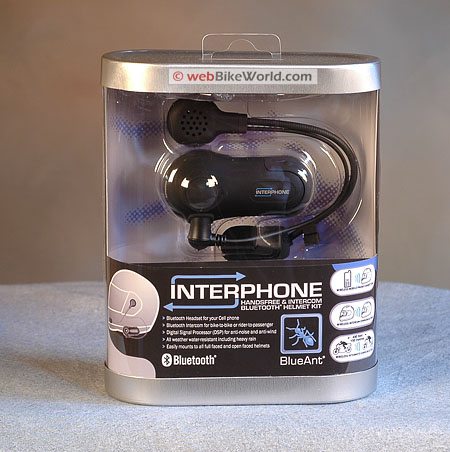
U.S. Interphone Distributor: March 15, 2007 – Several readers have asked about a U.S. distributor for the Interphone intercom. BlueAnt will be the distributor in the U.S.A. The MSRP is $189.00 and item is due for release in early April.
BlueAnt tells us that “In addition to the features mentioned in (the webBikeWorld) review, BlueAnt also offers a USA based technical support hotline and a 2 year replacement warranty should anything go wrong. More information available here. Also, MobileCityOnline.com is taking pre-orders on the Interphone.
Here’s a photo of the BlueAnt Bluetooth Intercom packaged as available in the U.S.A.:
GiMoto Canada is also an authorized distributor in North America and an online dealer. They offer full support for any purchases made through their site or their Canadian dealers. They also will warranty the unit for a two year period and provide any assistance required. They have current stock of Interphone units and all available accessories.
Connecting With a GPS
Update on the Interphone Intercom: From Moto Comp UK “A quick update on the latest regarding Interphone: We have now completed our compatibility, performance and endurance testing with the new Garmin Zumo 500 GPS unit – this included a sponsored ride to 16 countries in 4 days. I’m pleased to say they all work pretty well together. Garmin are pretty pleased with this, because they don’t have a “bike” BT headset.”
How Many Bluetooth Devices Can Be Paired?
Note that the Interphone or the Midland-Scala TeamSet Bluetooth intercoms are designed as a one-to-one intercom system only. Bluetooth intercoms will only pair (i.e., connect) one-to-one. They are not designed or meant to be used for group communications, e.g., one-to-many. Family Radio Service (FRS) based systems are designed for that type of communication.
Problems With Certain Types of Cell Phones
June 25, 2007 – An Interphone purchaser informed us that with certain types of cell phones, “the Interphone helmet headset goes from active to standby after speaking just a few words. That is, the phone will respond to the request (call, lookup, or check), begin to reply, but by the end of the first of second voice exchange, the headset causes the phone to return to standby mode.”
Interphone replied that “Unfortunately I have seen the issue you have described with all the Interphones when used with certain versions of the voice signal software, which is present on the Samsung you own. On occasions lowering the sensitivity of the voice dial can resolve the issue, to do this start a voice dial on the phone and instead of saying a command press Settings, then select Sensitivity and make sure this is set to Reject less.”
Battery Life Issues
July 6, 2007 – Some owners have been reporting less than expected battery life on their Interphone intercoms. BlueAnt just informed us that they have revised the talk-time during Intercom mode to “up to” 5 hours. The Intercom mode uses additional power and it was not originally mentioned in the manual hence the adjustment. Also, the batteries are not replaceable but they will soon be making car chargers available on the spare parts website.
Here’s a note on the Interphone battery life issue from Rob Ferrier, General Manager of GiMoto Canada: In response to your questions on reduced talk time, this is an issue I brought up with Cellular Line earlier in the week based on questions by our customers. The Cellular Line Interphone will allow up to a maximum of seven hours of “active” time, this means the unit will either be connected actively with a GPS, phone or in the intercom mode. All of the available devices, regardless of manufactures name (Cellular Line / Blue Ant) are the same unit and have the same restrictions.
The issue comes down to the use of the product and the specific conditions it is being operated in. This is similar to how far you can travel on a tank of gas in your car. If you are traveling the speed limit, you will be driving for a longer time period than if you are running a car at maximum speed. The Interphone is similar when you are connected to another rider and the distance apart, atmospheric conditions and sight line obstructions all play a factor. If the other rider is farther away or out of sight, the unit has too work harder to keep the units functioning and this take more power.
To maximize talk time, we recommend the following:
- When not actively speaking or listening to the other rider, put the units into standby mode. This would include the connection to the GPS when not required so the overall operating time is extended (for example: the 400 mile stretch between turns). To put the unit in standby, you only need to press the button on the side of the Interphone, to reconnect, either rider only need to press the main button for 2-3 seconds and you are back in talk mode.
- Keep a safe distance with the other rider, however, keep in mind that the farther you are apart, the more energy is required to operate the unit. If you spend the day running 400 meters apart, the device will not operate as long. This is also the case when operating in rain, fog, snow or other factors that interfere with the line of site between the units. The key issue is rider safety, but keep in mind the restrictions when using the device in certain conditions.
- Other possible options include carrying the charging unit with you on long trips or consider the mobile charger that will operate off the 12 or 24 volt system on most bikes. The Interphone usually takes less than one hour to fully recharge and this can be done during a meal break.
Hope this helps clarify the operation and restrictions on the unit.
Rob Ferrier, General Manager, GiMoto Canada Ltd.
From “I.C.” (03/11): “I bought mine second hand off eBay after reading your reviewers comments. Even second hand they were not cheap at £250 for two person set-up but comparing with new prices it was bargain.
Fitment was easy to my Nolan N103 flip front and my wife’s Caberg Justissimo (review) flip front I opted to use the external attachment plates that use a strong adhesive and have now been through one very summer and one very cold winter without showing any signs of deterioration.
Placing the speaker and headphone wiring so that it did not foul the flip front mechanism was a little fiddly and make sure you have a ready supply of double sided good quality adhesive tape so what is provided is rather meager. There is an optional clip arrangement but the clip would not fit around the width of either helmet.
Pairing up the devices was fiddly for the first one but easier for the second one, but I feel that’s just the same with most things electrical. Operation of the volume controls is ok without gloves but with gloves on is a hit and miss affair but the on / off button is easier just requires some force and a little patience because of the length of time needed to successfully turn it off (about 5 seconds continual pressure). As with all things practice makes perfect as you become familiar with the various operations.
Quality of communications does vary with wind speed but even so speaking clearly helps your partner understand or at least catch the gist of what you’re on about. Shouting doesn’t help it only distorts what your saying, if it’s that important SLOW DOWN 🙂 Any combination of flip front up or visor up etc affects clarity but generally speaking the slower the speed the clearer the communication. I’ve found 60 mph is ok were as 90 mph is inaudible and in between can be audible depending on the other factors; i.e., visor up or down.
Range is exceptionally good so much I have to tell her to turn it off if she goes to the Ladies while I’m refueling 🙂 so clarity is good at 25 metres through brick walls. Connection to other Bluetooth-enabled devices is ok (I use a BMW Navigator) but its either / or situation. It’s either the sat nav or speaking to my wife which is rather baffling so if I have it set up wrong please someone enlighten me.
Because I prefer to use an iPhone for calls, Apple reliably tell me that music cannot be played as it something to do with copyright and not their technology. Hmmmmm not sure about that one because I’ve purchased the music already and don’t intend to broadcast it.
Anyway I digress, charging is straightforward plug in, leave for an hour+ and your ready to go. Careful with the charging plugs they are a five pin plug arrangement and are easily bent out of shape if you’re heavy handed. So careful with that plug Eugene.
My experience of discharge times is this; my device always outlasts my wife’s device by up to one hour I think it’s to do with the fact that I diligently turn mine off / on to conserve power she is rather more lackadaisical with conservation. On our lasting outing, both units following full charge, lasted a full five hours before we turned them off. The longest we’ve tested then to failure was about 8 hours.
Overall a very good investment considering they were second hand, not sure if I’d paid full price. Quality of communication is good to excellent most of the time, weather proofing and general robustness of the units excellent, fitting was good as along as you follow the instructions with a degree of patience and a good supply of double sided tape.
Most of all you have to practice with the devices so that their operation becomes second nature. Doing it once then not again for three months is a recipe for frustration.
Overall 7/10 simply because the price is to high to justify the outlay new. I know they have to recoup R&D costs but the market demands better value, if Steve Jobs can do it with iPad2 then interphone certainly can.“
From “Dreamfox” (6/09): “Based on often positive news on several websites, I bought the twin pack Interphone headset via a Belgium based web shop.
Since testing it several times now, I must say I’m not at all impressed by this solution.
In fact I’m in discussion since 2 months now with Interphone in order to solve my problem. Their responsiveness is less then expected.
Although, published as being a solution that works well up to 180Km/h (mentioned on the box), my personal experience is a lot less. Only 70-90km/h is approximately the maximum attainable speed in order for me and my passenger to communicate. It might be due to one or two defective modules, but I’m not sure.
I drive a Honda Pan-European, and use a Schubert C3 flip-up helmet, one that is considered to be most silent in the world. The bike is also a very silent bike.
Secondary, as mentioned on the box and product descriptions, it should be possible to connect and use a GSM/cellular with this solution.
This might be trough, but only if you use it separately. Meaning, If me and my passenger are driving all day, It is impossible to receive mobile calls when in intercom mode during all day.
The product manual even speaks of putting the GSM/mobile in vibrate mode close to your body in order to detect an incoming call as it does not ring in the headset ?? On my motorcycle, often my mobile is packed in a bag or something, and even in my jacked, it is quit impossible to feel the vibrations and are missing the calls so this function is for me not usable and it should be mentioned on the box that this is only possible when not intercom mode.
As said before, I’m in direct contact with Interphone at this time, and hope that they’ll come back with an adequate solution in order for me top be satisfied as well.
I will keep you all informed about the evolution and come back with more details later on…”
From “J-M V.B.” (3/09): “I have been using the Interphone sets already for over some 25.000 miles (40.000 km) here in Belgium. One set costs here some 170 EUR or 330 EUR for the B2B (bike to bike) set. One defective extra boom mike was replaced immediately (seems one connector wire had broken in the connection to the central set).
I have set it up with my TomTom Rider 1st edition (the one with a lot of problems with power supply from the holder on the moto, but nevertheless thanks to that I could by 2 extra spare TTR’s for little money and the GPS-software is really brilliant), and the Nokia Communicator E90 pared with it at the same time.
As a B2B-solutino, I also use it often with pupils to learn with the bike of during a Sunday trip with another biker. Only at long trips, you here in one of the two sets a small beep alerting going lower on battery. Therefore I have also the 12V-plug connector to reload it during breaks when it would be necessary. Even reloading 20 minutes gives at least 3 extra conversation time.
We can use over more than 400 meters, and even when losing a pupil when I follow and choose to go safely straight on in stead of directly following the wrong direction, it does not disconnect. We must be careful however to choose the exact location for the earbox, but then is always remains loud en clear.
On highroads, we normally choose to press one time the large multifunction-button on ‘our ear’, and then it consumes even a lot less (when using it only as hands free kit for Nokia E90 or other phone, I only have to reload it every two weeks or less). Only one of two can press long enough to hear two beeps to re-establish full duplex and continuous conversation.
The boom-micro is in my Jet helmet often blown to the left when riding through heavy stormy weather, which seems to be normal. It is astonishing that their quality lasts so long, because they are very often put on and put off, removed and re-attached to the helmed or other helmets.
My kids also love the communication when sitting very closely to their dad and talking throughout about their days and about what they see when the prefer to be picked up with my bike to take them home (I have three kids, all taken up separately of course).
I hope the will get a little bit cheaper, so more people could make use of the safety of being able of talking and communicating on a bike, or to be able to be calling for help in situations with accidents or whatever situations that you better keep your helmet on.
We put the link to your site on a lot of forums here in Europe. Thanks very much!
Sorry for my poor English, we speak Flemish, but have to speak Dutch in school, and must then learn first French as second language and also get German and sometimes also Latin, Spanish, Italian etc, so we cannot handle al languages correctly!”

From “D.M.” (11/08): “I bought an Interphone Cellular Line in March 2008 for my helmet, and (have) used it until now with no problem. It’s winter now, but I don’t think the problem I experience is caused by the temperature outside. Suddenly I can’t take the call through the voice activation and if I’m lucky I can hear on the speaker the person talking but that person can’t hear me. It’s like the microphone is not working at all. Has anyone experienced such problem?
I also bought an extra kit (speaker and microphone), but still I experience the same problem. I tried and paired the device with another phone, but sill the same problem. What can I do? Is the producer continuing (to improve) this device, so as the new product not to be better?
Another question relates to some models of mobile phone which can transfer via Bluetooth even the mp3 songs. I bought a new phone (Samsung D780) with Bluetooth A2DP but I can’t listen the mp3 songs on my helmet as I used to with my previous one (Nokia 6300). Anyone knows why?”
Editor’s Reply: The Interphone Bluetooth intercom we reviewed is not an A2DP (stereo) system.
From “E.P.”: “In response to a few comments I read regarding Interphone talk time between riders. The intercom will last much longer for rider to rider if you don’t leave it activated for the entire ride. If you want to talk to who you are paired with, hold the button for three seconds and connect. When you are finished hold it for 3 sec and disconnect.
The unit stays on in standby mode without draining the battery and is simple enough to reconnect as the touch of a button. When my wife and I are on a ride, we keep an open connection in town or when deciding gas/restroom/food stops. For the rest of the time we don’t need to hear each other breathing or the wind from their unit. If we want to talk it is simple enough for either of us to push the button and connect.
Also, this gives you an entire day of use if there aren’t convenient stops to recharge the battery. Fortunately for me, I have a cigarette lighter installed to use a car charger on my bike. The only problem I have is with my cell phone. It tends to run out of battery life when searching for a signal when on the long rides (hence the need for car charger port).
The Interphone hasn’t been a problem with cell calls or intercom. Actually, by not staying in connection with the other paired head set, it makes it easier to receive phone calls by not having to deactivate with the other headset.”
From “D.N.”: “I am always looking to your website for reviews on products. After reading your review on the Interphone, I also read a few customers’ personal reviews. I made a purchase of two Interphones for about $300 total and had them in hand in just 3 days. I was hoping that they were going to be here before a group ride but they did not make it which was not really an issue.
After receiving them, I believe it took me about 30 to 40 minutes to set up two helmets with the system (pretty easy). I did plug them in and give them a complete charge. After that I turned them on and let them sit on the table for 7 hours in the paired mode and one of them crashed at just over 6.25 hours. I believe the other one lasted into the next day since one of the batteries had died.
Just purchased a new Bluetooth phone as the old one was was only blue in color and was toothless. That was very easy to set up, less than 30 seconds the phone was connected and I was able to receive a call and communicate with the family. The Bluetooth phone connectivity is the largest reason for the purchase and it works so slick. Just say hello and just talk like normal.
I have not had the chance to test the cell phone to interphone connection while riding and will update on that later. The headset to headset connection works reasonably well as it is not meant for idle chat as you ride down the freeway or back roads. It is made so you can say hey, do you need to take a break or look at that sunset over there and you do hear some wind even with the full face helmets above the 50mph mark. It beats the hand signals or trying to yell through a full face helmet.
So I believe they work great for what they were made for and did not expect them to like a full day on a single charge. I can see where if I were going on a long trip, it would be nice to have the capability to plug them into the bikes power while using them for a couple of hours or so when you reach that 4 hour time line or having the ability to upgrade to a battery that lasts longer than say 8 hours. Then again after about 4 to 5 hours, my wife is ready to stop for the day.
For me I will use the cell phone connection the most just for the purpose of keeping in touch with my family instead of missing and having to pull over and dig my phone out of my pocket and call them back. It is meant for short quick conversations only.”
From “A.M.”: “…Another compliment for your site first – it has guided most of my purchases since we bought our first 2 bikes (pillion, me? not!) late last year. I enjoy simply reading the reviews because they are well written and help me understand the world of motorcycling. Well done.
I purchased 2 Interphone sets on eBay for US$269, no shipping cost, which price seems to be available from two sellers. Setup from opening the boxes to paired was 3/4 hour.
They have transformed our riding experience. We can talk about routes, things to watch out for, and tell the other to turn off the indicator without tooting madly! We got 6 hours battery time from one of them on first use, the other lasted beyond trip’s end at 6.5 hours. For any longer trips, we will simply turn them off for agreed periods of time or top them up at restaurants over lunch.
When reception deteriorates over distance (we got 200m comfortably) you can shout and the essence of the words come through – urgent, not urgent. My husband paired his with his Palm Treo within seconds, it works well, and he is pleased that he doesn’t have to take his helmet off to make calls, e.g. to ask our friends to open their garage door for us when we’ve arrived. We will not be using cell phones while riding.
We have no problem with wind noise – it is no different to that which we get in the helmet in any case. We are both wearing ear plugs and the speaking volume is good. Overall we are very happy with them and I don’t think I’d enjoy the isolation of longer rides without them. Thank you to webBikeWorld; they are the reason we chose them.”
From “D.S.”: “Please update your web site to tell people that the advertised specifications for this product is in error. I purchased two of these units and made a two week trip with my wife riding as a passenger on my motorcycle. Immediately we found that we could get no more than 4 hours of use out of the units before the batteries were dead. As soon as I got back from our trip I called Interphone customer service in the United States, as the advertised specifications were “up to 10 hours of talk time”. They indicated something must be wrong with our units and that they had to call the main factory, and they would get back to me.
Finally, after two weeks and two more calls by me they stated that you only get 4-5 hours of talk time in intercom mode, and that the 10 hours of use that was advertised was for using blue tooth communications to a cell phone. I asked to return the units for credit, since they did not meet the specifications on their web site at the time I made my purchasing decision, but they said that there was nothing wrong with my units and they would not allow me to return for credit.
Shortly after that Interphone changed their web site, and it now states approximately 5 hours of use in intercom mode. I would not recommend buying this or any product from this company, as they did not stand behind the advertised specifications and would not allow an exchange for a legitimate reason.
I would not have bought this product in the first place if I had known that the batteries only last 4 hours in intercom mode, and I don’t think most people would. A typical use of this product is for rider to passenger communications, which means using it in intercom mode….and most people ride for more than 4 hours in a day.
I think it is important for people to understand that what Interphone calls “Talk Time” is not actually talking time, as I also originally thought. Anytime two units are paired in intercom mode it counts against the Interphone “Talk time”. So if you start riding at 8:00 am in the morning with them paired in intercom mode and never say one word to your passenger, the batteries will be dead in by 12:00 or 1:00 pm at the latest. The spec should say 4-5 hours battery life when paired in intercom mode – it doesn’t matter whether you are talking or not.”
Editor’s Note: See the note in the Addendum section above regarding the latest on battery life. The BlueAnt site claims “Up to” 10 hours talk time when connected to a cell phone and “Up to” 5 hours talk time when using the intercom feature. The Interphone Canada website claims “Up to” 7 hours talk time and “Up to” 700 hours standby”.
The OGK Shop also has a product data sheet that claims “Up to” 7 hours talk time. Mobile City USA claims “Up to” 10 hours talk time and “Up to” 700 hours standby (this site also has an comprehensive listing of compatibility with other Bluetooth devices). The Interphone Canada site sells a cigarette lighter charger cord for $19.99CDN. We’ve used the product and never ran down the battery, albeit on shorter rides. My opinion is that the functionality of the Interphone units outweighs the potential battery life issues.
From “D.B.”: “I had been looking for a bike to bike intercom system for my wife and I to use for some time. I did not want to use the bulky and expensive FRS systems. After monitoring the reviews (particularly webBikeWorld) of different Bluetooth headsets and intercoms I settled on the Interphone.
The installation was easy and took just a few minutes. Without repeating what the review has already covered, I will share our experience with the Interphone.
Both units are mounted on open faced helmets. One with a face shield and one without. While using the intercom between two bikes the sound quality is very good. We have tested up to 80 mph (129 kph) with very little background noise (on loud Harleys), however there is a little wind noise above 50 mph (93 kph).
The range so far has been further then the specs indicate. We have tested on an open road in the mountains at about 600 feet (188 meters) and the units worked fine.
We have found only two drawbacks to the Interphone. The first may not be specific to the Interphone and may be a combination of the Interphone and the cell phones used. When pairing with a Motorola V325i or a LG Chocolate cell phone, the phones will not recognize voice commands above 30 mph (48 kph). There appears to be just too much background noise. For incoming calls, the answer capability works fine and the sound is clear even at high speeds. The person on the other end does hear a little wind noise.
The other issue is the battery life. We have not been able to get 7 hours of talk time in the intercom mode between bikes as stated in the specs. The most we have obtained is 5 hours. As my wife and I travel up to 450 miles (724 km), taking 7+ hours of ride time a day, this has been an issue. I plan on purchasing the cigarette lighter adapter (to be available soon). This will allow us to charge the Interphone units while we stop for breaks or food.
A feature that would be nice to add to the Interphone is a mute capability. This would allow the riders to mute when they do not wish to talk, eliminating the constant wind noise at high speeds, and may even increase battery life.
All in all we are happy with the Interphone and look forward to using them this summer.”
From “S.O.”: “I have just (tried) and returned to the supplier, BlueAnt, their Interphone intercom units. After reading your not too appraising evaluation of the Midland Scala units I purchased the Interphone ones and had nothing but problems.
For a start at 70KPH with a full face helmet I had continual wind noise in my ear from my wife’s unit (No, not nagging to slow down). No amount of fiddling could eliminate it. When I wore my wife’s helmet the interference disappeared. It seems that they are sensitive to turbulence and different helmet design when worn by pillion passengers. We had to stuff a scarf up into the helmet to stop the noise.
As the units are on all the time you only get about 4-5 hours intercom talk before the battery is flat. One of the units microphone was loose on the stork and after only 2 charges one of the recharging units failed to operate. The sound quality on one unit was scratchy and you had to talk slowly to be understood.
Blueant replaced one of the units but the problems still persisted and then offered a full refund on both units which I have accepted. I have read your glowing report on these units and thought that somebody had finally got it right, sadly that is not the case for me. The problem that still exists is where to from here for motorcycle intercoms.”
From “R.W.W.”: “With the aid of webBikeWorld’s informative reviews I zeroed in on a pair of the Interphone motorcycle communications units and ordered same from BlueAnt in early May 2007 ($189 each, no shipping charge). They arrived about a week later-way sooner than I expected, considering availability comments from another one of your reviewers.
The were easy to set up and pair and work as advertised, in spite of the fact we both have shorty helmets and merely slapped the earpiece’s Velcro-type backing to the soft inside of zip-on neck curtains. Riding in Florida during the “love bug” season, we’ve been wearing face shields and the Interphones, with minimum protection from wind and road (and Harley) noise, seem adequate for the relatively short road trips taken so far.
We haven’t had the opportunity to test battery endurance; I’m wondering whether they will last the advertised 7-hour talk time. When the units are paired, the circuit is open all the time and I assume that counts as “talk time.”
I’m still having trouble understanding how exactly the two units reconnect after they’ve been turned off. Although the manual explains adequately how to switch from cell phone to intercom, I haven’t found the part about how long one should press the button to get the units to find one another once they’ve been reactivated. It could be just me. As a pre-Nintendo era button pusher I’m challenged by all devices that feature multi-function switches, whereby pressing combinations of buttons or maintaining pressure for a prescribed time period yields various results, I’ve resorted to carrying user manuals with me.
Speaking of cell phones, right out of the box I paired one of the Interphones with my Vox non-Bluetooth cell phone equipped with a Cardo BTII Bluetooth adapter (RadioShack, $19.95). That was easy and works just fine. According to the Interphone manual, the Interphone comm units can pair with up to five other Bluetooth devices and switch from one to the other with a press of the multifunction switch. I haven’t had a chance to test this feature.
I suspect that my Interphone’s initial pairing with the cell phone is the reason we’re having a challenge with the rider-to-rider pairing. With the other Interphone waiting to connect, mine may be looking for the cell phone; it’s a matter of getting the two units on the same frequency.
With the thought of new, 3/4 helmets in a foreseeable future we attached the comm unit to the shorties using the supplied double-stick tape. The mounting bracket is on there for keeps. We would have used the clamp-on bracket, also supplied, but the helmet liners were too tightly glued to the shells, a potential problem mentioned in the wBW review.
Thanks for all your thoughtful, well-researched wBW reviews.”
From “R.W.”: “I preordered 2 of the Blue Ant units from Mobilecityonline, one for me and the other for my wife. Mobilecityonline didn’t process my credit card until the units shipped, about 3 weeks after my initial order. The units were a bit hard to install, but with a little pittances and we got them in. We have used them on a couple of trips around Kansas City and they work great. Mine has a bit of static once in a while, but nothing to really complain about. I got a new helmet yesterday and had no trouble moving the unit from my old helmet to the new one. My wife loves being able to talk to me, kind of a back seat driver.”
From “K.R.”: “I purchased a pair of Interphones from Mobilecityonline a month ago. I returned them for a refund after giving them a 29 day trial. I love the idea of Bluetooth (I also have a Zumo 550 GPS which is Bluetooth) communication and getting rid of the wires, but the Interphone had some pretty big negatives at least as far as I was concerned.
Basically the communication quality was just as poor as my Chatterbox at speeds over 50 mph. The faster you go the worse it gets. The Interphone was not any worse than my Chatterbox, but it was not any better either (they both are practically useless at real highway speeds).
But what really was the key factor in my decision to return the Interphone was the battery life when listening to music. Right or wrong, legal or not legal I like to listen to music when I ride. The Interphone battery charge lasted less than an hour and a half when I streamed music from my Zumo 550 to the single earphone.
I talked to Blue Ant tech support and they said that it was because the unit is mono and it was trying to process a stereo music signal and it caused the battery to not last a very long time. Apparently I am not alone in my music listening while riding as the tech said it was the number one complaint and reason for returning the Interphone. I was able to listen to music on the way to work in the morning but half way home in the evening the unit would start beeping to let me know it was running short of battery power.
The Blue Ant tech also said that there are talks in his company about maybe developing a stereo Interphone with more battery life in the future but so far it has not gone beyond the talk stage. I guess I will go back to being tethered to my bike with my Chatterbox, at least until something else comes along. By the way, your website is the BEST!”
From “B.C.”: “By way of update, we purchased a set of the units from Rob at GiMoto in February this year, got them in about three days (Edmonton to Ottawa), with free shipping at the listed price for a pair.
Although we find the single headset and boom microphone combination a bit limiting, especially for installation in our ARAI helmets (RX-7 Corsairs for road use and new Arai XD units for on/off road use), the systems work fine. Setup takes seconds and once one is familiar with the multi-function main control, connection and mode selection is easy, even with heavy gloves on.
During our annual trek to Daytona this year, we used the devices during our commutes and we can attest of ranges up to and slightly beyond 500m and at higher road speeds. We do find that between the single headset and the somewhat limited maximum volume setting (especially if wearing earplugs) at higher speeds or when its windy, hearing the other party can be difficult. But by the same token, we do appreciate some design and power consumption constraints that were likely considered.
We are anxiously awaiting the arrival of a pair of the ‘Comfort’ headsets that Rob says should be out later this spring. This headset is supposed to have a dual speaker pieces and hopefully, a longer or more flexible boom microphone setup.
Bottom line, with some minor issues, we are very happy with the units and have recommended them highly to fellow riders. We had many people ask us about the systems during our trip south. We did not see anyone selling the units at Daytona this year, which was a shame.
Great site, keep it up.”
From “C.A.”: “I just placed an order with GiMoto. After entering my location of the USA and processing my order, the GST (Editor’s Note: Canada Goods and Services Tax) was removed from the order. Note that I did call to confirm availability and was informed by the owner, Rob, that they have plenty in stock. He was very helpful and recommended the $5 shipping Expedited option for shipments to the USA since this provides a tracking number.”
From “D.” (April 6, 2007): “Well, if you recall, I ordered my BlueAnt interphone from mobilecityonline on Feb 1st as a pre-order for $151.99 each. Of course shortly after I ordered, the pre-order price went up to $189. Not sure if they were going to honor my original price or not. Expected arrival date has been March 30 for a long time now so last Friday I called mobilecityonline to inquire about the status of my order and was told the units would be coming in this past Monday and then shipped out.
Since I hadn’t received my order by today, I just called mobilecityonline again and now they’re saying “maybe June, we just don’t know because they haven’t been released yet”. I think in this case, I’ll just go ahead and order from GiMoto. According to GiMoto, there isn’t any duty being charged on these units coming into the U.S. at this time (hope he’s right).”