


One thing’s for certain: If a webBikeWorld review reports that a helmet is relatively quiet, we can count on getting an email from someone telling us that it’s the noisiest helmet they’ve ever tried.
Conversely, if we think a helmet is loud, we will surely get emails informing us that we’re dead wrong.
The lesson here is that the perception of noise and the individual owner’s tolerance for noise levels varies greatly.
It varies so much, and is so hard to quantify, that it’s almost not worth the effort of describing in a helmet review, but we’ll continue to offer our opinions.
Don’t forget that we always wear earplugs and a separate cotton or silk helmet liner when evaluating helmets, so the noise levels we experience will probably be different than yours.
For more information on choosing and wearing earplugs, and a listing of several webBikeWorld earplug reviews, please visit the webBikeWorld Earplugs and Hearing Protection page.
Riding a motorcycle is a very noisy endeavor and it doesn’t matter if you’re wearing ear plugs and the quietest helmet you can find.
It’s all relative and the noise that is generated is always loud enough to be dangerous to human health and can easily cause permanent hearing damage.
We believe that high quality, correctly fitted earplugs are essential for motorcycle riding, and we wear them on every ride without fail. High levels of noise are proven to be very stressful and can cause a loss of concentration.
And the noise can quickly and permanently damage your hearing, and hearing loss is irreversible.
How do we know this? Two members of our staff have indeed suffered permanent hearing loss and moderate to severe tinnitus, due to exposure to unhealthy noise levels. Hearing loss is permanent, and we urge you to take the utmost care in protecting your hearing.
There’s no getting around the fact that motorcycle riding creates high noise levels, and the discussion isn’t about whether a helmet is noisy or quiet.
There is no such thing as a quiet helmet, period. Noise levels over 85 dB or so can damage hearing, and a motorcycle idles around 80 dB.
So once you’re moving and the wind is adding to the sound volume, you’re into dangerous noise levels which can permanently damage your hearing.
A motorcycle ride just isn’t worth losing your hearing; noise levels can reach 115 dB or more, which can permanently damage hearing within 15 minutes.
Motorcycle Helmets and Noise Levels
It is our considered opinion, based on many years of evaluating dozens of different motorcycle helmet of all types and talking to experts in the field that there are basically only two types of motorcycle helmets: loud and louder.
It’s essential to note that every rider and every motorcycle will have a different experience and comfort level when it comes to acceptable noise levels.
Our experience has demonstrated that there are basically three types of helmet noise: low frequency, or “booming” noise; mid-tone, “wind rustling” noise; and high frequency “whistling” type noise.
Individual tolerance for these noises vary with each rider. Our opinion is that the most annoying noises are the low frequency or “booming” type, which are usually caused by turbulence around the lower portions of the helmet around the chin and neck area.
This noise can be greatly exacerbated by certain types of windscreens and fairings, especially on sport bikes where the wind is dumped on the rider in a way that can cause turbulence around the lower and rear portions of the helmet.
Also, correct helmet fit and sizing is crucial. The “quietest helmet in the world” — if there is (not) one — wouldn’t be so if it didn’t fit correctly. The helmet must fit the rider’s head shape and profile, especially around the neck
For more information on that, be sure to read the webBikeWorld Helmet FAQ and choose your helmets based on the Motorcycle Helmet Shapes page.
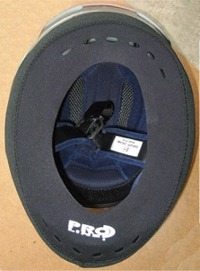
The Neck Roll
We have also found that careful design of the neck cushioning and the the amount of space between the padding and the neck/head in this area is crucial to noise control (see comment from L.S. below).
Unfortunately, most manufacturers have yet to address this problem.
In the meantime, we’ve found the Windjammer helmet wind blocker (review) (photo left) to be an effective and relatively inexpensive device.
It can be fitted to any full-face helmet to help prevent low frequency, turbulence-induced noise that enters the helmet from the bottom of the helmet around the neck and chin.
We have also evaluated the NOJ Quiet Rider helmet wind blocker (review), which fits more completely around the bottom of the helmet and the rider’s neck. This product is intended to eliminate drafts but may also serve to lower ambient noise levels.
The SCHUBERTH C3 (review) and SCHUBERTH C3 Pro (review) have special double neck rolls to help reduce noise levels. These helmets are very good at controlling noise levels, especially for a flip-up.
But, they must correctly fit your head shape and again, it’s all relative — no helmet will make it library-quiet, especially if you don’t wear ear plugs.
While it may seem strange, riding a “naked” bike can actually cause less turbulence and lower noise levels.
This may seem counterintuitive, and many riders don’t believe it. But helmets that are out in the clean air stream and not influenced by “dirty” air and turbulence caused by a windscreen can provide much lower noise levels.
Don’t forget that turbulent air isn’t always directly felt by the rider.
The aerodynamics of the motorcycle can cause lots of turbulence behind the rider that isn’t necessarily felt as a buffeting, but can still be the cause of noise levels because of the way the turbulent air affects the back of the helmet.
Motorcycle Helmet Noise Reduction
It is sometimes possible to reduce the amount of noise that is experienced by the rider. But first it’s important to understand where and how the sound is generated and how sound is propagated.
Sound is transmitted in waves. The basic components of a sound wave are frequency, wavelength and amplitude. In the graphic of a sound wave shown below, the period of one cycle of this wave is 0.5 seconds, and the frequency of this wave is 2 cycles per second or 2 Hertz (Hz) (Courtesy of theNational Oceanic and Atmospheric Administration).
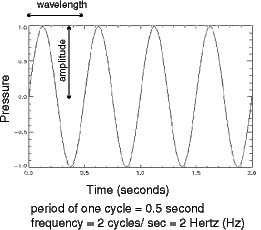
A real example of a sound wave graphic be seen in the noise frequency charts shown below, taken from actual sound recordings during a motorcycle ride.
We have been experimenting with recordings of helmet noise levels with stereo microphones placed next to the rider’s ear as we conduct our helmet evaluations.
The goal of these recordings is to provide you with an actual sound sample that can then be used as another data point when deciding which helmet to purchase.
We used a pair of very high quality Sound Professionals cardioid stereo microphones (SP-CMC-20) connected to an iRiver IFP-899 MP3 player and a few other tweaks to try and capture helmet wind noise as an MP3 file.
The mics were placed right over the rider’s ears in an attempt to duplicate the exact same sounds as we experience during our helmet evaluations.
The recordings were made at 32KHz at 128KBPS and converted from a native iRiver format to MP3 using the iRiver Music Manager software. We then used the free and open-source Audacity Sound Editor software to edit the sound files by saving just the relevant information.
We still have lots of work to do before we can determine the optimum settings for best results, but our initial trials have at least proved interesting.
We are in the process of completing a comparison review of the AGV Ti-Tech and the Suomy Extreme helmet (the article will be posted very soon), and we used those helmets to record these MP3 files. Each file is approximately 1 minute long.
We invite you to listen to each of these admittedly crude first attempts and see if you can notice a difference.
Listen for a difference in volume and also in the quality or type of sound (frequency). We may include individual sound files with each helmet review in the future for reference.
See also the wBW review of the NOJ Quiet Rider helmet wind blocker. This article also has MP3 files comparing the helmet noise with and without the Quiet Rider on the Bell Sprint and Arai Quantum II.
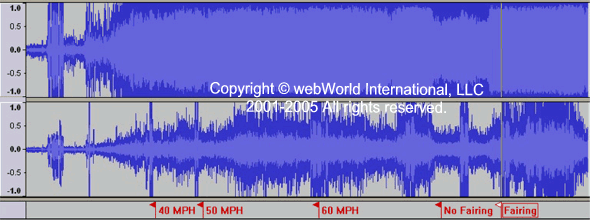 AGV Ti-Tech Helmet Noise, 0-60 MPH, 1998 Triumph Tiger.
Notice that the right speaker is picking up less volume in both recordings. This is probably due to a location issue with one of the microphones.
However, it is virtually impossible to record the exact same volume and sounds through two separate stereo microphones place on either side of a motorcycle helmet.
We have labeled the various points on the graph that correspond to the speed of the motorcycle. The rider’s narration will point out these marks, but his voice is muffled due to the placement of the microphones.
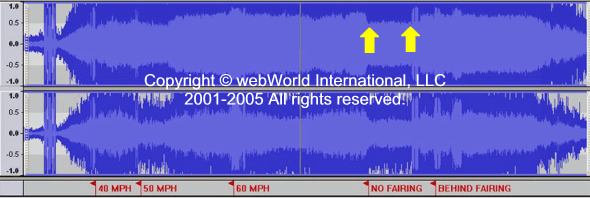 Suomy Extreme Helmet Noise, 0-60 MPH, 1998 Triumph Tiger.
Note also the yellow arrows, indicating the beginning and the end of that portion of the sound recording where the rider’s head was lifted out of the turbulence caused by the Tiger’s half windscreen.
The sound levels at this point drop noticeably due to the reduction in wind noise caused by the turbulence.
Conclusion
In our opinion, motorcycle helmets will not always reduce noise levels significantly, and, in fact, they may actually cause higher levels of noise in more harmful frequencies than might be expected.
Riding without a helmet is definitely not an answer, both for reasons of safety and because of the extreme volume of noise when riding without a helmet.
Some claim that riding without a helmet allows the rider to hear other vehicles more clearly, but this is usually not the case when riding at higher speeds without a helmet.
There are many variables that can cause helmet noise, including helmet design, motorcycle design, weather (i.e., cross winds), turbulence and also the configuration of the motorcycle’s fairing or windscreen.
Some helmets are intrinsically quieter than others, either due to their design, the liner, the aerodynamics or how the helmet fits the rider’s head.
We strongly suggest wearing high quality, correctly fitted earplugs whenever you ride a motorcycle. This can help minimize the risk of hearing loss, reduce stress and make the riding experience more pleasant. For more information, see the webBikeWorld Ear Plug Reviews index.
Owner Comments and Feedback
See details on submitting comments.
From “W.B.G.” (October 2015): “Further to your article on noise and helmets and hearing protection I think the biggest misconception is that noise does not only enter through the ear but even more so through the bone of the skull surrounding the ear.
To illustrate this put your earplugs in and tap the skull just up against the forward side of the ear and you will experience a loud banging on your hearing organ.
I have even spotted a new startup company that has developed a sound headset for athletes that works exactly through that location of the skull and does not go into the ear.
They claim the sound experience is just as good as with in ear plugs but keeps your ears free for ambient sounds like traffic.
Now that does not serve any purpose for a motor cyclist but it does show that you can well reach the inner ear other than through the ear itself.
I have been struggling with noise , bikes and helmets since the day I started driving and have always been looking for a quieter ride. So in my search for the answer I found today another proof for the above theory.
This article is geared towards the problem of protecting people who work at the launch deck on an aircraft carrier and are exposed to very high dB that would surely deafen them if they are not protected.
The article touches the exact same problem with sound reaching the inner ear through the skull.
My conclusion is that I would be interested to see endeavors by the helmet manufacturers to deal with the sound that enters the entire helmet, especially around the ear. Could there be special sound insulating foam that does a better job?
Could there be a sound cancelling system within the helmet interior around where the ears are?
I have seen that the Sena Smart helmet (preview) is using sound cancellation. This could be an interesting approach but I would like to find out if they also included fighting the through skull sound with this approach.
I also agree very much so in your article that the fairing can be a big cause for noise if height of the rider is ending up to be in the mid of the jet stream coming of the top of the fairing.
A big fairing producer in Germany is even explaining on its website that when you have trouble with being in the middle of the stream lowering the fairing is often a better solution than heightening it.”
Editor’s Reply: Thanks for the information, we have mentioned this phenomenon of bone transmitted noise several times in various webBikeWorld articles.
There are currently two helmets I know of that incorporate large insulating ear cups; in fact, we have actually helped one manufacturer to test prototypes and there is also the Sena helmet prototype.
But, the ear cups pose a problem for motorcyclists, we have found.
First, it makes it difficult to put on the helmet and take it off. Also, we discovered that the ear cups must be removable so they can be replaced with larger or smaller sizes. If it is too big, the effect is diminished; if it’s too small, your ear can’t fit inside.
But the biggest surprise we found is that while the ear cups reduce some external noises, they make other noises more prominent.
We found that vent noise, which disappears into the background sometimes on a normal helmet, becomes more noticeable when certain other frequencies are reduced when using the ear cups.
Finally, the large ear cups can make the area around the ears become very hot and sweaty. So, there’s no easy solution here.
From “P.M.” (September 2013): “I have a standard BMW K1100RS and three helmets. The original windshield directs the wind upwards and it hits my helmet with awful noise of turbulence.
I have some basic knowledge of aerodynamics.
I took a piece of polyurethane insulation and clued it over the original windshield. I cut it to a resemblance of a aeroplane wing and found a profile, which directs the wind down against my chest and not helmet. This made the bike nearly as free of turbulence as bikes without a windshield.
This works up to 120 km/h but after that there is a turbulent wind from the front tire, mirror, my hands and the sleeves of the jacket.
I have tested many kind of ear plugs during 30 years.
Most of them either make my ears ache or are too weak in noise cancellation. The best earplug so far has been a piece of soft toilet paper munched in mouth and fitted to the ear wet.

You can use this kind of plug for 10 hours with no problem before they get too dry. Then you just make new ones and continue your drive. I think that the saliva of the driver is the best antibacterial medicine for himself.
I’m going to build some noise cancelation to the helmet using thin, 0.1mm foils of lead and new soft pads of rubber foam around the ears. I also have a DIY analog noise cancellation circuit waiting for installation.
The best results so far I have found, when I rebuilt the collar of my driving coat. I used rubber foam from an old car bench and built the collar like a high chimney, which fits rather tight against the bottom of the helmet.
Of course you have to get the belt of the helmet tight, if you don’t have a sock between the collar and the helmet.
I tested a “beard” of ABS on the helmet. It helped some, but looked funny and was a bit awkward.
Sharp Kamm edges made of thin acrylic and gorilla tape at the back of the helmet help some to the turbulence which the helmet builds itself as long as you don’t turn your head. I also tested some soft spray silicone paint over the helmet with no noticeable results.
Follow-up from “P.M.” (September 2013): “In the mean time I made some testing. As I told, I bought a new helmet, RXA Explorer. It is made of polycarbonate, which seems to be bad thing.
If you have it on your head and knock it with your nails, it sounds like a guitar. The material does not damp the vibrations.
I might some day take the styrox out and paint the inside with some heavy soft mass which doesn’t weaken the material. Possible even a thin layer of camping mattress material or superlon between the helmet body and styrox might help without any clue. It cuts the path of sound.
I took the soft parts around the ears out and found there was a cavity for earphones, dia 35mm. My first thought was to install the DIY noise cancellation circuit there but I didn’t have that size of loudspeaker elements in my lab.
I took a piece of my camping mattress and cut it to fill the cavity. It was a bit too thick but as I tested it, it pressed my ears nice so I left it there and made a test drive.
Without earpads it was even more quiet than it had been with pads before. I rode some miles at about 160kmph and it felt better than 80kmph before.
Now I got to find some more of rubber foam and try that. Still.
Now I feel that the material of the helmet is important. Polycarbonate and styrox are not the best choice to damp the noise. They do not damp the vibrations. I don’t have too much time for this, I have a house and a sailing boat under work.”
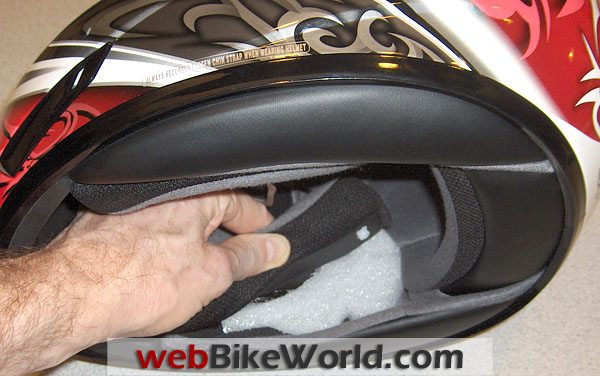
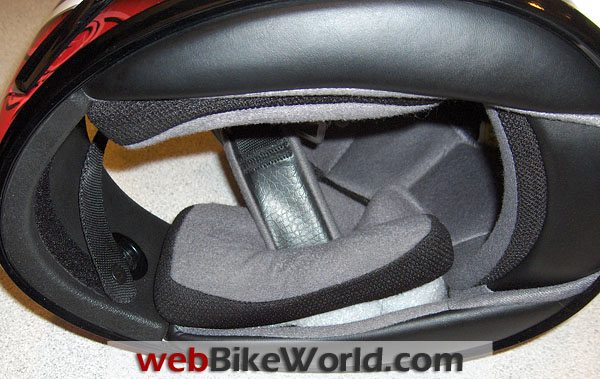
From “L.S.” (10/10): “I just discovered something (although this may be a DUH! moment to others).
I’ve got a problem with my custom earplugs — no matter how many times they try to refit them, my right ear is different than my left, and doesn’t hold the custom earplug in as well as my left ear does.
So the other day, I stuffed some padding behind the cheek pad of my HJC helmet that surrounds my right ear, in order to better hold the right earplug in place.
See attached photos. I went out for a ride, and the ride was silent, like riding in a bubble.
It occurs to me that that’s probably because I effectively increased the seal of the padding around my ear.
Specifically, what I really did is just increase that size of the roll of padding around the bottom rim of the helmet, in the area immediately under my ear.
That prevents the wind-rush noise from coming up from below into my ear.
So I did a test: I removed the Windjammer II that I’ve used on all my helmet to reduce wind noise, and improved the fit of the padding behind the right cheek pad, and added some padding on the other side too.
Then I took a ride, and without the neck gaiter that I usually use that also contributes to noise reduction. Fantastic, tremendously reduced noise.
So it looks like the most important thing to do to reduce the wind noise that comes from below is to have a thick roll of padding on the rim of the helmet, right under both ears.
I’m gonna try out some of the other helmets I have to see if that theory holds up.
From “B.D.” (5/09): “Human heads must be still evolving because there are so many different shapes.
But for mine, simply tying a bandanna around my neck and tucking it up into the helmet below my ears seems to help attenuate wind noise a bit, when riding with my HJC helmet.
Sure, earplugs are best, but with or without them, this helps me.
I have another helmet fitted with a Windjammer. It’s snug and quiet, but too damn hot for summer use, and donning it with the Windjammer installed stirs up some infantile memory of a trip down the birth canal!”
From “G.C.”: “I’m convinced that the poor vent, visor pivot, and neck roll designs are what make modern helmets so noisy. When I started riding 15 years ago, I got a cheap US$105 Bieffe B89 full-face.
It was so cheap it didn’t have ANY vents and the visor was permanently attached!
The visor pivots were a thin flat black disk that didn’t catch the wind. It had a continuous vinyl neck piece w/o the split that’s usually under the ears. The bottom of the helmet shell also came down a lot further (over an inch) than my Shoei RF200.
It was the quietest helmet I’ve ever had. It was literally like sitting in a car. Nothing else has even come close. If it’s quiet level is a 1, then other helmets would be 6-10.
One helmet I had (RF700?) had a neck roll with a split that scooped up turbulence and piped it right to the ears. I had to use duct tape to keep the thing quiet enough to wear, even with ear plugs.
I miss that piece ‘o crap! I’d trade my SCHUBERTH Helme Concept for it in a heartbeat.”