

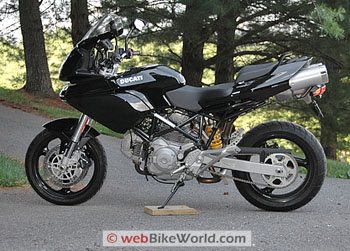
The Ducati Multistrada 620
July 2007 – The latest addition to the webBikeWorld inventory is this black Ducati Multistrada 620.
A brand-new 2006 leftover, the bike was originally consigned to Winchester Motosports in Winchester, Virginia.
That shop stopped selling Ducati (and Moto Guzzi), and Duc Pond Motorsports in Winchester picked up the Ducati franchise and bought the Winchester Motosports inventory, which included this 620.
I went to the Duc Pond open house after they became western Virginia’s newest Ducati dealership (and MV Agusta; photos coming soon!), where I found the 620 for sale.
I have to admit; I felt sorry for it — the poor thing had been bumped from dealer to dealer, sitting on the shop floor for over a year, hoping that someone would give it a home!
I was that lucky person, but how would I justify it to the wife? Hmmm, let’s see….
We like to have a variety of bikes to use for webBikeWorld reviews, and Burn sold off 6 of the 9 in his stable, and we needed something with a fairing to evaluate helmet noise on that type of bike.
Pretty weak? Yeah, she thought so too.
How about this — I’ll appeal to her sense of style:
“The booming Adventure Touring market justifies the expense; after all, the Enduro-styled clothing and helmets we’ve been reviewing are made for a Multi but they look rather goofy on the GT1000“.
She actually agreed — that I looked goofy in Enduro clothing on the GT anyway, but she didn’t buy it.
But how about this: “I loved the old ’98 Triumph Tiger “Steamer” and I can’t believe it’s gone, I regretted selling it the minute it left the driveway and I feel sorry for it”.
Sounds just as hokey, I know, but I think I hit some kind of emotional nerve.
She was apparently struck by the notion that a man could have feelings like that for a long-lost machine. Either that or she was so tired of hearing me kick myself for selling it that she relented.
I never even rode the Baby Multi — I just charged it to a credit card (“buy now, pay later”) and rode it home. It’s great — similar yet different than the GT1000, with the same riding position that I liked on the Tiger.
It’s forgiving where the GT is focused, and although the 620cc engine has plenty of thrust, it’s much more of a laid-back ride with a comfy, stretched-out riding position.
It should also prove useful for evaluating helmet buffeting and noise in a way that the GT1000 can’t, because the fairing on the Multi dumps the dirty air right around the bottom of my helmet.
We’ve already noticed that some helmets are greatly affected by this, while others are not.
For example, our recent review of the Scorpion EXO-400 discussed the relative quiet of the helmet on an unfaired bike (the GT1000), while behind the Multistrada, the helmet is about as noisy as can be. Contrast that with the Arai Quantum II, which doesn’t seem to care; there’s not much difference in noise on the two bikes.
There are plenty of goodies for the Multistrada, and we hope to feature some of them while we have the bike.
There’s probably not much new we can add to the discussion, as the Multistrada line has been around for a few years, proving to be one of the most popular Ducati motorcycles ever.
Some are put off by its styling, but I’ve been a big fan ever since the beginning.
The 620 version was only made for a couple of years, and I’m not sure why. I’ll guess that it probably cost nearly as much to make as its Multistrada 1000 (and now the new Multistrada 1100) siblings, combined with the American dislike for anything that might be perceived as a “beginner” bike.
It’s too bad, because the Multistrada 620 is a fine machine with a comfortable riding position (although I will admit the seat padding is a bit hard) and no bad habits.
There’s not all that much we can add to the Multistrada discussion, because there are plenty of enthusiastic owners, including many who have customized their Multis to the max.
A good place to start is Multistrada.net, which features discussions, photos, tips and user evaluations of the various accessories that are available for this unique motorcycle in its 620cc and up forms.
If you can recommend other Multistrada resources, drop me a line at editor@webbikeworld.com
Tinkerer that I am, I stripped the reflectors from the front upside-down forks and also removed the rear reflector assembly that framed the license plate.
I added a Battery Tender SAE connector to the battery, which, curiously enough, is underneath the left-hand side panel on what you’d think should be the fuel tank.
As it turns out, this is a great location for battery access, although I’m not sure what it does for the center of gravity.
I also added a Formotion thermometer and a Bike Watch clock I had laying around, and a Signal Dynamics LED brake light bar and Life Brite LED brake lights that have graced the rear end of several bikes that passed through the webBikeWorld garage.
We’ll post these articles and more in the same type of “blog” format that I’ve been using for the GT1000, which has proven to be popular with many owners.
And that’s not the end of it — we ordered up a set of Ducati Performance hand guards, a replacement windscreen and more.
We’ll also use the Multi to evaluate a variety of products in future reviews, such as an upcoming comparison of extra-loud horns, light bulbs and more.
By the way, the page you’re currently reading was the original home for the Ducati Multistrada information and original specs and information that were released when the bike was first announced in 2005; that information is located below.
So here are some photos of the new webBikeWorld Ducati Multistrada 620!
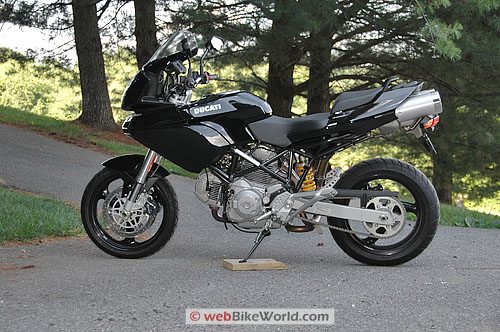
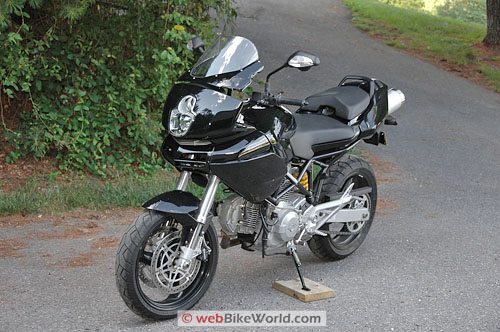
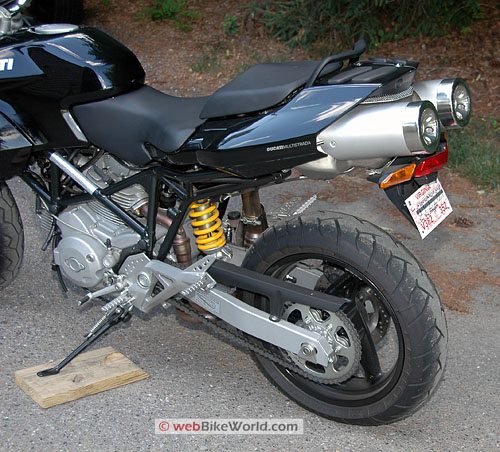
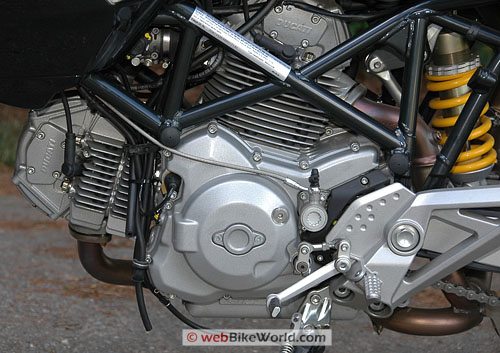 The 620 V-Twin with the evaporative emissions canister removed.
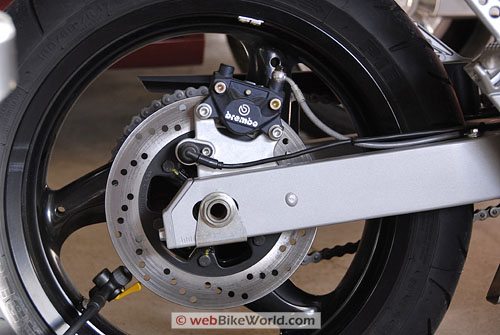 Multistrada 620 Rear Brake
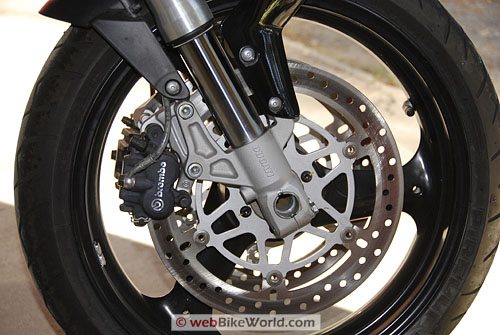 Multistrada 620 Front Brakes and Upside-Down Forks
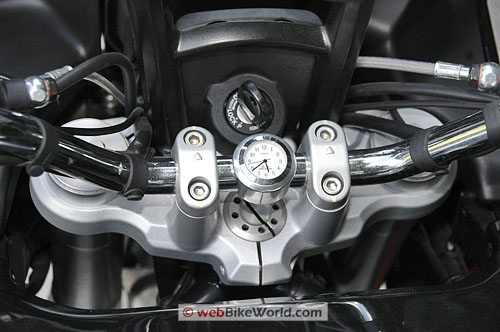 Bike Watch Handlebar Clock
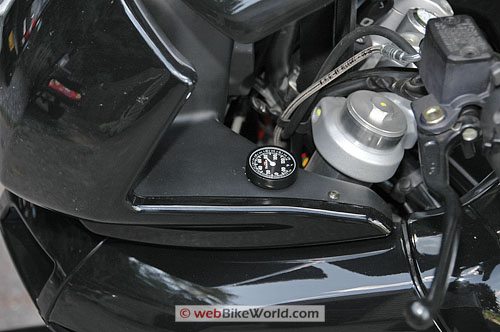 Formotion Thermometer
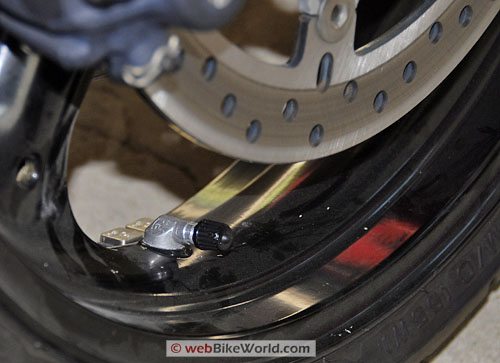 The Multistrada front rim comes with a 90-degree valve!
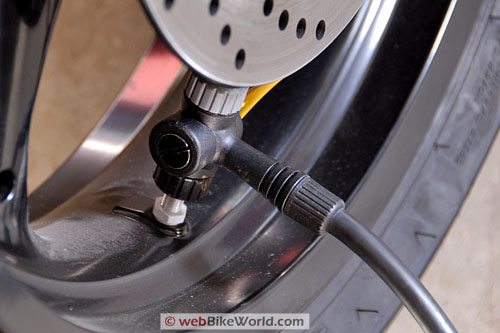 The rear rim has an offset valve, which makes it easy to fill the tire.
Ducati Multistrada 620 Information
May 13, 2005 – Ducati invented a whole new motorcycling genre with the release of the Multistrada line of motorcycles.
The goal is a motorcycle capable of tackling all types of roads with good performance, whilst combining all-day comfort and sports performance.
The Multistrada in some ways redefined versatility and performance, and offered a true alternative to traditional motorcycles.
The Multistrada is designed for fun on all types of road, from smooth asphalt surfaces to rough mountain twisties and city center cobblestones.
Delivering performance without sacrificing practicality, versatility without compromising road-manners and advanced design without forfeiting function, the Multistrada is a real-world motorcycle for real-world riders.
The Multistrada is a complete sport motorcycle for enthusiasts who ride as often and in as many challenging conditions as possible. Its riding position is more upright than the classic “forward-lean” ergonomics of most sport bikes, but still delivers sport performance and control.
As a result, the Multistrada carves up mountain passes like a race bike, but is still comfortable for hours of two-up adventure touring.
This balance appeals to a wide range of riding styles, from the most aggressive to the more relaxed. Capable of spanking even the most specialized of sport bikes, the Multistrada is also welcoming to new riders. The bike exceeds the expectations of any enthusiast who rides it.
Its winning characteristics include light weight and agility on the one hand and the sort of stability normally only found in thoroughbred racers on the other, the latter being indispensable for confident control on high speed roads.
The Multistrada concept combines two completely different types of motorcycles, the “big dual sports” with a pure sport bike.
The revolutionary Ducati Multistrada incorporates the key characteristics of both, the comfort and versatility of the dual sports plus the precise handling and engine power of the sport bikes, combined uniquely by Ducati. The result takes the name of: Ducati Multistrada.
Style
The new Multistrada certainly has an unmistakable and original look: from the futuristic instrument panel, to the sculpted lines of the fuel tank, to the streamlined exhaust pipes, there aren’t many other motorcycles like this on the road.
More than just style, the Multistrada offers a design that makes sense: the upper front fairing, integrated with the steering controls to ensure a tight turning radius. New features include a new windshield that has been raised and a seat that has been redesigned to offer even greater comfort and control.
Furthermore, the fuel tank has been stretched out beneath the seat to provide greater capacity while maintaining the compact design. The indicators are built into the rear-view mirrors and have been repositioned further apart to improve visibility.
Despite its revolutionary design, the Multistrada is still maintains signature Ducati features, with its trademark trellis frame, finely-calibrated suspension for precision handling, and braking system on par with that of our top sport models.
The Multistrada Family
Ducati provides more alternatives for the 2005 model year.
The Multistrada family has expanded in two directions, with even higher performance in the form of the new 1000 S DS with more sophisticated suspension to satisfy the most demanding riders, and to a wider audience with the introduction of two new entry level models.
The real news for 2005 is the arrival of the Multistrada and Multistrada Dark, with nothing in their names to identify the engine size but actually powered by the latest 620 cc engines.
Multistrada
The Multistrada shares the 620 cc engine and a number of dedicated components that sets it apart from the 1000’s, but still maintains the same personality and versatility of the Multistrada concept.
It is the perfect machines for riders who demand the versatility of these unique motorcycles, but is even easier to ride than its 1000cc counterparts.
A “Dark” version of the Multistrada 620 is also available. Its classic matt black coloring and front brake with single large-diameter disc evokes the minimalist aesthetics of a Supermoto.
Multistrada 1000DS
The 1000 DS is the evolution of the bike that revolutionized motorcycling by introducing a whole new type of machine in 2004.
All the qualities that riders have so appreciated are still there while the 2005 models have also improved on a number of points as suggested by owners of the first series.
Multistrada 1000 S DS
Ducati has developed an even more advanced machine based on the 1000 DS, made for riders who desire advanced sporting capabilities.
The difference between the 1000 DS and 1000 S DS lies in its special equipment, like variable section handlebars, multi-adjustable Öhlins suspension, and carbon fiber body parts.
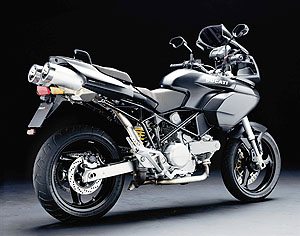
Multistrada 620
With a displacement of 618 cc, the Multistrada is designed to make the range more accessible to riders who are drawn by the unique style of this bike.
This entry-level model offers the same acclaimed qualities of the Multistrada 1000 DS: a sporting temperament combined with high levels of comfort.
When looking for the ideal engine to equip the smallest of the Multistrada models, we had a wide range of our twin-cylinders to choose from, but the final decision went to the 620, because of its confident linear power delivery and ease of riding.
This version also benefits from significantly lower weight (13 kg less than the 1000 cc), which enables you to tackle bends with outstanding agility, and a 20 mm lower riding position, which increases confidence in all situations.
The light lever pull of the new Power Torque Clutch (APTC) makes the bike even more of a pleasure to ride, especially in city traffic. The clutch is also equipped with a race-derived slipper device, to prevent rear wheel slip even when downshifting hard and fast.
The bike shares all of the aesthetic features which have contributed to the success of the family, and all the functional and stylistic updates adopted on the entire 2005 range.
All of the Multistrada models have a re-designed seat, with improved shape and comfort for the rider and an anti-slip cover for the pillion; not to mention an upper fairing with a taller windshield for enhanced rider protection.
Also rear-view mirrors 40 mm further outwards for improved visibility, and a reengineered side stand for more stable parking.
But the smallest Multistrada also features a number of dedicated components such as a lighter two-sided swingarm, which is stylistically similar to the one used on the Monster range; the die-cast footpegs, which integrate the rider and pillion footpegs into a single piece, and the front braking system, which is also used on the new Monster S2R.
Other items are identical in appearance but with different characteristics to those mounted on the Multistrada 1000. One of these is the fuel tank, whose capacity is limited to 15 liters, which is still enough to ensure high mileage between fill-ups because of the lower consumption of the 620 engine.
The distinctive features of this outfit are the manual choke control mounted on the left-hand side of the handlebars and the three-spoke alloy wheels.
The Multistrada 620 is also available in the Dark version, with its trademark matt black paintwork and single large-diameter front brake disc, which accentuates its minimalist Supermoto look. Both are also available in a European standards 25 kW limited power version.
And for all of the Multistrada models, there’s a long list of options to accentuate either the sporting or touring side of the bike’s character. So you can fit dedicated side panniers, a rear luggage rack, GPS navigation system, racing exhaust kit and a host of other accessories.
Chassis
In keeping with its original setup, the frame of the Multistrada is exactly the same size as the one used on the 1000 DS, but with a lower seat to make the bike even easier to ride.
In true Ducati style, the frame is of high-strength steel trellis type to ensure maximum rigidity and confident handling. The center section of the frame in particular has been designed for reduced width so that the rider can move more easily on the seat.
The ergonomics as on the larger engine versions, have a more upright and comfortable riding position.
The most obvious differences are in the tail section, where the single swingarm makes way for a more conventional two-sided unit.
The swingarm has been re-designed, to create a lightweight (5.7 kg) structure with parts extruded from hydro-formed steel.
The need to leave the exhaust pipe passage free (by creating a sharp bend) without sacrificing aesthetic considerations made it necessary to resort to hydro-forming for the right arm.
A circular tube 65 mm in diameter is forced to assume the shape of the mould by water pressure. The same technology was also used for the left arm. The swingarm bearings, like on the MTS 1000 DS, are fitted directly in the swingarm.
The suspension is comprised of Marzocchi upside-down forks with 43 mm diameter stanchions and a Sachs monoshock, with adjustable rebound and pre-load.
The rear suspension linkage, based on the one used on the 1000 DS, has a reaction rod which is not length-adjustable. The new steering top crown is die-cast, which made it possible to integrate the handlebar supports during the casting process.
Braking is entrusted to 300 mm double discs with floating calipers, actuated by a new master cylinder. The rear brake features a 245 mm single disc with fixed caliper and double piston.
The entry-level Dark version includes a further variation, in the form of an efficient 320 mm single front disc.
Body
The “fuel tank/seat unit”, with a length of 1100 mm, is made of rotational molded technopolymer.
This technology makes it possible to deposit plastic (nylon) on the walls of a shell made up of two parts which, in negative, reproduce the form of the fuel tank itself.
This shell rotates on two axes inside a special carousel, so that the liquid nylon is distributed in every area. During this process, which takes place at a specific temperature, the plastic polymerizes and therefore hardens to form the walls.
The design of its special shape keeps the width down where the rider’s knees rest, without limiting its capacity. The fuel is in fact also stored under the rider’s seat.
Eliminating the complex ventilation system of the 1000 models has reduced the capacity of the fuel tank from 20 to 15 liters, thus leaving space for a handy storage compartment.
The lower consumption of the 620 engine means that mileage between fill-ups remains unchanged compared to the 1000 models.
The fuel level sensor has been replaced with a thermistor for monitoring reserve fuel level, which is indicated by a dedicated warning light on the instrument panel.
The Multistrada is equipped with fairings with no visible fasteners, so as to keep a clean, fluid shape: this was achieved by using complex moulds and refined molding technologies.
The right-hand fairing does not have a storage compartment like on the 1000 cc version, but this is replaced with a useful compartment in the rear of the fuel tank/seat unit.
The pillion grab handle has been re-designed in plastic, thus considerably reducing weight.
The air intake system has a high volume (11 liter) air box, achieved because part of the fuel is stored “under-seat”. The air enters this box through two inlets, which also act as sound baffles (to reduce the noise emissions of the intake), then passes through the filter to the manifolds.
The separator for oil vapors originating from the crank case is built into the filter box, thus making the structure extremely functional.
This unit was made possible by vibration welding the plastic of the separator to the plastic of the air box. By causing the two parts to vibrate at high-frequency and low-amplitude, the plastic heats up and fuses together at the point of contact.
This technology makes it possible to join complex shaped parts, which could not be easily welded using the conventional hot blade method.
The exhaust system is no longer fitted with a central pre-silencer (a chamber for damping the pressure waves), but the manifolds are joined in a “Y” shaped element, with a catalyzer in the end, with a pipe leading from it to the end silencer.
Electronics
The instrument panel, which has been re-designed and simplified, features an analogue rev counter driven by a step motor, and is back-lit.
On its left, is a back-lit liquid crystal display, which as well as showing a range of information such as road speed, also tells you when the bike is due for scheduled servicing.
It is also possible to display the diagnosis of the first level engine control system (a more detailed diagnosis is made by dealer service technicians using a Mathesis tester).
The extremely compact instrument panel is made using a highly integrated electronic system. The Immobilizer system utilizes and is dependant on the instrument panel and engine control unit.
Engine
When looking for the ideal engine to equip the smallest of the Multistrada models, Ducati had a wide range of twin-cylinders to choose from, but the final decision went to the 620, because of its power delivery and ease of riding.
These qualities were then enhanced by the adoption of the recently developed Power Torque Clutch (APTC) which, as well as drastically reducing lever effort, is also equipped with a slipper device.
The engine on the entry level Multistrada is the air-cooled 618 cc Desmodue ‘L’. Its fluid delivery is now legendary and synonymous with light weight, controlled power and high reliability, not to mention low running costs.
With ideal power to torque ratio (63 HP @ 9500 rpm) to make the Multistrada agile on all types of road, the Desmodromic engine with two valves per cylinder, like all Ducati twin-cylinders, complies with Euro 2 emission standards.
The piston has a stroke of 61.5 mm and bore of 80 mm for total displacement of 618 cm3.
Manufacturing of the connecting rods, with distance between centers of 124 mm, has been improved to increase fatigue resistance, by having their surfaces undergo vibratory tumbling with a with a chemical agent, which eliminates the micro-imperfections which could lead to cracking.
The cam shaft, supported by a ball bearing at each end, has cam lobes designed to reduce acceleration as the valve head approaches the seat. The housing and discs of the Power Torque Clutch (APTC) are made of aluminum for significant weight reduction.
Fuel is of course supplied by an electronic injection system. The system has one injector and one coil per cylinder.
The Power Torque Clutch (APTC), which is already in use on some of the Monster models, is a device with follow-up torque, in other words the torque transmitted is a function of the torque applied.
This has allowed a significant reduction in the effort required to operate the clutch lever, while ensuring that full engine torque is transmitted to the gearbox primary shaft.
Another important feature of this device is its capacity to automatically limit the reverse-acting torque generated by hard downshifting: this therefore also prevents rear wheel slip.
Multistrada 620 Technical Specifications
Engine
- Type L-twin cylinder, 2 valve per cylinder Desmodromic, air cooled
- Displacement 618 cc
- Bore and stroke 80 x 61,5 mm
- Compression Ratio 10.5:1
- Power 46.4 kW – 63 HP @ 9500 rpm
- TTorque 55.9 Nm – 5.7 Kgm @ 6750 giri/min
- Fuel injection Marelli electronic fuel injection, 45 mm throttle body
- Exhaust Steel single muffler and pipe system with catalytic converter
- Emissions Euro 2
Transmission
- Gearbox 6-speed
- Ratio 1st 32/13, 2nd 30/18, 3rd 28/21, 4th 26/23, 5th 22/22, 6th 24/26
- Primary Drive Straight cut gears; Ratio 1.85
- Final Drive Chain; Front sprocket 15; Rear sprocket 48
- Clutch APTTC wet multiplate with hydraulic control
Chassis
- Frame Tubular steel trellis frame
- Wheelbase 57.4 in / 1459 mm
- Rake 24°
- Steering angle 35° right and left
- Front Suspension Marzocchi 43 mm upside-down fork
- Front Wheel travel 5.71 in / 145 mm
- Front Wheel 3-spoke in light alloy 3.50 x 17
- FFront Tyre 120/60 ZR 17
- Rear Suspension Progressive linkage with Sachs adjustable monoshock. Steel double-sided swingarm
- Rear Wheel travel 4.8 in / 121 mm
- Rear Wheel 3-spoke light alloy 4.50 x 17
- Rear Tyre 160/60 ZR 17
- Front Brake 2 x 300 mm discs, 2-piston, 2-pad floating caliper (Dark: 320 mm semi-floating single disc,4 piston, 2 pad caliper)
- Rear Brake 245 mm disc, 2-piston caliper
- Fuel Capacity 15 l (of which 4 l reserve) / 3.9 US gal (of which 1.0 US gal reserve)
- DDry Weight 402 lbs / 183 kg
- Seat height 32.69 in / 830 mm
- Max Height 52 in / 1320 mm
- Max Length 82.2 in / 2087 mm
- Instruments Speedometer, rev counter, clock, scheduled maintenance warning, warning light for low oil pressure, oil temperature, fuel reserve, neutral, turn signals, fuel injection diagnostic system, immobilizer
- Warranty 2 years unlimited mileage
- Versions Two-seat
Publication Date: May 2005
Master Listing of All wBW Motorcycle Product Reviews