

The Ducati Desmosedici Project: From Track to Road
Without a shadow of doubt, courage, ambition, pride, ingenuity and heritage all form the basis of the Ducati Desmosedici project. This important venture has simultaneously marked the return of Ducati to the MotoGP World Championship, and enabled the company to confirm its tradition of manufacturing successful, high-performance, four-stroke racing motorcycles.
2003 would see the Italian manufacturer make a spectacular return to the Moto GP with a project that had begun two years earlier and which had been developed by the Bologna manufacturer’s racing department. While still fully committed to Superbike racing, Ducati was also embarking on this exciting new challenge, taking part in the MotoGP World Championship for four-stroke prototype machines with the Ducati Marlboro Team.
“The philosophy of the Ducati Desmosedici project,” declared Filippo Preziosi, Ducati Corse Director General, “is best expressed as total integration between engine, chassis and rider. This basic concept has been our philosophy from the very moment that we decided to tackle this new challenge.”
“The bike represents an important evolution over the Ducati Superbike and is the result of new design techniques that have allowed us to integrate “virtual” modeling and analysis with our considerable racing experience. This has speeded up design and development time and enabled us to immediately obtain surprising results. Ducati is fully committed to this project, which has allowed us to grow quickly and transfer new technology to our street bike product range, which as a result has become increasingly reliable, thrilling and high-performance.”
At first, Ducati’s MotoGP technicians (a group of passionate engineers with an average age of 28) had considered the possibility of creating a MotoGP “super-twin”, a latest-generation V-Twin prototype, taking advantage of the regulations that give twin-cylinder machines a considerable weight reduction over four, five or six-cylinder bikes.
However, detailed analysis, including numerous computer simulations, indicated that a twin-cylinder engine would just not have been able to produce the required amount of power (more than 230 HP), without excessively increasing the number of revs. A Twin would have had to rev at over 17,000 rpm, but this would require a very short stroke and a very large bore, as a result producing possible combustion problems.
Ducati therefore opted for a brand-new V4 engine, which continued the traditional layout of its 90° L-Twin engines, together with desmodromic valve control. This marriage of tradition and innovation proved to be the path to follow. The engine was called Desmosedici because its 16 valves were controlled by the desmo valve train system, a key factor in Ducati’s numerous successes on the track.
The tried and tested V-90° layout offers a number of advantages that have contributed to Ducati’s success on the track and allowed the Desmosedici project to achieve major results. The layout of the cylinders guarantees perfect primary engine balance, an important characteristic for an engine that is required to rev up to 17,000 rpm with minimum vibration, thus improving mechanical efficiency and reliability.
The desmodromic system, designed for Ducati by the legendary engineer Fabio Taglioni, uses rockers both to close and open the valves, and this allows the engine to function with extraordinary precision at all rpm.
For the first 2002 tests, Ducati Corse produced two versions of the Desmosedici engine, one with a regular firing order, and the other with paired cylinders firing simultaneously (Twin pulse). It soon became clear that the latter version put the engine components through excessive strain, so it was decided to use the first configuration. Subsequently, starting from the 2004 Dutch TT at Assen, thanks to the evolution of the engine, the irregular firing Twin pulse version was used which gave better drivability.
Ducati has also always aimed at excellence in performance through courageous and innovative choices, such as the chassis of its bikes. While other manufacturers race with different versions of an aluminum box frame, the Desmosedici has a tubular steel trellis structure, similar to the one used with great success in World Superbike.
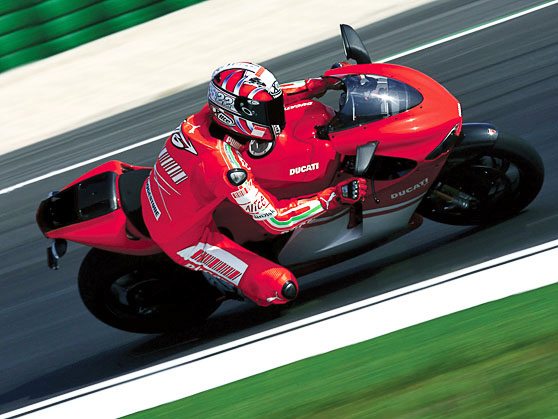
In May 2004, during the spectacular World Ducati Week, the mega-meeting held every couple of years that attracts Ducati enthusiasts from all over the world, Ducati made an announcement that many had been eagerly awaiting: The development of the Desmosedici Racing Replica, a road-bike version of the Italian MotoGP contender that has fired up the enthusiasm of fans around the world, was now underway and would soon be available for sale.
Thus began the Desmosedici RR project and, once again, in keeping with that tradition and spirit that has always marked every decision, Ducati wanted to share this significant and exciting moment with its fans and its public.
Orders started to flow in immediately and keen interest from Ducati fans made it clear that the initial company forecast of three hundred motorcycles would be surpassed with extreme ease.
Before long, the project had started to take shape and just five months later, the new L-four desmodromic engine was sitting on the test bench at the Ducati R&D department for its first reliability and durability tests. Thus the new engine was put through the first “in motoring” and “in firing” tests, designed to assess the duration and strength of the various components in view of the stresses generated by such a powerful engine.
With the contribution of Alan Jenkins, the designer of the MotoGP Desmosedici, work began on the aerodynamics and the livery – which, also from an aesthetic viewpoint, is absolutely identical to the bike used on race tracks.
The definitive version was presented at Mugello on the eve of the 2006 Italian GP. At the unveiling, the aggressive, streamlined design and the applied technical solutions stunned everyone: the first ever road-going motorcycle to offer the stunning performance of a MotoGP machine!
In the meantime, Vittoriano Guareschi, the official test rider of the MotoGP Desmosedici, continued with on-track evaluation, giving the development team a valuable helping hand in putting the finishing touches to this gem of technology and style.
2007 would see the debut of the Desmosedici GP7 — characterized by revolutionary changes to race rules that limit cylinder capacity from 1000 to 800 cc; yet 2007 would also see the Desmosedici RR hit the track.
It made its debut at Misano in front of 50,000 Ducati fans from all over the world who formed the very heart of the fifth edition of World Ducati Week. The first few laps were rightly notched up by Vittoriano Guareschi, who opened up the throttle and let the mighty L-four really roar — to the absolute delight of the public, diehard enthusiasts, and the over 1000 purchasers who had already ordered this esoteric motorcycle. All of the latter, in fact, had been invited to witness this first official outing and see and touch the object of their desire for themselves.
In the meantime, an assembly line exclusively dedicated to the Desmosedici RR has been set up at the Borgo Panigale factory. Everything is now ready for production (which will begin in October) and for delivery of the first bikes.
The Ducati Desmosedici RR is the first and only true MotoGP replica, destined to celebrate this prestigious race category’s era of maximum engine size (1000 cc) and establish a new milestone in terms of Italian technology, components, performance and style.
Ducati Desmosedici GP by the Numbers
2003
Capirossi and Bayliss have a sensational debut season with the Desmosedici, the Italian finishing on the podium in the bike’s first race and following this up with an extraordinary win in the Catalunya GP. Ducati finish second overall while Loris and Troy finish fourth and sixth respectively. Hodgson dominates the World Superbike season with the all-new 999 to take the riders’ title and, together with Xaus, clinch Ducati’s twelfth manufacturers’ crown.
2004
24-year-old James Toseland becomes the youngest ever World Superbike champion as he powers the 999 to its second successive title win. Team-mate Régis Laconi finishes runner-up to ensure Ducati’s thirteenth manufacturers’ title. Youngster Lorenzo Lanzi campaigns a 749 in Ducati’s return to World Supersport, finishing a creditable fifth overall. In MotoGP both Loris Capirossi and Troy Bayliss succeeded in finishing the season on a high note, a difficult season which saw both Ducati riders finish on the podium, thus demonstrating the worth of the Desmosedici MotoGP project.
2005
In MotoGP, Loris Capirossi campaigned the Desmosedici for a third successive year, the Italian scoring two spectacular back-to-back wins in the latter half of the season. His team-mate was Spaniard Carlos Checa, who also picked up two podiums towards the end of the year.
James Toseland and Régis Laconi both won races in the World Superbike Championship, but were unable to challenge for the title, while a new star was born when Italian Lorenzo Lanzi took a third factory 999 bike to two wins in the final races of the season. Ducati Corse were also officially involved on a third front, the Italian manufacturer making a major effort to win the AMA Superbike title in America with Neil Hodgson and Eric Bostrom.
2006
Capirossi again spearheaded the Ducati attack in one of the most exciting MotoGP championships in history. The Italian won three races and took eight podiums to finish his best season with the Italian manufacturer third overall. It was a difficult year for team-mate Sete Gibernau, who sparked off a spectacular crash at the start of the GP Catalunya which conditioned his entire season.
Troy Bayliss returned to World Superbike for Ducati Corse and capped a superb year by winning a second world title, five years on from his 2001 victory. The 37-year-old Australian then wrote another remarkable chapter in Ducati’s history when he won the final round of the MotoGP championship at Valencia after being called in to replace Gibernau.
2007
The first year of the new MotoGP 800 cc era. The Desmosedici GP7 has an all-new 800 cc power unit: smaller and more compact, it is, compared to the 990 cc engine, characterized by regular firing intervals which enhances maximum attainable power and contains fuel consumption. The two standard-bearers of the new MotoGP 2007 team are Loris Capirossi and young Australian talent Casey Stoner.
-
Qatar: Casey Stoner rode to a perfect victory and immediately occupied the top spot in the championship rankings.
-
Jerez, Istanbul, Shanghai: Following a 5th place in Jerez, the young rider from Australia notched up an authoritative win at Istanbul and then took his third victory of the season at Shanghai, reinforcing his leadership even further.
-
LeMans, Mugello, Catalunya, Donington: Following a 3rd place in the rain at Le Mans and a 4th place in the Mugello GP, Casey then went on to win epic battles both in Catalunya and in England at Donington Park.
-
Assen: At Assen, in the ninth round of the MotoGP world championship, the gifted Australian rider took second place and also achieved a good result at Sachsenring (5th place).
-
Laguna Seca: After dominating both practice and qualifying, he grabbed pole position and then, on the Sunday, once again clinched a place on the top of the winners’ rostrum.
-
Brno: Stoner notched up his seventh victory of the season and at Misano, in front of thousands of supporters, started from pole to take another victory and the highest place on the podium.
Thanks to eight wins, Casey Stoner is now in a commanding position at the top of the points table – a dream come true for innumerable Ducati fans, as he now looks unstoppable in his quest for 2007 championship glory.
The Engine
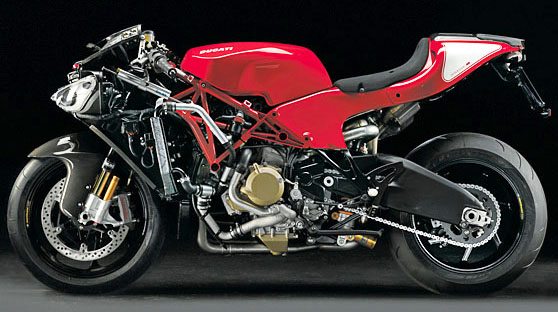
With a power output of 200 HP* at 13,800 rpm and a torque of 11.8 kgm* at 10,500 rpm, the new D16RR engine follows the guidelines laid down by the Ducati Corse GP engine, a masterpiece of engineering and precision.
Bore and stroke measurements are the same as those on the D16GP6: 1000 cc (86×42.56), as are the characteristic positions of the Ducati desmodromic timing system parts (camshaft rotation axis, rocker arm centre and valve centre distance), valve angle, distance between cylinder centers and pulse timing, which uses the Twin-pulse solution applied on the racing engine.
As in MotoGP, traditional Ducati desmodromic timing ensures accurate valve control even at the highest revs and blends perfectly with the modern architecture of this superb 4-cylinder engine. As is the tradition at Ducati, the 90° angle between the cylinders is maintained.
This authentic copy of the GP engine is further endorsed by the use of a cassette type six-speed gearbox and hydraulically actuated dry multi-plate slipper clutch.
The aim of producing a light but reliable engine has led not only to a component design of unrivalled quality, but also to the use of exclusive, individually-made racing-derived materials.
The crankcase and cylinder heads are sand-cast aluminum while the cam-drive cover and alternator casing are made of sand-cast magnesium, technologies that match the lightness of these alloys with the greater mechanical strength expected from structural components. The oil sump, cam covers and clutch cover are made by pressure die-casting magnesium alloy, a technology that allows significant thickness reduction on non-structural components.
A look inside the engine shows how the quest for high performance has led to the utilization of racing technologies such as titanium con rods, intake and exhaust valves – again in titanium alloy with CrN (chromium nitride) coating – and precision grinding finishing to reduce friction on certain components such as rocker arms. Even the camshafts have been drilled and cut to reduce weight.
Lightened through finite-element simulation (FEM), the timing gears are arranged according to a pattern highly similar to the one used in the GP engine. The piston has the classic high-performance engine architecture, with double ribbed undercrown and a compact combustion chamber that brings the compression ratio to 13.5.
The crankshaft rotates on brass bearing shells and has the crank pins offset by 70° to generate soft pulse timing (pulses at 0° – 90° – 290° – 380°). This component is produced via complete precision machining of a single piece of forged steel. The cone-shaped end of the crank-webs maximizes the use of the available space below the piston bosses and optimizes crankshaft assembly balance.
The sand-cast aluminum crankcases feature integral cylinder bores with Nicasil lining, and the crankcase halves’ separation layout is the same as on the GP engine. The oil pump is of the trochoidal (Gerotor) type and controls the water pump according to a cascade arrangement.
Also featured are four 50mm Magneti Marelli throttle bodies with 12-hole “microjet” above-throttle injectors. A Magneti Marelli 5SM ECU control unit and high-speed CAN line electronics have been employed to manage the injection and electronic ignition of the powerful four-cylinder engine. The throttle bodies, while serving two opposing cylinder heads, lie on the same plane, resulting in a straight, plunging intake port configuration.
Like its GP counterpart, the engine acts as a connector between the chassis and the rear swingarm/suspension, thus playing an essential structural and stiffening role.
This road-going MotoGP bike offers outstanding performance: when in its racing configuration, that is, with the kit consisting of the supplied racing exhaust (102 dB) and control unit, it can reach a maximum power of 200 HP.
With its catalyzed exhaust system, the Desmosedici RR, type-approved for on-road riding, is compliant with Euro 3 emissions standards. (*) Data obtained with exhaust open.
Ducati Desmosedici RR: The Ultimate Ducati Experience?
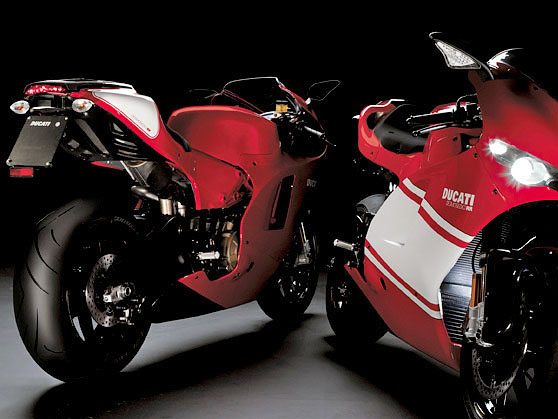
The dream of a true GP replica has finally come true and the Desmosedici RR will be the first-ever road-going motorcycle to offer such a stunning wealth of performance and technology that comes directly from Ducati’s experience in MotoGP.
The RR derives from the Ducati Corse Grand Prix racing Desmosedici GP6, the same bike with which Loris Capirossi and Sete Gibernau competed with in the 2006 MotoGP World Championship.
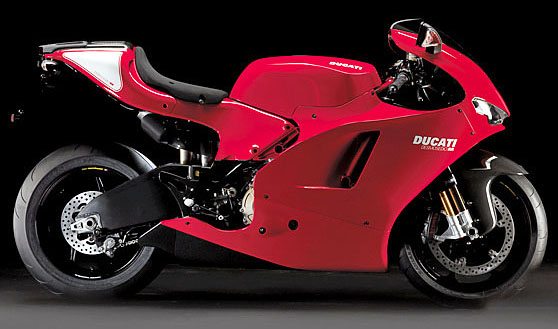
The body design and the aerodynamics faithfully reflect the Desmosedici GP6. The color scheme, the fittings, the materials used in its construction as well as the technical features of the powerful four-cylinder desmodromic engine built by the Borgo Panigale factory engineers, leave no doubts whatsoever: the Desmosedici RR is the ultimate expression of the most extreme MotoGP racing machine today.
This is the new frontier of Ducati technological evolution, a dream come true, demonstrating once again the courage and the passion of Ducati, as well as the ability to transfer the experience of the racing world to a machine that is destined for road use.
On Track With the D16RR
The week following the San Marino GP, which took place at the Santa Monica circuit in Misano, the riders of the Ducati Team were able to take a few laps on the track in the seat of the Desmosedici RR, the first real MotoGP replica that Ducati is putting on the market for the joy of its fans and passionate clients.
Loris Capirossi, Casey Stoner (winner of the San Marino GP and leader of the Championship and points) and Vittoriano Guareschi, official Ducati tester, wanted to test the bike, each taking a series of laps at the Misano circuit.
They all experienced a very familiar feeling and performance with this bike, very similar to that experienced with the bike they use for the GP. Actually, the blinkers and mirrors are the only hints that give away the road-going nature of this “made in Borgo Panigale” joy, but the sensation felt by riders on the track is absolutely that of a racing bike.
The Desmosedici RR, whose price was set at 60,000 euros, is at last ready for production, which will begin as scheduled in the middle of October, sure to please the thousands of lucky fans who will soon be able to experience pure bliss on streets and tracks throughout the world.
| Type | L-4 cylinder, liquid-cooled, DOHC, Desmodromic, 4 valves per cylinder, gear driven camshafts |
| Displacement | 989 cc |
| Power | 147,1 kW – 200 hp @ 13.800rpm |
| Torque | 11,8 kgm – 85,55 lb-ft @ 10.500rpm |
| Fuel injection | Four 50 mm Magneti Marelli throttle bodies, 12-hole “microjet” with injectors over throttle, manual idle control; |
| Exhaust | 4-into-2-into-1 vertical exit exhaust/silencer |
| Emissions | Euro 3 |
| Transmission | 6-speed; Cassette type |
| Clutch | Dry multi-plate slipper clutch, hydraulically actuated |
| Vehicle Body |
Full carbon fiber bodywork |
| Frame | Tubular steel trellis hybrid, carbon fiber seat support, aluminum swingarm |
| Front Suspension | Öhlins FG353P forks, 43 mm pressurized, with preload, rebound and compression adjustment, TiN coated sliders |
| Front Wheel | Marchesini forged and machined magnesium alloy wheels, with 7 spoke design as GP6 |
| Rear Suspension | Öhlins rear shock, with rebound, low/high speed compression adjustment, and hydraulic preload adjustment |
| Rear Wheel | Marchesini forged and machined magnesium alloy wheels, with 7 spoke design as GP6 |
| Tyres | Bridgestone, front 120/70 R17- rear 200/55 R16 |
| Front Brake | two Brembo radial “monoblock” calipers with four 34 mm pistons; two semi-floating 330 mm x 5 mm discs, |
| Rear Brake | 240 mm fixed disc, caliper with two 34 mm pistons |
| Tank | Aluminum alloy |
| Dry Weight | 171 Kg / 377 lbs |
| Instruments | New lightweight Corse electronic multifunction LCD dashboard with tachometer, speedometer, trip/odometer, trip fuel, clock, air temperature, engine temperature, lap time, anti-theft immobilizer, and several warning lights: fuel reserve, indicator lamps, oil pressure, neutral, high bean lamp, EOBD, overrev; complete error list. |
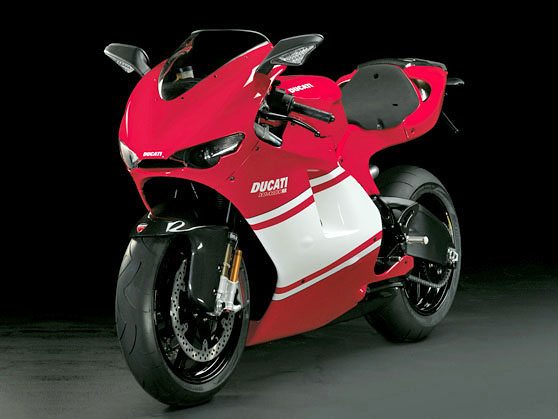
| Colors | Two color versions: 1) Desmosedici RR: painted in ‘Rosso GP’, with a white number plate on the tail section; 2) the Desmosedici RR ‘Team Version’ – painted in ‘Rosso GP’, and as with the factory Corse bikes, with broad white stripe on the fairing. |
| Versions | Single-seat |
Chassis and Vehicle
The engine clearly represents the beating heart of this fantastic motorcycle, but the technological advancements also extend to the chassis: a signature tubular trellis hybrid frame, refined components, and a superb carbon fiber body.
This is a motorcycle that is destined for an expert rider, someone who is always looking for extreme sporting performance, as well as being an exclusive, esoteric, reliable product that is more than capable of track racing.
The color scheme of the Desmosedici RR was the work of Alan Jenkins, the designer and one of the men behind the Desmosedici MotoGP, who was also responsible for the aerodynamics package which is aimed at achieving maximum speed and excellent handling.
The bike is totally inspired by the racing machine, the Ducati Desmosedici GP6, from which it inherits all the aggressiveness of its lines. It is fitted with a new lightweight multifunction dashboard, developed in collaboration with Ducati Corse, the same one that has been fitted to the racing machine, the Desmosedici GP7.
Desmosedici-style digital instrumentation is taken from Ducati’s MotoGP GP7 project. This pure racing, minimalist solution by Digitek has no switches or buttons to compromise its clean lines.
The wide screen allows the rider to read six values at the same time and to scroll through and select from various menus by handlebar-mounted switch gear.
Activating the Ducati Data Analyzer (DDA) riders are able to acquire up to 2MB of data (approximately 3.5 hours). The system records several channels of data including: vehicle speed, engine rpm, throttle opening, engine temperature, distance traveled, laps and lap times. So riders are able to compare, analyze and get an inside view of the Desmosedici RR performance.
The bike’s development could not have been made possible without the significant collaboration of Vittoriano Guareschi, the official Ducati Corse tester, whose riding abilities and hundreds of hours of track time have made a fundamental contribution to the evolution of the project.
For the first time the Ducati Desmosedici RR uses a new welded tubular steel trellis hybrid frame (ALS 450) with the frame geometry that is the same as that of the Desmosedici GP6.
This construction guarantees an excellent stiffness-to-weight ratio, allowing superior maneuverability and riding precision. Attached to the red frame is the rear seat support in high temperature resin type carbon fiber. This material, normally used only on racing bikes, has the characteristic of being extremely lightweight but exceptionally rigid.
Suspension
The Desmosedici RR sports a new extra-long, cast, forged and pressed aluminum alloy swingarm. The geometry and the technology of this component derive directly from the MotoGP bike, and give the RR a high level of traction, and excellent weight distribution as well as a superb stiffness-to-weight ratio.
In the suspension department the Ducati Desmosedici RR features the most advanced technical components.
The rear suspension geometry and layout is the same as that of the GP6, with the rear shock attached above the swingarm and to a rocker, which is hinged to the crankcase.
The front suspension features 43 mm upside-down Öhlins FG353P pressurized forks (PFF), with TiN coated sliders.
The forks, which come directly from competition use, as well as being pressurized thus ensuring excellent track performance, are fully adjustable in preload, rebound and compression.
The rear shock is also Öhlins and has rebound, low/high speed compression adjustment and hydraulic preload adjustment.
Wheels and Tires
For the first time ever, this Ducati production motorcycle features Marchesini forged and machined magnesium alloy wheels, with a 7-spoke design as on the GP6. This helps to reduce unsprung weight and inertia, all the while improving handling and suspension response.
With the aim of producing the ultimate track performance, Ducati and Bridgestone have developed special tires for the Desmosedici RR. The tread pattern, construction and profile are being specially developed and produced by the Japanese tire manufacturer.
Brakes
The numerous racing components of this high-performance machine also include its Brembo brakes. Up front the Desmosedici RR features a new pair of radial monoblock calipers with four 34 mm pistons.
Monoblock technology, until now only used for racing calipers, allows caliper stiffness to be increased, thus improving braking response; the front brake system is completed by a radial master cylinder, with hinged lever and remote quick adjuster that enables the right brake lever position to be found during the ride.
The pair of front brake discs are two semi-floating 330 mm x 5 mm discs, with machined flange. The Brembo rear brakes are made up of a 240 mm fixed disc and a caliper with two 34 mm pistons.
Exhaust System
The Desmosedici RR’s new exhaust system has been specifically developed to deliver the best power and at the same time to ensure road riding pleasure. Significantly lighter, it has been engineered with a power-increasing 4-2-1 layout that uses 42mm diameter tubing with wall thickness of 0.8mm (.030in) AISI 309.
The new exhaust system is equipped with a pass-by valve and ends with a silencer incorporated in the rear tail that features two exhaust exits to vertically release the exhaust gas. The upper part of the rear tail combines a ceramic carbon fiber cover, the same solution as single-seater F1 cars.
Versions
The Desmosedici RR will be available with a special race kit that includes a 102 dB racing exhaust, a dedicated CPU, bike cover and paddock stand.
Two versions of the RR will be available:
- The Desmosedici RR – painted in ‘Rosso GP’, with a white number plate on the tail section;
- The Desmosedici RR ‘Team Version’ – painted in ‘Rosso GP’, and as with the factory Corse bikes, this has a broad white stripe on the fairing. A team sponsor decal kit will be provided with each bike.
A new dedicated service plan is included for this exclusive Ducati. Each Ducati Desmosedici RR owner can benefit from a three-year warranty and three years of scheduled maintenance, free of charge.
Note: For informational use only. All material and photographs are Copyright © webWorld International, LLC – 2000-2011. All rights reserved. See the webBikeWorld® Site Info page. NOTE: Product specifications, features and details may change or differ from our descriptions. Always check before purchasing. Read the Terms and Conditions!
Other WebBikeWorld Brands Posts