

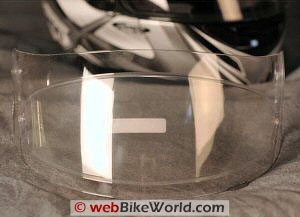

It works and it prevents fogging.
The Pinlock anti-fog visor insert is available as do-it-yourself installation kit or from the factory on some types of face shields.
Let’s see — we have an anti-fog liquid coating calledFogtech (review).
Then there’s an anti-fog wax coating called Cat Crap (review).
How about pre-treated anti-fog visors on the SCHUBERTH S1 helmet (review) and others?
And even an electrically heated visor (optional on the Zeus 508 (review).
Do you think visor fogging is a problem for motorcyclists?
Here’s one more option: the Pinlock anti-fog visor system.
The Pinlock name has been known in Europe for some time, but most motorcycle owners in the U.S.A. are not familiar with this product.
That’s about to change, because Pinlock is coming to the U.S.A.
First announced at the 2005 Dealer Expo in Indianapolis, we received a couple of visors with the Pinlock anti-fog system installed.
We have been using them during the recent unseasonably cold and wet Mid-Atlantic spring.
The Pinlock System
Development of the Pinlock system was started in 1978 by Derek Arnold in the Netherlands and has been continuously evolved since then.
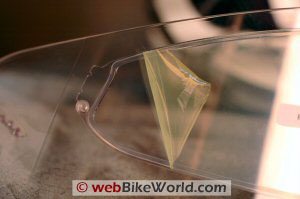
The system includes a special moisture-absorbing plastic insert that looks something like a miniature tear-off.
A silicone gasket is added around the edges of the Pinlock insert, which forms a virtually air-tight seal when it is installed against the inside of the motorcycle helmet visor.
The special plastic and the double-wall system work to create a very good anti-fog barrier on any helmet visor.
The Pinlock system is used on motorcycle helmets, motocross helmets, and on other types of visors and goggles. Several police forces and others use the Pinlock system to prevent fogging.
The system also has several international patents in Europe, the U.S.A. and Japan.
A dozen or so major motorcycle helmet manufacturers have been offering Pinlock equipped visors as an option in the European market.
The system has been tested and approved to ECE 22.05; the Snell Memorial Foundation says they’re OK; and several highly respected European motorcycle magazines have reviewed and recommended them.
Also, several MotoGP riders use them for racing in wet conditions.
The Pinlock system is available as a “do it yourself” add-on kit that will work with almost any existing visor. A special “service center kit” is also available to motorcycle dealers.
Pinlock Anti-Fog Visor Insert Details
The Pinlock system consists of the anti-fog visor, the two pins (thus the brand name), a drilling template, a drill bit and instructions. To install the system, the visor is first removed from the helmet.
The template is applied to the visor, and two holes are drilled into the visor using the supplied drill bit.
The two pins snap into the resulting holes, and the anti-fog visor is placed on the visor and between the pins.
The pins hold the two opposite edges of the Pinlock anti-fog visor on to the helmet visor very tight, holding the silicone gasket against the visor.
We did not receive the kit, so we can’t comment on the difficulty of the installation.
We did receive two helmet visors with the Pinlock system pre-installed; one visor for an HJC helmet and one for a Shoei.
But the instructions seem clear enough (pun intended!), and although drilling into a $40.00+ visor may make some owners nervous, I wouldn’t hesitate to try it myself.
We’re hoping to get a kit soon and we’ll report back after we try it.
Pinlock is working with U.S. motorcycle helmet distributors and manufacturers to get the system added to their option list. In the meantime, all this would be a moot point if it didn’t work to prevent visor fogging.
So how does it work?
So How Does It Work?
In a word, fantastic!
We tried the Pinlock-equipped visors on a couple of different helmets in a variety of wet, cold and nasty weather conditions. The plastic is optical quality and is crystal clear (once the protective shipping film is removed).
The Pinlock visors are available in clear, yellow, light tint and dark tint.
Since the Pinlock insert doesn’t cover the entire surface area of the helmet visor, the silicone seal does create a line above and below the rider’s line of sight, but it’s virtually unnoticeable.
We do notice that the insert’s plastic can sometimes separate or touch the visor plastic, causing some irregular patterns that are reminiscent of water spots.
The effect is like a slightly dirty or dusty visor, and the marks are random and different, depending upon the application.
But they’re also nearly invisible and seem to be a small price to pay for the excellent anti-fog properties.
Since it’s impossible to take a photograph of a real-life example of the Pinlock insert’s anti-fog capabilities, we tried the old boiled water test.
This is a tough test for any anti-fog coating — we boiled a pot of tea water and held the visor over the steam.
Any non-treated surface will immediately become fogged.
But the Pinlock insert area stays perfectly clear even when it is held directly over the steam. And the moisture absorbing plastic seems to work – we did not notice any drips or runs on the Pinlock insert.
This photo was taken through the Pinlock-equipped Shoei visor.
The animation shows two focus points: focusing on the tabloid, then focusing on the visor. The fogged portions of the visor can be seen surrounding the perfectly clear Pinlock insert.
The product is very new to the U.S. market, and we’re still waiting to learn about the suggested list price.
Pinlock visor do-it-yourself kits retail for about £19 (~$35.00 or so) in the U.K., so we expect the same in the U.S. and we’ll report back as soon as we learn more.
Conclusion
The Pinlock system has been tested, approved, reviewed and is used by many motorcyclists throughout the world.
No visor anti-fog system is without compromises (yet).
And the disadvantages with the Pinlock system include having to deal with the additional part attached to the visor; the potential for slight fuzziness in vision due to the way the insert seals on the visor; and the installation (with the DIY kit).
On the plus side, once the system is installed, it’s virtually maintenance free.
It fits inside the visor, so it’s well protected from scratches and bugs; it doesn’t have to be re-applied; and it’s available in several different tints.
And by the way, it works to prevent fogging, and does it with a minimal intrusion and maintenance, so it may be just the solution for you.
Owner Comments and Feedback
See details on submitting comments.
From “S.B.” (August 2015): “I’ve had visors with both the Fog City and Pinlock versions of anti-fog.
With the Fog City, they work great, until the glue holding them on starts to fail, which is why I ended up trying a Pinlock system on my Shoei Raid helmet.
I have two visors — a dark tint (I’m in New Zealand, and they’re legal here) and a clear — and just change the visor rather than the Pinlock (I agree with what Bosse said, they’re not really intended for regular changing).
Both Pinlocks were kits, I got it right with my dark tint visor, it never fogs. But my clear one has been having a problem with fogging, of course at night when it’s the only one I can use.
I’ve just been inspecting it and it has a small gap opening up on the lower edge but I already have the pins set to close up as much as possible. So it’s about to come off, and I’ll see what I can do to add a bit of packing.
Would I buy another one? Definitely, if it’s factory fitted!”
From “S.B.” (February 2015): “I’ve used one of these in my SCHUBERTH helmet for close on 10 years in all weathers.
Best investment I made and I wouldn’t ride without one. I think all the little pieces of negative feedback mentioned here are far outweighed by the performance (frankly I’ve never noticed any if them). A great product.”
From “C.W.” (July 2014): “I have used a Fog City visor insert in my Arai Astro R helmet for the last 5 years (helmet is now due for replacement) and found that the insert did everything it claimed.
I have no fogging except in the worst weather the British winter can deliver, when I shouldn’t be riding in any case but this soon clears as a bit of ventilation helps out.
As for the Photochromic performance, I find it just about perfect. I know I can ride around in the British sunshine like recently and I have clear vision that’s bright but not in anyway dazzling, I certainly don’t get any blurring you mention.
It’s a much better solution than riding with sunglasses that have a whole host of negative attributes when worn with a helmet.
The clarity of the view is perfect and I can pick out details very clearly so that it aids with good riding practice.
Like all the very best sunglasses the image should be bright but definitely not painful or dazzling and I shouldn’t have to squint either.
The only fault if it is one, is that it adds weight to the visor and my helmet doesn’t need more weight. I will be fitting a new one to my new helmet when I get it (Arai Quantum ST).”
From “B.H-R.” (November 2013): “I read the reviews of Pinlock inserts on the web and noticed several people saying the DIY set could not be bought anymore. I would like to confirm that they are available and I bought one in October from Racevisors.
The Stock Code is: A-PI-D11-CL, cost £25.99. Their address is: Racevisors.co.uk, Duques Garage, Rue des Landes, Forest, Guernsey, GY8 0DB.
I live in The Netherlands and postage to me was £8.99.
I communicated with them by email first and found them to be very helpful. I hope this helps because there must be lots of people out there who want the DIY kit but think they can`t buy any.
I appreciate you know this stuff already but I fitted mine and when I tried it on a cold, damp trip to my Dutch Language lesson and back last night: The peripheral vision was normal as far as I could see.
I only realised that the main visor was misted up when I actually looked at my “peripheral” area and saw the moisture in the corner ! The main part, covered by the Pinlock was fine.
I eventually plucked up courage and fitted it, using a cheap battery drill with “progressive” speed control so that I could rotate the bit very, very, slowly and “walk” it through the plastic visor.
I have no fear of losing visibility anymore. Overall I am really pleased and wish I had bought one years ago. I also made a kind of suede “finger-stall” to act as an external-visor wiper!”
From “G.H.” (October 2013): “I have the Pinlock system on my Arai helmet. The insert falls out regularly. It can be dangerous depending on when it decides to fall out.”
From “R.W.” (May 2012): “Hi, for several years I have been relying on your excellent coverage of motorcycling products — especially, relating to helmets, as these are often difficult or impossible to investigate in person prior to purchase.
I just started using the Shoei Neotec (review) (I must say, coming from years in several SCHUBERTH C2’s, I was amazed at how badly the Neotec was fogging up).
The Neotec came with a Pinlock-ready visor and with the insert, therefore after a few days of suffering I gave up and installed the Pinlock shield.
The installation was simple enough; though, as other reviewers noted, some struggle was involved:
I flattened down the shield on a towel and tried to wiggle the Pinlock onto the pins first, then to lay it into the shield. It resisted a bit and it was difficult to avoid finger prints; next time, I’ll use lint-free photographic gloves.
The result: as far as fogging prevention goes, Pinlock certainly does the job.
I was traveling in temperatures in mid 50’s and the helmet itself fogged so badly with the visor shut that moisture droplets were beading inside, on the bottom edge. Area covered by the Pinlock insert remained clear.
Now, for the bad news: the visor impairs visibility.
The sealing edge is distracting and the field of view slightly dimmer. This is particularly perceptible when looking at gauges or the GPS receiver; the image becomes much clearer and brighter when the shield is lifted up.
Also, the insert is not suited to nighttime riding. The packaging warns against night riding, stating that the transmission is 80% or so, and thus not approved in the EU.
That did not bother me so much; the problem I experienced was that the insert created multiple reflections at night.
Two weeks ago, I covered about 300 miles after sundown and felt very uneasy about not seeing the details of the road and being blinded by opposing headlights blossoming out in the reflections.
Today, I took the insert off. I intend to ride a bit more without it, to see if the anti-fogging properties are worth the visibility tradeoffs. I wish there was a reasonably functional coating available on the market.
I’ll be looking forward to reviews/announcements of webBikeWorld! RIA2 sounds great, but is not available. SCHUBERTH was apparently using something that, while not perfect, worked well.”
Editor’s Note: See our Clarity DeFog It review (our current favorite) and these other anti-fog coating reviews.
From “M.J.” (August 2011): “I bought the Pinlock Anti-Fog visor for my Shoei full face helmet. I live in Wisconsin right next to Lake Michigan. During early spring and late fall I use to have problems with my visor fogging up.
I read about the Pinlock insert and bought one to give it a try.
That was a year and a half ago. Since I’ve had it installed I never have had a problem with fogging. Installation was a little awkward, but not difficult. The seal is tight and I have had absolutely no problems with it.
I still don’t have any scratches on mine, as one person wrote.
All in all I’d give it a 9 on a scale of 1 to 10. If anything ever does happen to this one I’ll definitely not hesitate to buy another one.
It’s been well worth the money and the ability to keep my visor down in cold weather, even waiting for stop lights.
Without it, I had to open my visor every single time I was at a stoplight. Not anymore.”
From “K.M.” (August 2011): “I have recently purchased an Arai Chaser with a slightly tinted Pinlock Insert already fitted.
After a few tryouts I decided that the loss of undisturbed peripheral vision, both down and to the sides, was not a worthy trade-off for the excellent anti fog properties. I found the edges particularly distracting.
I have now removed it and it will soon be on EBay!
Incidentally, the best to way to fit one is to flatten out the visor, outside face down (on a towel or other soft material), and then work in the insert between the pins.
When the visor is slowly released (it is much easier with two persons) the insert will be pressed up against the inside of the visor.
The pins are eccentric, so, in theory, one could turn them up to half a turn to increase the pressure should it not be sealing adequately.
Good luck with this as once the pins are pressed in the visor it would be difficult to turn them without breaking them.
There also seem to be two types of pins; a 2-piece with a collar, and a single piece pin. I have found a source of replacement pins on the European side of the Atlantic!”
From “J.L.” (July 2011): “I had been using a FogCity visor for years on a clear Arai shield, and a tinted Arai shield for summer without a Fog City visor, because there is normally no fogging problem in summer.
When the Pinlock system became available about 2 years ago, I thought it was a great idea: a lot of space saved by not having to carry a spare visor (clear/smoked), together with the ease of removing/reinstalling the Pinlock inserts.

I also thought the non-tinted space around the tinted insert would be great when areas of bright sunshine and shade alternate, or in tunnels, for instance.
After two years of use, I am quite disappointed with the Pinlock system.
First, it is quite more expansive than a regular visor plus FogCity insert, which in itself is already not a chap proposition.
Second, the Pinlock Insert is very sensitive to scratches (it appears to not be treated against scratches, unlike the visor itself), which requires inserts to be carried inside some soft cloth to protect them.
Scratches on the Pinlock insert are much worse, and appear more rapidly, than the micro-scratches which eventually appear on the FogCity insert.
Third, Pinlock inserts are not easy to install or remove (the Fog City is not either, but installation is done once and for all).
There is no practical way to install them (on the roadside) without some dirt or other fingerprints on the inside, which impair vision.
On the other hand, Fog City inserts can be installed at home with OR-clean fingers and no fingerprints inside.
Finally, when a pin pops (which happened to me on the road, when I attempted to install a dark insert which had caused issues before because it was apparently too big), you are on your own: pins are not sold separately, so one needs to buy a new visor.
So, I will return to my reliable, proven and true non-Pinlock visors, which I never stopped carrying because I — and rightly so — did not trust the Pinlock system in the first place.”
From “H.S.W.” (02/11): “I just figured out why the shield on my Shoei X12 helmet is fogging, even with a Pinlock insert installed! It turns out that the inner (Pinlock) shield is not flush up against the outer (Shoei) shield and air is getting up in the gap.
And once up there it doesn’t get out easily, and once it’s fogged, it stays fogged.
This may be happening because the Pinlock shield isn’t sliding on its pins the way it should. That may be happening because I have several widths of black electrical tape across the top of my shield to serve as a sun visor.
It’s only as thick as 1 layer of the tape, but perhaps that’s enough to prevent the insert from sliding around on the pins properly?
The electrical tape is on the inside of the shield. It’s never been an issue before, but then I’ve never used a Pinlock insert before, either!
Now that I know what the problem is, I can adjust the insert by putting some pressure on it right at the midpoint of the shield and that should cause the insert to slide out enough to actually create the “storm window” effect… and prevent the fogging!
We’ll see and I’ll let you know what I figure out.”
From Pinlock USA (11/10): “Just wanted to point out that Pinlock does not and has not offered a do-it-yourself kit for the Pinlock. We have discontinued offering it in Europe as well.
In the United States it came down to a product liability issue and modification of the helmet which neither the manufacturer or distributors wanted.
Drilling polycarbonate is difficult on a flat surface let alone on a curved piece such as a shield.
To meet the consumers’ interest in our system, Pinlock will be offering an adhesive fog-resistant lens for those that do not have a helmet offering a Pinlock option. It will be available in December.”
Editor’s Note: Just for the record, the Pinlock described in the review above was indeed a kit which is apparently no longer sold. This doesn’t change the overall impression of the product however.
From “S.S.” (7/09): “I ordered the Pinlock visor with my new Shoei RF1000 helmet, and it works great! I actually swapped in the stock visor the other day as it was warm and clear, and I wanted to see if the stories about the stock visor fogging problems were true.
As soon as the evening cooled down, I discovered that this shield has a terrible fogging problem, and all of the complaints were definitely on the money.
I can’t understand why a helmet as expensive as this Shoei can’t provide a visor at least as fog free as my old Scorpion EXO-400?
Sorry for the rant; back to the Pinlock: the only downside is the halo effect of lights at night which occurs where the silicone seal adheres to the visor.
Since this area is not in your depth of field while riding, I think they could improve the design by making the seal black, which would not induce the halo effect.
I have even been toying with the idea of using a black Sharpie pen on it, but I’m afraid of getting it on the visor itself, so I have thus far refrained.
Otherwise, this has been 100% fog free, which even the excellent Scorpion visor was not able to achieve. This visor is definitely a permanent attachment! Thanks for the great reviews!”
From “T.B.” (2/09): “I will echo the comments of the other posters on the benefits of the PinLock system. It’s great.
Works 100% – with one caveat: I find that if the seal between the silicone bead on the insert and the visor itself isn’t 100% good (especially around the bottom edge) then some fogging will occur.
One issue I have though, with Shoei visors is that the only visor that is available with pre-installed pins is a clear visor.
I have tried contacting PinLock USA via email to no avail in order to source a “kit” for installing pins on another shield (in my case a tinted/mirror shield).”
From “J.K.”: “I’ve been using a Pinlock visor on my Shoei for years and wouldn’t be without it. My helmet fits rather snugly, so much so that I can’t even squeeze a pair of sunglasses on so the smoky visor is invaluable in the summer – such as we get in the UK.
I originally fitted it using the do-it-yourself kit and it worked well. The tip is to protect the area with plenty of masking tape and be very, very slow and careful when you drill the hole.
I regularly change my smoky Pinlock for a clear one depending on the prevailing weather conditions and I’ve never had a problem fitting or using it.
You do, however, have to be very careful to keep an eye on the little pins when you change over as they can ping out and are very difficult to find.
I’d forgotten just how good the Pinlock system really is until I had occasion to use a non-Pinlock visor recently, the difference was quite noticeable and I was glad to go back to my old helmet.
I’m looking to change my helmet for one with an integral sun visor this month so will not need to keep changing my Pinlock over when the sun goes in which will save time and wear and tear on the visor and the pins.”
From “Bosse”: “As a new scooter owner I was annoyed by the fog inside the helmet and Googled for a solution and found Pinlock. I’ve been using Pinlock for a couple of weeks now and I’m totally amazed!
Bought the clear do-it-your-self-kit and installed it in 30 min on my cheap full faced helmet. I can’t describe it! It just works! Never have to open the visor!
I don’t think that you are supposed to take it off and back again all the time. Just leave it there and it works. You can take it off but why should you? I can totally recommend this product!
Editor’s Note: I checked, and no, “Bosse” doesn’t work for Pinlock!
From “M.K.”: “I have been using Fog City visor inserts for several years with excellent results.
The Pinlock system looked like the same idea with a simpler mounting system, which would allow me to remove it in warm weather to reduce wear & tear. I liked the idea, and after a bit of debating with myself because of the cost, I decided to try the Pinlock system.
So far, I am not happy with it. For some reason I get a lot more distortion with it. I am still conducting experiments to see why it is distorting as it is.
The effect is very much like getting new eyeglasses with the lenses not ground exactly to the specified prescription (I was always sensitive to this problem).
I thought maybe it is due to the increased distance between the shield and the insert caused by the thickness of the silicone bead (versus the thinner line of adhesive used on the fog city).
So, I turned the insert inside-out so that the inner surface is against the shield. This seemed to help some, but the distortion is still noticeable.
Next, I will try the face shield w/o the insert.
There is a slight flaw in the plastic of the CX-1 Pinlock shield itself, but it is not in the line of sight, and does not appear to be of the type that would cause the type of distortion I am experiencing (the flaw is a very slight crazing about 1/2 inch long, but the distortion appears to be in the entire field of vision).
The flaw appears to be related to clarity, but the distortion is more related to refraction and lens shape.
I’ll continue to narrow down the cause of the distortion, and will try to get the component with the defect replaced, but it could be that the distortion is inherent to the Pinlock system.”