

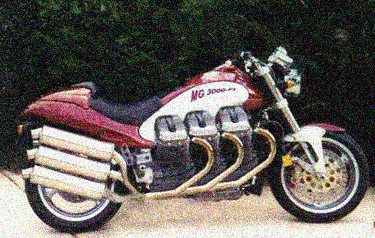
First 6-Cylinder Guzzi Announced
Mandello del Lario, Italy – Moto Guzzi S.p.A. has announced a limited production run of 6-cylinder cruisers based on the famed Moto Guzzi Centauro chassis and engine.
The new MG-3000ie (iniezione elettronica) will also be sold in the U.S. starting this fall as a 2009 model.
The bike will be known as the MG-3000 ie (or fi for fuel injection).
But the biggest news is that the new bike was developed from a prototype created by our own webBikeWorld contributor “Texas Joe”.
He is known to our readers from his articles describing his “Custovation” projects, including theDucati 750GT, his matching Ducati GT1000 and his beautiful Royal Enfield InterceptorCustovation.
This 6-cylinder Guzzi was obviously a much bigger challenge.
Joe was able to mate three complete 1000cc, 4-valve Centauro engines together in his shop to create the incredible-sounding 6-cylinder Guzzi powerplant, which he then embedded in a Centauro chassis for the ultimate Custovation.
That would be enough to make an interesting article, but as it turned out, the project has attracted the interest of Moto Guzzi engineers when they saw Joe’s creation at a custom bike show last fall.
They brought the idea back to Italy and company officials rather quickly decided to use the concept to create a limited edition production run.
Joe’s work will apparently short-cut the process of getting a 6-cylinder engine to market to beat the upcoming Honda and Kawasaki inline 6-cylinder bikes that are being contemplated by those companies.
Roberto Colaninno, the Chairman and Chief Executive Officer of Piaggio, said that the honor of bringing the final version to production will be given to Ing. Coglionare “Cazzata” Fancazzista.
He is the nephew of the revered Giulio Carcano, who in 1954 put the final touches on the original Moto Guzzi V8.
Connections?
We asked Joe if he could relate to webBikeWorld visitors the interesting story of how this all came to pass, and this is his report:
You may remember a television show entitled “Connections”, which was based on a book written by James Burke, a British historian.
He sets out to prove that inventions stem from ideas, innovation and coincidences that reach critical mass at a point in time to unleash major technological achievements. This is a story of such an occurrence.
It’s been like an incredibly fast-moving dream – who ever thought that one of my Custovation projects would actually be picked up by a motorcycle manufacturer, much less Moto Guzzi?
I sort of feel like the next Roland Sands or something!
Why a Moto Guzzi and why six cylinders? I know exactly how the idea came to me, believe it or not. It all started one warm day last July as I was finishing up a recent Custovation project.
Because of my lust for old British iron (see Joe’s article on the Royal Enfield Interceptor), I was reading a biography of Edward Turner, the inventor of the Ariel Square Four.
I became fascinated by that engine, which was an incredible design for its time and it’s even startling to imagine today.
The Square Four was named because of its four cylinders; two in front mounted on one crankshaft, with the second pair of cylinders mounted on a separate crank in the rear. Both were tied together by an intricate system of counter-rotating gears.
Now this is the crazy part — but believe me, it’s true: It was hot in the garage, so I figured I’d cool off outside in the shade. On the way out, I grabbed a six-pack of beer from the ‘fridge, knowing my sons were on their way over.
Now when I get into a contemplative mood that involves beer, I usually don’t remove the six-pack plastic can keeper. I just start at the “number one firing order”, so to speak, and go until number six.
This saves time and keeps the cans together, ready for recycling, along with the plastic keeper.
Well, my sons never showed up, so I ended up finishing the “sixer” by myself (which probably helped to generate this idea!). I tossed it into the recycling bin and continued reading, but something caught the corner of my vision — it was the empty six-pack.
It landed upside down and the cans lazily leaned over to from two rows of three cans in a V. That’s neat, I thought; I wonder if I tried that a few times, would it land the same way?
Then Mr. Turner’s spirit must have suddenly touched my head because it hit me!
The Square Four engine has pistons in each of four corners — and the triple “V” made by the cans looked a lot like the cylinders of an engine: the Moto-Guzzi engine that was never built — a V6!
I started to wonder if three Guzzi engines could be ganged together. If that could be done, I’d carry on the Edward Turner tradition of exemplary creative engineering genius.
I mean, why not make an extreme Guzzi Custovation that would scream, burn up tires and scare the life out of any street squid looking for a race? Could it be done? I had no doubts, but it would take a lot of work…
So it began. I just happened to have two spare 4-valve, 1000 cc fuel-injected Centauro engines in the garage that I was holding for use on some type of project, and here it was.
Moto Guzzi has since asked me to keep the technical details a secret until the final release, so let’s just say that a project like this obviously took a lot of drawing, a little cutting, and some grinding, machining and welding over the next few months, but before I knew it, there it was. The MG-3000ie.
At first I had the prototype fitted with Borla silencers but, as you can imagine, the many ‘round-the-block test runs with the raw V6 screaming and backfiring brought the police out in short order.
They issued a restraining order on the bike, but the ticketing Officer told me off-line that I’d probably have no problems riding it out in West Texas.
Well, Pecos is something like a 6-hour drive from here, which makes for quite a long trailer haul, so I decided to fit some stock silencers instead. While legal action is no longer a problem, I discovered that the stock cans do take some off the top end.
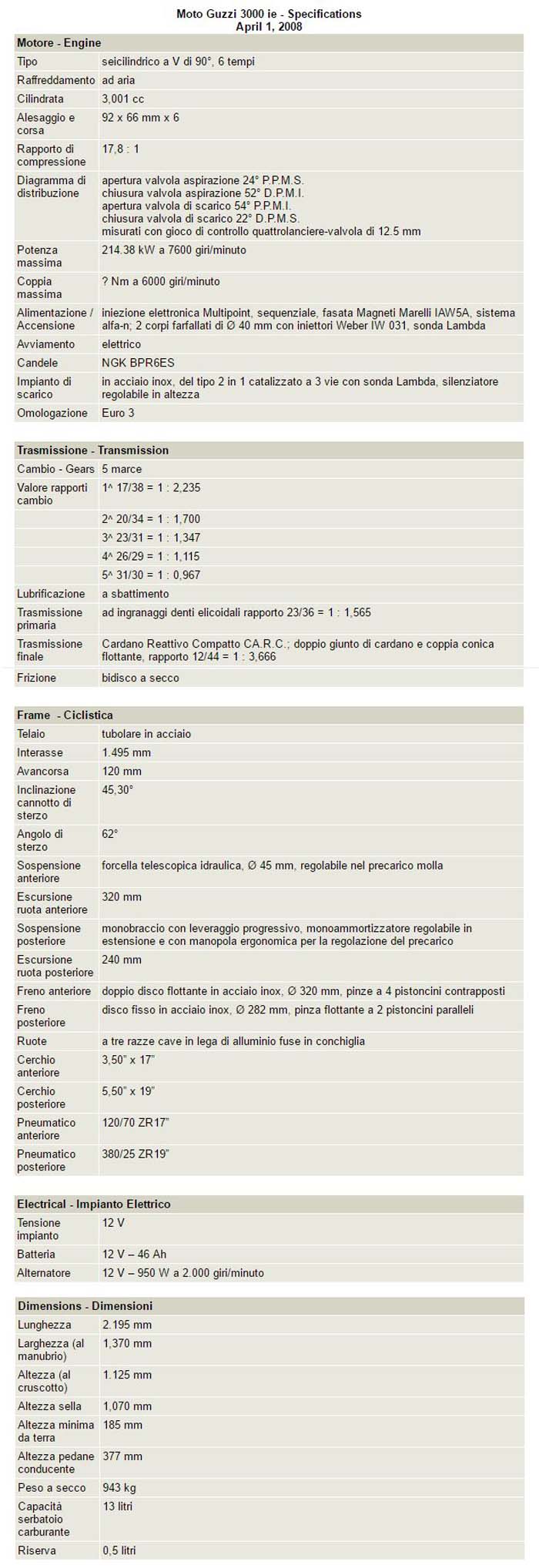
On the dyno, the prototype MG 3000ie produces an adequate 278.5 hp at the rear wheel and maximum torque occurs as expected at 6,000 rpm. However, the torque that this beast puts out is so massive that it actually broke the instrumentation on the dyno!
So at this point, the figures are known only to the Moto Guzzi engineers, who currently have the prototype. Top speed in 5th gear is a respectable 197.5 mph, where it actually feels like it’s only just loping along.
There are also a few functional issues to sort out. For instance, the Centauro’s stock 3.5-gallon tank is obviously a bit small for cruising, so I’ve suggested that Moto Guzzi increase the capacity in the final version.
Also, fuel consumption will have to be improved above the current 13 MPG; I discovered it’s a little better if I use premium.
Idling is fairly smooth, although from a dead stop, you have to ease the throttle to avoid the severe engine rotation, and the resulting rocking motion feels like the Love Boat during Hurricane Katrina.
This problem should be solved by time the bike gets into production, as the Guzzi engineers have designed a new I-Beam CARC shaft drive system to handle the massive output.
The Marelli fuel injection system also needed some tinkering; I tried stock and performance chips but finally settled on a series of fuel maps of my own design. And as long as I was doing it myself, I integrated it with my GPS!
So the bike now selects the correct map for any load, terrain and altitude. Unfortunately, Moto Guzzi said they probably will not be able to get this feature passed through the tough Euro 3 emission specs.
The suspension is stock White Performance, however I had to crank up the damping and spring pre-load to the maximum positions to settle her down especially on hard acceleration and braking.
While the brakes were over-built and perfect for the stock Centauro, for the MG 3000ie, I had to add a third rotor in front and a second rotor on the rear wheel for better performance.
So far the gel-cell battery is holding up when turning over those six big cylinders, but you obviously wouldn’t want to bump start it!
Tires are currently a weak spot, as you can imagine. By this time the project was costing me some serious money, so I was looking for a sponsor.
I managed to get Cheng Shin interested, and they said they’d work up a compound that should yield at least 1,000 miles before replacement. That’s a lot better than the 200-mile life of the Pirelli Dragons, which can’t seem to take the weight and torque.
Wind protection was a bit of a problem at speed but I didn’t want to alter the voluptuous and sensuous lines of the Goose. Above 130 mph it feels like my head is being pulled off my shoulders and the chin strap on every cruiser helmet I’ve tried feels like it’s choking me like a tourniquet, so I actually rigged up an adjustable keeper that runs from the chin strap to the handlebar to hold my head down at speed.
I’m real pleased with the performance and handling of the MG-3000ie. It turned out to be a rather ambitious project for sure — I’d rank it an 8 on the difficulty scale.
That Moto Guzzi picked it up for production is unbelievable and humbling, but this particular Custovation project turned out to be everything I expected. I couldn’t have done it without the inspirational genius of Edward Turner.
*Custovation is a combination of customizing, and renovation. Not a restoration, which means to bring back to an original condition; Custovation has a more specific meaning:
CUSTOMIZE, to make or alter to individual or personal specifications combined with RENOVATION which is to restore to an earlier condition, by repairing or remodeling.
Publication Date: April 1, 2008
Master Listing of All wBW Motorcycle Product Reviews
Owner Comments and Feedback
See details on submitting comments.