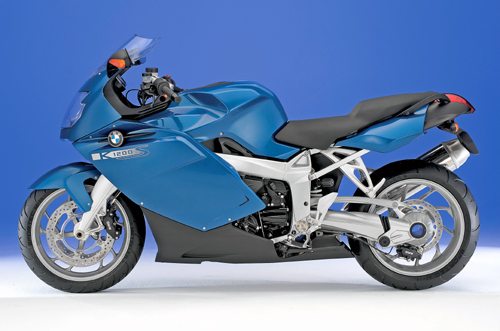

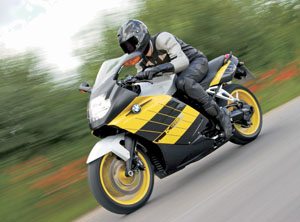
BMW Announces the K1200S High-Performance Sports Bike
It’s finally here! The time for speculation is over. Now it’s official: the K 1200 S has arrived!
In motorcycling as in boxing, the unexpected moves are sometimes the most effective. BMW, successful for more than eight decades with reliable, durable and, well… sensible motorcycles, has unleashed a most unexpected performance vehicle into the hands of sporting enthusiasts the world over.
The new 2005 K 1200 S is a synthesis of everything BMW has learned from decades of motorsport success and detailed motorcycle development. It is a sport model without precedent and devoid of compromise. The K 1200 S exists to define maximum performance with unprecedented sophistication and technology-enhanced safety measures. Yes, it accelerates aggressively enough to take your breath away-thanks to an all-new four-cylinder engine with 167 horsepower-but also embodies everything BMW has learned about rider comfort and safety.
No Overnight Success
For BMW to step into a new realm of performance required extensive research and development. The K 1200 S is the result of a five-year process that first looked at the overall concept of a high-performance road bike and considered several options along the way to building a sophisticated aluminum-frame sporting model with an innovative inline-four-cylinder engine.
Central to the development of the K 1200 S was the realization that the inherent benefits of BMW’s customary designs – the opposed-twin Boxer engine and the longitudinally mounted four-cylinder in the K series – could not be ignored in the new model. And a primary advantage of BMW design has been the centralization of motorcycle mass and, particularly, the desire to keep the overall center of gravity low.
Such a philosophy ensures that the motorcycle is highly maneuverable and yet remains completely stable and composed even while traversing rough roads. Furthermore, a low center of gravity makes the motorcycle more comfortable for riders with shorter inseams. Take two motorcycles of equal weight, and the one with the lower center of gravity will feel, subjectively, much lighter and confidence inspiring.
With the decision made to develop the K 1200 S with as low a center of mass as possible, BMW engineers set to work creating inspired and uncommon solutions.
Driven by New Engine Technology
BMW’s famed Boxer engines have continued along an aggressive development path to their current state of the art, but it has been recognized that an inline arrangement is the best overall compromise for a four-cylinder engine when maximum performance and lightest weight are the primary goals.
BMW chose a novel arrangement for the K1200S’s four-cylinder engine. The liquid-cooled four-cylinder powerplant is aligned across the frame-a significant departure from the K-Series standard of a longitudinally biased configuration. Not only has the new engine been designed to be as compact as possible, but in an effort to optimize the motorcycle’s overall center of mass and fore/aft weight distribution, the cylinder bank is leaned forward 55 degrees from vertical.
By canting the cylinder block forward, the four-valve-per-cylinder head rides much lower in the chassis, moving the engine’s center of mass forward and down, which helps improve steering response and front-wheel traction on such a powerful motorcycle.
It might be enough for some manufacturers to come up with this unique arrangement, but BMW has pushed the advantages even further. The space created by canting the cylinder block allows the transmission shafts to be stacked vertically to help reduce overall engine height and to better centralize the powerplant’s mass.
A direct gear drive from the crankshaft to a wet, multiplate clutch minimizes driveline losses, while the compact nature of the engine allows for the use of a shaft final drive without compromise. The high-strength crankshaft is forged out of a single piece of steel, and employs 8 counterweights for excellent vibration control. In fact, the K 1200 S combines a superbike’s power with a touring bike’s low maintenance requirements, all at a remarkably low weight: The engine and transmission weigh less than 180 pounds.
Racing Experience Informs the Design
In an effort to maximize power output, BMW turned to its history of racing experience for design elements of the K 1200 S’s 1157cc engine. The goal was not just class-leading power but compactness and low weight. To reduce engine dimensions, the K 1200 S employs a unique water pump arrangement. The lightweight pump is driven directly from the intake camshaft on the left side of the motorcycle. This location permits the pump to have very short and efficient connections to the cooling jacket in the cylinder head and to the radiator mounted below the front section of the frame. Reducing the length of hoses saves weight and improve heat dissipation.
Other techniques are used to reduce engine weight and size. For example, the lubrication system employs a remote reservoir so that the engine does not require a deep oil sump. The result is an engine that can be placed lower in the chassis for improved handling.
Inside the engine, the oiling system has been tailored using BMW’s motorsports experience. Using a technology employed in BMW’s famously powerful Formula 1 engines, the K 1200 S’s crankshaft is lubricated by oil pumped directly into the end of the hollow crankshaft, where it can flow directly to the main-bearing and connecting-rod journals without the need for a ring groove in the big-end bearings.
This technology improves lubricating-oil flow and strengthens the connecting-rod bearings. Finally, dedicated oil galleries direct lubricant to the bases of the pistons to help dissipate the high thermal loads encountered by an engine tuned for this much sheer power.
Careful attention to the ancillary systems helps create an engine that is unusually narrow, too. For example, the camshafts are driven from a single chain to the exhaust cam; lightweight and accurate gears drive the intake camshaft from the exhaust camshaft. This design element allows the engine to be narrower overall and permits the head to be shorter front to back than would be possible with conventional technologies.
In addition, the 580-watt alternator is driven by gear atop the transmission case, further reducing width. Overall, the engine, at crankshaft level, is less than 17 inches wide, closer to the current 600cc powerplants than engines in the K 1200 S’s displacement class.
The forward-angled cylinder bank reduces the engine’s center of mass but carries other significant benefits as well. For instance, the intake tract can be very straight, which improves intake efficiency and power, and reduces emissions. On the other side of the cylinder head, the K 1200 S’s lightweight exhaust system can be straighter, also for improved efficiency.
Twin Balance Shafts for Ultimate Smoothness
Inline-four-cylinder engines have characteristic vibration but the K 1200 S powerplant uses a technology also explored in the new R 1200 Boxer engines to make it inherently smooth. Twin balance shafts are gear driven by the crankshaft at twice the crankshaft speed and employ rubber bushings to reduce transmission of noise and vibration. These balance shafts reduce transmission of second-order vibration from the engine to the chassis and, therefore, to the rider, who will experience four-cylinder serenity as never before.
The K 1200 S’s four-valve-per-cylinder head uses modern Formula 1 architecture, with a narrow valve angle – 10 degrees for the intake valves and 11 degrees for the exhaust valves, from vertical – to ensure a flat, efficient combustion chamber. This fast-burning chamber can then support a high compression ratio – 13.0:1, compared to 11.5:1 for the K 1200 RS – that not only maximizes power but helps reduce emissions and improve overall thermal efficiency. In this case, you can have power and low emissions in one package.
The K 1200 S’s 16 valves are operated by lightweight rocker arms directly on the camshafts, with the cams displaced slightly outboard and down from the valve themselves. This configuration reduces the size of the cylinder head and permits longer valve stems for increased rigidity and durability. The lowered cam position also makes the engine shorter, front to back, considering the 55-degree angle of the cylinder block from the vertical.
Uncommon Partners: Shaft Final Drive, Cassette-Style Gearbox
Transferring power from the crankshaft to the rear wheel is a new-design six-speed transmission using stacked gears in a “cassette” configuration, installed into the cases from the side. This racing-inspired technology is not only lighter than conventional layouts but considerably more compact. The straight-cut gears are stronger than other types so they can be kept slender, for an overall reduction in width.
Sportbike enthusiasts have had to live with the muss and fuss of a chain final drive. No longer. The K 1200 S uses an updated version of BMW’s highly regarded Paralever system, which employs a simple spur gear from the transmission output shaft. Although there are inherent efficiency losses with a dual-gear shaft system – one gear is used between the engine and the front of the shaft and another at the rear wheel – BMW has found from studying the real-world effects of chain deterioration and lack of maintenance that the actual losses are extremely small. Compared to previous shaft-drive systems, the K 1200 S’s is far lighter and more compact.
Intelligent Engine Management
BMW’s BMS-K (BMW Engine Management with Anti-Knock Control) Digital Motor Electronics debuted on the R 1200 GS and is implemented in a highly developed form on the K 1200 S. It features fully sequential cylinder-specific fuel injection with integrated anti-knock control and a new technology called alpha-n momentum-based engine management.
This innovation takes a range of parameters into account and uses indirect determination of air volume as a function of the throttle butterfly angle and engine speed. Fuel injection is fully sequential; each cylinder receives a jet of fuel precisely during the intake stroke. In addition, the fuel delivery system features variable-pressure technology- this reduces the need for a fuel-return pipe; the engine consumes all the fuel delivered to the injection rail.
This system also allows fuel pressure to be varied for optimum fuel/air mixture, which is then checked by an oxygen sensor in the exhaust manifold. The K 1200 S’s BMS-K also employs an automatic idle speed control. To ensure maximum output, the throttle bodies measure a generous 46mm across and use a patented progressive linkage to improve low-speed throttle response.
An important part of the BMW-K engine-management system is an integrated anti-knock system, which allows the engine to use a very high (13.0:1) compression ratio for optimum combustion efficiency without the worry of damaging detonation. Two sensors – one positioned between cylinders 1 and 2, the other between 3 and 4 — detect knock and cause the BMS-K computer to retard ignition timing. As a result, this high-output engine can be run on a variety of fuels without damage; the main difference is the power output, which is greater with high-octane fuel.
And A Radical New Suspension System
BMW remains at the forefront of new suspension design with the K 1200 S. Using a concept developed by British inventor Norman Hossack in the 1980s, BMW then created a front-wheel suspension — called Duolever — with perfect kinematics. Conventional front suspension designs have involved a compromise between comfort and handling plus varying degrees of anti-dive effect when applying the brakes.
The modern Duolover system employs two longitudinal arms in parallelogram arrangement. A rectangular pivot made up of two almost parallel longitudinal arms turning within the frame allows free wheel motion. A bearing is housed in a light alloy casting and is connected to the longitudinal arms by two ball bearings. In this way, it can convey steering forces through an assembly resembling a pair of scissors. A central spring/damper assembly on the lower longitudinal arm provides the suspension and damping effect required.

The primary advantages of the Duolever design is that wheel stroke follows an almost straight line, with the bike’s overall steering rake (castor) and wheelbase changing only minutely regardless of wheel travel. This consistent chassis geometry allows optimum stability while retaining agility. In addition, the low friction of the longitudinal arms means that wheel response remains smooth and consistent even under high lateral forces or when subject to severe bumps.
Because of this, the spring and damping rates can be kept firm without sacrificing comfort. This is the ultimate goal: Combine comfort and stability, stability and agility, high-load absorption and small-bump compliance. All at once.
In addition, the Duolever, like the Telelever A-arm system used extensively in the BMW line, transfers suspension loads into the frame, so that the overall stiffness of the frame is enhanced. And it’s light: Weighing just 30.2 pounds, the entire Duolever system is 10 percent lighter than a comparable Telelever.
The Duolever system also provides effective anti-dive action when braking. Because of the Duolever’s geometry, forces acting on the front wheel when applying the brakes cause virtually no compression of the spring, so the chassis attitude remains predictably flat. However, the dynamic distribution of wheel load gives the rider important feedback on braking effort similar to that of a conventional fork.
Full Electronic Control
With the K 1200 S, BMW introduces electronically controlled springs and dampers. Riders of high-performance sportbikes are accustomed to reaching for tools to make fine suspension adjustments, but they won’t have to do any such thing on the K 1200 S. Using high-quality gas-pressure shocks and coil-over springs front and rear, the K 1200 S’s suspension can be ordered with an option called ESA — Electronic Suspension Adjustment.
This feature allows the rider to simply press a button on the handlebar and affect a change in spring and damping rates front and rear. The rider sets the load configuration – solo, solo with luggage, or rider with passenger and luggage – and the system determines the appropriate spring settings automatically. In addition, the rider can choose three riding modes – comfort, normal or sports – and the ESA will adjust the damping rates to suit. The damping modes can be changed on the fly, while the spring settings must be made with the bike at a standstill. The inherent benefit of the K 1200 S’s ESA is that the damping rates are adjusted equally and suitably for the riding style.
Innovative Technologies Supported by and Advanced Frame
For the K 1200 S, BMW embraced new chassis technologies and frame designs with the aim of further reducing the bike’s center of gravity and dramatically improving chassis rigidity and therefore dynamic stability. The frame is made up of a special construction of aluminum alloys. The side elements are pressure-cast aluminum notable for its very high strength-to-weight ratio and easy manufacturability.
Joining those elements are alloy extrusions and die-cast members welded by a high-precision automated machine. All together, the frame weighs a mere 25.4 pounds. Because the counterbalanced engine does not vibrate like a typical four-cylinder, it can be mounted solidly to the frame – no rubber isolators are necessary. In this way, the frame is further strengthened by the engine structure.
And it’s not just the materials that break new ground. Because the K 1200 S’s engine has been designed to lay forward, the main frame members could then be tilted toward the horizontal as well, which provides two crucial benefits: the overall center of gravity of the engine/frame unit can then be lower, and with a straighter path from the front suspension pickup point to the swingarm pivot, the frame could be more rigid without suffering a weight penalty.
Impressive Brakes With Adaptive Anti-Lock Control
BMW’s acclaimed EVO brake system is standard on the K 1200 S. Integral ABS is available as an option. Disc diameters in front are 320mm with a single 265mm disc at the rear. The K 1200 S includes BMW’s Partial-Integral adaptive braking system. Both brakes — front and rear — are activated whenever the rider pulls the handlebar-mounted lever, but only the rear brake is activated by the foot pedal. BMW has continued to develop the EVO ABS system and for the K 1200 S, the technology has been refined once again to take full advantage of the bike’s peerless sporting performance.
These powerful brakes work through new-design wheels that are light yet strong. They carry traditional sportbike-sized tires – a 120/70ZR17 in front and a large-footprint 190/50ZR17 at the rear.
Ergonomics
The ergonomic design of the K 1200 S reflects its aggressive performance but retains the traditional BMW long-distance sensibilities. The frame is kept thin between the rider’s legs because of the canted-cylinder engine design. Partly because of that, the rider’s footpegs can be mounted low, for increased legroom. Despite this, the K 1200 S can be leaned at an angle of more than 50 degrees.
Cutting Edge Electronics
The K 1200 S breaks so much new ground for BMW that it would be easy to lose sight of the totality of the motorcycle’s forward-thinking technologies. For example, like the R 1200 GS, the K 1200 S employs BMW’s single-wire, CAN-bus electrical system, which greatly reduces the number of wires used in the main harness and dramatically reduces weight and complexity. Part of the CAN-bus is a new fully electronic instrument cluster featuring Info-Flatscreen for additional system information available at a glance.
Options and Accessories
A comprehensive list of BMW options and accessories are available for the K 1200 S. These include:
Options: Anti-theft warning system – Heated handgrips – Low-profile seat – ABS BrakesAccessories: BMW Navigator II GPS moving-map system – Center stand – BMW adjustable side cases – Tank Bag