Summary
Excellent quality in the materials and
construction and classic adventure touring style.
Full set of thick padding includes a
better-than-average sized back protector. The
overall shape and the type of materials make the Rallye
3 a comfortable jacket for riding.
The cost of the BMW Rallye 3 suit is a definite
factor, but the quality, the features, the comfort and the
versatility could mean that the Rallye 3 jacket will be worn more
often and could outlast several lesser quality
jackets, which may actually save
money over the long term.
Introduction
Visit any online motorcycle clothing
retailer and you'll find a huge variety of helmets,
jackets, boots and other motorcycle gear -- a panoply of
choices that were beyond our dreams only a decade ago,
when webBikeWorld first came online.
In the 1990's, high-tech breathable fabrics,
CE-approved armor and even mesh jackets were, for the
most part, yet to be incorporated into motorcycle
clothing. Experienced riders
looking for something beyond the basics were limited to
a small handful of brands, including a company called Aerostitch...and BMW.
Motorcycle riders who are without a
local a BMW dealer may not realize that the company has
been designing and manufacturing an extensive line of stylish motorcycle
gear for many years.
Of course, the clothing is a
perfect match for their equally extensive line of
motorcycles. But clothing and accessories have been an integral
part of the BMW experience, just as it
has for Harley-Davidson, Triumph and others. In
fact, a solid clothing and accessories lineup has saved
one of those brands from bankruptcy on at least one
occasion...
Background I remember seeing the first BMW Rallye suit when it was released in -- I think it was
back in 2001 or so? Only select BMW dealers were
chosen to sell BMW clothing at the time, which required
a separate showroom featuring
the gear in use.
I distinctly remember one of the
BMW displays, with samples of the leather and textile
jacket materials that had undergone wear testing and
were being compared to the materials developed or chosen
by BMW for their own gear. It was impressive and
so was the styling of the BMW clothing -- as was the
price.
I'll address this aspect of the BMW Rallye Suit
first, because there's no sense hiding it. The
fact is that the Rallye Suit is expensive, compared to
many other choices. The Rallye 3 jacket has a list
price of $799.00 in the U.S. and the Rallye 3 pants list
for $549.00.
That's a lot of money in anyone's book, and it's up
to the individual to determine whether the cost is
justified or not. I can't make that decision for
you...but obviously many happy owners have, or this
wouldn't be Version 3 of a suit that has been in
production for a decade.
All I can say is that after
wearing the clothing, comparing it to others and
considering the target market -- hard-core, experienced
adventure touring riders who really do ride off-road and
demand the best equipment money can buy -- an
argument could be made that, all things considered, it does pay to
buy the best gear available and wear the heck out of it.
I've gone through too many cheap helmets, jackets,
gloves and pants, which has taught me to stop being
"penny wise and pound foolish", as the saying goes, when
it comes to dependable gear. Others may have a
different strategy, and I'm hoping we'll hear from BMW
Rallye Suit 1, 2 and 3 owners who can comment on how
they came to their own personal cost/value decisions.
One thing I can tell you is that the BMW Rallye Suit
is by no means the most expensive off-road jacket and pants
outfit available. There is indeed a market for
even higher-priced gear; Rukka and Klim to name names.
For example, try the Rukka Armax jacket at $1,295.00.
Or how about the Rukka Edison at $1,995.00? Those
brands
make the Klim Adventure Rally jacket and pants at
$2,149.98 seem like a bargain.
I'm not saying all of this gear is equivalent; in the
absence of any independent laboratory testing, that no
one really knows the answer to that. But there is
definitely a market for higher
quality gear that fits right and performs well.
Fit and styling is also key; after
all, no matter how wonderful the jacket might be, if it doesn't fit comfortably or doesn't look good,
a jacket will hang in the closet, quickly reversing that
cost/value equation. The same can be said for
helmets, gloves, boots...and motorcycles. And this is why I think the
BMW Rallye Suit is worth the cost.
This spawned the
adventure touring clothing style, with the original BMW Rallye jacket which looked much different than just
about anything else on the racks back about 10 years
ago.
My memory of that original BMW Rallye jacket is a bit
dim, but I do remember that the styling seemed a bit odd
at the time compared to other motorcycle clothing styles
of the day.
The second-generation Rallye 2 jacket styling was tamer, and now the Rallye
3 suit, released only recently in the Spring of 2010,
seems nearly mainstream in its appearance. That's
because the last
10 years have seen tremendous growth in the adventure
touring segment and everyone is familiar with the look.
Jackets, boots and even helmets
specifically designed for on- and off-road plonking are
now readily available and commonplace.
The BMW Rallye suit styling cues have remained
consistent; indeed, BMW has
kept a consistent styling theme for their motorcycles
and their
clothing. This may be desirable or
not, depending upon individual taste, but one thing
hasn't changed: everyone knows a BMW Rallye jacket when
they see it coming, and we think that's just fine.
The Rallye 3 jacket comes in your choice of black with
gray and yellow accents or gray with
blue and red accents (illustrated in the extended Flash slide
show below).
BMW originally intended to send us a Rallye 3 suit,
consisting of the jacket and pants, but when the very
large box arrived, it contained two jackets. We
took the opportunity to take some quick photos of the
black/gray/yellow version but had to send it back in
exchange for the pants, which are covered in Part 2 of
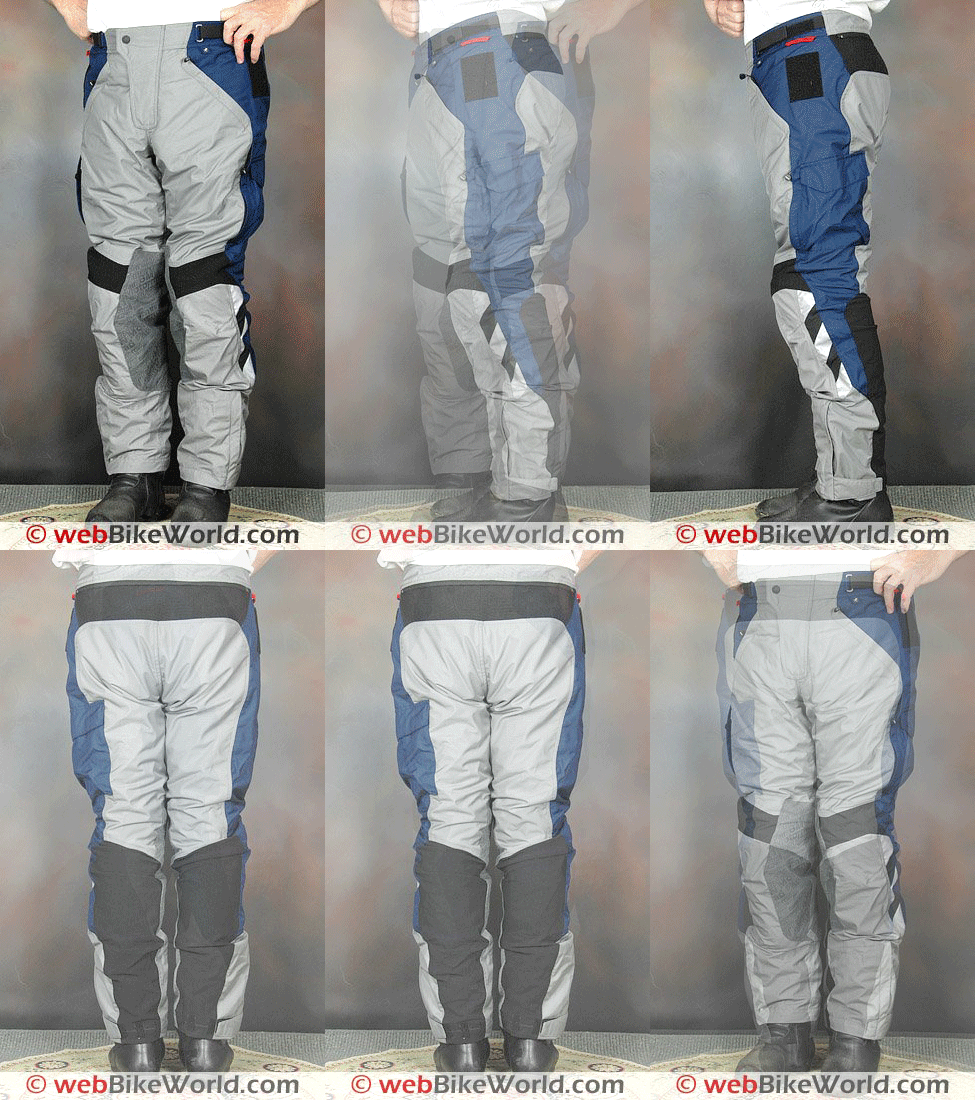
this review. Once we got the pants sizing figured
out, the matching gray/blue/red suit was a real hit and
everyone agrees it looks great.
Adjustable neck on the BMW Rallye 3 jacket.
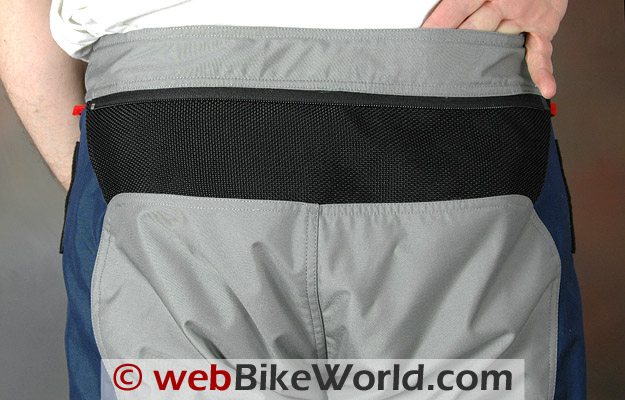
Rear cape on the BMW Rallye 3 jacket covers a large
area of mesh for ventilation.
BMW Rallye 3 Jacket - Overall Construction
I will say that the vast majority of motorcycle clothing
that comes through here has an all-too-similar look and
feel.
Motorcycle jacket and pants are the most difficult
subjects for a review, because 1) they basically all look
and feel the same and 2) there's no way we can
objectively determine the level of protection they might
offer, so the reviews tend to be more subjective than
they are for other types of motorcycle gear.
However, the BMW Rallye 3 jacket is an exception to the
rule. There's
something about the material that the jacket shell is
made from that gives this jacket a different persona.
BMW says it's genuine
DuPont Cordura, and not the faux stuff used in cheaper
jackets, and it is specially developed and
specified by BMW.
The material just feels stronger, sturdier and more
protective but at the same time it has a softer hand than most of
the other jackets we've reviewed. I'm sure BMW has
all sorts of logical explanations about their choice of
textile for the jacket shell, but to us it's one of
those subjective things that just makes the jacket feel
different.
BMW Rallye 3 jacket upper chest with one open and one closed vent.
The Rallye 3 jacket isn't a showplace for
over-the-top and
untested features and it doesn't overload the owner with
its Transformers-like ability to convert pockets, vents
and sleeves (although the sleeves are removable, a
feature we have never taken advantage of in any jacket
where it is available).
BMW specifically states that the Rallye 3 suit is
designed for off-road riding and for the most part, the
jacket sticks to the basics but does them very well.
We can only assume this is based on feedback and
experience gleaned from 3 generations of Rallye jackets
over the last decade.
The stitching is all absolutely perfect, with double
rows where needed, single rows where it isn't and a few
blind seams thrown in for good measure.
The jacket is highly functional, with a heavier-feeling
Cordura all the way up the outside of the arm,
continuing at the shoulder up to the neck. The
elbows do not have separate external abrasion protection
add-ons, but it
must be kept in mind that the Rallye jacket is focused
on off-road use. The
"specially developed for off-road use" label
means that a few of the features in this jacket are indeed different
than some of the 3/4-length pure street jackets you may
be familiar with.
The very soft water-resistant (actually we can say this
one is fully waterproof, based on our evaluations) liner
deserves its own description, because it's a very
high-tech piece quite unlike any other liner we've seen.
It removes easily from the Rallye 3 jacket shell,
and the shell itself then becomes a highly functional
all-around jacket that will serve in a wide range of
conditions and temperatures other than perhaps extreme heat or extreme
cold, when other options might be a better solution.
Zippers, Attachments and Closures
The main entry uses a high-quality YKK Vislon zipper with
nylon teeth and metal runners and equally high-quality metal snaps
made by Prym are used
throughout the jacket.
It's a two-way zipper and the interesting feature
involves the runners, which have a locking mechanism inside, so the
zipper will only open when the pull is pulled in the
correct direction. If the zipper is opened
half-way, for example, the runners will lock in place,
preventing the zipper from opening any further.
These are the type of small details that are expected
but still surprising with the higher-quality jackets.
Locking YKK zippers are also used nearly everywhere else
on the Rallye 3 jacket, including the sleeve cuffs
and the vents.
The only hesitation one might have is with a fairly
extensive reliance on hook-and-loop closures used in
several locations on the jacket. This includes the upper vents,
as a backup for the main placket (which otherwise closes
with pairs of Prym snaps), pockets and sleeve cuffs.
It remains to be seen how well this material will hold
up over time, although one thing to note is that all the
hook-and-loop strips are both sewn and sealed to the
jacket shell, so they should at least remain in
position.
Hook-and-loop fasteners are used elsewhere on the
jacket, including the collar (which gives it about 60 mm
of adjustment), the pockets, the sleeve cuffs and the
front and rear vents. Nothing wrong with
hook-and-loop actually, the "lightweight miracle
fastener", but it can get dirty and eventually lose its
gripping power. On the plus side, it can be fairly
easily replaced.
Sleeve Removal and Waist Adjusters
The main zipper is covered by an entry flap that uses 6
large rubber-covered Prym metal snaps. The Prym
snaps (which are the best in the business and actually
very expensive for what they are) are used also at the
shoulders to fasten the removable arms, each of which
have their own locking zipper so they can be removed.
Curiously, the zippers for the removable arms start in the rear and end in the
front; we wonder if reversing them would have allowed
the shoulders to be peeled down and perhaps secured on
the side of the shoulder with the Prym snap to allow
more air flow.
Each arms has dual adjusters, one at the bend of the
elbow on the inside to keep the elbow armor secure and
one at the forearm. The waist includes sewn-in
elastic but no adjustment, and another curiosity is a
zippered vent that opens right across the elastic,
effectively splitting any effect that the one-piece
elastic section might have in gathering the waist. Fortunately, the
jacket is cut on a taper so not much waist adjustment
(in or out) has been needed.
BUY YOUR
Motorcycle Books, GPS, Electronics,
Training Videos, Clothing and More
at the
wBW Amazon.com Store!
Sleeve Cuffs
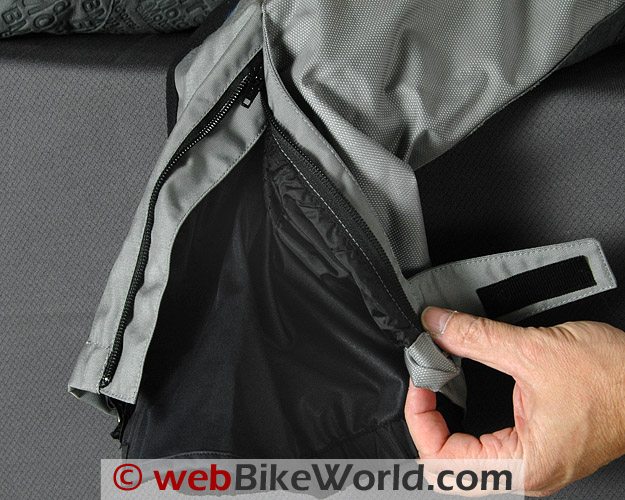
The 150 mm long locking zipper on the inside of each
sleeve cuff on the Rallye 3 jacket opens to reveal a
mesh dart. The zipper can also be left partially
open for more ventilation. The sleeves are
adjusted at the end with hook-and-loop and the material
is thinner here; or rather, the lining is thinner and
there is plenty of adjustment provided by the
hook-and-loop, which makes it very easy to slide the
sleeve cuffs into glove gauntlets.
Pockets
The front of the Rallye 3 jacket includes four large
waterproof pockets, each with a flap that secures with
hook-and-loop. In this case, the hook-and-loop
works better than a zipper or snap to allow quick and
easy one-handed access to the pocket contents.
The upper chest vents could also be used as pockets
unless the vent cover is folded back and snapped to the
jacket for full air flow. Both the left and right
placket have a vertical zipper-covered pocket, and these
are lined with mesh to allow full air flow on to the
chest.
The rear of the jacket has a large pocket across the
back; actually, it's two pockets, one in back that is
accessed through a locking zipper on either side and one
that is accessed via the flap across the back that has
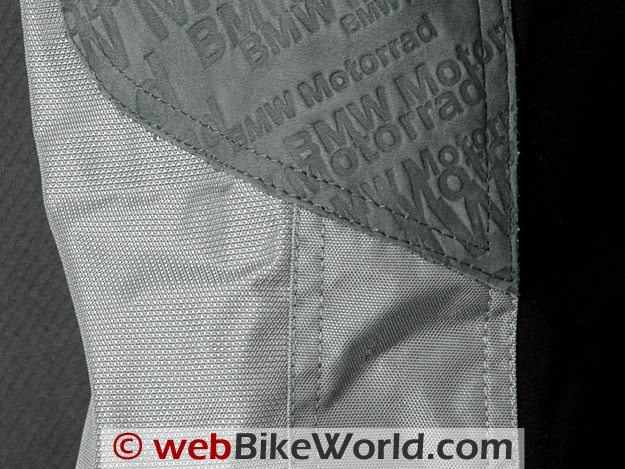
the "BMW Motorrad" embroidered logo.
The Rallye 3 jacket also has a pocket for a hydration
bladder on the back. It can be accessed underneath
the vent flap across the upper back.
Finally, the jacket has a non-removable pocket on the
lower left sleeve. This pocket has a clear cover
and is accessed with a large zipper pull on the side
towards the rider.
BMW Rallye 3 jacket reflective stripes and
open front vent.
Posi-Lock, Posi-Twist,
Posi-Tap and More!
NEW! Posi-
Assorment Packs!
Ventilation
Most of the ventilation in the Rallye 3 jacket comes
from two large mesh portals located on each side of the
jacket at the upper chest. The vents are covered
by the jacket shell material, which is folded back and
secured with the Prym metal snaps to keep the vents
open. The vents close with snaps and 6 narrow
strips of hook-and-loop to keep the vent cover closed
(but not water-tight).
The arms have vents that open with two-way locking
zippers. The upper zipper pull can be lowered to
allow air to pass into the jacket through the mesh
lining and the lower zipper pull can be raised to meet
the upper pull also. However, the systems seems to
work best when a few inches of zipper remain closed at
the cuff and the upper zipper is lowered to let in air.
Each side of the jacket has a vertical vent that opens
with a locking zipper pull. These vents are about
20 cm long and run nearly up to the underarm area.
The zippers open from the top to the bottom, so they can
be lowered about half-way and stay in place due to the
locking mechanism on the pull.
The rear of the jacket features a horizontal flap across
the upper back. It seals with two large patches of
hook-and-loop located at the top of the hydration
bladder pocket. The flap covers the upper back and
it's open and loose around the jacket collar and
underneath is lined with mesh. This provides a
good exhaust for air, but we think BMW could have done a
bit more to take advantage of the design, perhaps by
allowing the rear flap to be folded back to completely
uncover the mesh lining.
As mentioned, the sleeves can be removed from the
jacket, something we've never found necessary on any of
the jackets having this feature. Each sleeve has a
zipper that starts up in back of the neck, underneath
the rear vent flap, then unzips under the arm and up
around the front.
We also think that more advantage could have been taken
of this feature; for example, if the zippers started in
the front, perhaps the sleeves could be unzipped down to
the underarm, allowing air to flow in when the bike was
in motion. As it is, the removable arm feature
isn't really useful when riding.
But overall, the ventilation is very good for this type
of 3/4-length jacket. It follows a pattern set by
other adventure touring type jackets, such as the
British Motorcycle Gear Discovery jacket (review).
These jackets are not fully comparable with "normal"
street/sport 3/4-length jackets such as the
Firstgear Rainier jacket (review), as an example,
because they are designed for different types of riding.
The adventure touring style jackets have much more of an
off-road influence with features and styling that are
compatible with the street but aimed at the true
off-road adventurer.
This is somewhat comparable to the difference between an
adventure touring bike like the BMW R 1200 GS and the G
450 X. The R
1200 GS is perhaps a 70/30 street/off-road bike where
the G 450 X is just the opposite. In this case, a
jacket like a Firstgear Teton may be something like
70/30 street/adventure where the Rallye 3 jacket is
70/30 adventure/street. Or something like that...
Sizing
This Rallye 3 jacket in gray/blue/red is a European size
54, which fits like a U.S. size large for a male with an
approximately 43-44" chest. We couldn't find a
sizing chart on the BMW website or at the retailer, but
we're confident that the 54 should be the equivalent to
a U.S. size large. The black/gray/yellow Rallye 3
jacket was a size 56 and it felt like a size XL.
The model shown in the photographs is wearing the size
56 and he usually wears size XL. You can see it
fits him pretty well.
Safety and Protection The Rallye 3 jacket includes BMW developed or
specified armor and padding. It does not carry a
CE label and the BMW clothing website doesn't refer to a
CE approval, so we can only guess that BMW went its own
way on this. But the padding is thick and large
and it feels protective.
The back pad (photo in the slide show) is much larger
and sturdier than most of the padding found in
motorcycle jackets. It's easily removed through
the zipper at the bottom and it feels very similar to
the controlled density SAS-Tech padding that can be
purchased as an accessory for clothing.
The elbow padding also feels like the SAS-Tech product,
so we wouldn't be surprised to learn that it is made
specifically for BMW. Both the back pad and elbow
padding will compress when slowly squeezed, but firm up
if squeezed or pounded quickly, which is the way the
material helps dissipate energy in a crash.
The adjusters on the outside of the arm act to secure
the padding in place, which is important for efficient
protection.
Reflectivity
The white stripes seen on both versions of the Rallye 3
jacket are retro-reflective, as seen in the photo above.
The jacket also features a reflective strip of piping
across the back.
The reflective material is well placed for visibility at
the upper arms and the stripes also function as a
styling cue.
Rallye 3 jacket liner and inner section of jacket shell.
Three-Zone Liner and Water Resistance
The BMW Rallye 3 jacket includes a removable liner that
BMW claims is waterproof -- a claim which I can
personally attest to. This liner definitely is
different than anything else we've seen. It feels
soft but slightly thicker than most. The seams are
all heat sealed and the inside of the liner is marked
with the words "Flow", "Comfort" and "Shield" marking
the internal "zones".
BMW wouldn't be BMW unless they did things there own
way, and this is a good example. BMW likes to say
that the liner is one of the most technological aspects
of the Rallye 3 jacket. They say that the zones
are designed to match the body's needs in certain areas
by combining different types of membranes into the liner
fabric. In reality, it apparently means that the
liner is breathable where it needs to be,
water-resistant where necessary and the additional
kicker is some softer material used to help keep the
skin warm.
The "Flow" zone covers the back and lower portion of the
body; the "Comfort" zone is the knees (in the pants
liner, obviously), shoulders and neck; and the "Comfort"
zone includes the rest, in areas where the liner can be
used to keep warm. The rest of the jacket is the
"Shield" zone, including the front of the liner, which
is supposed to be the most water-resistant part of the
liner.
It may sound a little goofy, but it seems to work -- at
least the waterproof/windproof part. It's too warm
to tell how the jacket shell with the liner will fare in
the winter, but based on all of our experience with
various types of jackets over the years, I think it
should do fine with the vents zipped shut and the liner
installed.
Of course, in the coldest weather more insulation will
be necessary, and although the liner is windproof, the
shell material really isn't designed to block a lot of
cold air, so you may need to turn to other BMW jackets
for those conditions.
The liner attaches to the shell with zippers on either
side of the placket, along with metal Prym snaps at the
sleeve cuffs (two) and in back of the neck. I
can't recall seeing the high-quality Prym snaps being
used to attach a liner to a jacket shell, so this is an
interesting use of the product.
The liner is much more comfortable than any other wind-
or water-resistant liner I've tried and I'm not sure how
BMW did this, but I rate the liner as outstanding in
terms of performance and comfort.
The
wBW
Opinionator - The BMW Rallye 3 Suit
Picks...
...and Pans.
Comfortable material feels
different.
Excellent quality and
construction.
Specially designed liner works.
Excellent fit.
Good ventilation in jacket.
Classic good looks.
Waist could use wider range of
adjustment.
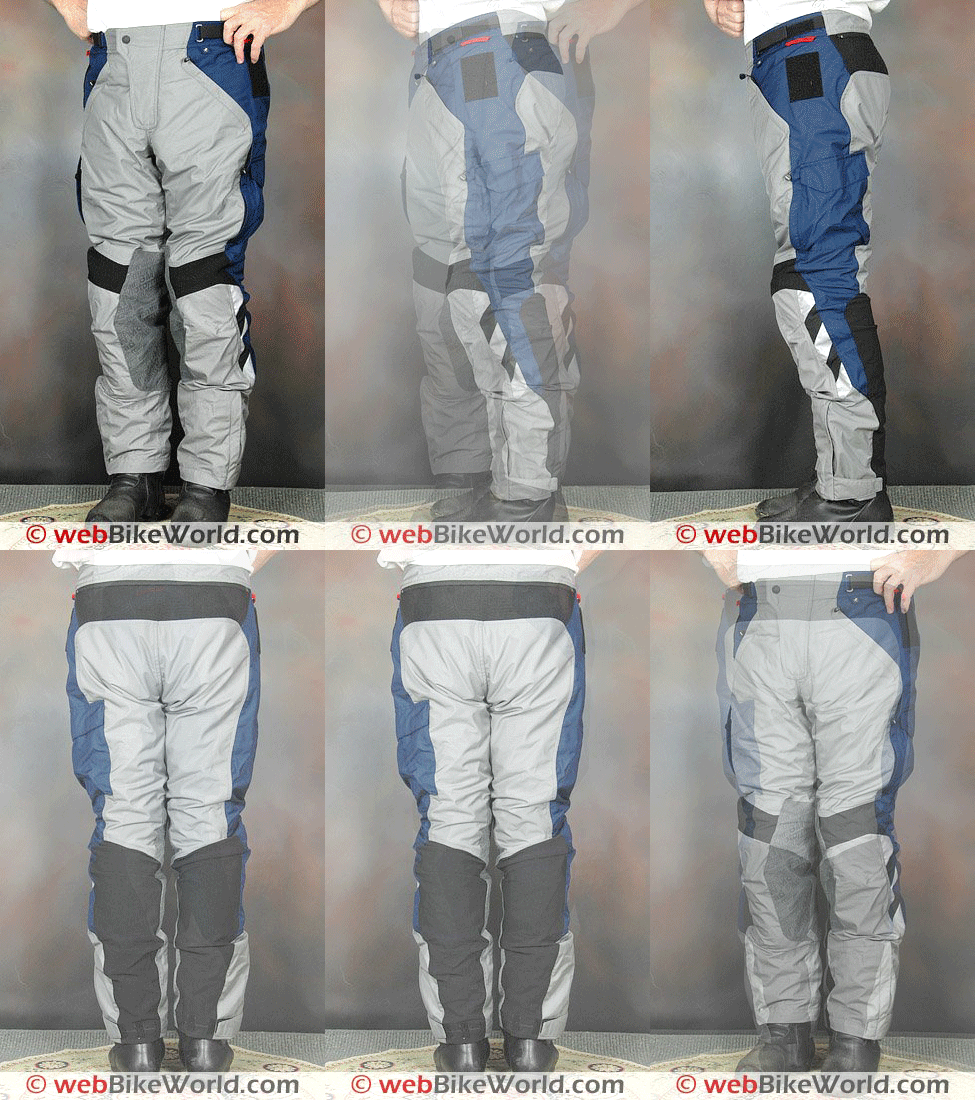
Pants liner hangs out the bottom
of the pant cuffs.
Miscellaneous Features The Rallye 3 has a short collar with a soft
leather-feel piping along the top. But the inside
of the collar is lined with a rough-feeling material
similar to the type used to line a motorcycle helmet.
It's perforated and padded but can feel scratchy against
bare skin. I'm surprised that this area wasn't
lined with some type of micro-fleece or suede, although
when the liner is installed, it has a much
softer-feeling collar that covers the area and protects
the skin.
Riding With the BMW Rallye 3 Jacket
Even though the weather became brutally warm soon after
the Rallye 3 arrived, I was able to give it a good
workout in a variety of conditions, including a
several-hundred mile, three-state trip that included
heavy rain.
It's important to remember that this is the type of
jacket in which the shell provides only a minimal amount
of water resistance in heavy rain while the liner is
designed to keep the rider dry.
The combination of the jacket and pants liners in the
BMW Rallye Suit do seem to be completely waterproof but
the external material of the shell will become quite
wet. Since very few jacket shells are designed to
provide water resistance due to the breathability issue,
it's a good idea to take along a true waterproof one- or
two-piece oversuit to throw on in the worst conditions.
The front chest vents work very well, as do the arm
vents. The cape-type shoulder cover in the rear
with its mesh lining underneath helps to pull the air
through the jacket (when the liner is removed), so
overall I rate the ventilation excellent, comparatively
speaking for this jacket style.
Conclusion The BMW Rallye 3 jacket is comfortable and it has a
nicely tailored shape that gives it an undefined feeling
that is different from other jackets I've worn.
Fit and comfort are heavily weighted criteria in my
book, because if the gear doesn't fit well, it ends up
staying home and then the cost of the gear is a total
loss.
Me? I'd rather
spend more to buy gear that I'll wear for a long time
while getting more satisfaction along the way. I
know others may not agree, and there are the "cheaper is
always better" crowd. That's fine, but BMW has
been making the Rallye Suit for a long time with many
happy customers, so the cost/value equation must be
there.
Please
send
comments to
Comments are ordered from most recent to oldest.
Not all comments will be published (details). Comments may be edited for
clarity prior to publication.
From "S.K." (7/10): "I don't own the
Rallye 3 suit, but I do own a few BMW products and there
are a few little things that are to be appreciated.
BMW products are made (or used to be made) with as few
panels as possible to reduce the probability of a seam
blowing out. My BMW cover pants consist of 6
panels, with two reinforcing panels over the knees.
Impact areas have double layers that are seamlessly
integrated into the garment.
The outer side of the sleeve on the Rallye 2 pro is
actually two layers of 500d Cordura. Likewise the
front panel on the Summer 2 pant from the knee down is
also a double layer. It may be worthwhile to check
for these double layers in the Rallye 3.
If the quality on the Rallye 3 is consistent with
previous generations, I would wager that the red/yellow
accents on the sleeves are separate layers over either a
solid piece, or unsightly seam, whereas a cheaper suit
would simply use the accent as a connecting piece.
In fact, I think I can see the black fabric showing
through the yellow in your pictures, and the seam
allowances can be made out as they are a more vibrant
yellow.
Extra labor goes into strengthening the seams.
(Above) is a picture of an outer leg seam on the BMW
Summer 2 Pants (below). The two panels are serged/overlocked,
and then finished off with four additional rows of
stitching. The inside leg is similar with only
four total rows of stitching.
The cheapest riding gear uses no blind/hidden stitching,
or overlocking. My (not cheap) Rev'it Cayenne Pro,
a competitor to the Rallye 2 Pro, has two rows of
stitching plus overlocking at its critical seams.
On paper the two are similar in function and appearance,
with a $200 difference in price. While some of
that is for the Roundel, some of it is in the
construction.
None of this is mentioned in BMW literature. I
imagine they are lazy and encompass it under "BMW
C.A.R.E Quality".
The orange armor (BMW's NP armor) in the Rallye 3 is CE
certified, although yours may not have come out of the
mold properly. My armor shows "CE EN 1621-1".
It is larger than standard 1621-1 A and B shaped
protectors; my knee armor reaches further down, and
wraps around the outside of my calf. It should be
noted that the pads ARE prone to cracking if flexed in
cold conditions, much like SaS-Tec pads. I have
repaired cracks with contact cement with no ill effects.
The BMW size chart is hidden on pages 98-99 of their
electronic catalogue."
From "S.G." (7/10): "Love the suit
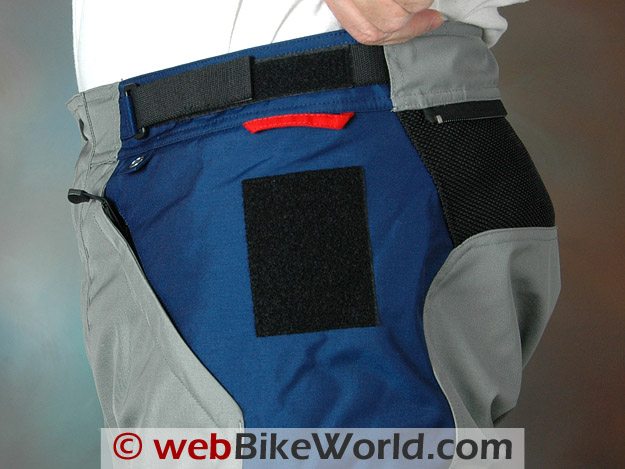
and it is completely waterproof. No idea what the
section of loop on the hips is for…I’d love to know as
well.
As far as cost/value goes, it is cheaper to buy the best
first instead of a few cheaper ones along the way that
end up costing as much as the best in end anyways.
I have worn mine from 0 C to 34 C and been comfy…with a
heated liner at the lower extreme. Very heavy duty
armour that completely ‘disappears’ once you are wearing
it.
Great suit…I would buy it again in a heartbeat."
From "P.S." (7/10): "Do you think
the hook and loop patches and the red “loop” on the
pants might be related to the "BMW Trinkpak Hydra"
accessory?
Most websites say "there is an outside back pocket"
where this thing is supposed to go but I don’t see any
such pocket on the pants or jacket in any of the
pictures in your review. It does, however, look to
me like the hook and loop patches could be attachment
points with the red loop being a guide/security device
for the siphon tube. Just a thought.
The black/yellow color is gorgeous and the entire suit
creates an instant desire to own it. Man, I would
love to have that suit. Unfortunately, it’s not in
THIS year’s budget."
Rick's Reply: I think the BMW
marketing info said the "Trinkpak" fit into the bladder
pocket, check the photos above again, you can see it on
the back of the jacket, the triangular shaped pocket
above the "BMW Motorrad" logo on the rear, just
underneath the cape vent in the back.
I'm surprised they didn't include the hydration
bladder itself, now that I think about it, I should have
nicked them on that!