

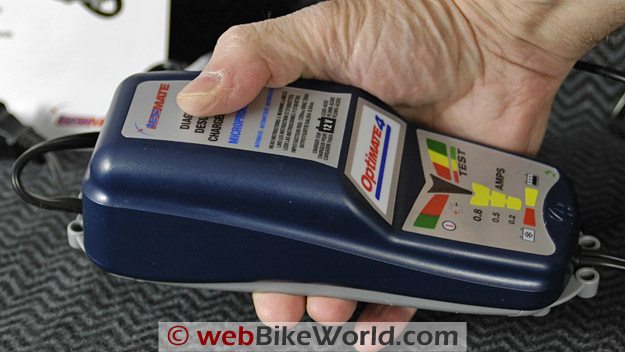
The Optimate 4 has several microprocessor controlled stages that analyze, desulfate and charge motorcycle and automobile batteries.
I evaluated and reviewed the Optimate 3 only a few months ago in the warm and fondly remembered month of August (2008).
Wouldn’t you know it — just as soon as that review was published, Tecmate, the makers of the popular Optimate line of motorcycle battery chargers, released the Optimate 4.
I always figured a battery charger was a battery charger — as long as it does the job, who cares?
Although I will admit that some features are nice to have, like the microprocessors in the Optimate and other battery chargers like those made by Battery Tender, Acumen and others.
Their little brains monitor the battery and keep it maintained and topped off with a trickle charge in winter.
But I usually compare them all to the original benchmark, the Battery Tender.
Rick has three of them, and at least two have been in continuous use, 24 hours a day, 365 days a year for something like the past 8 years. I’ve been running two of them also, and they haven’t failed me yet.
Battery Tenders are very simple and easy-to-use devices: plug ’em in and turn ’em on.
Red light bad, green light good. Simple and effective.
Sure, they aren’t the most elegant-looking things on the block — in fact, I’m not even sure if there are any more Battery Tenders like these, with their slotted metal cases. But they work.
The Optimate 4
So along comes the Optimate and the other sleek-looking, solid-as-a-brick devices, with all sorts of blinking lights and fancy levels and stages for charging your battery.
They seem work just as well as the old-fashioned Battery Tender, but I’m wondering what the real difference is with some of them.
I would think that the person who buys a trickle battery charger must at least have some sense of the importance of proper battery maintenance — just the sort of person who’d be least likely to let a battery get into such a bad state of charge to begin with.
Conversely, I would guess that anyone who did allow a battery to get so bad that it needed to be desulfated probably isn’t much a gearhead to begin with.
So when they needed a charger, they’d probably run down to their local Big Box store and buy the cheapest one they could find (or maybe just chuck the battery and buy a new one).
Thus, my conclusion is that a battery charger that can desulfate, emulsify, homogenize and spit-shine the terminals may be wasted on the target market for the thing:the person who’s a maintenance freak to begin with.
Read the Manual!
On the other hand, I can also see where a techie gearhead might like all the bells and whistles on the Optimate 4. I mean it works, for sure, and it works beautifully and it looks very cool and it has all sorts of lights and things.
So many, in fact, that I had to read the 6+ page owner’s manual at least 4 times — literally — before I could figure out what to do.
And I had to keep the manual near the charger so I could keep referring to it to interpret what was happening to the battery.
The manual lists 13 different combinations (that I can count) of steady and/or continuous light that can be seen on the flat panel of the Optimate 4 to let you know what’s happening.
But even after studying the manual from cover to cover, I don’t see where it tells me which light is on when the charge is over, finished, done and successful.
LED Light Notifications
Reading the Optimate technical info again I discovered that Tecmate (the manufacturer) states that there are 19 different LED light combinations. Some of the functions they list for the Optimate 4 include:
- Deep-discharge diagnosis
- Recovery and TURBO recovery
- Charge optimization and verification system
- Automatic power loss test
- 5 possible status test results
- Energy efficient, low heat rise
- Sealed weatherproof enclosure
I’m not sure how many stages the Optimate 4 goes through to charge the battery — I can’t find a reference to that information in the owner’s manual or on the website.
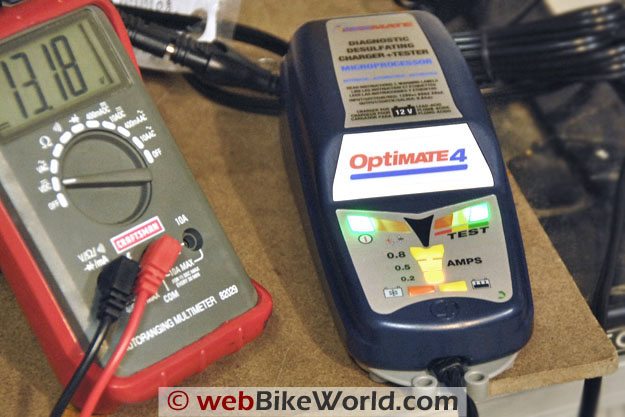
I’m guessing it’s the combination of the green light #1 in the upper left-hand corner and the green light #5 in the upper right-hand corner, because those are the only lights still glowing after all the other lights have gone off. You’d sort of think they’d tell you that in the manual, but I can’t find it.
That’s the only real downside I can see to the Optimate 4. You may want to keep a color copy of the inside cover hanging on the wall next to your unit; the “Optimate4 Quick Guide – LED Information Panel”, as it’s called.
Operating the Optimate
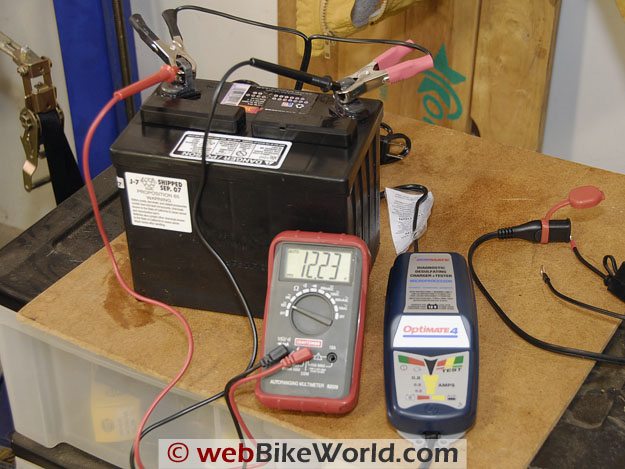
To evaluate the Optimate 4, I used a riding lawnmower battery that has been sitting in the lawnmower since April of this year.
One of the belts that drive the blades was broken, and I was too lazy to fix it — lazy enough to pay the local lawn service guy to mow the lawn instead. So the mower and the battery have been sitting there for 8 months.
The water level was about half-way down, so I topped it off and took a reading of 12.23 Volts. Not bad actually, considering it’s been sitting outside in a shed for so long.
Sulfation?
Sulfation apparently starts right around that Voltage, according to the battery tutorial on the Batterystuff website:
“Sulfation of Batteries starts when specific gravity falls below 1.225 or voltage measures less than 12.4 (12v Battery) or 6.2 (6 volt battery). Sulfation hardens the battery plates reducing and eventually destroying the ability of the battery to generate Volts and Amps.”
Once you get past the owner’s manual, the Optimate 4 is pretty easy to operate. It comes with a very nice, heavy-duty SAE connector type harness for your battery, instead of the white square plastic things that came with the Optimate 3.
I call these the Battery Tender connectors because that’s the first time I ever found them.
The female SAE connector on the harness for the battery on the bike is bigger and heftier than others I’ve seen and it has a nice cover to keep out the dirt and moisture.
It also has a built-in 7.5A ATO (Automotive Technology Organization) blade-type line fuse in a waterproof holder.
It also comes with an alligator clip harness if needed and the Optimate 4 unit itself has about 8 feet of electric cord, along with screw holes for wall mounting (but no screws).
The instructions warn the owner to connect the charger to the battery first, then plug into the wall. When disconnecting, unplug from the wall first, then remove from the battery.
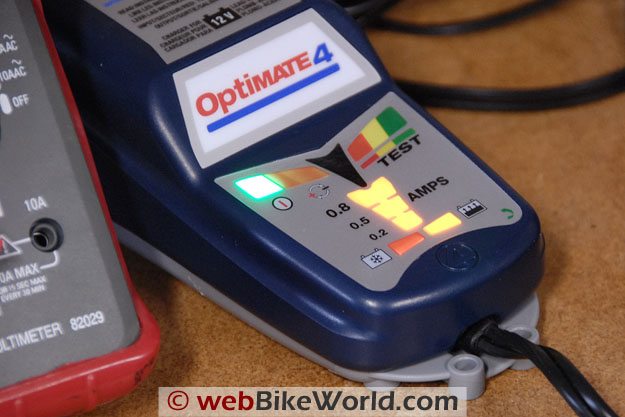
Other than that, it’s pretty simple. A few lights blink on and off momentarily — you’d have to be very quick indeed to see them. The yellow lights #8, 9 and 10 came on and apparently the Optimate 4 was going through its paces and rejuvenating the battery.
Here’s a photo taken a few seconds after engaging the unit:
About 8 hours later, I went out into the garage and the green lights were on, so I assumed the process was complete.
Here’s what it looked like:
Compared To…?
It’s very hard to tell with a motorcycle battery charger whether one or the other brand or model would have the same or better results. Other than the claims on the packages — which I’m sure the different manufacturers would adamantly defend, they all seem to work well.
The Optimate 4 does have a lot of nice features, and it is nice to have all the lights to let you know what’s happening, as long as you have the manual nearby to interpret them.
And who knows — maybe your friends will unload their old batteries on you to be revitalized by the desulfating, all-singing-and-dancing Optimate 4!
Conclusion
The Optimate 4 works, it has a lot of lights, a two year warranty, and many different types of accessory harnesses. It’s been “Recommended by 8 major powersport manufacturers”, according to Tecmate.
The Optimate 4 is relatively difficult to find in North America; apparently the strategy is to first sell all of the Optimate 3 chargers still in retailer inventories.
It also looks like the Optimate 4 will be released at the 2009 Indy Powersports Dealer Expo, and perhaps the Editor will give us a report from that show.
The list price for Version 4 is also unclear as of this writing, but the Optimate 3 can be found for about $44.95 on the street, while the Optimate 4 usually costs about $30.00 more. Meanwhile, the tried-and-true Battery Tender Plus lists for $59.95 and has a 10 year warranty.
Is the Optimate 4 worth it? I’m not sure. Again, regardless of the hype laid on by the battery charger manufacturers, the products all seem to do the job for me.
I just have this feeling that there really aren’t any distinguishing characteristics that make one all that different from the other — beside the fancy cases and LED lights, that is.
I’d be very interested in reading some independent lab results that demonstrates why and how one brand of battery charger is better or worse than another.
To quote Sherlock Holmes in A Scandal in Bohemia: “I have no data yet. It is a capital mistake to theorize before one has data. Insensibly one begins to twist facts to suit theories, instead of theories to suit facts.”
Personally, the only motorcycle battery charger features I’m really interested in are its ability to keep a maintenance charge and last for years while doing it, because I never let my batteries run down to the point where they need to be raised from the dead anyway.
So I leave you with mixed feelings on the Optimate 4. There’s nothing at all wrong with it, it seems very well made and solid and I like the quality of the hardware and connectors it is supplied with.
I just wish I could tell you that paying the extra money for one is worth it, but it’s beyond my abilities to tell.
wBW Motorcycle Battery & Charger Reviews | Maintenance & Repair Articles
| wBW Review: OptiMate 4 Motorcycle Battery Charger | |
|---|---|
| Manufacturer: TecMate | List Price (2008): $79.99 |
| Colors: Gray/Blue. | Made In: China |
| Review Date: December 2008 | |
Owner Comments and Feedback
See details on submitting comments.
From “T.A.” (March 2015): “Optimate 4 dual battery, Yuasa YTZ10s. Use out of vehicle with clamps on standard program.
As per the instructions, I have the outlet disconnected before mounting the clamps on the battery; positive first, negative second. I plug in the outlet and I get a red test indication even if my battery steadily shows 12.67V for 2 days now.
When trying to disconnect the outlet and connect it again without removing the clamps, I get a correct test result and the charging proceeds as expected.
But every time I start over without the clamps initially (when I have packed my charger), I get a wrong test result again and have to disconnect and reconnect the charger to the outlet to get a correct test result.
After the second connection to the outlet all next connections give correct result indications, until I remove the clamps (even for a few seconds). When I remove the clamps, I make disconnect the outlet first as per the instructions on the manual. I have the charger used indoors only.
I have product for almost 2.5 years and it was OK till now. Currently a message was just send to company for review and waiting for answer.”
From “C.H.” (8/09): “I have to agree with the comments posted (below). The Optimate4 I bought with great expectations has proven to be just another hyped up product skillfully promoted with the aim of thinning your wallet without providing the advertised benefits.
I’ve tried it on several batteries so far and it either DID NOT revive the battery (one motorcycle battery was in use only a month ago and I had kept it on a trickle charge so it “should” have been a good candidate for “revival”. The other, a deeply sulfated battery.
The Optimate4 did not revive either and in the case of the motorcycle battery, reported it as good and charged but it was not. Repeated cycles of charging (as suggested by their documentation) yielded no improvement. It gave up on the deeply sulfated battery.
My advice, heed the advice of Mike Cecchini of MRC Engineering (below) and the very generous advice of webBikeWorld. He is dead on and webBikeWorld was very generous to TecMate.
Bottom Line: just buy a good regular battery charger. Skip the dog and pony show. The Optimate4 is ok only as a battery trickle/maintainer. Apparently, a dead battery is just that.”
Editor’s Note (7/09): Here’s another take on the OptiMate 4, written by Mike Cecchini of MRC Engineering in Bethesda, Maryland U.S.A.:
“Various size and types of motorcycle batteries where connected to the OptiMate 4 over a two week period to test all OptiMate4 functions.
Three (3) near new (12.5 + volts) lead acid wet cell 7 ah to 24 ah batteries went through all the charger cycles and both green lights lit continuously indicating the charger had completed it’s full range of tests and charging sequences.
Two (2) desulfated wet cell lead acid 10 ah & 14 ah batteries were hooked up in an attempt to desulfated these batteries and revive them.
Four (4) 7 ah to 16 ah AGM (absorbed glass mat) batteries were tested over a 12 day period.
One of these AGM batteries read 10.3 volts indicating it had one desulfated (bad, grounded ) cell and it also was connected to the Optimate 4 to see if the desulfation mode would revive the cell and bring the battery back to full life.
Pros:
- Great looking unit with lots of accessories included.
- 19 different light combinations = lots of visual information for users.
- Great “bells ‘n whistles” show when hooked up to battery.
- Charging indicators (.2, .5, .8 amps) are very accurate.
- Weatherproof sealed housing capable of being mounted on wall.
- Two (2) year warranty.
Cons:
- Low maximum charging rate (.8 amps)
- 19 different light combinations = confusing and too many variations of charging rates/blinking lights.
- Red/Yellow/Green lights on unit are referred to in the 5 page densely packed owners manual by numbers only requiring owners to memorize multiple and varying color/ number combinations.
- Desulfation mode never kicked-in with my attempts to recover three (3) different types and size light to medium desulfated motorcycle batteries.
- Final battery float voltages never went above 13.3 to 13.5 volts vs. 14.0 to 14.5 volts needed to bring wet cell and AGM batteries to full charge.
Summary
Battery chargers should be simple and easy-to-use devices: plug ’em in and turn ’em on. Red light (wrong/bad) , green light (fully charged and ok). Simple. The OptiMate 4 is definitely not simple.
Additional lights, bells, whistles are all well and good, but let’s face it — we didn’t buy a battery charger to be entertained, we just want it to do the job. And this is where the poo hits the fan with the OptiMate 4.
Like its predecessors, the AccuMate and OptiMate variations which I’ve tested — and so many other battery and trickle/maintenance chargers on the market in the past 10 years (when I began to see an alarming rate of battery failures) — not a single one of them achieved the main reason we use battery chargers.
And this is to charge a battery to its full potential; not 80% or 90% as this leads to short battery life and pre-mature dead batteries.
Our motorcycle batteries need to be charged to full voltage potential (14.2–14.5 volts for AGM’s and 14.0–15.0 volts for lead/acid batteries). And this, I feel, is the reason why our batteries don’t last as long as they use to when chargers use to fully and completely charge a battery.
Luckily I still have a 1985 ($39) Sears/Schumacher automatic 2–10 amp battery charger that does work properly.

And it takes my all my car and motorcycle batteries up to 14.5 volts and holds them at this voltage while the charging amps are dropped to almost zero. This keeps a battery at full potential (14.0–14.5 volts) — not the 13.0 to 13.5 volts many chargers stop at.
My Sears/Schumacher charger has a on/off switch, which I can’t find on any battery/trickle chargers today (WT ??) and it has a analog (meter w/ needle) amp meter that lets you know what’s happening at a glance.
The only thing the Sears/Schumacher charger doesn’t have (which all chargers should) is an 8V to 20V meter to display the only other piece of valuable information I’d like to know when I connect it to a battery.
Conclusion and Bottom Line
The OptiMate 4 is far too much about giving the owner a light show and the impression that they have bought the final solution to all the dead batteries they’ve been experiencing.
Sadly, as the months go by and their batteries still continue to die they will again be in search of a charger that actually achieves it’s primary goal: to charge a battery properly.
Frankly, all we need is a charger that does what it’s suppose to do and many of us only need red and green indicator lights to let us know the basic information.
The rest of us techno-geeks would appreciate a simple combined digital volt and amp meter for our $50 to $100 we spend on such units and I cannot understand why this hasn’t been done decades ago when digi-meters hit the market for under $5.
And while a two year warranty sounds good, this warranty is only good if the unit only fails to operate as designed and that, my friend, is the snag.
It’s been designed not to charge the battery up to voltages our batteries need; therefore the impressive 2 year warranty isn’t worth much — this side of black/white non-function.
Sadly, the OptiMate like so many other chargers out there: comes close but no cigar. It fails were it counts most; the final battery voltage, so the search goes on with a test on the latest and greatest bells ‘n’ whistles unit on the market: the Xtreme Charge Motorcycle Battery Charger @ $100.00.
My thanks to American Classic Motors, Zeiglerville, Pennsylvania, for providing the OptiMate4 for testing and stepping up in wanting to actually know if the products they sell really do work.”
From “M.G.” (2/09): “I do have a question about the OptiMate 4, and a comment for JTG’s comments in the same article about his charger failures:
TThe question – is the OptiMate 4 unit itself waterproof? Like many riders living in condo’s & apartments, I don’t have the pleasure of a garage, and so the charger needs to be out in the parking lot with an extension cord.
I’m currently using the Deltran BatteryTender Waterproof 800 (have for about 3-1/2 years with no issues), but would prefer to move to the optimate-4 if (and only if) is a waterproof unit.
In that sense, the Deltran has done wonderfully, and I did test it when first acquired by leaving it in a bucket of water overnight while in use.
The comment for JTG’s commentary – odds are you have one of two particular problems:
(A) Condensation in the area you are keeping the battery chargers in. This is particularly problematic in areas that have very high humidity levels, and he may want to consider a water-proof alternative instead of a vented-cased charger;
(B) A grounding issue with the main ground for the building itself.
As a computer consultant, I see this a lot in residential situations here in Florida — after 15 – 30 years of duty, the 12′ of copper grounding rod that the electrical system ties to is so corroded that it no longer does a good job of conducting the ground-to-earth connection (or the grounding strap itself where it connects to the ground-rod).
Easy way to test — check the voltage difference between the ground pole of the electrical outlet in question and a piece of wetted concrete in the garage.
$25 in rod segments and a sledgehammer (to drive in a new one), plus a bit of sanding on the grounding strap & some dielectric grease, and the problem is normally resolved for another decade-plus.
When the ground signal can’t find a good path to ground, you can get all sorts of strange electronic burn-out issues, especially if there are 230 volt devices on an uninsulated (grounded) floor, such as ovens & electric water-heaters.”
From “T.C.” (12/08): “In your most recent report of the OptiMate 4 Battery Charger you mentioned it had several stages but you did not say how many? I like the final stage on the Yuasa battery maintainer when it turns off for 28 days and then turns back on. I wish we knew if this Optimate could do this extended rest or not?”
Editor’s Response: I don’t know the answer, I haven’t been able to locate this information. However, I did find the following bulleted information on the Tecmate website (quoted):
- The automatic multi stage program engages as soon as the OptiMate is connected to a 12V battery that has at least 2V.
- The OptiMate 4 immediately checks if the battery has enough voltage to start the program, and whether the battery is deep-discharged (“sulfated”) or not.
- For neglected batteries, the OptiMate 4 starts the recovery mode, initially limiting the applied voltage at 16V, and if necessary for sulfated batteries, engaging TURBO recovery at a voltage of up to 22V at low current for up to 2 hours, to recover the battery to a condition in which it can accept a normal charge.
- As soon as the circuit detects that this point has been reached (immediately for most batteries), the “bulk charge” mode engages and delivers current at a constant rate of 0.8A to charge the battery.
- When the battery-sensing circuit observes that charge progress is sufficient, the unique ‘verification’ stage engages. The voltage is limited at a lower level, & if sensed necessary, a voltage pulsing action provides further desulfating (and) tops off the charge. When this has been verified, or if after 48 hours from connection the battery has been unable to accept (and) retain adequate charge, the next stage engages.
- The OptiMate then stops current to the battery for 30 minutes while it monitors the unsupported battery voltage to check whether the battery can retain sufficient charge to crank an engine, before the long term maintenance and test cycle begins.
- During the next 30 minutes the OptiMate offers the battery a supporting (and) maintaining charge, but only to the extent necessary to counter any losses or connected loads such as an electronic alarm or immobilizer. Overcharging and/or overheating of the battery is ruled out by this 50% duty cycle as the battery is interactively maintained for 30 minutes and then rests during the power drain tests of each alternative 30 minutes. So the battery is always 100% good to go, but never overcharged.
From “JTG” (1/09): “It is interesting for me to note that you are measuring the Optimate 4 against the Battery Tender, presumably because you have had such stellar luck with the Battery Tender. I am interested in the Optimate 4 for exactly the opposite reason.
I own a fleet of six small batteries (they are installed in my motorcycles). Since I can only ride one of them at a time, the Battery Tender was attractive to me. I have had 5 out of 6 fail within two years of purchase!
In case you think I have a systemic problem, you should know that I don’t live on the Tundra with my only electricity being provided by a cranky old generator. I live on the power grid with buried power lines.
I availed myself to the much adored 10 year warranty. I need to ask Bill C. if he can put his hands on his original 8 year old invoice for the purchase of his Battery Tender.
If not, he should be prepared to shell out 50% of list price to replace his Battery Tender under the Del Ray warranty program – or about the street price at a deep discounter.
Well, they had me, so I bought the 5 replacements (they did graciously discount the purchase somewhat in light of my volume of failures). Guess what?
A year later my fleet of Battery Tenders is currently down to 3 operational units and three defunct Tenders “with their slotted metal cases” looking back at me – no lights – no nuthin. I’m not going back to Del Ray. I may just buy a fleet of Optimate 4s and try them out.”
From “F.M.” (12/08): “Thanks for the review of the OptiMate 4.
I am an Integration and Test Engineer with (a major engineering and scientific firm). Much of my time is spent testing and monitoring batteries and charging systems.
In fact, I am getting ready to ride my motorcycle out to do a daily check on a battery that is trickle-charging on a soon-to-be-launched satellite.
I monitor battery pressure (~930psi), temperature, active cooling, pack voltage, and cell balance. I also write software that tests the battery charging subsystem in the spacecraft.
I can tell you that there are some significant differences between battery chargers sold for motorcycle use. I own a Battery Tender, a Schumacher (1.5A), and a Yuasa Smartshot (1.5A).
I’m convinced that the Yuasa is the best of them and that the Battery Tender is the worst.
If one wants to maximize battery life, the cycling that Yuasa does is very desirable. Let’s think about this, too: Of all of the manufacturers selling battery maintainers, how many of them actually design, produce, and sell lines of batteries? I count one: Yuasa.
And those are about the most respected batteries in the motorcycle industry. Yuasa employs full-time scientists and engineers who fully understand battery chemistry and design, as well as battery charging.
I hope that you find the article helpful. It the best comparison of motorcycle battery chargers that I’ve yet seen, though I’d love to see an update to it.
To the best of my knowledge, the Yuasa chargers (1.5A and 900ma), Battery Tender Plus, and Schumacher chargers have not undergone significant redesigns since that article was published.”