


NOTE: Many comments on chain cleaning in the comments section of our original chain cleaning article
This is the next chapter in our never-ending search for the easiest and most efficient motorcycle chain cleaning method…
webBikeWorlder Tim S. (Oz) read our review of theMoose Chain Scrubber (review) and suggested we try the Kettenmax Chain Cleaner.
He said that the Kettenmax seemed to be “similar” to the Moose version.
After receiving the Kettenmax from its manufacturer in Austria, I’d say it’s much more than similar.
I don’t know which one came first (I suspect the Kettenmax) but I’m surprised that there isn’t a patent issue involved here, because these chain cleaners are definitely first cousins, if not siblings.
Nevertheless, the Kettenmax seems to be a more advanced version of the Moose product.
It also did a better job of cleaning the chain on our Triumph Tiger test mule.
I’ll get into the details in a moment, but first I want to ruminate on the efficacy of these devices, which are designed to clean a motorcycle chain and, I assume, whose purpose is to make the job easier, cleaner and/or more efficient.
I’m still not sold on the concept of a semi-automated device for cleaning a motorcycle chain.
After all, it doesn’t take very long to slop on some kerosene, some Motorex Chain Cleaner (orMotul Chain Clean) and scrub away with the Grunge Brush or even some wadded up paper towels.
Motorcycle Chain Cleaning
Our favorite chain cleaner was WD-40, which seemed to do the best job with the least cost.
But we’ve been warned off using it because it can apparently dissolve the grease packed behind the O-rings on a motorcycle chain.
See the webBikeWorld article on cleaning a motorcycle chain for more info on that issue.
Although it’s apparent that some webBikeWorld visitors still swear by the WD-40 method, based on the emails we’ve received on this topic.
The Grunge Brush (review) is still one of the best products to use to clean a motorcycle chain, no matter which cleaner you use, so always be sure to have one on hand.
It can easily be used to scrub in different directions, with differing levels of pressure that allow the user to focus on the dirty sections. Just be careful of those O-rings!
It doesn’t take much time to pull the Grunge Brush out of its home (an old oil drain pan used to hold all the greasy dirty stuff in the garage) and get down to business.
The problem with the semi-automatic chain cleaners like the Kettenmax and Moose is that it can take more time to get them set up than it does to actually clean the chain.
They’re also messy, although let’s face it — cleaning a motorcycle chain is a messy job no matter how you slice it.
But pouring chain cleaner into the Kettenmax or Moose cleaning boxes and rotating the chain around seems to spread the cleaning solution mess over a wider area as the chain rotates, so plenty of newspapers are called for to protect the floor, wheel and tire.
The question is, does a semi-automatic chain cleaning device do a better job than the manual method?
The Kettenmax Cleaner
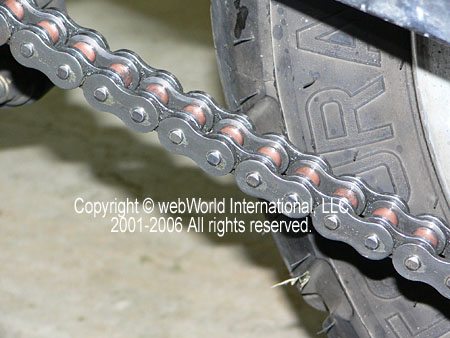
One of the photos (below) is a close-up of the Tiger’s chain after running it through the Kettenmax device for about 5-6 revolutions. The chain certainly looks clean, but on closer inspection, is it really?
I have no data to support this, but I could probably argue that clean side plates do nothing to increase chain life.
Rollers maybe, but what’s really important is getting the grunge out from between the side plates; that is, the places where the plates rub against each other as the outer links rotate over the inner link sections.
And neither the manual nor the semi-automatic chain cleaning methods seems to do a good job at cleaning those areas.
So who really knows how much longer a motorcycle chain will last using the commonly applied methods of chain cleaning?
I’m being somewhat rhetorical here, because there’s certainly experience that demonstrates taht clean chains last longer, but the real question is how clean do they really have to be and how much longer will they last?
Maybe it’s enough to simply wipe ’em down once and a while to remove most of the obvious grit and then to spray on some decent chain lube as insurance.
Who knows for sure?
Some people in the know say that a modern grease-filled O-ring type chain doesn’t even need external lubrication, and some of the spray chain lubes may actually get the chain sticky enough to allow the dirt to collect on the chain, causing most of the wear.
Alright, enough theorizing — the bottom line is that the average owner will still feel guilty if the chain isn’t kept clean.
The Kettenmax System
Which brings us back to the Kettenmax and the search for the best/most efficient chain cleaning system.
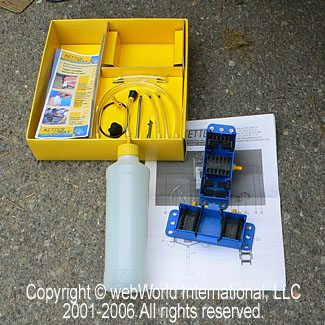
The Kettenmax comes in a box with what at first appears to be an overwhelming assortment of parts.
Even though the instructions are printed in about a dozen different languages, the only photos in the box were on a small strip of paper with three grainy color images, obviously spit out of someone’s ink jet.
My first suggestion, therefore, is to can the printed instructions and just provide a handful of clear photos for prospective Kettenmax owners, which is why we’ve added some larger sized photos in this article to illustrate the process.
How It Works
The basic feature of the Kettenmax Chain Cleaner is a brush-filled box that clamps around the motorcycle chain.
Chain cleaning fluid is introduced into the box, which cleans the chain as the rear wheel is rotated.
The brushes provide the physical agitation necessary to remove most of the grit off of the chain and into the fluid, where it (supposedly) exits out the bottom of the box and into a catch basin.
The brushes in the Moose chain cleaner seemed too widely spaced to work very well on the size 530 chain of our Triumph Tiger.
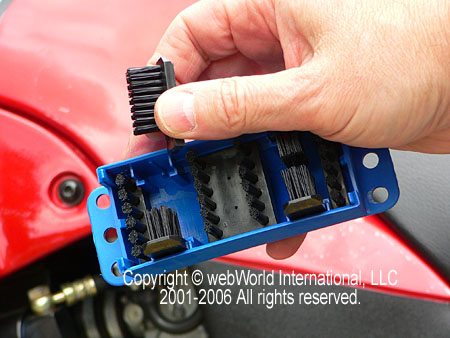
In comparison, the Kettenmax box has plenty of brushes, but the brushes that clean the side plates must first be trimmed to fit the chain width.
The box will not fit over a 530 (and probably wouldn’t fit a 520 either) as it comes from the factory.
The brushes slide into holders on the sides of the box and they can be easily removed, so it would have been nice if Kettenmax had provided a variety of brush widths for cleaning different sized chains.
Instead, the brushes must first be trimmed by cutting them with a scissor.
Once they’re cut, they obviously will not fit a chain smaller than the new width. So the trick is to be very careful about cutting them, making sure that they are not trimmed too much, which would leave them too narrow to effectively clean the chain’s side plates.
We tried a couple of different methods for trimming the bristles, but a long pair of scissors worked best — the longer the better. Insert the brushes back into the box after trimming.
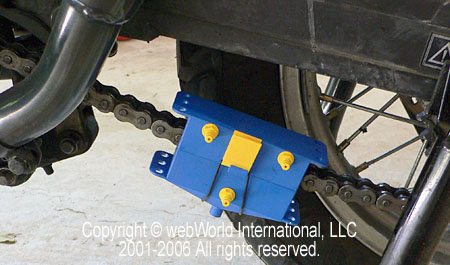
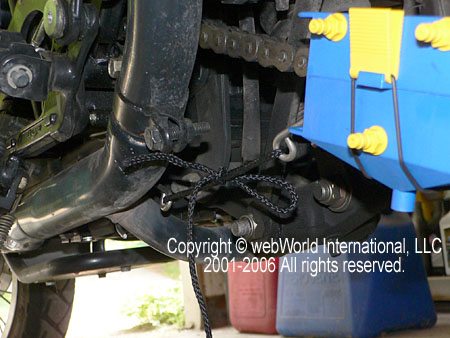
The next step is to clamp the box over the chain. A large O-ring is provided (along with a spare), which wraps around the bottom of the box and holds it tight.
The yellow square object in the photo above is wedged behind a blue plastic tab, which holds the box tightly around the chain.
The yellow nipples are used to introduce the chain cleaner into the box. But first, the box must be secured to the bike.
Securing the Kettenmax Chain Cleaner box on the chain.This is done by using the two provided hooks and nylon rope. The box has a tab attached on either side of the upper and lower sections and each tab has three holes to locate the hook.
The idea is to locate the hook as central to the chain as possible to avoid skewing the box as the chain is rotated.
By the way, the photo above shows the chain before cleaning. It looks much cleaner in this photo than it was; the brownish-green discoloration does indicate some of the dirty grunge on the sideplates.
Tying the Kettenmax to the motorcycle frame.The other (larger) hook must be located somewhere on the motorcycle, towards the front.
We were able to located it on the Tiger’s exhaust crossover underneath the engine.
Finally, the nylon cord is used to tie the two hooks together. I used a slip knot, which makes it easy to untie the cord when finished.
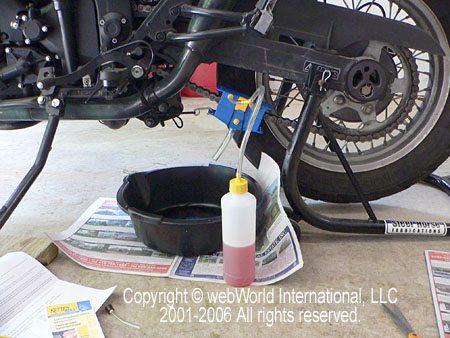
Once the box is properly located on the chain and secured to the bike, the clear hoses that are provided can be installed on the nipples.
The shorter, larger tube goes on the underside and is supposed to direct the fluid out the bottom and in to a catch basin.
The directions say that one or more of the holes can be used to clean the chain in any combination, depending upon how dirty the chain is. A “Y” connector is also provided; we opted to use it to introduce the cleaner into the box through the top two nipples.
The pink-colored fluid shown in these photos is the Moose “Sludge Away” Chain Cleaner fluid, which seems to work well in the Kettenmax bottle.

Does It Work?
We have also used the Kettenmax Chain Cleaner with kerosene as the cleaning fluid, which works well and is a better method of applying the kerosene than anything else we’ve found.
Our alternative has been using a rag dipped in kerosene, which is both messy and dangerous.
By the way, remember that rubber gloves are recommended when using any of these types of cleaning solutions or petroleum based products.
One of the three photos that come with the Kettenmax by way of instructions show the user spraying chain cleaning fluid into the bottle from a spray can. We tried this but it seems wasteful and it’s also messy.
A six or eight ounce can of spray is expensive and not really designed to be emptied out of the spray can and into a vessel.
Once the box is attached, the actual cleaning process is simple; hold the bottle containing the cleaning fluid above the Kettenmax box and rotate the rear wheel. After about 5-6 runs through the box, the chain looks pretty clean.
As I mentioned above, it takes much longer to get everything set up than it does to actually clean the chain.
After using the Kettenmax several times on different bikes, we’ve found that the dirty cleaning solution doesn’t always exit the box via the bottom hose.
A lot of it stays on the chain as it’s rotated and also spills out the back of the box, depending upon the rearward tilt of the chain and tire.
So it’s important to place newspapers or something around and under the entire chain to prevent a mess.
Here’s a photo of the chain shown above after running it through the Kettenmax. It looks nice and clean from a distance, and it is, in fact, cleaner looking than we’ve been able to get it with any manual cleaning method.
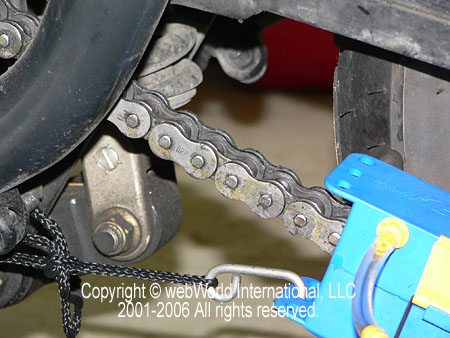
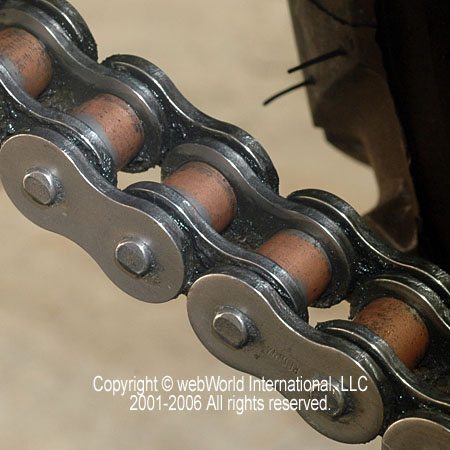
The chain after using the Kettenmax system.However, on closer inspection, here’s the same chain, photographed with a Nikon 60mm macro lens:
As you can see, there’s still lots of grit between the inner side plates and the back side of the outer side plates.
This is probably one of the most important areas to get cleaned to help prevent wear and to minimize the amount of grit that can get on to or past the O-rings.
I’m not sure how to get this area cleaned properly; the Grunge Brush doesn’t work on this area either. Perhaps removing the chain and soaking it in kerosene might help, but that would be way too much work to do every 200 miles or so.
I wonder how much of this grit is caused by dirt sticking to the chain lube?
After running the chain through the Kettenmax device, we wipe the chain clean with paper towels and then let it dry before lubricating it.
Conclusion
We have mixed feelings about the Kettenmax Chain Cleaner. It is easier to set up once the routine is learned. It does seem to do a good visual job of cleaning the chain, and the chain does look cleaner than it does after using any other method we’ve found so far.
Whether or not this will translate into longer chain life is anyone’s guess.
Owner Comments and Feedback
See details on submitting comments.
From KettenMax USA: “I just stumbled across your review of the KettenMax Classic, and just wanted to comment on a few things. I am glad that you gave KettenMax a shot, but I would really love for you to try the Premium Version of it.
KettenMax Premium comes with four different brush sizes to accommodate different chains, an improved brush system, a bag that catches the excess cleaner and lubricant (instead of just the hose) and a few other tweaks I think you would approve of.
Also, I see that someone else commented on KettenMax being in the US now, which is true. You can order through KettenMaxUSA.net”
From “M.M.”: “I have tried both the Kettenmax Classic (the product you tested) and the Kettenmax Premium. I feel the Classic does a good job if you have one bike and trim the brushes properly.
I also found the more frequent I used it (I cleaned my chain about every 500 miles), the better it cleaned the chain each time.
I purchased the Kettenmax Premium when I got my new bike. Since my wife and son also ride, we now have 4 motorcycles. 2 Harley Davidsons, 1 Kawasaki street bike and 1 Yamaha dirt bike.
The Premium kit comes with 4 different size brushes (no trimming brushes), of which are color coded to match up with the colored measuring guides. I found the process to be very simple.
Your web site said that if there was a better way to clean your chain, please let you know. I bought the Kettenmax Premium Kit.
Please try the Kettenmax premium kit. I think you will be impressed. The Premium Kit was $69.95 + $5.95 shipping.”