
The Shark Evoline is a new helmet design that picks up where the ROOF Boxer (review) left off.
It’s more functional than a simple flip-up helmet because it is dual homologated as both a full-face and “Jet” style helmet.
This means that it’s legal to wear the Evoline with the chin bar rotated all the way back.
This is unlike most/all flip-up helmets, which are not designed to be worn (and are not safe) with the rotating visor in the raised position.
Lots of moving parts here though and the weight is substantial, but this is a ground-breaking new design.
Probably one of the most anticipated helmets of 2008, the Shark Evoline has finally arrived.
And the good news is that it has passed both ECE and DOT testing schemes, so this is one exotic flip-up helmet that will be sold in North America and Europe.
In fact, it’s currently going through the distribution process in the U.S. and should be on dealer shelves very soon.
The Evoline was just released in Europe — after many retailers were taking orders for months, knowing full well that they couldn’t deliver. But that’s another story…
So what is it? Probably not as radical as some would hope actually. Some motorcyclists may not know that the rotating chin bar concept was pioneered by the still-radical-looking ROOF Boxer, ahelmet we reviewed back about 5 years ago.
The Shark Evoline (is it “Evo-line”, or “Evo-leen”?) takes it one step further, with a slick but complex system to rotate the chin bar all the way back, where it stays out of the way, nice and snug and nearly flush with the helmet shell.
The design of the Evoline allows it to be worn this way while riding, unlike all of the “normal” flip-up helmets I’m familiar with, which are not designed to be worn with the rotating visor in the raised position, although many riders do indeed wear them that way — a dangerous proposition.
Now why a motorcycle rider would want or need a motorcycle helmet with the functionality of the Evoline is a question we can’t answer — we’ll leave that up to you to decide.
Suffice it to say that there must be a defined need, or we doubt very much that Shark would have spent so much time, money and energy into designing the Evoline
Not to mention the cost involved in getting it to a point where it passed both the ECE and DOT testing regimens, finding a distributor, getting it into the distribution process, parts and accessories and all the rest.
So let’s take a look and see what this interesting new helmet is all about!
Paint, Graphics and Overall Quality
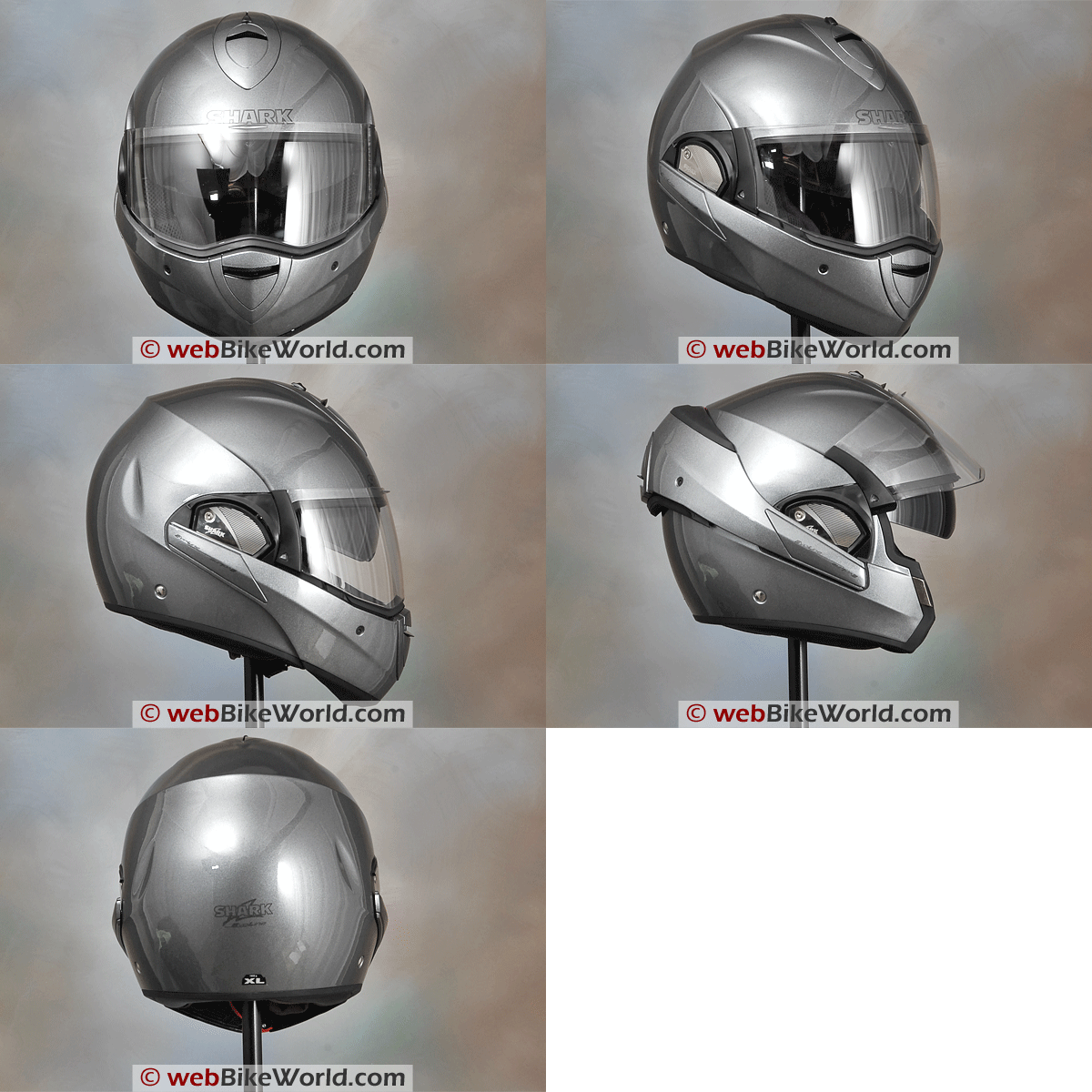
The Shark Evoline shown here was purchased in Europe, thus it is ECE 22.05 approved only and was sourced using the European color palette, which is rather subdued.
This one is the gloss silver color, which is actually more like a graphite.
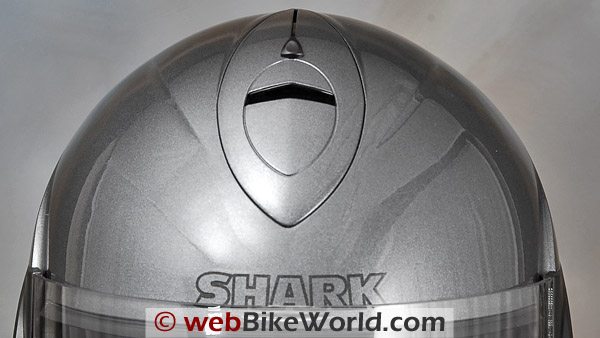
The metalflake paint is nicely applied on the polycarbonate Lexan shell, with no obvious flaws. There’s not much you can say about gloss silver or graphite; it is what it is.
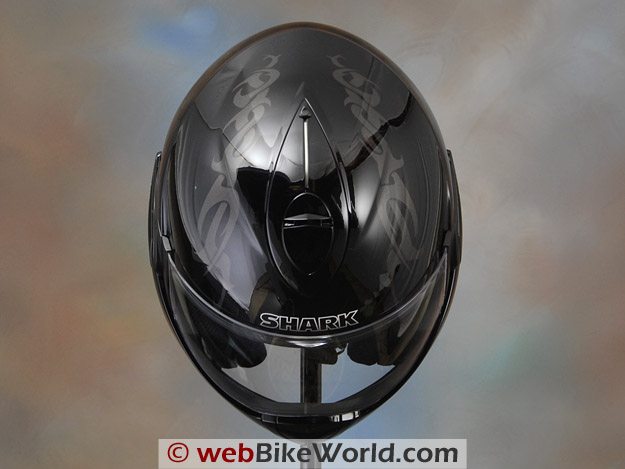
It’s unclear at this point whether the Evoline helmets sold in North America will have a different color palette or will be offered with a variety of graphic designs.
But for the most part, flip-up helmets seem to have relatively boring colors compared to their full-face counterparts. Perhaps flip-up owners are a conservative breed?
But overall, the finish is about as good as it gets. The finish does “feel” thick and the clearcoat also seems thick and protective.
This helmet was apparently one of the first off the assembly line, and there are some quality issues here and there that we hope are resolved by time the distribution channels are filled.
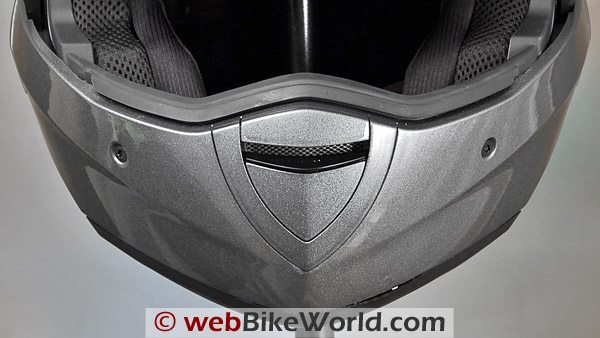
The gasket around the bottom of the helmet has a few gaps and some glue is showing; the metal latches on the helmet shell are pitted and look unpolished.
There’s a bit of polish residue or wet sanding residue here and there; you can see in some of the photos that the screw heads and other metal bits are showing (a design, not a quality issue).
Also, the Phillips head screws that hold the eccentric cam on the sides that rotate the visor are crooked.
This is a complex helmet, with more moving parts than many other “normal” flip-ups, and obviously more than a typical full-face helmet. All the parts add up to a bit of a creaky feeling — the helmet isn’t as solid as we’d like to see…but what flip-up is?
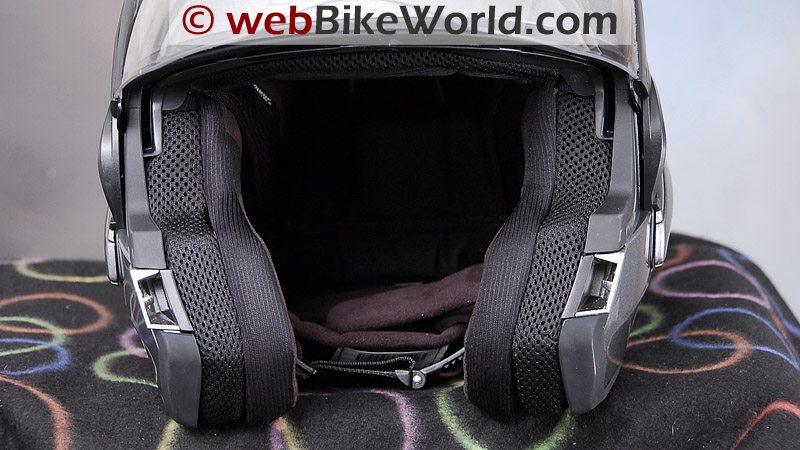
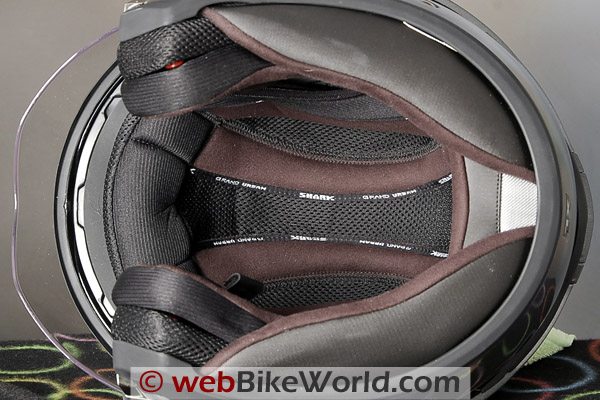
The liner looks more expensive and plush than what is usually found in flip-up helmets, and it’s relatively comfortable, although not as comfy as the ultra-plush liner in the Shark RSX, for example.
The vents click open and shut with authority, but the clear visor feels flimsy and has some distortion at the top and bottom, which is surprising for Shark and probably due to the completely different visor design.
Score: Overall, I’ll give the Shark Evoline a “Very Good” rating for the paint and the finish, with a “Good” for the rest. See the ratings scale in the summary table at the bottom of this page.
Helmet Internal Shape and Fit
The Shark Evoline has what we’d call a neutral internal shape that’s neither too oval nor too round, but probably just the thing to fit the majority of head shapes.
It seems rounder up top than the Shark RSX (review), and definitely rounder inside than the Shark RSI (review) or Shark S 650 (review), if that helps.
Shark doesn’t have a round internal shaped helmet in their lineup as far as we can tell, and we’ve reviewed just about all of them. But the Evoline is more of a one-shape-fits-all than any of the other Shark helmets, which tend towards the long oval.
It’s also a bit rounder inside than the recently reviewed Nolan N103 (review), and almost — but not quite — as round as the Shoei RF-1000 (review). So perhaps those few examples will help you understand how it fits?
It’s interesting to note that many flip-up owners buy that helmet type because they feel that the design works better with eyeglasses.
That may be, although we’ve found that some wire frame and other type of eyeglasses will fit in just about any full-face helmet, and Rick says his pair of cut-down eyeglasses fit in every full-face helmet he’s tried.
The reality is that buying a flip-up helmet doesn’t necessarily mean you’ll have no more problems with eyeglasses; indeed, some some flip-ups are actually harder to wear with eyeglasses than some full-face helmets.
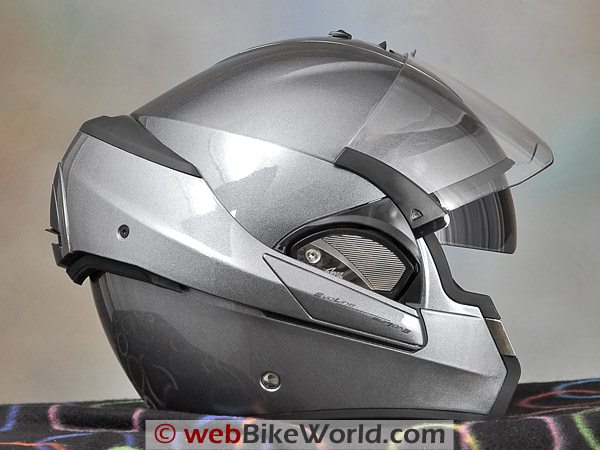
The Evoline is an example; the helmet shell is curved down towards the bottom, where it fits over the cheeks; this can be seen the photos of the helmet with the visor rotated back.
“Although the Evoline’s visor can be rotated back (or up) to get the Evoline over my head and eyeglasses, it isn’t easy and the sharply tapered sides pull my glasses down.”
“So I have to end up taking my eyeglasses off anyway, put on the helmet, then fit the temples of the eyeglasses in and around my ears. It isn’t that easy to do for me, and it may not be for others also, so take note”, says Burn.
The Evoline is the heaviest helmet we’ve ever reviewed at a massive 1960 grams in size XL; more on that in a minute, but I’m mentioning it here because the helmet does seem to at least balance rather well when the visor is in the downward position.
Rotate the visor back and the helmet does become top heavy and feels like the center of gravity has shifted also towards the back, which is probably to be expected.
The size XL also fits as expected for an XL; we’d say this one should fit heads with a 61-62 cm circumference, so we’ll have to assume that other sizes will also run true.
There’s plenty of room behind the chin bar when it’s rotated down; more than most flip-ups and, I’d say, even more than most full-face helmets. And by the way, the helmet feels and seems just like a “normal” flip-up or full-face when the visor is in that position.
See the wBW Motorcycle Helmet FAQ for more information on choosing and fitting a motorcycle helmet and for a discussion regarding human head shapes. And don’t forget that choosing the correct helmet shape is crucial for both comfort and safety!
Score: The Shark Evoline gets a “Very Good” for comfort and fit and its sizing, which runs true.
Helmet Liner and Padding
The liner material used in the Evoline is somewhat different than the other Shark helmets we’ve sampled.
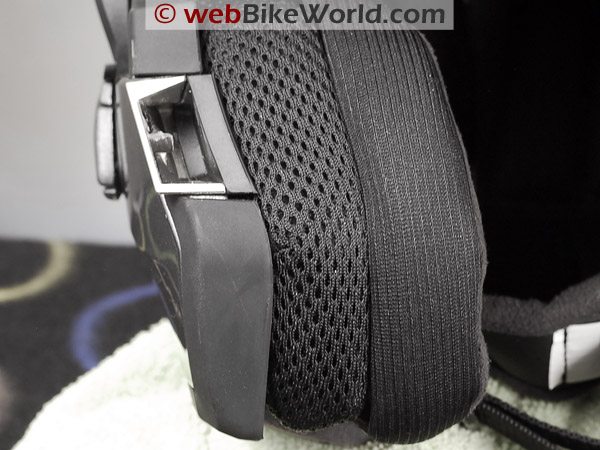
The liner looks high quality and it’s put together rather well, although there are some gaps where the liner snaps into the helmet shell around the cheeks, as you can see in the photos.
The lining material is a combination of smooth as silk with some sections that feel like Alcantara suede. Shark says it’s Coomax, but it doesn’t feel like any Coolmax we’ve ever seen. Unfortunately, it doesn’t seem to have a strong moisture wicking ability.
“The weather has been hot and humid here recently, and my head seems to get more sweaty inside the Evoline than other helmets”, according to Bill’s notes. “The vents don’t do much to help the cause either…”. More on that in a minute.
The padding is relatively thick and it’s comfortable, so no complaints there; it’s probably about as good as we’ve seen in a flip-up helmet.
The liner is fully removable and washable. It snaps in via the same type of plastic male/female button snaps that Shark uses in other helmets in their lineup.
Shark also says the Evoline helmet liner is “adjustable”, but we’re not sure if that means they will offer different sized cheek pads or not.
The neck padding (aka neck roll) around the bottom of the helmet fits well, and the chin strap has adequate padding.
Score: The Shark Evoline gets an “Excellent” for liner comfort and padding.
Ventilation
The rotating visor of the Shark Evoline has apparently prevented the designers from adding a lot of vents in the helmet.
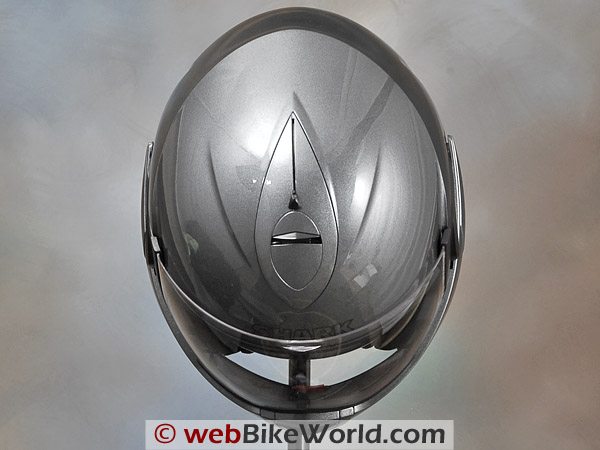
There’s a minimal top vent that clicks open and closed, but the air must first hit the lip of the vent switch, then work its way down into the helmet through two very tiny holes that are about 5 mm in diameter.
The top of the liner has three mesh panels, and the EPS foam shell is grooved, which is a Shark trademark but also theoretically helps the air to be directed on to the rider’s head.
But the amount of air flowing in through the tiny top vent holes and the absence of any exhaust vents on the Evoline conspire to minimize the amount of air flowing in through the top vent.
The chin vent operates similar to other Shark helmets; pushing it down allows air to flow directly through the chin bar through a couple of narrow slits.
The chin bar is vertically wide (probably to meet SHARP tests?) and a lot of air comes up from underneath, which is where most of the venting in the Evoline takes place.
Some of the air that flows in when riding is also caught at the back of the chin bar when it’s in the down position, and it hits the cheek pads and causes some noise.
There’s enough air coming in from up underneath the chin bar that it makes it hard to tell whether the chin vent does anything or not. It doesn’t seem to make a difference whether the vent is open or closed, and the air flows up on to the rider’s eyes and face.
This isn’t bad when the weather is hot like it is now, but not sure about the winter.
So the bottom line here is that the top venting is minimal and most of the ventilation is felt on the rider’s face only. How this will work out when the weather turns cold is questionable — our feeling is that there may be too much air coming in from up under the chin bar.
Of course, when the visor is rotated backwards, there’s plenty of air coming in from under the clear visor, which covers about down to my upper lip.
Riding with an open-face helmet isn’t something we do very often, and it will remind you that there are a lot of bugs are out there!
How do those cruiser guys with the shorty helmets do it, anyway?
Score: The Shark Evoline gets a “Poor” for venting and air flow, most of which comes from up underneath the chin bar.
Noise Levels
The disadvantage of most flip-up helmets is weight, complexity and noise. As a rule, the average flip-up helmet is louder (transmits more noise) than the average full-face helmet, although, of course, there are always exceptions to the rule.
The Evoline is louder than most flip-ups, mostly due to the unique design and construction.
As mentioned above, a volume of air comes in under the chin bar and some of it blows against the joint where the rotating chin bar meets the cheek pads. A hand placed there helps make it quieter.
There is also a relatively large gap between the helmet shell and the rotating chin bar; in fact, you can look up from the bottom of the helmet and see through the top.
This may not seem like much, but it’s gaps like these that catch the air and cause turbulence, which, in turn, can cause noise levels to increase.
But with the visor in the lowered position, the average overall noise volume of the Evoline is greater than the average flip-up, in our opinion. Considering that the helmet will probably be used by many touring riders, this may or may not be an issue.
When riding behind a big, tall fairing that blocks the air from hitting directly on the front of the helmet, it may be fine.
The irony here is that when the visor is rotated backwards (up), the Evoline is much quieter! Other than the wind rushing noise typical of an open-face helmet, the noise levels can decrease to almost half when riding without a windscreen.
For more information on helmet noise, visit the wBW Motorcycle Helmet Noise page.
Also, note that we always wear high-quality, correctly fitted ear plugs when riding — see the wBWEarplugs and Hearing Protection page for more information on choosing and wearing earplugs.
If you don’t wear ear plugs, all bets are off — every motorcycle helmet is dangerously noisy, in our opinion, and your hearing is as precious as your eyesight, so don’t mess with it. Wear ear plugs.
Score: The Shark Evoline gets a “Good” rating for noise levels, which takes into consideration the unique design.
Face Shield and Visor
The clear face shield on the Evoline is a completely different design than used on other Shark helmets, and we do think it feels slightly flimsy. It measures 2.3 mm, so it’s not the thick 3 mm type used on other Shark racing helmets.
The face shield on ours has some waviness at the top and bottom, which is surprising. It rotates on a spring-loaded mechanism that allows a small initial opening for defogging, then one other position to hold the visor open.
That’s it: not other detents on this one.
The defogging position is very hard to achieve on this example, and again, we hope this is due only to the early production models. The visor raising tab is at the top, not the bottom of the visor, which is very strange and it takes some time to become accustomed to this location.
We think this makes it even harder to get the visor to lift to its first initial defogging position.
You sort of have to brace your hand on the helmet and slowly try to pull up on the tab to crack the visor — way too much effort and concentration while riding, not to mention the time with the hands off the bars and fussing around up top.
Note that the clear face shield must be raised to rotate the chin bar back and especially when rotating the chin bar back down. We do not advise messing with this whilst riding!
If the clear visor is not first placed in the raised position, the chin bar will not lock in place when pushed back down. Actually, it’s rather surprising that Shark didn’t design some type of lockout to make sure this doesn’t happen.
Shark claims the visor has a “hermetic watertight edging”, but the sides of the visor are completely without gaskets, the clear visor doesn’t snap shut and doesn’t seal tightly and there are some gaps in the gasket along the bottom edge.
We haven’t worn it in the rain, but it’s obvious that water will come right down into the visor on either side.
The visor and the eye port provide good visibility in both the vertical and horizontal planes. Wearing the Evoline, you’d never know it had a “secret”; it feels and seems pretty much like any other full-face or flip-up helmet.
Score: The Shark Evoline gets a “Poor” rating for the design of the clear visor.
Rotating Chin Bar
The main feature of the Shark Evoline is, of course, the chin bar that can be rotated all the way back, converting the helmet from a virtual full-face to an open-face design.
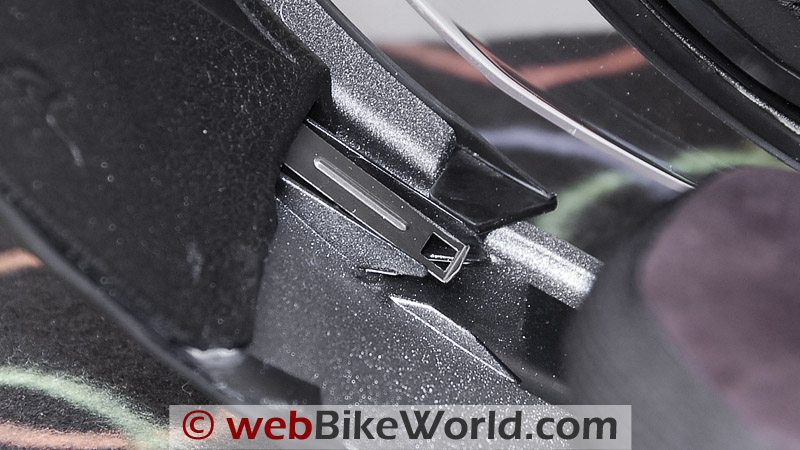
The rotating chin bar locks into place in the down position with stainless steel (claimed) metal latches inside the chin bar and corresponding stainless steel (claimed) metal latches located on the helmet shell, at the tips of the cheek area.
A single lever is located under the center portion of the chin bar releases the chin bar; this is similar to most flip-up helmets. As mentioned above, the clear visor must first be fully raised before the chin bar can rotate.
Once the chin bar is rotated back, it snaps into place with small plastic tabs on either side. It’s not fully locked in this position; it just takes a good tug to pop it out from behind the tabs to move it forward.
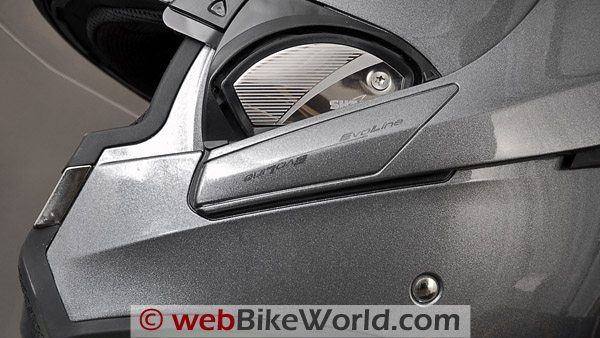
It all works about as easily as other flip-up helmets, but the chin bar rotates on an eccentric cam mechanism located on either side of the helmet (see photos).
The release button on the helmet shown here is slightly loose and the chin bar does have a slight amount of play when it’s closed. It sometimes takes a couple of strong whacks to get it to close and lock, but otherwise, it all works smoothly.
The button sometimes needs to be nudged to spring back into place, or the visor won’t lock, which is worrisome and possibly a sign that the locking mechanism may give problems later on.
Internal Sun Visor
The Evoline has an internal sun visor that operates with a slider switch on the top of the helmet, behind the top vent. It can be opened to any position.
When the internal sun visor is rotated all the way down, it’s just below the line of sight in the center, but it is cut up towards the sides, and those sections can remain in the rider’s line of sight when looking both ways.

Apparently, the ECE rules call for no less than 50% light transmission, which leaves the sun visor on the Evoline and the Nolan N103 reviewed recently with not enough tint. They do block the sunlight, but it would be nice if they were another 20-30% darker.
We’ve complained about these sun visors before; we’re not really big fans, because they add complexity and weight to a helmet.
Unless they are very dark; rotate all the way down to go out of the rider’s line of sight; have perfect optical qualities and are lightweight, they’re not very useful.
The optical quality of the sun visor on this helmet isn’t as good as it could or should be.
Score: The Shark Evoline gets a “Good” for the operation of the internal sun shade.
Helmet Weight
We won’t belabor the point here, but this size XL Shark Evoline is the heaviest motorcycle helmet we’ve ever reviewed at 1960 grams, nearly 2 kilos or 4 lbs., 5-1/8 oz. Fortunately, it balances fairly well when the visor is in the down position.
Motorcycle helmets can be looked at as having five dimensions: they should protect the rider; they should meet all applicable safety standards; they should be light in weight; quiet; comfortable and fit correctly.
If any one of these dimensions is out of sorts, the helmet may not be optimal for the rider.
It’s interesting to note that Shark used a polycarbonate, Lexan, for the helmet shell, rather than one of the high-tech materials like carbon fiber or fiberglass composite.
Using other materials may have saved weight, but probably would have added to the already expensive helmet design.
See the wBW Motorcycle Helmet Weights page for the complete chart, comparing the weights of every helmet we’ve reviewed.
Score: The Evoline gets a “Poor” for extreme weight.
Miscellaneous
The Evoline uses the standard European “quick release” buckle. It has a serrated tab that fits into the buckle mechanism like a ratchet, and it releases quickly.
The strap length must be adjusted the first time it’s used, but the serrations insure a small range of micro-adjustment when the buckle is secured.
We’re not in favor of these complicated systems, but the good news is that the North American versions will apparently get the tried-and-true double D-ring.
This Evoline meets ECE 22.05 safety standards; obviously the helmets sold in the U.S.A. will meet DOT standards. Shark provides a 5-year warranty with the helmet.
Conclusion
The Shark Evoline is an interesting new helmet design that may be welcomed by some motorcycle riders. But in the end, we’re not sure the complexity and weight is worth it — the helmet doesn’t seem to have an overwhelming advantage.
We don’t recall ever wanting to convert a flip-up helmet to an open-face version, but we’ll leave that up to the touring riders.
Also, although the Evoline has decent sized ear pockets, installing an intercom system with speakers and a microphone may be problematic, and this issue will affect touring riders most, and they are presumably the target market for the helmet.
But overall, you have to give Shark a lot of credit for moving this design forward!
| wBW Review: Shark Evoline Helmet (ECE) Version 1 | |
|---|---|
| Manufacturer: Shark Helmets | List Price (2008): £249.99 |
| Colors: Solids and graphics. | Made In: Unknown |
| Sizes: XS-XL Shell Sizes: Unknown | |
| Review Date: August 2008 | |
|
Rating Scale is subjective: Unacceptable, Poor, Neutral, Very Good, Excellent, Outstanding.
|
|
Owner Comments and Feedback
See details on submitting comments.
From “J.D.” (August 2009): “I think I was Australia’s first purchaser and wearer of this new helmet. It had to be ordered for me, as is often the case in this remote city of Perth, from the allegedly wise men of the east (local Oz joke).
After a week it arrived at the retailer and I parted with nearly $900 Oz! It replaced my Caberg Justissimo (review) at age nearly five.
After some two months I offer the following comment. It looks good, it is larger than the Justissimo and whilst quieter does attract more air buffeting but the balance of the rear retractable chin bar makes it a far superior riding experience.
Getting used to the locking mechanism takes about ten days, but once used to it, it does become a natural habit and is secure.
I enjoy the chin bar free (jet?) configuration around the city with good airflow (of course) at low speed, and out on the open road with the bar down the air flow through the vents I find to be perhaps the best I have experienced of any helmet.
I agree with some comments about the visor but I’ll wait for summer before In condemn. However, the totality of the package makes this the quality of helmet that any replacement must compete with. As a modular, it takes some beating.”
From “K.W.” (April 2009): “Having ridden to Daytona ’09 with my Shoei Multitec I finally had had enough. The Multi suffered from poor aero in my opinion causing it to push back into my face/head with more buffeting than necessary.
That caused the already tight chin bar to push, into my chin. It was a tiring helmet to wear without a windshield on my Rune. I ask the doorman at the hotel to throw it away.
Now the Shark Evo has arrived and I went for a 100 mile test ride.
The Evo does feel lighter than it weighs and suffers none of the poor aero that quite frankly a lot of lids do. I’ll admit that out of the box it took a little coaxing to get the chin bar to unlocked and up but that was the only time.
Raising the outer visor is necessary to go from open to full face otherwise it will stop the chin bar from locking.
Overall noise is slightly high and I accidently found that if I raised my arms causing my jacket to seal around my neck/helmet their was virtually no noise. I don’t recommend raising your arms at highway speeds.
The ability to go from full face to 3/4 without an imbalance in weight on your head, transferred to your neck, is priceless. Either open or closed it still looks nice. That’s my story and I’m stickin’ to it.”
From “D” (September 2008): “I’d agree completely with the review of this helmet, and add a few comments as an owner of 6 months.
BAD STUFF:
1. The anti-misting coating on the visor is pants, but I’m “Mr. Heavy Breather” and its never worked on any helmet I’ve ever had. Buy a fog city.
2. The hermetic rain seal on the visor is pants, it runs down the inside just like any other helmet I’ve had, but this shouldn’t happen on an expensive model like this. they should’ve tested in an English summer.
3. The internal sun visor doesn’t come down far enough and its a strange shape, the view ahead is tinted but the mirrors aren’t, an epileptics nightmare. also, its not tinted enough. My mate has a big scratch on his where some grit went up between it and the helmet.
4. The visor tab, top vent, and sun visor tab (when down) are all very close together and virtually impossible to use with gloves on, so its a good thing that the top vent doesn’t work much anyway.
5. The chin bar mechanism works great in your hands, but if you have a big chin like me, your face pushes the sides of the helmet out a bit and the latch doesn’t click without a big two handed shove, obviously not too good while on the move!
6. The visor mechanism seems quite fragile and doesn’t give much confidence, and mine and a friends visors have both come off in our hands before! you must use the tab to raise/lower the visor and check frequently that the visor is mounted properly.
GOOD STUFF:
1. You get used to all the above.
2. The finish (mines matt black, mates is sort of bronzy metalflake) is lasting very well even though all the fiddly bits are on the top where they get bashed walking under the garage door.
3. It’s my 3rd flip-up and it compares with the others for noise and weight, maybe a few ounces in it but not noticeable.
4. The sanitized removable lining is a godsend, most of my helmets get replaced because they smell like a wet dog.
5. I didn’t like the strap at first but now im used to it its very fast, you have to count the clicks!
So am I happy? yes, there’s always a few niggles but on the whole I think its a good helmet. Bit expensive but its a new model, perhaps in another year it will be cheaper and they may sort out the major issues, mostly the visors.
You can only get the original visors too, nobody makes mirrored/irridium/coloured replacements yet. Hope this helps someone.