

One hundred and sixty bucks is the “sweet spot” of motorcycle helmet retail pricing.
Based on our observations of motorcycle helmet purchases, that price is very competitive and is near the maximum amount that many riders want to pay for a new helmet.
That’s not a problem – after all, everyone likes to get a deal. Hopefully, there’s also a cost/benefit analysis that takes place prior to the actual purchase that addresses the safety issue.
Other factors which are an important consideration are comfort, noise, air flow and ease of use.
Finding the “right” motorcycle helmet isn’t as easy as it should be, because there are so many variables to be considered, and too much of it is a guessing game. Who really knows which helmet will protect better in a crash?
Does a $160 and a $500 helmet that are both DOT and Snell certified offer equivalent levels of protection?
Will the helmet still feel comfortable an hour down the road? It’s just about impossible to conduct any type of useful scientific analysis comparing all of these factors.
Fortunately, there are at least many different brands and models to choose from.
The market for motorcycle helmets has become ultra-competitive, with each manufacturer trying to win the game by offering more features for less money. This benefits all of us, because the competition means that quality goes up and prices go down.
Believe me, it wasn’t always like this. There was a time not all that long ago when the choices for any type of motorcycle gear were very limited and most of it was junk, at least compared to today’s high quality equipment. Good thing we didn’t know it at the time…
But that was then, and this is now.
The Scorpion EXO-700 is a good example of the benefits of economic competition. Your hundred-and-sixty bucks buys a nice looking, Snell certified helmet with a removable moisture-wicking liner, anti-fog treated visor and lots of air flow.
Combine this with surprisingly good comfort and you have a winner.
It’s not the cheapest Snell approved helmet out there (see the wBW review of the M2R motorcycle helmet), but believe me, you don’t want the cheapest Snell approved helmet anyway!
All of us at webBikeWorld get the warm and fuzzies when we find a low-cost product with high-rent features. We’ve been using the Scorpion helmet for a while and it’s become a favorite.
It’s not the lightest motorcycle helmet we’ve tried by any means (see the wBW Motorcycle Helmet FAQ page for a comparison of helmet weights), but it’s not the heaviest, either.
The Scorpion EXO-700 is both DOT and Snell certified. For those looking for Snell certification, this is important.
It’s also important to note that you can’t always believe what you read – we’ve found several motorcycle helmets with claimed Snell certification that don’t show up on the official Snell list of certified helmets.
So be careful, and make sure you check that list first, otherwise maybe the price really is too good to be true.
Apparently, all of the Scorpion helmets are Snell certified and they’re all on the official Snell list of certified helmets, so kudos to Scorpion for going through all the effort.
I’m not sure if Scorpion is really a motorcycle helmet manufacturer or some type of distribution marketing organization.
Their 2004 ads with “Dr. Nikki Sloan” the computer-generated, over-endowed female, who is supposed to be the “Sports R & D Director” are, in my opinion, rather lame and an insult to women motorcycle riders.
Our EXO-700 is made in China, and apparently the entire Scorpion marketing approach has been developed in the U.S.A. to market helmets that are all subcontracted out. Scorpion, whoever you are, you don’t need the glam approach – let the helmets speak for themselves.
Scorpion EXO-700 Features
Let’s take a look at the Scorpion EXO-700’s feature list. The shell is a fiberglass and Kevlar composite, not polycarbonate.
These materials should offer a theoretically lower weight helmet, but the EXO-700 in size XL is slightly on the porky side at 1733 grams (3 lbs., 13 oz.).
It’s been said that motorcycle helmets designed to pass the Snell penetration test are heavier than their ECE 22.05 counterparts, so this may be part of the reason why the EXO-700 is heavy.
But the weight is distributed evenly, and the helmet doesn’t feel like it’s sitting way up on top of the head, which is a plus.
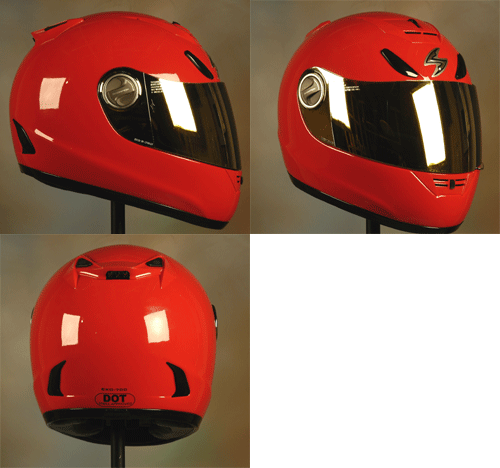
The EXO-700 has a contemporary shape, with the obligatory assorted vents and claimed aerodynamic wings that are supposedly designed to prevent lift.
We’ve been finding lately that these wings and protuberances usually cause more noise than anything else, and we hope that the trend will move towards designing quieter openings.
Almost any opening in a helmet’s shell will cause noise; the problem is that very few of them seem to offer any advantages when it comes to flowing air through the helmet.
This is one area that helmet manufacturers need to work on and avoid the temptation to glue on airfoils just for looks.
Scorpion EXO-700 Ventilation
The EXO-700 actually does flow a decent amount of air, but some of the vents suffer from the “blowing air over the Coke bottle” effect as the wind passes over them.
I’m not sure if Scorpion were trying to out-do the competition by adding more vents than anyone else, because there are certainly a lot of holes in this helmet, which affects the noise levels, as we shall see.
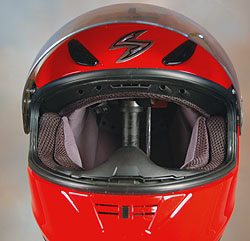
The front of the helmet has a simple chin vent with an up/down switch.
The air is directed into the chin bar and up on to the back of the visor, ahead of the removable but relatively ineffective breath guard.
A series of vent holes are located in the shell/liner interface at the top of the visor opening that allow the air to flow back over the rider’s head through the helmet liner.
Two slash-shaped openings are located on the helmet, above the visor.
These have sliding covers to control air flow. The slash shapes give the helmet a somewhat sinister look, because they appear to be frowning black eyebrows.
These covers slide back in 3 positions: closed, half open and fully open. Both the chin vent and these covers are fairly easy to locate and adjust when riding with gloved hands.
By the way, we think the Scorpion logo is pretty cool looking also. It’s kind of a three-dimensional “S” shape, but each end of the “S” looks like a Scorpion’s stinger.
There’s a vent located on the top front of the helmet that is incorporated into a nicely shaped air scoop assembly. This vent operates via a four-position switch that goes from closed to fully open.
It’s not possible for me to notice a difference in air flow when the is in the fully open or half-open position, but it does seem to let in a decent amount of air when it isn’t closed
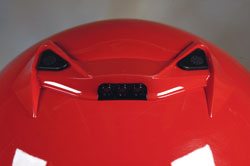
The rear of the helmet includes an airfoil assembly that’s not quite as nicely integrated as the one on the front, because it appears to be glued on to the helmet shell.
This assembly has two vents on either side, each with a sliding three-position cover.
An exhaust vent is located in the center of this assembly, and it has three round exhaust tips poking out.
If you peek underneath, you can see a hole drilled into the helmet shell, so these exhaust tips must be designed to create a negative pressure, helping to pull air through the helmet.
Scorpion EXO-700 Noise Levels
All these vents seem to work well, but the airfoils create turbulence that manifests itself as a high-frequency whistle. It’s not the noisiest helmet we’ve tried, but there are some whistling sounds that come from the vents.
I can place my hand in different areas on top of the helmet while I’m riding and stop the noises, which tells me that the Scorpion engineers should have spent more time in the wind tunnel.
Note that we always wear earplugs and an extra helmet liner when we ride – see the wBWEarplugs and Hearing Protection page for more information and a list of earplug reviews that we’ve posted on the site.
I’ll bet that the Scorpion helmet will be pretty noisy without properly inserted earplugs.
On a positive note, the EXO-700 seems to be less prone than other helmets to the more annoying, lower-frequency “booming” sounds that are usually generated by turbulence around the lower part of a helmet.
It’s interesting to note that these low-frequency sounds are almost completely absent with the EXO-700 when riding a “naked” bike in a relatively upright position.
But on a sportbike, with the head tilted forward, the booming sound in the Scorpion is noticeable.
This is the opposite of the effect found in most helmets, which usually create the lower-frequency noises when the helmet is upright. So sportbike owners and those behind windscreens should take note.
Scorpion EXO-700 Liner
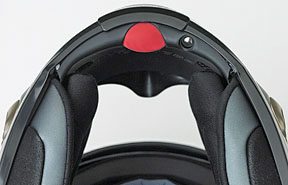
One of the best features of the EXO-700 is its liner.
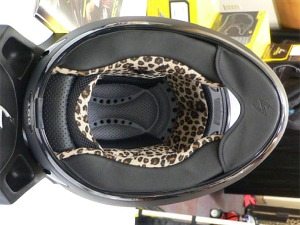
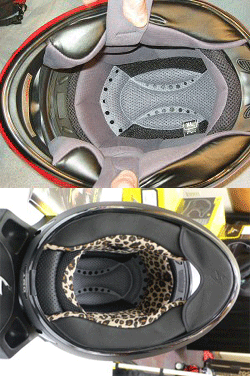
The liner and cheek pads are removable, and Scorpion offers some really cool pattern liners in leopard skin, zebra skin, jungle and desert camouflage, along with an “op art” checkered pattern.
They also have different colored vent sliders and visor twist grips (see below).
We ordered the leopard skin liner, thinking it would look outrageous with the bright red helmet.
But apparently the liners are on backorder; it’s been several weeks and we haven’t heard anything about a ship date.
Update: Finally got a photo of the leopard skin liner at the recent Dealer Expo (more photos from the Dealer Expo) and created the animated image above. The liner is faux, of course!
Our opinion is that the size XL Scorpion EXO-700 is shaped for a round head, which is fine by me (see the wBW Motorcycle Helmet FAQ page for more information on head shapes and fitting and purchasing motorcycle helmets).
Maybe it’s the water around here, but all of us here at webBikeWorld have round-shaped heads.
The EXO-700 is one of the few helmets that offers adequate room across the cheek and temple area, so my face doesn’t feel squished and I can actually close my mouth when wearing the helmet!
The liner does have some ridges that are felt on the top of the rider’s head. The ridges are designed to raise the top of the helmet off the rider’s scalp to allow the air to reach the scalp, and although it feels a bit strange at first, they quickly become unnoticeable.
The liner material seems to be of better quality than you’d expect in this price range, and it’s fairly comfortable. Can’t wait until the leopard skin replacement arrives though, and when it does, we’ll post a photo.
The Scorpion EXO-700 has a D-ring attachment (hurray!) and the extra piece of strap includes a button to keep it from blowing around in the breeze.
Face Shield and Accessories
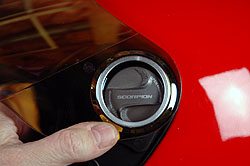
The EXO-700 uses a different method for attaching the face shield, and although it’s a bit fussy, it works well. To remove it, first lift it to its most upright position.
The dials on either side of the visor are then turned clockwise, and two internal spring-loaded tabs move out of position and allow the visor to be removed.
The procedure is reversed to install a new visor. It’s effective, but to be honest, I have my doubts as to the longevity of the mechanism, because it seems cranky and I can hear lots of plastic snapping noises when fitting the pieces together.
We purchased a gold-tinted visor with the helmet (which will look great with the leopard skin liner!) and it took more fumbling around then should be necessary to replace the clear original visor.
I wish the motorcycle helmet manufacturers would standardize on a simple and robust system for visor attachment and leave it at that. But in any case, the Scorpion system is easier to use than most, and hopefully it will last for the few visor changes that will be made on this helmet.
So far, opening the visor takes a bit more effort than we’d like.
We’re not sure if it will loosen up over time, but the stiffness of the lifting mechanism makes the visor twist quite a bit when it’s pushed up.
Also, we’d like to see the first notch open the visor about 5mm (1/4″) or so, which is just about wide enough to allow a small amount of air to flow in to cool the rider’s face or de-mist the back of the visor.
But the EXO-700’s mechanism opens the visor about 40mm (1-3/4″), which is too much, in our opinion. The visor has a total of 5 notches up to the highest position.
The Scorpion helmet visors are supposed to have anti-fog properties, but like most of the built-in anti-fog visor treatments we’ve tried, it doesn’t work very well.
There are a variety of anti-fog treatments that can be applied by owners; check the wBW Motorcycle Accessory Review index for more information.
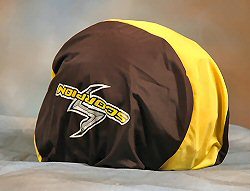
By the way, Scorpion includes a nice helmet bag with the purchase. I wonder why the Scorpion logo is upside-down though?
Conclusion
The Scorpion EXO-700 helmet isn’t the quietest helmet around, but it’s loaded with features, it has a comfortable liner, the build quality is above average, it flows lots of air and it’s both DOT and Snell approved.
When you add up all these factors and throw in the relatively low price of about $160.00, it’s hard to beat.
Of course, we’re partial to helmets that fit comfortably, and the round-head shape of the EXO-700 gives it extra points. We really like this helmet and it’s become a favorite for everyday use.
| wBW ProductReview: Scorpion EXO-700 Motorcycle Helmet | |
|---|---|
| Manufacturer: Scorpion USA | List Price (2004): $179.95-$199.95 |
| Colors: Solids and patterns. | Made In: China |
| Review Date: December 2004. | |
Owner Comments and Feedback
See details on submitting comments.
From “S.Z.” (04/11): “Funny, I don’t have any whistling noises on mine at all. And my bag doesn’t have an upside-down logo…LOL!
I ride a 2006 Honda Interceptor with a Givi touring windscreen and have a Sargent saddle (which raises me about a good inch or more than the stock seat).
Oh btw, I bought the EXO 700 Chameleon in black – sharp lid, flawless decal application with no ripples or bubbles. Very nice clear coat.
Vent controls are firm and easy to find and use. No looseness… Very nice. Just another affirmation of a solid build quality ethic.
I find it as stable as my Bell Star and a heck of a lot more quiet at highway speeds of 70-80mph+. I can actually hear my music on the highway playing in my cheapo Koss earbuds on my iTouch over the wind rush.
I can get it to whistle if I cock my head down and to the right or left to a precise angle that catches the vent holes, but it’s not a position I find myself using even for head checks or in a tuck, so in normal riding the whistling just does not exist.
Turbulence from the windshield hits me directly on the visor (I am 6’2″). All vents open, no whistling. the low booming at the collar is a lot less than the Bell Star’s. I attribute that to the snugness of the cheek pads and overall more snug fit on my entire head. It’s very comfortable and plush.
I bought a size large, It vents decent even at city speeds. The back of my neck sweats a bit, but not a deal breaker. I am in Florida and right now the heat and humidity are on the rise, so not ideal for commuting in the city during peak temperatures (over 85F).
But I bought it for the colder weather and for the highway for its quieter properties and I am not disappointed at all.
The trick I found to visor removal is this; Turn the ‘knob’ till you hear it click and then let it go. You can then grab the very back of the visor and pull it straight out with ease.
Lining it up is a bit trickier, especially with tints, but that’s all helmets, even my Bell Star, since you can’t see through the visor to line it up and it then becomes a task that requires you to ‘feel’ for the sweet spot where it clicks in place. No biggie.
One comment was that the visor leaked water. The Scorpion has a hefty gasket actually, so I suggest you loosen the base plates on both sides and move them back as far as they’ll go. This should provide a tight seal.
I had to do that on my Bell Star, so it’s kind of a factory thing. I don’t think they put them on super tight so they don’t compress the gaskets too tight against the visors while they’re in their boxes waiting to be sold.
If they sit in box a long time then the gasket would tend to start sticking to the visor in the box and would leave a mark on the visor when finally cracked open.
Gaskets are a petroleum or oil-based product and give off oils over time and dry out if left sedentary… yes rubber does degrade if left alone.
You shouldn’t do a carb rebuild with old gaskets, even if they’re still in the OEM bag… they do all show a manufacturing date, and there’s a reason ;-).
I also have to disagree about the anti-fog. That’s the first thing I tested on the helmet in the cool, clammy Florida mornings and it works great. Much better than any other visors I have ever had, and I’ve owned all brands at one time or another.
I blew on it and yeah, it fogged. then it cleared in a matter of seconds, even at a full stop with no venting and the chin curtain installed.
I plan to put my ZG tinted windshield (no double bubble, just the straight stock replacement) on to test the effects of noise with a lower shield in place. I can only imagine it to get more quiet with a calmer airstream.
The weird thing for me is that this helmet externally is wider left to right in a size large than my medium Bell Star is. I know this because it fits more tight into my stock hard cases, and I have to force it gently closed.
I love both helmets, and they were bought for specific uses. The Bell Star for summer riding in the city and commuting to my job. At lower speeds the noise of all that venting is not an issue (up to about 65mph).
The Scorpion EXO 700 for it’s warmth in colder riding temps and it’s quietness on the highway.
Now if Scorpion would just jump on the bandwagon, or drink the Kool-Aid and start offering the Transitions visor, they’d be damn hard to beat. I’ve contacted Scorpion and they are looking into it. Cross your fingers!”
From “J” (03/11): “I recently purchased one of Scorpion’s EXO-700 helmets and I’d like to provide some feedback. I bought the helmet after trying on several sizes and brands at the local BMW/EURO bike dealer.
The shop was having a sale on Scorpion helmets, and I got it off the shelf for $150 + tax.
I had been using a $75 off-brand (Fuel) modular helmet that was comfortable and quiet, but flimsy, heavy, and ugly. I wanted something with a smaller, lighter and sturdier shell.
The EXO-700 medium fits my narrow/neutral-shaped head pretty well. It’s snug, but not uncomfortable. If anything, I would prefer thicker padding around the very top of the head. The fabric is comfortable.
There’s a good bit of air coming at the lower half of my face with the visor down. It feels like it’s coming from the front vent, but it doesn’t seem to change when I close it.
The helmet weighs less than my modular off-brand, and about the same as a large HJC CL-14. This is just going by my neck-scale.
The finish is pretty good, except for some sharp edges around the mirror visor. The visor release mechanism is kind of finicky, but it just takes a bit of wiggling. I much prefer it to the CL-14s older mechanism.
Noise is a problem. On my Vulcan 750, there is noticeably more noise than the off-brand modular helmet, but it wasn’t more than I could tolerate without ear-plugs. On my SV650S, however, noise-levels were extreme!
The forward-leaning riding position causes a great amount of mid-high frequency wind noise across the top and sides of the helmet.
A big contributor, I think, is Scorpion’s rotating-dial visor-mounting system. The protruding knob/handle of the dial has sharp edges, and is not horizontal to the ground. If I cover one with a glove, a lot of noise goes away.
I may end up returning the helmet due to the amount of noise. The amount of noise while riding in a forward-leaning position is so much higher than any other full-face helmet I’ve worn, even my off-brand modular. There is nothing else about it that I dislike.”
From “G.R.” (03/11): “I have been riding with an EXO-700 for 3 years now. The cost and comfort are the only things that I like about it. I have a few critical issues with mine.
I ride with both the face shield that came with the helmet and an aftermarket tinted shield. The seals on the top edge on the shield that came with the helmet doesn’t seal properly.
Not only does it allow for a lot of air movement across my face and make the vents pointless, but it allows water to come in on the inside of the shield. On the aftermarket, it is worse.
I’ve also had a mirror finished shield which only lasted about 2 months. I cleaned it as recommended by the manufacturer. The paper work said to let a warm damp cloth rest on the shield to soften the bugs and then wipe the remainder off after they are soft enough.
When the mirror finish started deteriorating after only two months, I called Scorpion, sent them photos and they would not replace the shield. They also told me that I had not cleaned it properly, otherwise the finish would not have deteriorated.
The other critical item I have is that the vents and cladding started breaking last summer (second year of use). I am always careful with my helmet. I store it in the bag on a shelf when I am not using it, and I have never dropped the helmet.
I would rather buy a $600 helmet than have to buy a $160.00 helmet every year. It goes to show that you get what you pay for in a helmet.”
From “B.S.” (8/09): “I purchased a Scorpion EXO 700 Burst Red/Black and was very happy with fit. I settled on an Xlarge even though sizing chart recommended smaller. You review was right on about comfort.
I ride a Harley Ultra Classic and wanted this helmet for riding in the rain and cold weather. I ride year round. Unfortunately the helmet did not live up to its no fog Everclear claim.
I was riding south towards Washington DC in the rain and the visor immediately fogged up causing a very dangerous situation since the first notch does not allow for defogging and will allow rain to enter.
I had to ride with the visor up and ducked down behind the windshield. I was very happy with quality and other features and the rest of your review was right on.
The Everclear shield claim is false and I am going to try to return this helmet and try a 900 modular. I purchased this helmet to replace an overpriced older Harley full face helmet that is about 7 years old and has been dropped one to many times.”
From “C.H.” (5/09): “I bought a Scorpion EXO-700 helmet because I was impressed with the Scorpion XDR jacket I bought before. I had heard some rumors about ill-fitting shields and I was bummed out when I noticed a large gap between the shield and gasket.
I emailed Scorpion to get a replacement shield, but instead they gave me a helpful tip: The problem isn’t with the shield, but the adjustment of the shield mechanism. If you remove the shield and the “twistgrips,” you will see two Phillips screws.
Loosen them, and push the mechanisms down and toward the back of the helmet, so the shield will stretch tighter over the front. Tighten the screws and re-attach the parts. The seal is perfect now but it took a few tries.”
From “W.R.R.” (5/09): “I wanted to share my review of the Scorpion EXO 700 that I recently purchased. Much of my research was done on your site, and I was influenced greatly by your review.
I don’t know exactly when your review was first published, however, based on the current prices of $209 for the plain model and $219 for models with graphics, I assume it was not 2009.
Pros: I agree that the overall fit and finish of the helmet are very, very good for the money. The helmet definitely represents a good value. Scorpion has done an excellent job of getting dealers in my area to carry their products. The graphics are nice, and not over done.
The materials used in the interior are also of decent quality. The helmet fit me nicely (and I have round head) and the Fog Free feature is excellent.
Cons: I would not recommend this helmet to anyone traveling over 45 miles an hour. The wind noise generated by this helmet at highway speeds (55-70 mph) is unbearable. Ear plugs do lessen the noise somewhat, but the whistling is present regardless of whether or not the vents are open or closed.
Riders of “Naked” bikes or those using Fly Screens will find wind buffeting and wind noise to be excessive to the point of causing fatigue on extended rides.
Simply turning your head to lane check at highway speeds results in even greater levels of noise. I attribute much of this to the multiple vents on the tops, sides and back of the helmet, and possibly due to the Embossed logo placed on the forehead of the helmet.
In the end, the consumer will have to determine whether all of the extra venting is worth the trade off for wind noise and buffeting. If your shop allows it (and a good shop will), take the helmet for a brief test ride and draw your own conclusions.”
From “F.M.”: “First of all, thanks for your hard work providing riders with first-hand reviews on products.
Second, I purchased a Scorpion EXO-700 based on your all your helmet reviews as I wanted to try a full-face helmet after using the original HJC Sy-Max flip-front (also purchased based on your review) for years since I too wear glasses .
Yes, as you noted the helmet does have a chocolate or cocoa smell to it! Not overpowering but you do notice it.
Overall, your review is right on and there is one feature I discovered while reading about the EXO-700 on the Helmet Harbor web site, the cheek pads are not only removable but you can do your own custom fitting by trimming the foam padding.
The pads are built up with multiple layers of foam so you can carefully remove layers since the adhesive isn’t that strong. I’ve trimmed the top portion so there is some room for my full-temple glasses.
I wear those flexible titanium alloy frames that are difficult to insert into a full-face helmet, so I used to wear an older pair that had stiffer alloy temples. After trimming the cheek pads now there is enough room to slip the untrimmed flexy full-temples onto my ears.
Another trick is the tilt the helmet backward on your head, in other words pull up the chin bar, then slip in your glasses since there is a straight shot back to your ears. Once your glasses find your ears you can rotate the helmet downward.
Keep up the good work, riders really appreciate the real-world reviews!”
From “JBD”: “I bought a yellow EXO 700 Raider in Dec ’05, based on fit, looks, and definitely price. I find that ear plugs are a must. Its noisy on a faired or unfaired bike and the noise increases if you turn your head.
I feel that the vents work well in a wide range of temperatures. Above 50F I like them open.
The visor has fogged on me when it was in the low 40F’s and I found it would not remain clear with the visor shut. The visor is cumbersome to change but not too bad.
The helmet is all day comfortable. I have had the liner out once and it was fairly easy to reinstall and once in, it looked and fit as it did prior to removal.
Compared to an Arai Quantum II, the Aria is quieter and lighter, but I honestly don’t see a big difference since I prefer to wear ear plugs anyway and the price difference equals a track day or a good pair of boots.”
From “R.T.”: R.T. asked if the EXO-400 and EXO-700 was available in different shell sizes. Here’s the information he sent us from Scorpion: “Currently we offer only 2 shell sizes per style (EXO 400 and 700, VX-14 and 17).
All our extra-small to medium sizes come from one mold while the large to double extra large sizes come from another shell mold.
The internal white EPS (expanded polystyrene) liner is also the same size for the smaller and larger helmet ranges mentioned. It is the softer, upholstered “comfort liners” which are installed to actually “size up” or size down” within the shell range to get the perfect head size for you.”