

Icon has been around for only a few years, but they’ve had an extraordinary impact on the motorcycle industry.
Their edgy “street/stunt” styling pushed the envelope of motorcycle fashion, and everyone else has seemingly been playing catch-up.
You can see the influence of Icon’s trendsetting style by taking a look through our 2008 “What’s New” motorcycle helmet slide show.
We last reviewed an Icon helmet in our Icon Mainframe review of December of 2006.
The Mainframe was new at that time, and apparently Icon was still getting it together, because we had a few quality issues with the helmet.
But if the Airframe is any indication, those problems are gone; we’ve been very impressed by both the quality and the feature set in this helmet.
And it’s not all just good looks, either; the Airframe meets both DOT and Snell safety standards with a high-tech fiberglass, carbon fiber and Dyneema composite shell.
It isn’t the lightest helmet around, but it’s competitive and the shell feels great — if that can be said about a motorcycle helmet shell.
Icon is also right out there at the leading edge of color and graphic design trends.
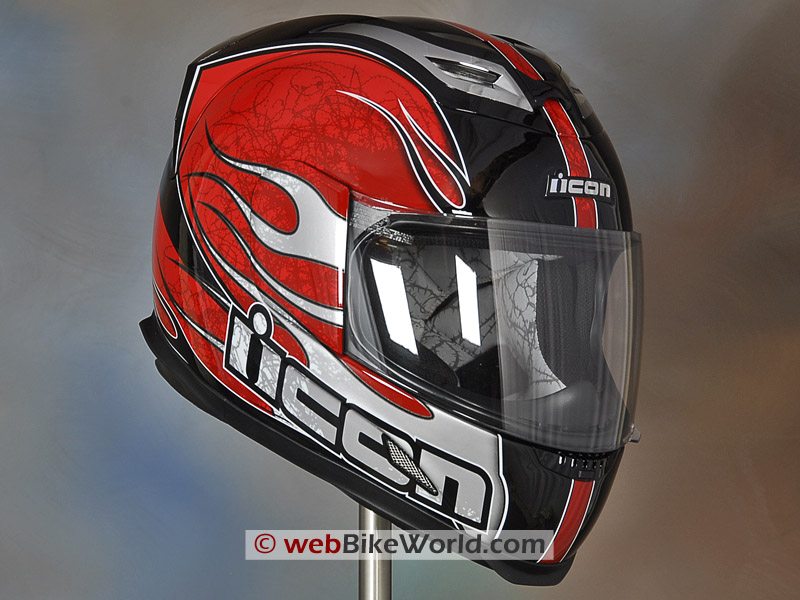
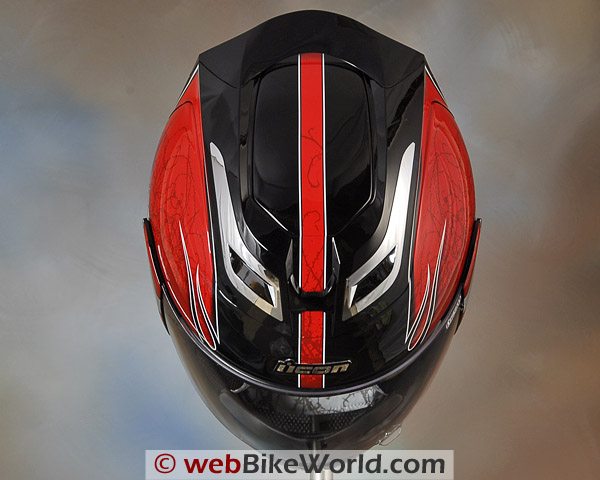
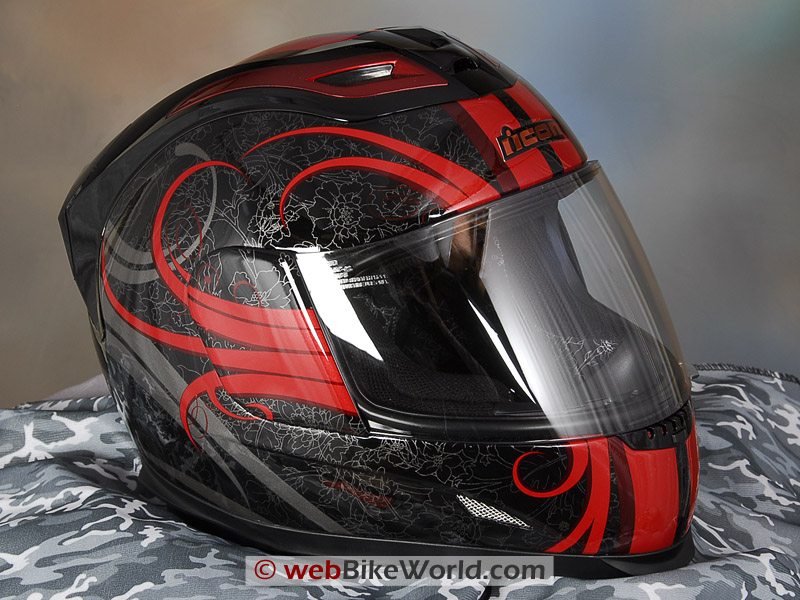
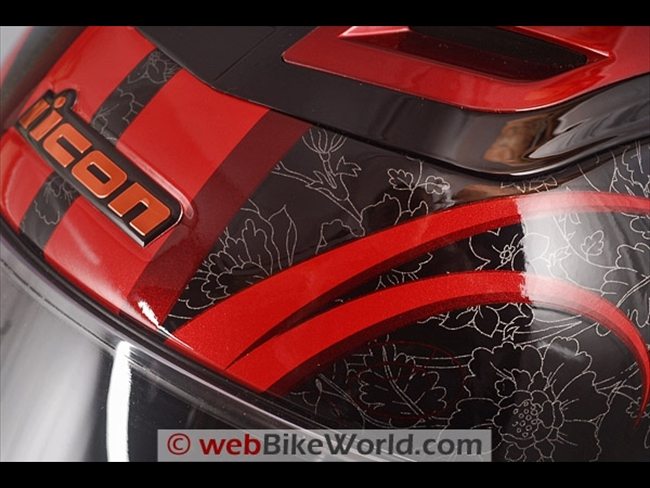
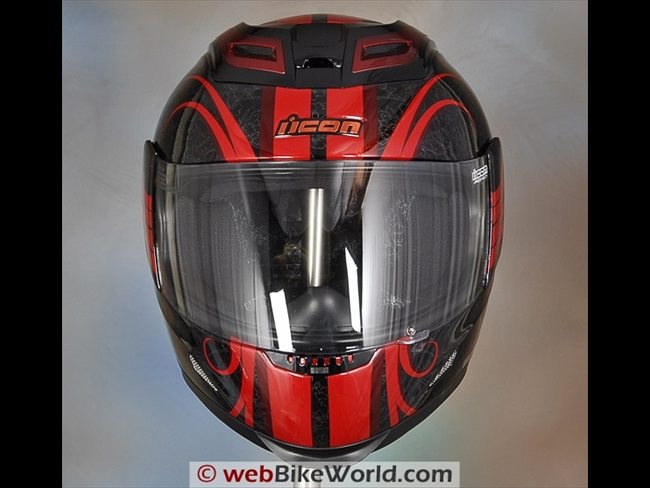
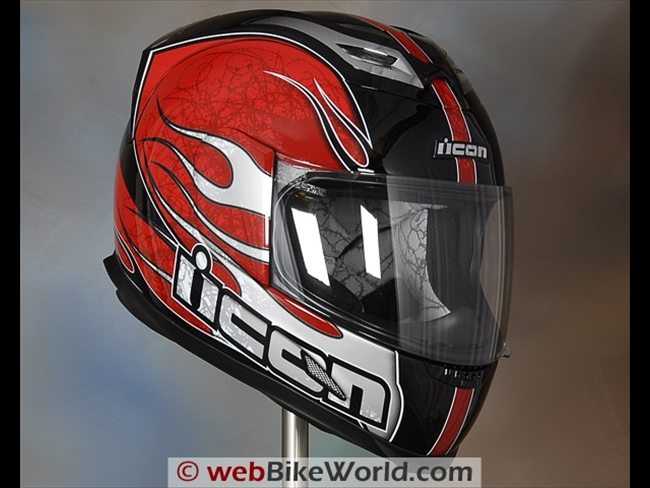
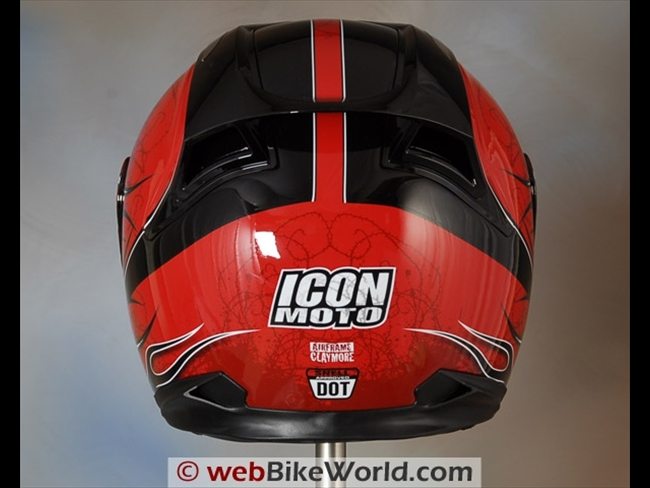
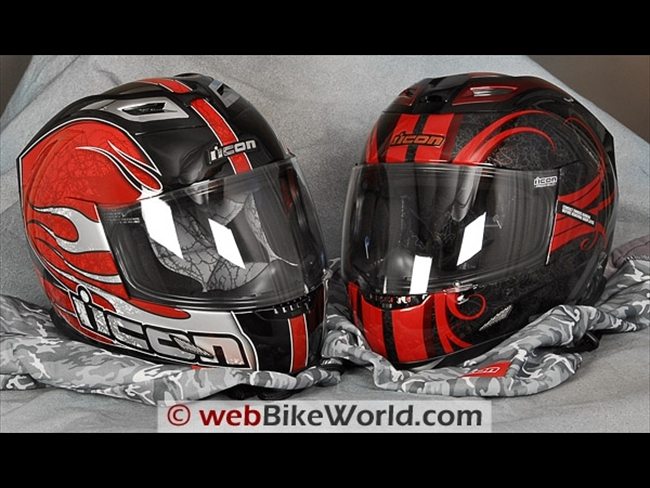
We’ve been wearing the Icon Airframe “Claymore” (red, left in photo above) and the women’s “Regal” pattern (right, photo above) since the helmets were released in February, and they’ve gotten the “thumbs up” from everyone who’s seen them.
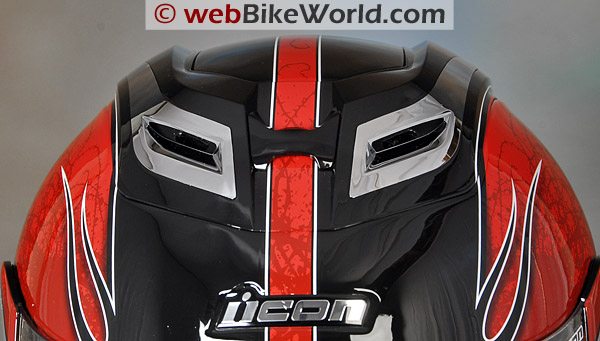
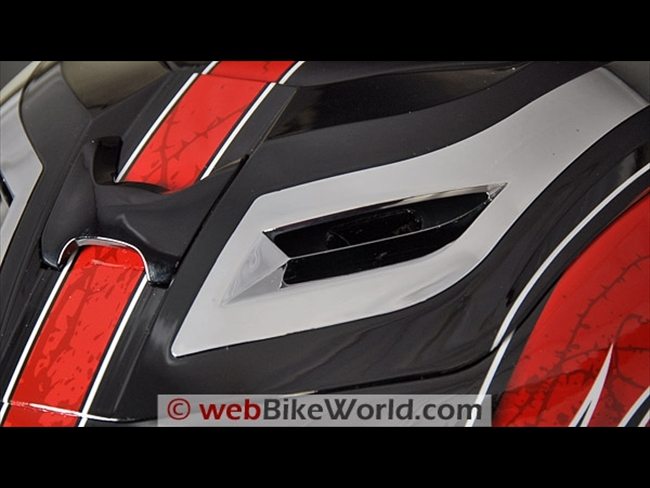
“Jewel-like” is a term I can use to describe the colors and the finish; especially the Regal pattern, with its ruby-red-chrome “Icon” logo and top vent openings and super-detailed finish. But color is one thing; performance is another. Do they have what it takes? Let’s see…
Icon Airframe Helmet. Icon Airframe in the Regal Goth graphics. This is a size XS.Paint, Graphics and Overall Quality
I stole my own thunder in the intro, so you already know what the answer is to this one. It takes a lot to impress us, after 87 or so helmet reviews.
We’ve seen it all, and first impressions count for a lot. When I get that little sucking feeling in my chest and I can feel my eyes start to pop the first time I lift the helmet out of the box, I know it’s a winner, and both the Claymore and Regal patterns shown here did it for us.
I’m not exactly sure where the Airframe fits in the Icon hierarchy — I think the Domain2 is now the “top of the line” Icon helmet, at least in pricing.
But other than some slight differences in the shell composition (the Domain2 uses Aramid in place of Dyneema in the composite and is also listed as ECE approved in addition to Snell and DOT), the Airframe could easily fit into the top spot in any helmet manufacturer’s lineup.
The paint and finish is both beautiful and perfectly applied.
There are one or two very tiny imperfections under the clearcoat where a graphic pattern meets another in the back of the Claymore, but you pretty much have to be looking with a magnifying glass to catch them.
And considering the complexity of the graphic design, this is forgivable.
In fact, one of the hardest things about buying an Icon helmet is choosing from the vast array of very, very cool graphics and colors. I guess that’s the plan — you’ll have to buy more than one!
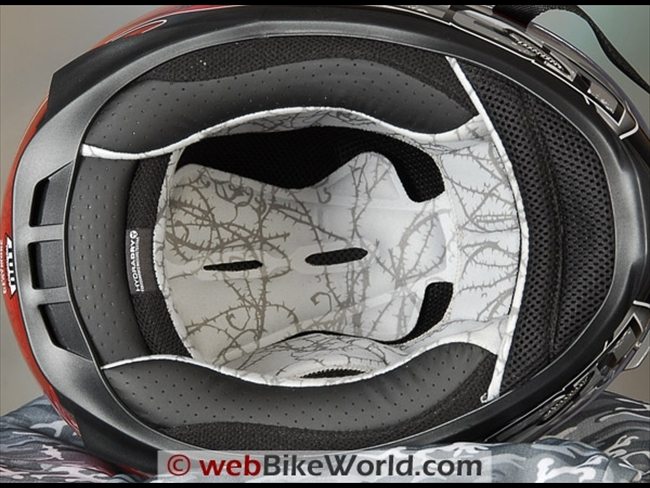
The rest of the Airframe doesn’t disappoint either. The liner is beautiful — Icon has taken liner material to a new level; the Claymore has a sort of barbed-wire pattern and the Regal has a kind of curlicue pattern consistent with the “Goth” graphics.
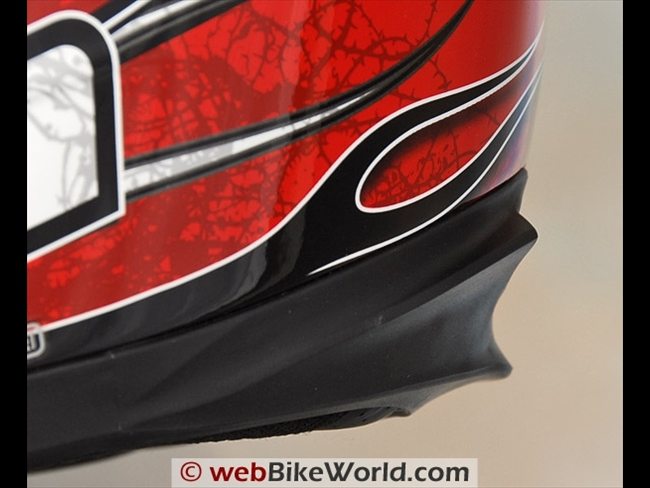
The liners fit perfectly and the bottom gasket surround isn’t just Dad’s own O-ring; it’s molded and formed to be part of the air control system, with fins and a spoiler on the back.
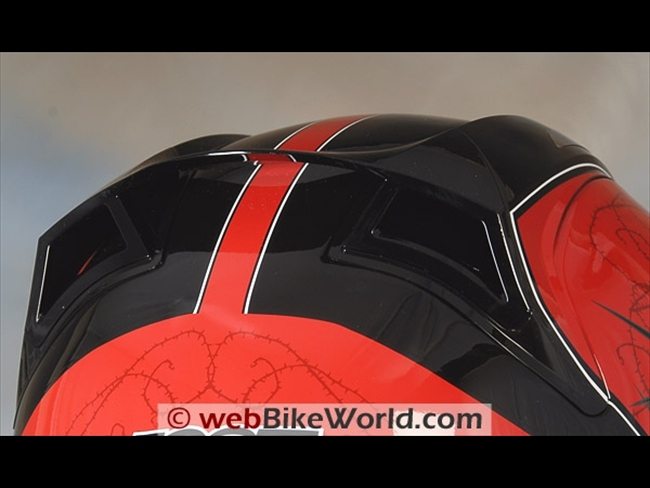
This, combined with the Airframe’s signature spoiler up top, is part of Icon’s “Supervent” venting and aerodynamic package, and it does all seem to work. But I’m getting ahead of myself again…
Score: The Airframe gets an “Outstanding” rating in my book for paint, graphics and overall quality. See the ratings scale in the summary table at the bottom of this page.
Helmet Shape and Fit
This Airframe “Claymore” is a size XL. It fits as expected for an XL, as does the size XS Airframe Regal in the Goth pattern, also shown in the photos. So if this is any indication, it can be expected that the Icon Airframe fits to size across the line.
Bonus: Icon is making the Airframe in an expanded size range, all the way from XXS (that’s small!) to XXXL. We can’t tell how many shell sizes this range spans, because helmet manufacturers are usually reluctant to share that information.
However, the XL’s shell has a nice fit — it doesn’t feel too large, especially around the front, where it actually seems closer-fitting than other XL’s I’ve tried.
UPDATE: Icon recently sent us this information on their shell sizing and safety standards: “Just wanted to clarify a couple things I noticed in you review.
The Airframe will be released as ECE/DOT we are just working on final sizing and packaging now. Also, we have no issue sharing our shell breakdown information. We are proud of the fact the Airframe has 3 shell sizes and 4 EPS liners.
- Size A: XS Shell. EPS – XS; Interior XXS – XS
- Size B: Med. Shell. EPS – M; Interior S – M
- Size C: Large Shell. EPS – L; Interior L – 3XL (Note: Size 3XL has its own DOT only EPS interior)
The shell on the Claymore XL does a nice job of covering my chin and the lower parts of my head, which gives me a good feeling of protection, unlike some of the modular helmets we’re in the process of reviewing, which seem way too short and have my chin sticking out the bottom.
The deeper shell also seems to help control noise and air flow…but I’m getting ahead of myself yet again!
The shell size for the XS Airframe in the Regal pattern is smaller than the XL Airframe for sure, but both Lori and Daphne, our women’s motorcycle clothing evaluators, think that the shell feels a bit large and it gives a touch of the “space helmet” effect.
This is to be expected though, as they both have very small heads.
The Airframe has what we’d call a neutral fit; it fits my round “earth” shaped head with just a touch of space up top where the upper part of the liner is slightly more oval shaped than I’d like.
But my head shape is definitely out on the tail of the normal distribution, so the Airframe should fit the vast majority of riders with no problem.
Make sure you read the wBW Motorcycle Helmet FAQ for more information on choosing and fitting a motorcycle helmet and for a discussion regarding human head shapes; choosing the correct helmet shape is crucial to fit, comfort and safety.
I’ve worn the Airframe for a couple of hours at a stretch with no discomfort, and I can’t ask for more than that.
And there’s another bonus: in addition to the expanded size range, Icon sells an entire set of both thinner and thicker cheek pads for the Airframe.
So the helmet can be custom-fitted if you’d like — I may actually try the next size thinner pair of cheek pads just to fine-tune the fit for my bulb-head.
By the way, the availability of the accessory cheek pads is a very good thing, but I wonder about the logistics of stocking the cheek pads in all those sizes AND for all the different liner patterns? Sounds like a stock clerk’s nightmare!
The liner fabric in the Airframe is very comfortable. The material is Icon’s “HydraDry” moisture-wicking material and it does seem more comfortable than I’ve experienced on other helmets.
We’ll see how good it does the wicking thing come summer, but my impressions so far in up to near 70-degrees F is that it works very well indeed.
The liner and padding is both plush and complete, with no bare surfaces visible inside, including in the ear pockets. Yes, the Airframe does have ear pockets, but they are probably not as deep as some helmets that do without lining against the ears.
The helmet has a separate section of liner that covers each ear pocket, and I suppose you could cut it to remove it if necessary to install speakers, but who’d want to mess up such a beautiful liner?
I can fit my full-framed wire frame eyeglasses on my head when wearing the Airframe, but the ability to do so is highly variable and it will depend on both the individual’s head shape and eyeglass frames.
The best solution is to cut the ear loops off an old pair of glasses; see our motorcycle eyeglasses article for more information.
Score: I’ll give the Airframe another “Outstanding” for comfort, the way the shell fits around my head and for fit.
Venting
The Airframe has a basic chin vent that opens via a small lever that pushes the “teeth” side to side. I have to memorize “right to open; left to close” and the lever button is rather small, so it’s not easy to find at first when wearing gloves.
Although I have the open and closed positions figured out after wearing the helmet for a few weeks, I still think it’s more intuitive to have some sort of a snap system, like down for open and up for closed.
The chin vent does seem to provide a good volume of air though. It’s always hard to tell, because unless the rider is wearing a helmet wind blocker that fits around the bottom of the helmet, the helmet will almost always have a large volume of air coming from up underneath.
This air blowing up and around inside the helmet is oftentimes mistaken for good venting by many motorcyclists.
The Airframe gets extra points because it not only has an air “splitter” on the breath guard to direct the air coming in via the chin vent on both the back of the visor and the rider’s face; it also has air channels in the chin bar itself.
Chin bar channels or holes seem like a logical feature, but I’d guess that only about 25% or so of the helmet manufacturers go through the trouble of adding them.
I can’t see under the chin bar padding, so I’m not sure if the air that comes in the chin vent is actually directed through the chin bar holes, but the bottom line is that the Airframe does seem to have decent venting.
There are two mesh-covered exhaust vents on either side of the chin bar, and I think these work to draw air out of the chin bar holes also.
The top vents open as one, via the single sliding lever in the center of the vent assembly. The lever has a positive feel and it moves the visor covers to one of three positions: closed, half open and fully open. The air exhausts out the back through the always-open vents that form the rear of the “Supervent” spoiler system.
The top vents open into air ducts or channels in the EPS helmet liner, and the lining material that covers the channels is made from mesh.
This does seem to work to provide good venting in the top of the helmet; I had to keep the vents closed on a couple of cooler spring days, because there was too much air coming in with the vents open.
The forward-facing vents do generate some noise though — but before I get ahead of myself one more time, so hold that thought…
Score: The Airframe gets a “Very Good” for venting and air flow.
Noise Levels
The shell of the Airframe has a unique shape, with molded indents along the bottom on either side of the chin that come to a point at the front.
The graphics and the top vent/spoiler assembly conspire to make the helmet seem like it has a swept-back shape, and the overall impression is of an aerodynamic structure that surely will part the air smoothly and efficiently.
That’s the subjective feeling anyway; objectively, who really knows? We’ll have to go with Icon’s word that the Airframe was shaped in the wind tunnel — but aren’t they all?
In any case, the Airframe does seem to control wind noise in all respects except one.
Of course, wind noise and buffeting is widely variable, depending upon anything and everything from the rider’s head shape to the windscreen (or not).
Also motorcycle type, shape and design; helmet fit and even the type and shape of jacket and collar that the rider is wearing. See the wBW Motorcycle Helmet Noise page for more information.
But overall, I’d say that the Airframe is relatively quiet — low frequency “booming” noise around the bottom of the helmet seems well controlled, as reported by two separate riders on a variety of motorcycles. The exception is the top vents.
Those forward-facing vents may gulp air and force it down on to the rider’s head, but not without the expected result — noise. Not a whistling noise, like blowing over a Coke bottle, but a continuous wind rushing noise, especially when the vents are open.
With the vents closed, the noise decreases by — I don’t know — maybe 75% or so. But expect some noise from up top, especially if you’re sitting upright and/or if your windscreen creates unusual turbulence directed at the upper part of the helmet.
Burn reports much less noise when wearing the helmet while riding his TL Suzuki, and I did notice that if my head is tilted forward, as it would be in a Sportbike riding position, the noise decreases.
Otherwise, if it wasn’t for that, the Airframe would probably remain relatively quiet. I’d like to think that the chin curtain underneath the chin bar helps keep turbulent air from making noise in that area, and the very nicely shaped lower helmet gasket, with its molded-in spoilers, helps flow the air around the bottom of the helmet, decreasing “booming” noise from that region.
The very thick eye port gasket and good visor seal work to prevent noise from the front, but there I go again…
Score: I’ll give the Airframe a “Good” rating for noise control, but I have a feeling this will be very variable, with some riders, depending upon the circumstances as mentioned above, reporting anything from “very loud” to “acceptable”.
By the way, note that we always wear high-quality, correctly fitted ear plugs when riding. Please see the wBW Earplugs and Hearing Protection page for more information on choosing and wearing earplugs. If you don’t wear ear plugs, all bets are off — every motorcycle helmet is dangerously noisy, in our opinion, and your hearing is as precious as your eyesight, so don’t mess with it. Wear ear plugs.
Face Shield
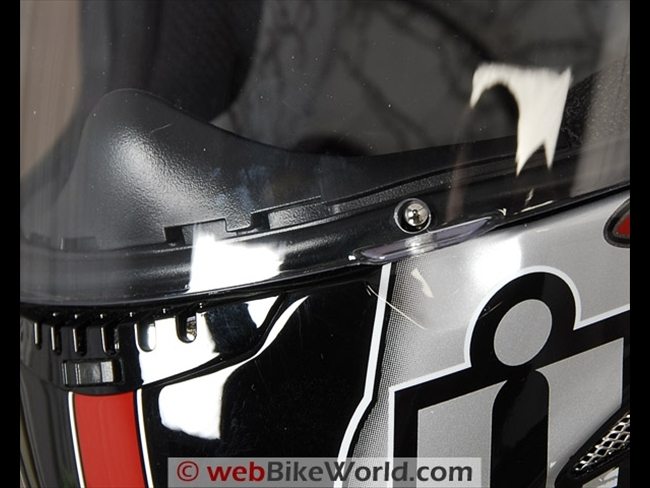
It’s interesting to note that while just about every motorcycle helmet manufacturer other than Arai has gone to a flush-fitting, over-the-shell visor, Icon is using a side plate system on the Airframe and most of their other helmets.
This is both good and bad news: the side plates do give more surface area for graphics, as Icon says, but they also add some complexity to an already too-variable feature of a motorcycle helmet.
The visor and visor removal system on the Airframe appears to be nearly identical to the fussy system we first reported on the Icon Mainframe review a couple of years ago, but with the addition of the side plates.
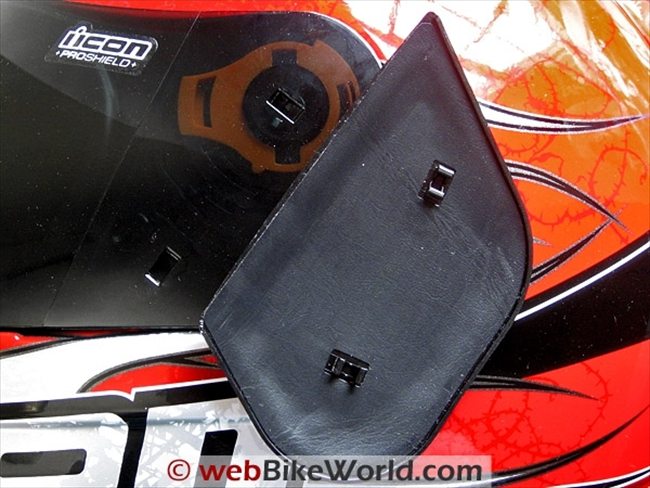
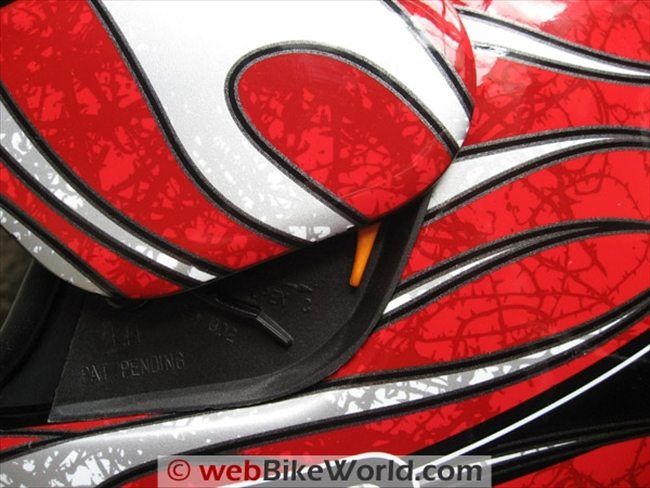
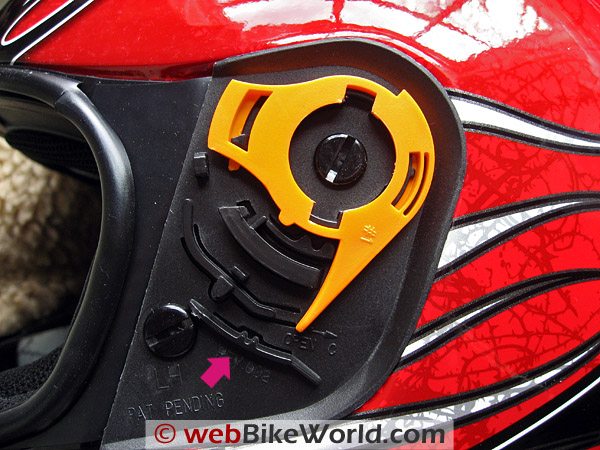
To remove the visor, Icon recommends first lifting it to the full upright position. There are orange-colored levers underneath, and these must be pulled forward to release the visor (see photo below).
They’re tricky to catch and pull, but I got the hang of it after a few tries. Once they’re pulled forward, the visor will release.
The side plates can be removed after the visor has been released from the helmet. It’s simply a matter of grabbing them with a fingernail and pulling them off the visor.
Yep, it will sound like you’re breaking the visor, just like the Arai system.
The side plates are held by friction via two little split posts that poke through holes in the visor. So far, they’ve survived, but I’m not sure what their life expectancy is. Let’s hope that modern polymer technology will keep them flexible.
The trick is getting the visor back on. With the orange levers still pulled forward, the visor should slip right back in.
But make sure the visor lifting detents are correctly located and the visor is pushed firmly in place before moving the lever back; see the purple arrow in the photo below.
If the lever isn’t firmly in position, there is a chance that the visor will not be seated and it may pop out, hopefully when you lift it the first time to put the helmet on, but hopefully not when you’re riding.
This is similar to the visor problem we reported with the Icon Mainframe. If the visor isn’t perfectly seated and the lever doesn’t snap back with authority, chances are the visor is not correctly installed.

With care, patience and caution, you should be fine, but be forewarned. It’s a little too easy to get it just slightly wrong — if the visor is not nice and snug and flat against the helmet on both sides, you’ll probably need to check it again to make sure everything is correct.
Otherwise, the Airframe visor is excellent. The eye port and the visor provide a very wide top-to-bottom view. The side-to-side view is slightly above average; not the best in class, but very good.
The eye port has an exceptionally thick gasket, which helps to keep the visor sealed against the helmet to keep out noise.
Just by coincidence, we are currently in the process of doing a long-term Shark RSX helmet review; a review of the AFX FX-28 modular and a review of the Vemar Jiano (all forthcoming soon!).
One day, it was about 48 degrees F and slightly damp, and I had the opportunity to ride back-to-back with all three helmets plus the Airframe.
The Airframe has the largest viewing area by far, but, believe it or not, the AFX FX-28 had the best anti-fogging ability of the four helmets. It seemed impossible to get it to fog at all when I deliberately steamed my hot breath directly on the back of the visor while the helmet was on.
The 3 mm thick visor of the Shark was next, then the Jiano and finally the Airframe in this highly subjective and very unscientific evaluation. So the Airframe’s anti-fogging ability isn’t bad, just not as good as the best, in my opinion.
The Airframe’s visor is clear and has very good optical qualities on both helmets and also with the dark smoke and silver tinted visor we tried.
Once the visor is correctly installed, the detents are strong and hold the visor in any of 6 positions, including a small opening for de-misting. By the way, the visor lifting tab is slightly small, making it difficult to find when wearing thick winter gloves.
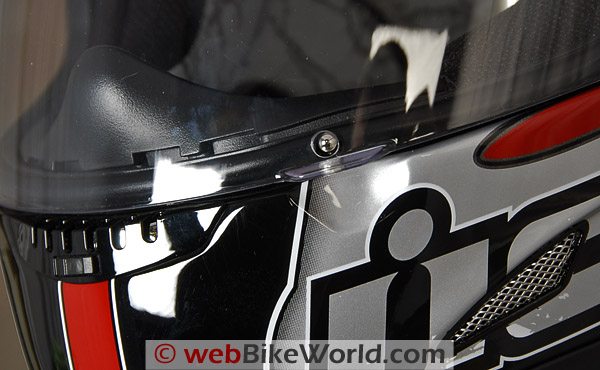
Finally, the visor on the Icon Airframe has a little button in front that is designed to keep the visor locked during head checks. It seems to work, but I can’t say that it’s as positive as the lock on a helmet like the Arai Quantum II (review) for example.
The good thing about the lock on the Airframe though is that it’s “always on”; it doesn’t take a deliberate motion to place it on and off the visor.
Score: I’ll give the Airframe a “Good” rating for its fog prevention and the visor removal system, qualified with my notes above. Otherwise, it gets an “Excellent” rating for visibility and its other functionality.
Icon Airframe Helmet Weight
The size XL Icon Airframe shown here weighs 1657 grams (3 lbs., 10-3/8 oz.) with the clear visor. Curiously, the helmet weighs a few grams more with the dark smoke visor, for some strange reason.
The Airframe isn’t the lightest helmet around; in fact, it’s in about the top 1/3 of the 87 helmets we’ve reviewed so far on the wBW Motorcycle Helmet Weights page (where you can find the chart comparing the weights of every helmet we’ve reviewed).
In the neighborhood are the size XL KBC VR-3 Stealth at 1653 grams; the XL Arai Profile at 1658 grams and the Craft R2 Aerospeed in size large at 1660 grams.
However, the Airframe definitely feels lighter than it is, and the rear spoiler seems to work to flow the air smoothly over the helmet, actually making it feel lighter and less affected by turbulence and cross winds at speed.
Score: The Airframe gets a “Good” for slightly higher than expected weight that is well-controlled by the aerodynamics.
Safety
The Icon Mainframe is labeled as meeting U.S. DOT and Snell standards. All Icon helmets sold in Europe meet the ECE 22.05 standard.
Chin Strap
The Mainframe uses the classic “D” ring attachment system. There’s plenty of extra length on the strap, which can be secured from flying around in the wind via a snap.
Conclusion
The Icon Airframe is a beautifully executed helmet with high levels of quality, comfort and polish in a very nice package. Yes, the visor removal system can be slightly fussy, but I wouldn’t let that bother you — how many times do you really remove and replace a visor?
That the helmet comes in an expanded size range, has a huge array of colors and graphics, and a bunch of accessories like all sorts of tinted visors and a full array of cheek pads is a real plus.
This could be a helmet you could live with for a long time. Or until you get the yen to buy one in another cool color!
| wBW Review: Icon Airframe Helmet | |
|---|---|
| Manufacturer: Icon | List Price (2008): $300.00 |
| Colors: Colors and graphics. | Made In: Korea |
| Review Date: March 2008 | |
|
Rating Scale is subjective: Unacceptable, Poor, Neutral, Very Good, Excellent, Outstanding.
|
|
Note: Item provided by a retailer, distributor or manufacturer with these Terms and Conditions.
Owner Comments and Feedback
See details on submitting comments.
From “L.S.” (March 2013): “I think you are spot-on about Icon’s styling efforts – they are ahead of the pack. I especially tracked down an Icon Airframe helmet with the Claymore design in dark grey with the chrome highlights and I still think it’s the best looking helmet around.
I also have to agree that those visor detents are rather tricky. At one point when I lowered a new visor it did pop out and I realised that I didn’t have the detent on that side locked in properly.
Probably the trickiest part of it is that you can’t see what’s going on if you have already attached the side plates, but I managed to work it out, after a small panic that the mechanism was faulty or broken.
It really does sound and feel like you are breaking something when pushing the detents back and they snap into position.
Same for removing the side plates, which I’ve left off for now, I think the design looks just as good with or without them but I really appreciate having them as an option.
I have a size S which weighs 1557 grams, 33 grams heavier than my Shoei TZR in the same size. They are both really well-balanced helmets that feel the same weight on.
There is a noticeable difference in fit between the Icon and the Shoei, the Icon feels larger and more airy although I’m not sure if it’s simply the result of being a better shape for my head and having less bulk in the padding.
I have a long, narrow head shape and the Shoei gives me a red forehead and can be downright painful if my forehead isn’t in exactly the right spot. The Icon has soft padding in a crown shape and no such pressure point so far.
There is no way I could fit into a XS TZR but I’m still wondering if the XS Icon would fit, probably not but I’d like to know.
The Icon is definitely noisier than the Shoei but given the rather solid padding around the ears in the Shoei I’m not surprised. Between the two, the Shoei feels like a really solid, well built helmet but the Icon wins for comfort and looks.
I still use both, one with tint for daytime and one with clear for night.”
From “W” (11/09): “Hello from Down Under and thank you , I owe you a beer or two.
I recently bought the Icon Airframe helmet just loved the graphics, that was one of the reasons why I bought and secondly the quality looked good for the price, which has dropped down considerably from $400 Australian dollars to $289 so I grabbed it.
I went out on a ride to test the helmet absolutely loved the view and the helmet is great for changing lanes I found I didn’t have to turn my head to much to see into the next lane. The comfort level is great – well done Icon.
As you know no helmet is perfect. I had a fair bit of noise underneath the helmet at faster speeds but no worse than any other helmet, ear phones were very hard to stay positioned as pads are very thick but hopefully they wear in a bit.
The reason why I owe you a beer: I thought I would buy (an extra visor in silver). I looked at the book supplied with helmet for instructions on shield removal, it looked pretty easy to do (but) I was cursing for 1 hour because the visor kept popping of, my fingers were killing me popping the side plates off.
I checked on the Icon site still couldn’t find the answer, I was about to take the helmet back because I have better things to do with my time. I then thought of your site and at last the answer was there with a picture (above) showing the visor detents.
Now I’m happy – thanks again.