

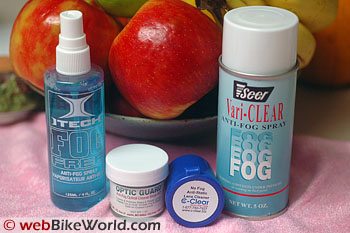


What started out as a review of Itech Fog Free Anti-Fog Spray turned into a search for this year’s “perfect” anti-fog coating.
You won’t find it here, unfortunately, but the search will continue…
Kevin started the latest round in what’s become almost a yearly survey of motorcycle visor anti-fog treatments.
These include coatings, waxes, sprays, preparations, ointments, blessings, curses and anything else that might keep a motorcycle helmet visor from misting up on those cold, damp winter mornings.
The perfect anti-fog treatment would be none at all, actually. In theory, a helmet visor should have some type of factory treatment that makes fogging a thing of the past.
Some visors are better than others at keeping that Ol’ Demon Mist from mucking up the sight of another gray morning.
But there are still a heck of a lot of visors out there whose claims of magical anti-misting properties are, shall we say, greatly exaggerated.
In the absence of that perfect nano-treated visor that just says no to fog, how about the next best thing?
That would be an easy-to-use, clear, odorless, easy-to-apply, dries-in-a-jiffy and lasts a long time spray?
(UPDATE: There is one! Read the RIAA Permanant Anti-Fog Visor review).
Spritz it on, wipe it off and you’d have week-long protection. Itech Fog Free Anti-Fog Spray fit the description, at least about the ease of use, and Kevin threw down the gauntlet with that opening bid.
But it just so happened that we’d been collecting a small sampling from the zillions of other anti-fog treatments available, waiting for cold weather to strike so we could try them out.
Vari-CLEAR Anti-Fog Spray looked promising; it’s an aerosol spray in a can that seemed easy enough to use.
And since we had pretty good results with the semi-solid Cat Crap anti-fog coating, we figured we’d try a couple of waxy cousins.
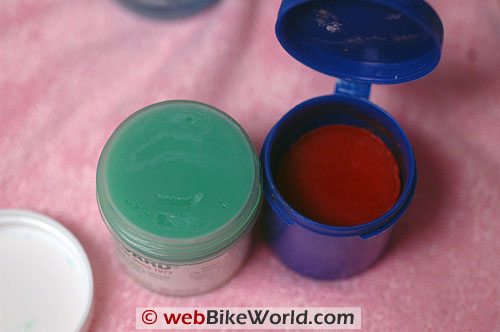
The C-Clear No Fog Anti-Static Lens Cleaner (which, in addition to its anti-fog capabilities, apparently solves two other problems I didn’t know I had) and Optic Guard Anti-Fog Optical Cleaner, which also cleans while it works to persecute fog. Or something like that…
Optic Guard (L) and C-Clear Motorcycle Visor Anti-Fog CoatingsAbout This Review
The logistics of a motorcycle helmet visor anti-fog treatment review are difficult.
First, it’s hard to come up with a “standard” evaluation procedure.
Then, it’s a challenge to get photos that accurately represent the results.
And finally, the products have inconsistent performance, both in the “lab” (i.e., kitchen) and on the road.
In other words, there’s a certain measure of subjectivity here, so our results are not definitive and your experience may, and probably will, vary.
By the way, just in the past week or so, we’ve come across many more interesting concoctions that all lay claim to being the “best” anti-fog treatment…”guaranteed”.
We’ll be trying more of these, including some home-made recipes that we’ve found.
That’s right — in the search for better, cheaper and faster, we’ve been, uh, “reduced”, I think is the word — to looking both outside and waaay outside of the motorcycling sector to see if perhaps there are other types of treatments that might do the deed.
This is all because there just don’t seem to be many dedicated motorcycle helmet visor anti-fog coatings that:
1) Actually work.
2) Are easy to apply (see our criteria for the “perfect” anti-fog treatment above).
3) Affordable. #3 is important, because one could get very carried away here.
For example, a reader sent us a link to a nanotechnology based coating that is supposed to work the charm, but costs something like $15.00 USD per ounce.
So let’s take a look and see what’s new (puns intended!):
Since this all started with Kevin and the Itech Fog Free Anti-Fog Spray, I’ll let him go first.
When Kevin, who lives in the Land of the Maple Leaf, completed his review of the Itech Anti-Fog Spray, I bought a dose myself to see if we would both end up with the same results.
The short answer is yes, and I’ll post my brief follow-up below.
Kevin Sez…
Sometimes, when buying motorcycle gear, a person can feel like they’re newly engaged and planning for a wedding: the price of everything has suddenly tripled.
So it’s always good to stumble across a product aimed at a stingier clientele, or at least a larger clientele.
In this case, I’ve been keeping tabs on Itech’s products ever since being tipped off about their Fog-Free wipes, which are intended for hockey players.
And no doubt about it, the number of hockey players in Canada vastly outnumbers the number of motorcycle riders.
If anyone has to deal with fog on a visor, it should be a hockey player.
Combine sub-zero temperatures with heavy exertion and it’s almost a guarantee that a visor will fog up. After all, it’s the coolest game on ice, right?
So when I spotted Itech Fog Free Anti-Fog Spray while picking up a batch of motorcycle winterizing fluids, I snatched a bottle, thinking to put it to the test in the few weeks remaining before the snowy season starts up in earnest and forces me into public transit.
Upon reading the fine print, I was even more eager to try out the Itech spray.
Turns out this product is made in the Montreal suburb where I grew up, by the company that makes the official visor of the NHL! Made in Canada for pro-hockey players? It’s got to prevent fog in a motorcycle helmet!
Unfortunately for hometown pride, that’s not the case.
Application
The instructions are simplicity itself. “Shake well, Spray inside surface of shield. Rub solution on entire surface of the mask with clean fingers. Polish dry with soft cloth.
Wipe with soft cloth until Fog Free is worked in, and surface is clear. Reapply as required.”
So I set to work when I got home by pulling the visor off my Shoei and giving it a good cleaning in the kitchen sink, then drying it off with a dishtowel.
Next, I sprayed the inside of the visor with Fog Free, and things started to get complicated.
How exactly does a watery blue substance get “worked in” to polycarbonate?
I’m not really sure, but I dutifully rubbed the liquid around every square centimetre of the inside of the visor for a minute, then dried it off with a microfibre towel and rubbed it until it was clear.
Aside from a slightly sweet odour, there was no way to tell anything had been done to the visor. Time for the steam test!
Does it Work?
The standard torture test for anti-fog coating at webBikeWorld is to hold the visor over a boiling kettle.
Stepping proudly into the shoes of tradition, I fired up my Capresso for a cup of English Breakfast…and was incredibly disappointed to see steam condensing all across the visor.
For a lark I flipped the visor over, and maybe I was imagining things, but it seemed as if the fog was actually lasting longer on the Itech-coated inside than on the outside!
Sitting back to enjoy my cuppa I pondered what had gone wrong, and decided to reapply the Itech spray. Another spritz, another rub, another polish, and another failure to repel steam rising off the kettle.
Three times is my limit for trying anything, so I gave the Itech one more shot.
This third and final time I sprayed the visor thoroughly, swirled it around the inside, and let it sit for five minutes.
Thinking that maybe the microfibre cloth was too absorbent, I swapped it for one of my daughter’s old 100% cotton spitrags (and as parents know, these things are better suited for pushing liquid around than actually absorbing anything).
The steam test is admittedly unrealistic (unless you routinely ride past a nuclear power plant and are prepared for an emergency) so I held the visor to my mouth and engaged in some heavy breathing.
Complete. Utter. Failure.
What Went Wrong?
After the test I called up Mission-Itech Hockey, the makers of the spray, and spoke to Eric Marquis in their marketing department.
I told him that we were evaluating the spray, and asked what he thought the results would be.
“First off, you have to say that this is only certified for hockey use,” said Marquis. “It’s not approved for any other application, although we do get people from outside the industry who do use it.”
As it turns out, motorcycle riders aren’t the only people trying to adapt hockey gear for their own uses.
Cowboys are buying hockey helmets made by Itech to use in bull-riding, since there aren’t any manufacturers designing equipment for people who routinely get thrown off a one-ton animal.
But we ride steel horses and we do our best to stay on them, and right now we only care about making sure our visors don’t fog up. So is there any difference between a hockey visor and a motorcycle visor?
Quite a bit, actually.
Looking at the Itech website (links below), it’s easy to spot that the average hockey visor is full of great big ventilation holes.
Half-visors don’t even come to the tip of a player’s nose, and are fully open at the top to allow complete airflow.
The full-facial visors still have plenty of ventilation at the top, and a polycarbonate cage around the mouth and jaw line. Hockey visors also come out of the factory with an anti-fog coating.
“Most of our visors are already pre-treated with an anti-fog/anti-scratch coating,” said Marquis. And yet these visors, coated at the factory and treated with anti-fog spray, still manage to fog up in the arena.
“We test our visors regularly, more than anyone else in the industry, and they never fog on the ice,” said Marquis.
“Sometimes they fog on the bench, but in any arena that’s going to happen when you’re breathing hard and sweating in a cold arena. But they never fog on the ice.”
Kevin’s Conclusion
The Itech Fog Free Anti-Fog Spray isn’t designed for a motorcycle visor, and in my opinion doesn’t stand up to the conditions that a motorcycle visor experiences.
The manufacturer says the Spray is effective at eliminating fog on hockey visors while players are skating on the ice, but admits it may not be as effective while players are sitting still and breathing hard.
Given the design of most motorcycle helmets, with limited ventilation across the visor, it’s my opinion that the Itech Anti-Fog Spray isn’t going to do much to eliminate fog for the average rider.
Itech Fog Free may be more effective for those wearing helmets without a chin bar, but I think those riders are less likely to get fogged visors in the first place.
Kevin’s Steamed Visor After Being Treated With ItechRick’s Turn
I heard and understood everything Kevin said about the Itech product, but I went ahead and bought a bottle anyway. After all, anti-fog is anti-fog, non?
I do find it somewhat hard to believe that a product made to keep a hockey player’s clear polycarbonate visor from fogging won’t do the same for a polycarbonate motorcycle visor.
Does the stuff have some intelligence that can tell the difference?
“Strange”, I thought. But truth is often stranger than fiction. Now my investigative juices were flowing. The first thing I did after the water was boiling was to hold a completely untreated visor over the steam as a control.
It fogged up instantly, just like somebody threw the fog switch to “On”.
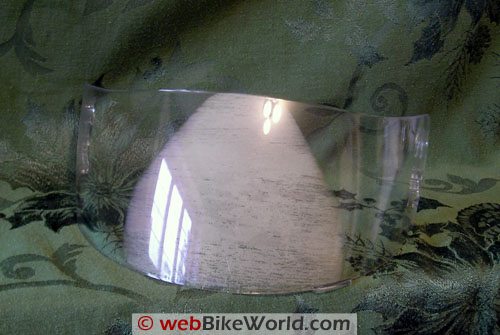
I even took a photo of the clear visor before any treatments were applied, just for the sake of a controlled experiment:
The Control: Untreated Visor, No Steam Visor Fogging After Treatment With Itech Fog Free Anti-Fog SpraySo I repeated the tea-time test and followed it up with an early morning, 37-degree cold unddamp ride. Yep — I mean nope — the stuff doesn’t work. At all. Not on motorcycle helmet visors anyway.
Then I broke out the Vari-CLEAR Anti-Fog Spray, which claims to be “The finest anti-fog spray produced…”.
It’s supposed to give “24 hour fog-free protection on all faceshields, goggles, windshields, glass, mirrors and glasses.”
Vari-CLEAR is made by Super Seer, the company that makes those old-fashioned-looking 1950’s style Police helmets, but I dare you to find information about Vari-CLEAR on their website.
Vari-CLEAR’s caveat, which is way true, by the way, reads “Under certain conditions, no product can remain totally fog-free.”
I followed the directions. Vari-CLEAR comes out as a foamy spray that has a smell reminiscent of a dry cleaning establishment.
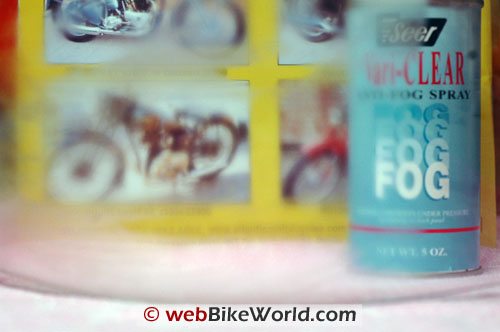
I wiped and buffed as directed and held it over the boiling pot of water and…the visor fogged up just as quickly as before.
Visor Fogging After Treatment With Vari-CLEARNext I washed the visor three times in warm water with dishwashing soap, rinsing and rubbing thoroughly each time to clean off any remaining treatment.
In theory, I’d have separate visors for each of the runs, but hey — nobody claims we’re running a lab here! Just a seat-of-the-pants inquisition.
I then coated the inside of the visor with C-Clear, a waxy substance very similar to Cat Crap. C-Clear claims to be the “World’s Leading No Fog Spray & Gel” that “Cleans and protects microscopes, camera lenses, rifle scopes, and computer monitors”.
It’s also a “No Fog, Anti-Static lens cleaner ideal for safety goggles, masks, glasses, protective lenses in cold or dusty areas”.
Note that they do not mention motorcycle helmet visors, but they don’t not mention them also. Huh?
Anyway, the product is applied with a fingertip and buffed out. It’s certainly a bit more time consuming and messier than the sprays, but not bad actually.
But holding the visor over the steam gave about the same result; the treated section doesn’t look as “steamy/foggy”, but it gets a sort of watery thick coating that still blocks the view.
Visor Fogging After Treatment With C-ClearFinally, I tried Optic Guard Anti-Fog Optical Cleaner. Optic Guard’s claim to fame is that it’s been around since 1977.
It “Cleans & Polishes Glass and Plastic Lenses”, “Repels Lint & Dust Inhibits Fog & Steam” and is “Safe on Coated Lenses”.
It’s interesting to note that Optic Guard lists the ingredients on the container. It consists of water, coconut powdered soap, glycerin and coloring (Yellow 5 and Blue 1).
I cleaned the visor as before, treated it with Optic Guard and tried again. This one seemed slightly better, but not up to visual motorcycle riding standards.
Visor Fogging After Treatment With Optic GuardI tried all four products during various 35- to 45-degree morning rides, and experienced the same results.
None of them seemed to make much of a difference, and the visor would become just as fogged both before and after treatment with each product.
Conclusion
In the absence of a factory solution, we’re still looking for that perfect anti-fog coating. And yes, we’ve tried the Fog City and Pro Grip visor liners and don’t like messing with them.
I do have a batch of Salclear TT and TT-X anti-fog coatings on order from the UK and will report on that as soon as I can. Got a fave anti-fog treatment? Let us know at editor@webbikeworld.com
In the meantime, hold your breath!
UPDATE: Here’s our favorite helmet anti-fog treatment product that works!
More wBW: Anti-Fog Treatment Reviews | Heated Clothing Reviews
| wBW Review: Motorcycle Helmet Anti-Fog Treatment Comparison | |
|---|---|
| Manufacturer: Itech, C-Clear, Optic Guard, Vari-CLEAR | List Price (2007): Itech $4.99 CAD; C-Clear $7.95; Optic Guard $12.99; Vari-CLEAR $8.95. |
| Sizes: Itech: 125 ml (4.0 oz.); C-Clear: 1 oz. cup; Optic Guard: 1 oz. cup; Vari-CLEAR: 5 oz. spray. | Made In: Itech: Canada. Others: U.S.A. |
| Review Date: November 2007 | |
Owner Comments and Feedback
See details on submitting comments.
From “F.D.” (January 2016): “As you asked for feedback on anti fog products, I ride all year round and I use Calotherm Calosport to clean my visor.
I apply a couple of quick squirts and give the inside a quick clean (make up removal pads work great), then I repeat and it’s good for quite a few days, best I have found to date anyway.
Available in 25 ml pump spray (nice and slender to carry) or 220 ml economy size, UK product but ships worldwide. Calotherm products are found in opticians and camera shops here, and I’m not connected with them in any way.”
From “R.W.”: “The main reason divers use baby shampoo over other types is because in the closed environment of a dive mask and with leakage issues the residue can get into the eyes and sting.
Most anti-fog solutions are nothing more than wetting agents which decrease the surface tension of the glass/plastic surface causing water to run off rather than fog the surface.
On a motorcycle helmet you don’t have the issue of residue getting into your eyes so there is really no reason to use baby shampoo.
In fact a heavier gel type shampoo would work better. Simply smear it on the interior of the shield, let it sit for a minute or two and buff clear. Reapply as needed. I’ve used Prell in the past with fairly good results.”
From “Marty”: “Wash the inside of you shield and dry it. Then put one or 2 drops of dawn dish soap on the inside. Rub it around, take a clean towel and wipe it off. Take one more clean towel and finish the in side so it is streak free.
I always use micro fiber towels. Never use paper toweling. It should not fog up, it should bead up, move your head and they run down. Try it. Price is right.
Has worked for me down to 18 (degrees) riding in town, stop and go. Need to do it again when it starts to fog up and not bead up.”
From “D.W.”: “Thank you for a great website and a great resource.
If you happen to have one of the helmets that support Pinlock shields, I highly recommend giving these a try. Maybe they are more popular in the EU, but they don’t seem to have much of a following here yet.
Too bad, they work really well.
I was holding off on the extra expense (and holding my breath on humid days) until a “friend” accidentally sent my Shoei bouncing down the driveway, none the worse for wear except for a very scratched shield.
Rather than a plain replacement, I ordered a Pinlock version and insert. My prior ancient Shoei had a Fog City insert so I was hoping for at least this level of performance. The new Pinlock shields are far better.
They are easy to set-up, crystal clear, and fog-free to live with. No smooging and buffing various compounds or bodily fluids (yuck) to see clearly. I don’t know if they can be retrofitted to a non-Pinlock but it would be worth checking into.”
Editor’s Note: See our reviews of the Pinlock anti-fog visor insert and also the Fog City visor insert.
From “T.B.”: “Thanks again for a great website that helps the rider on a budget keep going.
I think the motorcycle industry knows that most put their machines up on blocks in the winter. No way here.
It does amaze me that the helmet and visor manufacturers put so much time designing a helmet, perfecting the visor optics, and get an almost airtight seal between the two, but do not fully address the fogging issue.
You’d think that on a design center or laboratory scale, this would be low hanging fruit.
Anyway, back to the All Kleer review, I had perceived that you guys applied it to both sides of the visor since the anti-fog aspects of the product were mentioned, but I see that comment was a repetition of the description from the bottle.
If you come to think of it, the conditions in the cockpit of a small aircraft are much like the conditions a helmet visor sees.
There is little airflow at a standstill, the windscreen is polycarbonate, there is a lot of breathing going on in a small, sealed space, and there can be a large temperature delta between the outside and inside environment.
Unlike hockey, I think aviation holds the antifogging answer for now.
In my opinion, the beauty of All Kleer is that you can use a single product on both sides of the visor.
I do get about a week of cold, damp commutes with an All Kleer application, but less if it is raining heavily. With All Kleer, I can ride at highway speed and minimum temperatures (down to 33F) with all the vents on my X-11 closed.
I don’t need to crack the visor at stop lights either with a fresh application. Toward the end of a duty cycle, some of the properties do drop off. The one aspect that does not change is that as soon as I roll away from a stop, any fog that is there is gone in an instant.
I am sorry to report that I have not tried the steam test in the kitchen, but believe that All Kleer will give results similar to your Cat Crap review and lasts a lot longer.
The only negative that I have experienced with All Kleer is that it will water spot on any surface that it is applied to. In light of this, I have stopped using it on the painted surfaces and the small headlight windscreen on my bike in the summer when I actually wash it.
If I don’t intend to reapply All Kleer after a wet commute, I wipe off the wet visor with a microfiber cloth to prevent these water spots on the next ride.
BTW, a guy I know that races amateur motocross has been using All Kleer on the inside of his goggles with similar, positive results.”
Editor’s Note: Thanks for reminding us, we’ll add All-Kleer to the next round of anti-fog treatment comparisons.
From “M.Z.”: “Per the request of the anti-fog product comparison, here is what I use (Rain-X Anti-Fog). This product has one major problem I have found…it leaves a film on the visor that is not 100% clear to see out of.
The bonus of this product is that it works well and lasts a few days on the visor.
It will last ~2 weeks on my car windows. I have found that the visor will fog up, but the fog dissipates almost immediately after doing so. It is not a 100% perfect solution, but I don’t have the time or money to try every product. Hopefully, others will submit their solutions and after testing, we will have a winner.”
Editor’s Note: Rain-X advised us not to use their anti-fog liquid on polycarbonate visors because it can cause permanent damage.
From “C.P.”: “I ride a (Kawasaki) VN 2000 with a windscreen that is high enough to actually have to see through rather than over. In drizzle and rain visibility can be dropped severely.
Grab a potato and cut a slice off and smear the freshly cut slice over the Perspex.
Stops the rain from beading and makes it run off. Similarly with fogging visors, the moisture runs off, but at least you can see. This has to be cleaned off and reapplied each ride as the visor will distort the view in a few hours time or the next day.”
From “C.M.”: “First: thanks for the great site! it is truly unique and dependable. I rely on it heavily for insight reviews without bias. Keep up the good work!
Second: with the anti-fog treatments I totally hear you! I have tried the Cat Crap and some other generic anti-fog treatment (no to mention spit) and nothing really ever works that long/well.
I have also tried the Pinlock insert for Shoei helmets. blah. It’s okay, but I think that the visual quality is definitely less. and, even worse, there is extra glare from it at nighttime.
I feel that it is this second item that is most disturbing… I was willing to trade off some visual clarity but not the nighttime glare.
However, I did try the Respro Foggy Mask last season. And it works like a charm.
It does exactly what it says it does and is far less intrusive than you think. So, that’s the story. Try it if you haven’t already. I think it works best. Hope this helps.”
From “D.D.”: “I too tried a whole bunch of treatments without success. I mentioned it to the paint boss at work and he gave me a sample of what his guys use in their full face respirators.
It’s made by Uvex (www.uvex.com) it’s a reusable towelette.
It’s a little bit of a PITA to use in that the visor has to be very clean, no plexus on the inside, and dry. If you follow the directions it works very well and lasts about 10-12 rides. each towelette seems to be good for about 5 or 6 uses.
I had our purchasing department buy me a box of 100 so they were cheap. I have no idea what the retail price is, but they work so who cares!
We get ’em from our safety supplier but I’m sure they are available elsewhere.”
Editor’s Reply: Thanks for visiting webBikeWorld and for this tip… Another product that uses a similar delivery mechanism is the Fogtech anti-fog product we reviewed.
What we’re really searching for in this series of anti-fog treatment reviews is a “spray on – wipe off” anti-fog product that can be applied quickly and easily, that lasts for a long time and that works to eliminate fogging.
From “D.F.”: “I’ve used a product in scuba diving that has a pretty good success rate, but I don’t know how well it will translate to motorcycle visors as the conditions are not really compatible:Super Sea Drops
Scuba Divers have a long history of using their own spit as a defog device, which has never really worked well for me, but the Super Sea Drops do. The usage of this product is pretty simple in scuba applications.
A drop in the middle of each lens, spread it around really well with your fingers, making sure to get it into the corners, then a quick rinse water and it’s ready to go.
The only problem I foresee with this is that there might be a film of the drops left inside, while not really a problem in scuba as you’re about to submerge your head in fluid, it might affect visibility in motorcycle visors.
I wish I had a second visor to test it on, but I’m not really willing to risk screwing up my only visor right now as I’m anticipating some riding over the next couple of days.
I thought I’d pass the info along as it’s pretty cheap and another outside of the industry product that might apply.”
Editor’s Reply: I wonder if the Super Sea Drops will work on a polycarbonate motorcycle helmet visor? I thought diver’s masks used tempered glass (but maybe not), so the two materials may call for different formulations.
From “G.D.”: “Fog is also a major issue on diving masks. What most divers use is spit (saliva) and it works really well. The second most commonly used substance is baby shampoo (Johnson’s to be precise). Cheap, ease to use.”
Editor’s Reply: Thanks for these tips — about the baby shampoo, should it be diluted first, or just rub some of the shampoo on the visor and wipe it off, or……?