

UPDATE: See the extensive comments from Midland in the Comments section below.
Also: See our Scala Rider MultiSet Q2 review and our Interphone Bluetooth Intercom review
It’s been a long time coming, but motorcyclists finally have a couple of solutions for wireless rider-to-passenger communications with Bluetooth intercom systems.
Our definition of wireless definitely does not include “Gen 1” motorcycle intercom systems, which involved connecting both the rider and pillion intercoms to some wires that go to a “hub” and then back to the helmets.
These systems will be with us for a while and when they’re properly installed, they work very well indeed, but they’re not wireless by any stretch of the imagination.
An example of a Gen 1 intercom is the Baehr motorcycle intercom we reviewed several years ago
A “Gen 2” system could be classified as something like the original Cardo Scala Rider system, which uses a Bluetooth intercom connected to a cell phone to allow communicating.
Make that two Bluetooth intercoms connected to two cell phones; to communicate, the rider and passenger must use one cell phone to call the other and the cell phone conversations connect through the Bluetooth intercom.
I’m not sure if the original Scala Rider system still uses that technology, but as far as I’m concerned, the system is a technological dead-end. We’re looking for true Bluetooth-to-Bluetooth communications!
Which brings us to the “Gen 3” system shown here — a truly wireless Bluetooth only system that does not require any other type of intermediary device like a cell phone or multiplexer for rider-to-passenger communications.
The explanation about who makes and markets these things is long and complicated. The packaging for our system and the intercom itself is confusing, with way too many logos and labels.
My best guess is that the system is actually made in Germany by Albrecht, where it’s called the Albrecht Rider Bluetooth Headset.
But the box and the intercom also have a Cardo label; Cardo is the manufacturer (or distributor?) of the Cardo Scala Rider TeamSet Bluetooth intercom system.
The Bluetooth intercom shown in our photos looks identical to the photos of the Cardo Scala Rider TeamSet.
But wait: there’s more! Our intercom also has a Midland label. Remember them? Midland was famous during the CB craze in the U.S.A. in the first half of the 1970’s.
They still make communications devices in the U.S., but there’s no reference to a Midland Bluetooth intercom system on their U.S. website, although the Midland logo on our Bluetooth intercom and packaging is identical to the logo on the Midland website.
And finally, Alan UK is apparently the distributor for Midland in the UK and Europe, and the Albrecht Rider or the Cardo Scala Rider TeamSet or the Midland Bluetooth intercom, which are all one and the same, is distributed as a Midland product by Alan UK.
Yikes!! If you’re confused, join the club.
Even Alan UK had a hard time explaining this to me. I can understand where companies may want to collaborate on the development of a technology, but how about making it less confusing to the consumer (For Midland’s explanation of this, see the Comments section below).
Believe it or not, this isn’t the only motorcycle Bluetooth intercom system that’s marketed like this — the Interphone system is apparently made in Italy and marketed under several different labels around the world.
We’re hoping to get one soon for an evaluation; it’s my understanding that the Interphone Bluetooth intercom system can also be used for bike-to-bike communications at fairly significant (relatively speaking) distances.
But let’s put the marketing issues aside and take a look at the Cardo Scala Rider TeamSet – Albrecht Rider – Midland – Alan system shown here. For some reason, none of the websites of the four different companies involved provide a clear explanation of what you get and how it works.
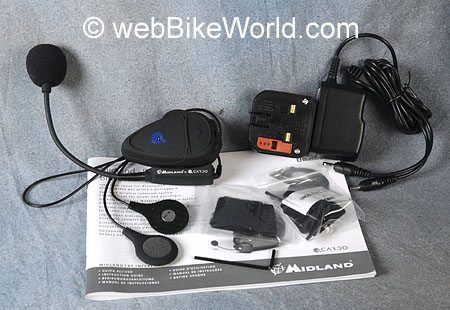
Our kit came with a pair (that’s two!) of the Bluetooth intercom units and a charger (with a UK-style electrical plug; we used an adapter for the standard U.S. 110-Volt outlet).
Also an owner’s manual in 5 different languages (English, Spanish, French, Greek and German); and a couple of small packages of Velcro stickies and two hex wrenches, used to attach the bracket to the helmets.
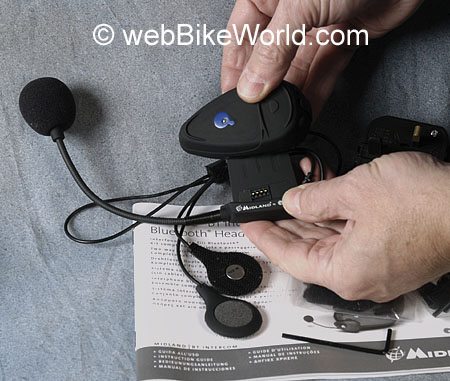
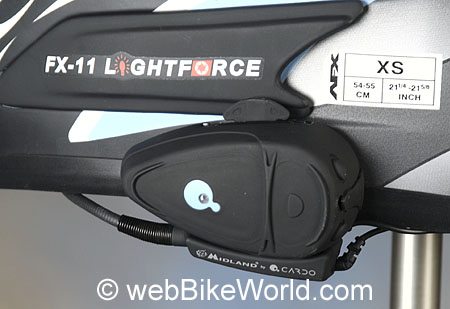
The battery control module snaps on to the unit.I was surprised at how easy it was to get everything set up — there are only 7 pages of instructions, not counting the quick reference chart. There really isn’t any setup – charge the batteries and you’re ready to go.
The batteries detach from the Bluetooth intercom and can be charged separately, which is a nice feature that apparently is not available on other systems.
The manual calls for an initial charging time of 4-5 hours, which was about right, in our experience.
The charging time is claimed to be 3-4 hours after that, but we found that if the batteries weren’t completely run down, they’d recharge in about half that time. A red LED light glows when they’re charging and goes out when they’re ready.
The batteries are claimed to last up to 7 hours and although we haven’t used them for 7 hours straight, they do seem to last about that long when the system is used over several rides, although long intervals between uses will still deplete the batteries.
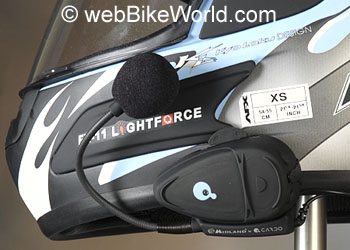
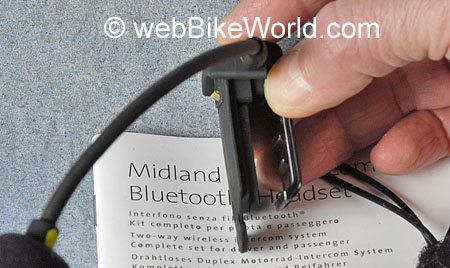
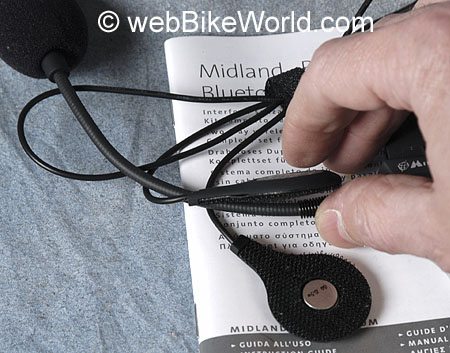
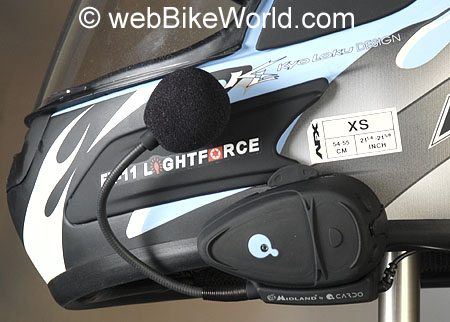
The Bluetooth intercom helmet mounting bracket. The 5mm thin speakers.The oval-shaped battery easily snaps into place on to the Bluetooth unit, which is a self-contained device, including a built-in microphone and two thin speakers.
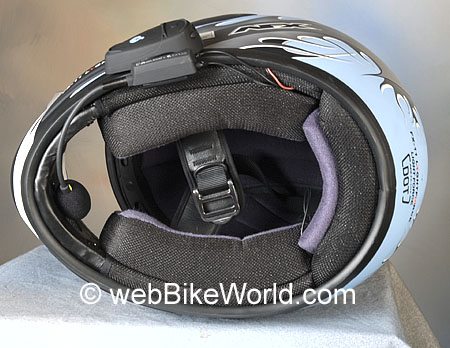
The module has a metal bracket that is installed on the helmet by slipping it between the helmet liner and the helmet shell and tightening the Allen screws. We had no problems installing the intercoms on any of the helmets we tried, including a pair of open-face helmets.
The 5mm thin speakers have a circle of the “hook” half of the Velcro connectors on the back. We found that the speakers stick readily to the fabric used in most helmet liners.
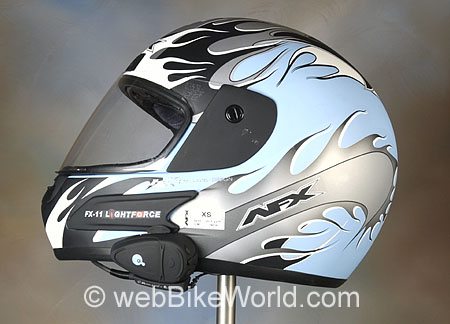
Some helmets, such as the AFX shown here, do not have fabric in the ear pockets, and the “stickum” Velcro squares that come with the intercom can be attached to the helmet shell as a receptor for the speakers.
The bottom line is that we had virtually no problems installing the system or the speakers on any of the helmets we tried.
The left-side speaker has a short (approx. 7″) wire and the right-side speaker is attached to a 22″ wire. This is enough wire length to tuck up under the liner of most helmets, making for a clean and simple installation.
The entire unit, including the battery, speakers and microphone, only weighs 3 oz. (88 grams) and it’s virtually unnoticeable on the helmet.
The Bluetooth intercom system is designed to work without any set-up as soon as it’s turned on. There’s a small button in the middle of each battery module to turn the system on and off. The rider’s intercom has a dark blue button and the passenger’s button is light blue.
Press the buttons and hold them for several seconds until they beep and start blinking blue and you’re good to go. The buttons are flush with the surface of the battery module and they are very hard to find when wearing gloves.
The system is supposed to default to automatic voice activation mode — that is, the rider and passenger can communicate without having to first press any buttons.
Unfortunately, our voice activation system doesn’t seem to work.
I don’t think we’re doing anything wrong — we’ve tried everything we can think of and followed the directions, but no matter what we do, we cannot communicate using voice activation.
Our system does work in the “always on” mode, and that’s what we’ve been using. I’m assuming that this depletes the battery faster than normal, but since we haven’t been able to use the system any other way, I don’t know how much faster.
When used in the “always on” mode, there’s a constant slight hiss in the speakers. I would describe the quality of the sound as adequate, but not perfect, and nowhere near as good as the Baehr wired system.
Some hissing and static is always noticeable, especially when speaking the letter “S”.
Communication is possible, but it’s not FM quality by any means. It’s interesting to note that the sound doesn’t seem to come from the speaker but from somewhere within the helmet itself.
Note: The red wire is from the built-in light and fan in the AFX FX-11 helmet (review).
The battery module also has two buttons, one to raise and one to lower the volume.
But ours don’t seem to do anything — we can’t raise or lower the volume. The standard volume is barely adequate, especially when riding and when wearing ear plugs.
The sound is sort of in there, in the helmet, but it is not really loud enough for comfortable communications.
The system is also designed to connect to a Bluetooth cell phone if desired. We do not recommend using a cell phone when riding a motorcycle.
But we tried the system (when parked on the side of the road) and it works, although we can not get the automatic voice activation for the cell phone to work either.
When a call comes in, the rider is supposed to speak a word and the intercom will connect with the caller. Ours does not work unless we use the manual answer mode, which answers the phone when the power button is pressed once to connect to the cell phone when it rings.
Even in “always on” mode, we occasionally have a problem where the communication link is dropped. It’s my understanding from talking to other Bluetooth users that this is a relatively common problem with many types of Bluetooth systems.
To re-establish communications between our intercoms, the buttons have to be held until both units reconnect.
It’s interesting to note that the system seems to drop the link only after the passenger starts talking after a minute or so of silence.
After the first few words, the link drops. The hissing of the “always on” speaker stops and the connection must be re-established. This doesn’t happen all the time, but it does occur frequently enough to be an annoyance.
I have contacted the distributor with some questions on the operation of the system and I’m waiting for a reply (Note: See Midland’s explanation in the Comments section below).
I’m not sure whether this is a problem with our system or something that’s endemic with the design.
I’ll report back when I learn more, but in the meantime we’ve had such a great demand for information on this system that I wanted to get this review published as soon as possible with our initial impressions.
UPDATE: We received a revised pair of the Midland-Scala Rider TeamSet intercoms but I have to report that we had no better luck with the new set. In fact, they don’t work as well; we can’t get them to communicate with each other at all, either using voice activation or the “always on” mode.
We have since reviewed the Interphone Bluetooth intercoms and we had no problems at all getting them up and running with loud, clear sound and they have become our favorite intercom system.
Conclusion
The Cardo Scala Rider TeamSet – Albrecht Rider – Midland – Alan Bluetooth intercom system is easy to install and use, which was a pleasant surprise.
Based on my experience with other motorcycle intercom systems, this one definitely wins the ease-of-use award.
Once the batteries are charged, you can literally be up and running with an intercom system in a matter of minutes without the fussy wiring harness installation of the “Gen 1” systems.
Although the quality of the sound on our system isn’t great, in our opinion (and it may improve if the volume can be raised) it’s thrilling to have a nearly seamless, unnoticeable rider-to-passenger communication system for the first time, as long as you don’t mind the “early adopter” problems.
I’m assuming that our problems are due to some initial bugs that will be worked out as the systems evolve.
In general, my experience with Bluetooth communications with this intercom system, in cell phones and elsewhere, leaves something to be desired. I hope that the protocol and the hardware will improve over time, because it has lots of promise.
NOTE: See manufacturer’s comments below.
UPDATE: The Midland-Scala Rider TeamSet Bluetooth intercoms were our first exposure to this technology used in a motorcycle application.
We have since reviewed the Interphone Bluetooth intercoms; thus, we have something of a benchmark to use for comparison.
Our experience with the Interphone intercoms is far more positive.
They worked right out of the box with loud, clear sound and at this point, we’d have to recommend the Interphone intercoms over the Midland-Scala Rider TeamSet product for anyone looking for a one-to-one Bluetooth intercom system.
Owner Comments and Feedback
See details on submitting comments.
From “D.M.” (1/10): “The second Teamset, I managed to get working.
Howeve, the only operation working was one speaker on the Zumo sat nav and no contact with the passenger set.
Again the help line were very good, mentioning that it could be the contacts needing a wipe with a suitable cleaning liquid, and an e-mail giving me the telephone number of a customer service helper, followed up by a phone call onto my ansafone.
All this is very commendable but is absolutely no use at all if the product is not fit for purpose.
Sometimes, I have learned through bitter experience, to just “walk away”. I have now purchased and had fitted by the local motorbike shop a Midland BT2 intercom set, it works very well with my Zumo, and with my i-pod.
I haven’t yet had time to test it with a pillion, but suspect it needs further adjustment which I will take up with the seller in due course.”
From “R.V.” (8/09): “This unit has not operated properly since day one. When using the intercom, the microphone cannot be “tuned” sufficiently to eliminate wind noise which will turn on, and keep on, the mic with an awful white noise ringing in your ears.
If you are getting voice commands from the GPS device (in my case, Garmin Zumo 550), I can hear effectively, but that function was only one reason I purchased the device.
The intercom function does not work, in my opinion, as advertised. Now, to make matters worse, the battery will not re-charge. The unit is only two years old (one year past warranty). Batteries cannot be replaced, so that make this unit scrap.
Cannot recommend this unit in any way.”
From “J.G.” (9/08): “Firstly I’d like to thank you guys, you do a great job with your site and are very informative.
I purchased the scala-rider TeamSet last week, however I have encountered the same problems as I think that you had with yours.
The unit pairs perfectly with its TeamSet and the drivers headset has paired perfectly with my TomTom Rider v2.
By manually pressing the talk button my (passenger) and i may hold a conversation, however once my sat nav begins to talk to me (rider) the rider to passenger communication is cut off. This is understandable, however our communication does not return.
This would be fine if the auto voice connection worked and turned the headsets back on allowing us to talk, however this doesn’t and unless the passenger press’s the headset we cannot initiate a conversation.
If the auto voice recognition function worked and allowed the headsets to begin pairing I would be happy.
However as the rider I am very disappointed, because i have no way of talking to my pillion once the sat nav has taken over even when the sat nav has finished giving instructions.
I have tried shouting! yelling! saying lalalalalalalala etc…etc…
But I have had no joy I think only once did the headset recognise my voice and then start to function again, but was knocked straight off again as soon as my TomTom started talking.
Therefore while I still have 14 days money back guarantee I would like to know if you would recommend me returning my TeamSet as the voice connection thing doesn’t work.
And can recommend me getting a pair of scala rider Q2’s? as on your site you don’t really mention that this is a problem with the q2! or is it?
I would appreciate any help.”
H.B.C.’s Reply: An interesting, but not atypical situation. After having lived with the Cardo scala-rider Q2 (review) units for further time, but not having the Editor some update notes yet…here is what I believe is germane to the issues identified:
a. The TeamSet system seems to be pretty good, but not without fault, especially in restoring or initiating rider/passenger intercom functions…
I have not used a TeamSet myself, but I know there are issues (in speaking with owners while travelling this summer) and as a heavy user of the Q2 systems, I can state that the fault is common, despite some differentials between the two systems.
b. When a higher priority activity is initiated, ie – NAV or phone, the Intercom will be cut off, as you have correctly identified, and even on the Q2 sets, used as rider/passenger, or bike to bike (our normal configuration), the intercom will not restore itself, unless the Intercom button is pushed once to initiate a new session.
While I am loath to absolutely point the finger, I suspect that as an incoming call (phone) will always be Priority One (firmware programming) and the intercom session which should be a transparent function (always in the background if so activated) gets switched out/off completely.
Bluetooth priority schemes are there for a functional reason and to address the one to one limitation.
But, many Bluetooth systems (old and new) can intelligently differentiate between priority activities – switching and restoring, something that should be happening in the Cardo systems, but it does not seem to work well…if at all (see d below)
c. There is one configuration setting that might be the culprit, although I suspect you had worked through this, that being the Enable/Disable Voice Command feature.
A long press of both the Volume UP and Volume Down buttons until a beep is heard.
Although the default is Voice Command enabled, some units seem to come with this feature disabled, or in setting and playing with the systems, it gets disabled. I did this with our Q2 units inadvertently once.
d. On a somewhat related note and from a switching perspective, the Conference Call function, if used for a higher priority session vis-a-vis a previous intercom session, could be interfering.
But this would only apply if it was being used – do you just interface with the NAV or do you have a phone linked to the NAV via wire or BT?
e. Back to the Voice Command or VOX (Q2), the Voice Command or VOX function is very weak and extremely slow, which is why I made the comment earlier.
Our Q2 units very seldom respond to voice activation, loud or otherwise, and unless an active session is held open (time based and due to environment nose), we have just resigned ourselves to manually initiating a session, which is not a major effort, but…its the principle that bugs me.
On the same hand, the Q2 sometimes likes to open a session at whim…probably the VOX being triggered by a noise spike vice anything else.
So, re the two systems, I guess the decision is up to you.
If you want to stay with Cardo, I would try a pair of the Q2 units, separately, or as now bundled as the Q2 Multiset.
Overall functionality seems to be a bit better than the TeamSet units, and the Q2 has other features that might be attractive as well.
However, the Intercom session/VOX issue obviously needs to be addressed by Cardo…have added this to my list, again.
Option wise, there are other systems on the market and being introduced that offer enhanced features and seemingly better management of priorities and devices, although the cost is typically higher.”
From “J.F.”: “I’ve been using my Scala FM Bluetooth system for one month now and I am very satisfied with the performance of the unit.
(Editor’s Note: This is a different system than the TeamSet reviewed above),
The FM radio provides background music when I’m riding on monotonous roads, and the Bluetooth link with my Verizon Chocolate phone has been flawless.
When using the phone feature, my wife could not tell that I was riding; in fact, she told me that the fidelity of my voice was better then when I used an Autocom Pro-M1 on my last motorcycle.”
From “S.L.”: “I just bought and tested a Scala TeamSet unit…
At first, I was disappointed when trying to chat with my girlfriend in the living room. I obtained the exact same results as you….hard time recognizing voice, frequent disconnection.
Then, I decided to try them on the motorcycle. After all, it is what they were designed for and I read on some user comment that it actually worked better on the road. The results were fantastic ! Literally night and day !
I suppose the really were designed to eliminate the engine and wind noises and, when used in a perfectly silent environment, don’t perform as good as they can.
About the voice recognition, we found out it’s better to keep speaking for a certain time for it to work. If you just shout GO, START or TEST it doesn’t work. But just saying in a normal tone LALALALA will start the unit without problems.
It does not seem to disconnect and the unit is very clear at speeds of 90kph and below, still reasonable from 90 kph to 120 kph.
And although we had to shout, we could understand simple commands like “Do we take this exit or the next ?” at speeds of up to150 kph.
To conclude, the unit works great on the road…”
From “K.S.”: “You’ve got a lot of user reviews/comments on the Interphone review, but none for the Cardo Scala Rider TeamSet review. Well I hope you post this one.
I not sure that I agree with all of your comments about the Cardo Scala-Rider TeamSet product, or your recommendation about which product to choose.
I bought the Cardo TeamSet for $200 USD or $210 CDN ($279 CDN) in Fargo North Dakota, and they operated properly right out of the box, and sound great, with lots of volume (in intercom mode, I don’t have a Bluetooth phone).
The Interphone version cost a lot more – $450CDN on the Interbike website (plus two taxes) for two sets.
We found that if the passenger can’t initiate a conversation, the driver just has to push the intercom button to toggle the intercom operation, I probably hit it while experimenting with the buttons.
The units charged for 3 hours out of the box (the company says they sometimes send them charged a bit).
They were already paired. They have two speakers each, and lots of speaker cord. The voice activation worked just fine up to 120 kph speed that we tested them at.
The sound adjusted for ambient noise as anticipated, and at times I actually needed to turn the volume down!!!
After reading the review of the Interphone headsets, successfully using the Cardo TeamSet, and considering the functionality and cost, I’m glad that I purchased the Cardo TeamSet.”
Note: We contacted the manufacturer about our problems with the Midland Bluetooth intercom system and received this thoughtful and detailed response.
Although we made every attempt to follow the instructions to get our set working in a variety of conditions, both on and off the bike, we’ll try again and also will report back when we get the updated set.
“Dear Rick, Thank you for your email regarding your review of the Midland BT Intercom. I have read this and the review on your website, and would like to respond with the following points.
Regarding the voice activation:
- Ensure that the yellow sticker by the microphone on the intercoms is pointing towards the user’s mouth. Failure to do this may mean that speech is too quiet to be heard.
- If you wish to speak over the intercom, simply start talking. The units will connect to one another when they detect speech. This avoids having to have a Bluetooth link permanently set up between the two units, thus extending battery life.
- Users sometimes find that they cannot talk to one another when they first try out their intercoms. This is usually due to them being used in a quiet environment. The intercoms are designed to automatically increase or decrease the volume of speech in order to be heard when on the move, whilst preventing speech being too loud when stationary (AGC technology).
- If you find that you cannot hear one another, and the intercoms are not mounted on helmets, try cupping your hand around the back of the microphone, allowing a gap at the front so that your speech can get to the microphone. This simulates the acoustic conditions inside a motorcycle helmet. Now try talking, it may be necessary to talk quite loudly. This may also explain the problems that you had with the volume from the earpieces.
Intercoms shutting off:
- When the background hiss disappears, it simply means that the Bluetooth radio link has dropped, i.e. the two units are no longer continuously sending data to each other. The link should be re-established as soon as one or other party starts to speak.
- From your comments about the “always on” function turning off and the difficulties that you experienced with the voice activation of the intercom, I suspect that your sample is an early unit. The second batch had some modifications to the voice activation, and could be set to have the Bluetooth link permanently on, to give true always on functionality.
- By the way, the part that you refer to as the battery is in fact the Bluetooth radio as well as the battery. The part that attaches to the helmet is just a clamp, microphone and speaker.
Voice activation of mobile phones:
- With most mobile phones, two different things are usually done by spoken commands, voice dialing and voice commands. It is very important to speak loudly and clearly, so the phone can recognize the word. This may be difficult when wearing a helmet. Some models/brands of phones are better at this than others.
- Voice dialing is where the phone user records a word, such as a name, that is called a “voice tag”. This is associated with a particular phone number. When the phone is put in to voice dialing mode, the user says the voice tag and the phone dials the call.
- Voice commands are also words that have been recorded on the phone by the user, but they are used to answer, reject or divert calls. On some phones, they can be very tricky to set up and use, and are not always reliable even when using the phone on its own, let alone via a Bluetooth headset on a moving motorcycle. Some headset manufacturers recommend not using them at all.
Regarding the brand and place of manufacture:
- The units are not made in Germany but China.
- Midland is the wholly owned trade mark of CTE International as is the Albrecht trade mark. Midland USA is part of the group as are all of the Alan Companies including ALAN UK Ltd.
- The units are all designed by Cardo, The Rider is a badged version of the Scala with packaging variations. The Midland BT Intercom is a different product designed around a specification issued by CTE on Cardo, as such it is currently unique.
- There are a raft of new Bluetooth based products due to be launched this year under the Midland banner along with the Bluetooth Radio dongles recently launched under the Albrecht label. These products and the reason for the marketing differences will become more apparent as 2007 moves along and will give the motorcycle Comms industry a much needed boost.However, as we are still in the early stages of the development of Bluetooth intercoms, we understand the requirements of Bikers such as yourself that need multi-point wireless connections. To this end, we are currently working on a multi-point Bluetooth “hub” that will essentially act as an automatic wireless connection switch for several devices at time, when used in conjunction with the existing Bluetooth intercom. We expect this device to be available by the end of May this year.
What is the range from helmet to helmet?
- Approximately 10 meters (30 Feet). This is the limit for class 2 Bluetooth devices, such as headsets and intercoms.
- Editor’s Note: Range comment deleted.
- At present, the Bluetooth intercom is a quick plug and play system that enables the user to talk rider to pillion and to connect with one other device (or two if used with some GPS systems).
Battery life:
Although the Bluetooth link will drop automatically to maximize battery life, using the intercoms in always on mode will still give you an acceptable battery life, in the order of several hours.
Volume and sound quality:
We have sold a great many of these intercoms in the UK and Europe, and have received no complaints about either sound quality or level. Were you trying to listen to music through the earpieces? If so, please bear in mind that the intercom is intended just for communication, and whilst it could be used to listen to music, it does not and was never intended to provide Hi-Fi quality audio.
Finally, we have a web forum (where) you will find FAQs and other useful information about our products.
I hope that this answers your question, if you have any further queries, please do not hesitate to contact us.
Best regards,
Steve Read
Engineer
Alan UK Ltd.”
Addendum: Apparently, our intercom system is the Cardo TeamSet. It contains the Nordic Semiconductor nRF24E1 2.4GHz transceiver, which is a “single chip, true GFSK transceiver with embedded 8051 compatible microcontroller and 9-channel, 12-bit, 100 kSample/s ADC and 1 Mbit/s maximum data rate” and has the following listed features, according to Nordic Semiconductor:
- Designed and engineered for heavy-duty use and performance
- Receive, initiate and reject calls by voice control (subject to cell phone capabilities)
- Two-way radio between rider and passenger (INTERCOM/rider-to-passenger communication)
- Enables 3-way cell phone calls between caller, driver and passenger using the nRF24E1 and Bluetooth simultaneously
- Weather protected headset fits open-faced and full helmets
- Self-installation of entire system within 5 minutes, leaving no traces on helmet
- HIB (High Impact Balancing) microphone for high speed conditions
- AGC Technology automatically self-adjusts speaker volume according to ambient noise level and driving speed
- VOX technology provides voice-controlled receiving and rejecting of incoming calls
- Rechargeable batteries deliver up to 7 hours of talk time
nRF24E1 Standard
It “supports frequency hopping across up to 125 channels with a sub-200 µs (microsecond) switching time…operating temperature range is -40 to +85 ºC”.
It’s commonly used in applications such as “wireless mouse, keyboards and joysticks/gamepads, remote controllers, alarm and security systems, phone peripherals, PC peripherals, home and building automation, telemetry, wireless tags, intelligent sports equipment (e.g. wrist watches and associated sensors), industrial sensors and toys”.