

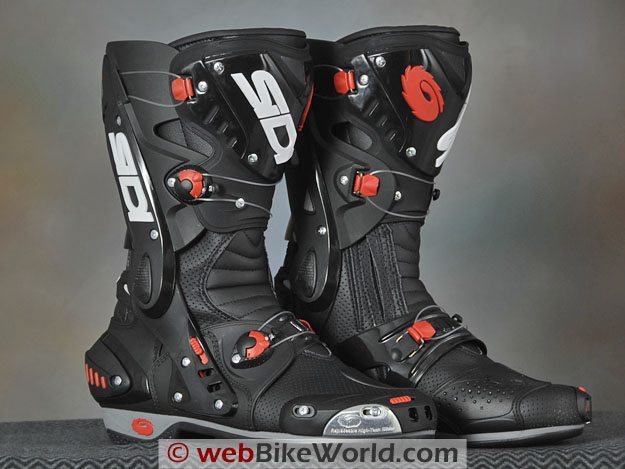
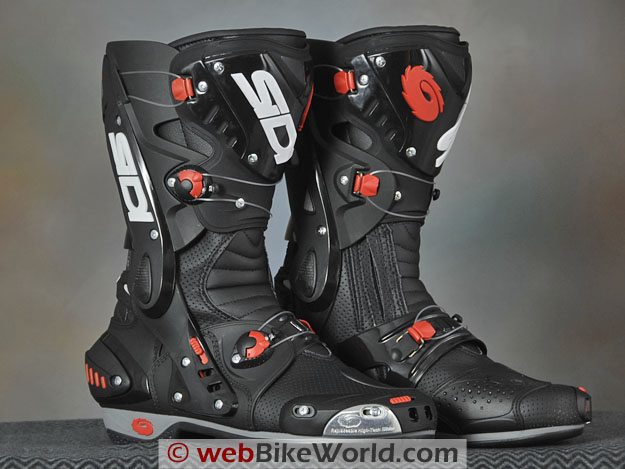
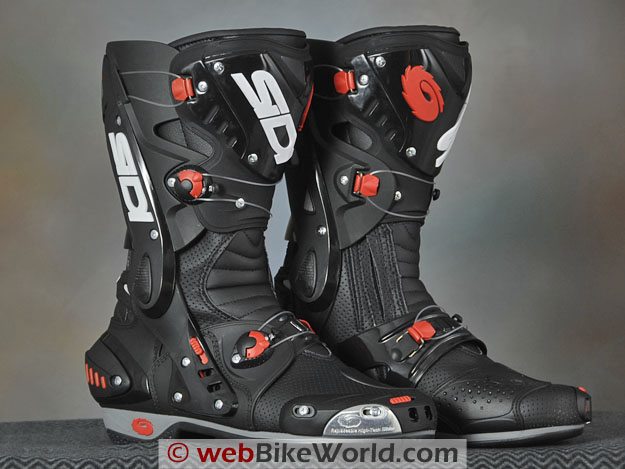
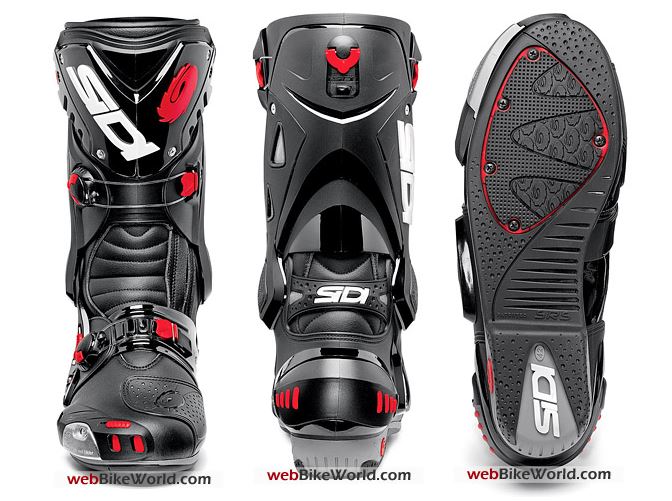
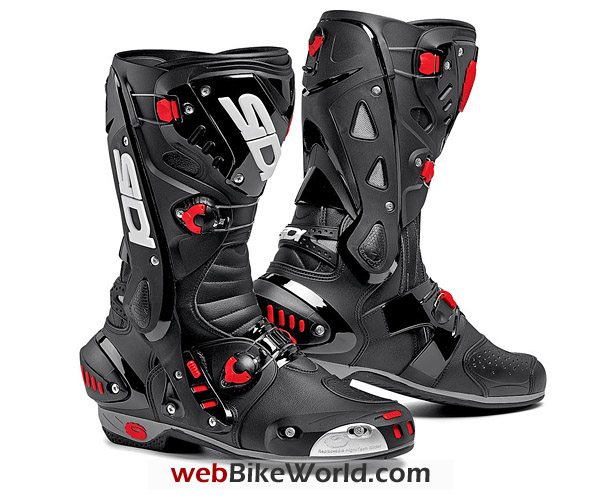
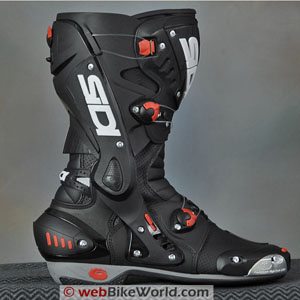
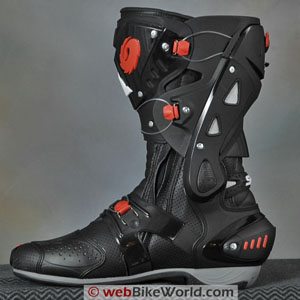
Serious track or race day boots with a closure system that provides securer fitting across the instep, the calf and the shin.
We published a Sidi Vortice boots preview almost exactly two months ago in September of 2008.
At that time, Motonation (the North American distributor for Sidi) promised that the boots would be available for purchase at retailers by December.
Well, they weren’t fooling around — we’re a couple of weeks ahead of schedule, and the Vortice boots are here and ready to go!
The new Sidi Vortice boots have been designed to replace what was probably the best-selling motorcycle track day and race boot ever made: the Sidi Vertigo Corsa.
There are many similarities between the old and new boots, but Sidi has incorporated the latest technology in the Vortice boots.
They can be considered as an advanced evolution of the Vertigo family design rather than a completely new direction.
We never actually reviewed the Corsa version of the Sidi Vertigo boots, but Dave Young reviewed a pair of the street/sport oriented Sidi Vertigo boots back in 2005.
They were the “non-Corsa” version of the popular Vertigo line, with a list price of $275.00 back then. Three years later they’re still available, with a list price that has only gone up $25.00.
It’s not clear whether or not the rest of the Sidi boot lineup will be revised for 2009, but Motonation still carries the Vertigo Corsa ($425.00 list) and the regular Vertigo in both the solid leather and the perforated “Air” versions.
They also sell the Vertigo Rain version with a waterproof membrane.
And while we’re at it, Sidi also still makes their popular boot for larger-sized motorcyclists, the “Mega” Vertigo, with sizes up to 48 Euro (13) in EE widths and extra volume around the calf and shin area.
Oh, and don’t forget the Sidi B2 at only $235.00; the Strada Air and Strada Rain and Sidi’s little sawed-off shotgun of a street/stunt boot, the Streetburner.
Each of the different boots feature Sidi quality and protective features, and yes, there really is a difference — when you pick up a Sidi boot, you know you’re holding something special.
$475.00 for the Vortice boots may seem like a lot of money, but these boots do everything but carry a label that reads “For Professional Use Only”.
No doubt about it: these are serious, focused, no-compromise motorcycle boots, designed for track day or race use.
That’s not to say, of course, that some street riders won’t be interested, but honestly, for normal street use and even an occasional track day, the rest of the Sidi lineup simply makes more sense.
But for anyone looking for some of the highest levels of protection and technology available in a motorcycle race boot, the Sidi Vortice boots come from a proven quality family background, with excellent support through a wide network of retailers.
“Tecno” Boot Support and Tensioner System
Let’s start with the most obvious feature on the Sidi Vortice boots.
It’s the Sidi “Tecno Support System”. First used on the Sidi Vertigo Corsa, this patented system is designed to adjust and tighten the boot around the rider’s instep, shin and calf.
The idea here is to help keep the boot firmly planted on the rider’s foot; to keep the boot in place during a crash and to keep the rider’s foot from sliding forward in the toe.
Since each human foot, ankle, shin and calf combination are different, no single boot design could account for the all the variations without some type of adjustment system.
Sidi has a name for each part of the Tecno system, with the Tecno Calf Tensioner, the Tecno Shin Tensioner and Ankle Support System combining to hold the upper part of the rider’s leg.
And the Tecno Instep Tensioner system, previously used on the Sidi Vertigo Corsa, takes care of the instep.
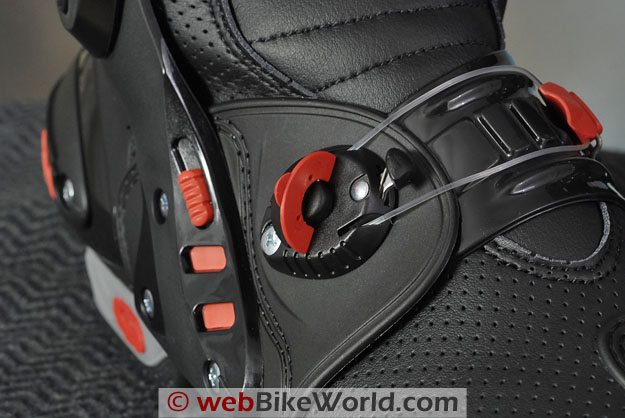
I’ll describe how this system works, but let’s first take a look at three close-up photos of the Tecno system, starting at the top and working down towards the instep:
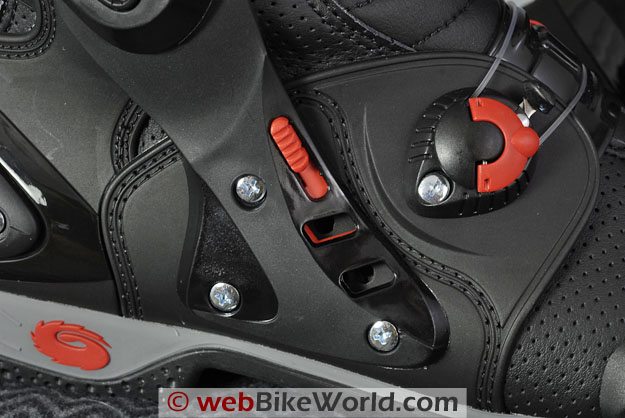
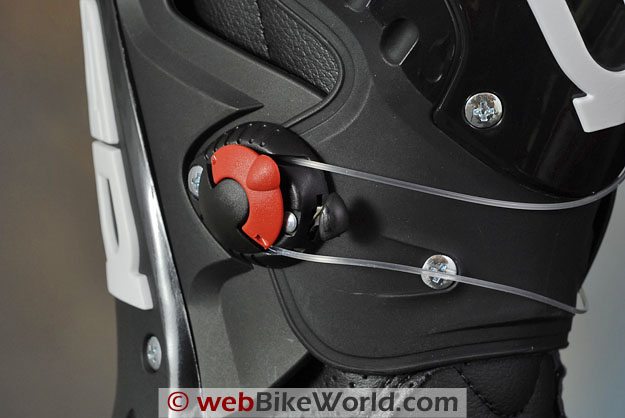
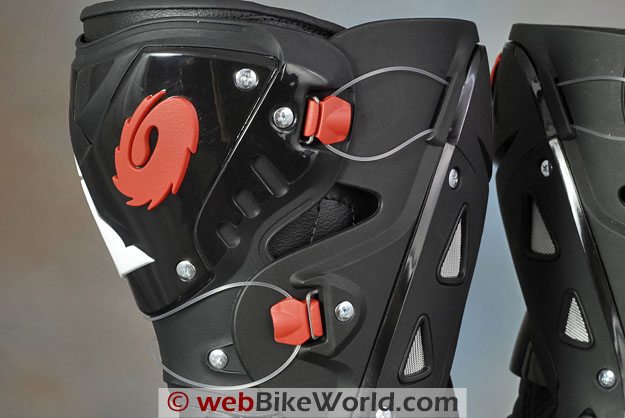
The Tecno Calf Tensioner (top) and Shin Tensioner system. Close-up of the Tecno Shin Tensioner. The Tecno Instep Tensioner system with the adjuster dial flipped open.Notice also the small hammer-like lever just to the right of the dial; this is the lever that is used to release the tension on the adjuster.
The second part of the system is a plastic or nylon hook that is attached to a section of thick nylon cord. This can be seen in the first tensioner photo of the three shown above.
The tensioner hook catches and levers on to a metal bar on the opposite side of the tensioner adjuster “dial”. So when the hook is placed over the bar, the tensioner is tightened to make the custom fit.
Wearing the Sidi Vortice Boots
Before entering the boot, each of the three tensioners must be fully released.
Note that the Sidi Calf Tensioner at the upper rear section of the boot has two hooks, one on either side of the calf, and the tensioner dial is located in the rear, which means that it’s basically a two-handed operation.
I’ve found that it’s best to turn the tensioners anti-clockwise to fully release all of the tension on the nylon cords before trying to put on the boots.
Note that the Sidi Tecno tensioner system may cause a problem for some riders with large-sized calves. There is only so much cord that can be wrapped inside the tensioner, and Sidi says 5 cm (50 mm or about 2 inches) of adjustment is available.
I measured the maximum and minimum distance of the uppermost calf tensioner, measuring inside the boot liner from front-to-back. I get approximately 140 mm (5.5″) with the tensioner fully relaxed and about 115 mm (4.125″) when it’s fully tightened.
This isn’t a lot of distance, even for me, and I have “normal” to thin calves, with a circumference measured over the bare skin of 38 cm (15″) at the distance from the ground to where the top of the Vortice boot meets my leg.
Sidi recommends entering the boot and then kneeling down prior to tightening the tensioners, and by moving the shin forward, the tensioners can be attached and adjusted.
Note that probably every owner of the Vortice boots will be wearing them over leather race pants.
When I wear my Joe Rocket Speedmaster perforated pants (review) or my favorite (and misnamed) Triumph Classic Jeans II (review), I barely have enough width/circumference adjustment on the calf tensioner to get the hooks wrapped across the boot and secured.
That’s the case even with the tensioner released as far as it can go.
It’s definitely not as easy as throwing on a pair of, say, Oxtar TCS Sport boots (review), which admittedly are not anywhere near as track-ready as the Sidi Vortice boots.
But once you get the hang of the Tecno system — as long as you can fit into the boots — it’s not that bad really.
Actually, I think it takes less time to put on the Vortice boots than it does to enter the Gaerne GRS boots (review)..
Sidi also recommends, in their funky owner’s manual (formatted like a newspaper), starting at the bottom with the instep tensioner and working your way up, and this is good advice.
It’s very easy to get the instep tensioner hooked up and ready to go, because you can see it and access it with both hands.
The shin tensioner is next, and this too is relatively easy to get connected.
I have the most trouble with the calf tensioner, due both to the initial snugness of the boot (which I’m sure will loosen up over time with break-in) but mostly because the tensioner dial is in the back of the boot, making it difficult to see and grab.
I wish there was about maybe another 25 mm or so of adjustment available, but there may be some technical reason why this isn’t possible.
I may be making more of a deal out of this than it really is, but I just wanted to describe in detail the Sidi Tecno tensioner system.
This is really what separates the potential customers for this boot from street riders to track day riders or racers, because I don’t think most street riders will want to fuss with the system, while serious racers will have no problem doing what it takes to stay safe.
Sidi Vortice Boot Details
I’m a bit ahead of myself actually, because I didn’t describe how to actually enter the Vortice boot.
Once all the tensioners are loosened and the clips are removed from their posts, the boot easily folds open front-to-back.
The boots have a built-in cushioned “sock” inside, with a nearly full-length, 22 cm zipper on the inside of the boot.
The zipper has a large leather flap at the top with a hook-and-loop attachment that offers more protection and covers the OPTI branded zipper runner when the boot is secured, since the zipper runs from bottom to top.
The rear of the boot rotates backwards from a point near the ankle. This very heavy outer protective section is made from a type of polyurethane that acts as both “armored” protection and a scuff protector.
Believe me, if you crash and slide hard enough to wear through any of the hard plastic on the Vortice boots, you’re in deep, deep trouble!
I can’t imagine any type of motorcycle crash that would wear through this stuff, but I suppose it could happen.
So once the rear of the boot is rotated backwards and the shin plate is rotated forwards, the inner “sock” is uncovered. It has a huge leather finger loop on the back which is super-easy to grab and offers a lot of leverage to yank on the boot.
Once the initial friction is overcome — because this is, after all, a race boot and the ankle has been made as narrow as possible as one more method to ensure the boot stays on the rider’s foot — my foot slides easily inside.
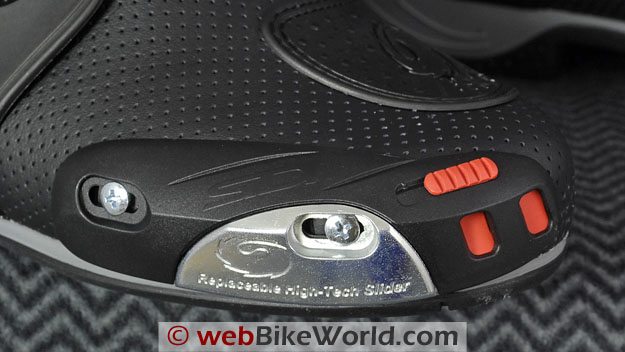
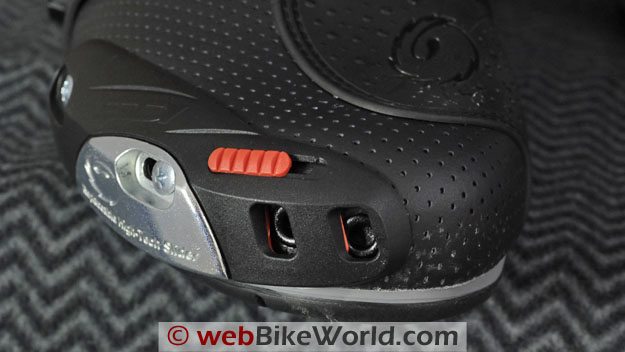
Sidi Vortice “Air” boots have large ventilation sliders on the outstep of the boot and… …at the very front of the toe. These provide excellent ventilation, in combination with the perforated Lorica.Fit and Sizing
The boots shown here are a size 44 Euro, and they fit my 10.5 US medium width foot just the way I like them: as snug as possible without cramping my toes. Each boot shown here weighs 1208 grams (2 lbs., 10-5/8 oz.).
These boots were just not made for walking, so any evaluation of their walking comfort was not taken into consideration.
But suffice it to say that they seem just as comfortable, if that can be said, of any other race-oriented motorcycle boots I’ve worn and, in fact, are easier to walk in than the aforementioned Gaerne GRS boots.
Once everything is buckled up and adjusted (and I’m not sure if there is a prescribed amount of tightness that should be applied to the tensioners; I adjust until snug but not uncomfortable), it’s actually rather comfy inside.
By the way, the soles are also designed to transmit good feel and the tensioner system also helps keep the foot firmly planted on the footbed, which adds to the ability to feel what’s going on through the foot pegs.
This is important for racers; much of the feel of the bike is provided through the metal foot pegs, just like a good pair of race gloves with thin kangaroo palms provides the best feel at the handlebars.
Air Flow, Ventilation and Lining
The boots shown here are the Sidi Vortice “Air” variant, with very, very nice toe and outstep vents that work beautifully to allow air to flow into the boot (see the two photos directly above).
The vents work via a slider that positively opens or closes the vent; their operation can be seen in the video below.
The sides of the boots in the Air variant are perforated leather, which also helps.
Also, the Vortice boots have mesh-covered panels in back of the external calf protector, with corresponding perforations inside of the hard material.
I think these act more like a low-pressure exhaust, similar to a motorcycle helmet rear exhaust system.
The Vortice boot liner is a typical, all-around, slightly padded motorcycle boot material, and it feels fine. A comfortable and cushy liner is important on race boots to keep the hard outer polyurethane protectors from rubbing or chafing.
The “leather” is actually Lorica, and Sidi says the lining is made from a Teflon coated mesh with Cambrelle in the toes. Lorica is supposed to be stronger than leather and easier to take care of, with a side benefit of lower weight.
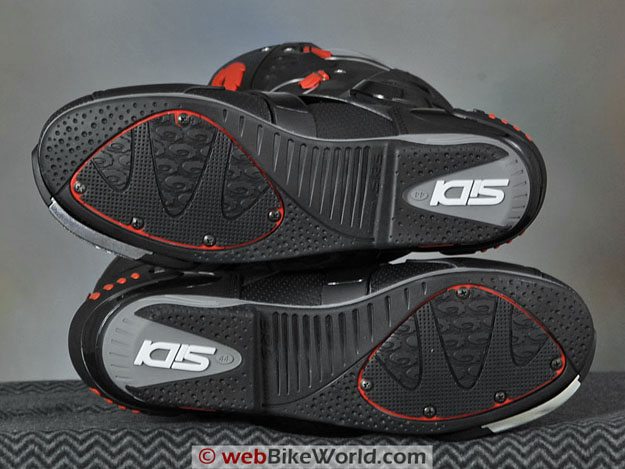
All parts on the Sidi Vortice boots are replaceable, including, of course, the toe slider. Toe vents are shown in the closed position in this photo. Sidi Vortice boot soles. The sole material under the ball of the foot is replaceable.Other Features
It’s important to note that Sidi claims that every part on the boot is replaceable.
This even goes for the soles, as you can see in the photo directly above. The section of sole that gets the most wear from the foot pegs is attached with Phillips head screws and can be replaced.
Replacement parts are important in the Vortice boots.
That’s because if the rider does go down, it’s possible that the tensioner system bits, including the nylon cord and the tensioner release lever, might become bent, ground or scuffed.
In fact, if I was a regular racer or track day rider, I might think about having a few extra tensioner parts on hand just in case.
The large rear heel cup is also replaceable, and it acts as a “shock absorber” during a crash.
Apparently, this part has been designed to deflect and move slightly in a crash, because it’s a part of the boot that may experience the brunt of the impact.
Sidi says that the toe shift pad is made from a special type of DuPont polymer “to ensure that the plastic properties do not change in high or low temperatures.”
Insoles
Also, the insoles of the Vortice boots are made from a type of composite material.
Sidi claims that “the inner sole … resists side to side compression offering greater protection compared to the leather inner soles that our competitors use.
The insole features a removable arch support and will never lose its dynamic characteristics, even after months of intense use; it is water resistant and is designed to withstand high foot peg pressures.”
Sizing and Availability
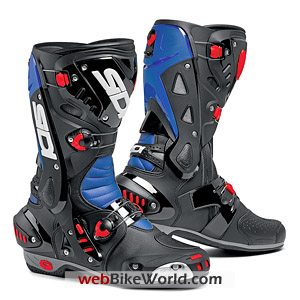
The CE-certified Sidi Vortice boots should be in stores soon (December of 2008). The Vortice is priced at $475.00 and is available in the non-vented version in black, white, red or blue or in the “Air” variant in black or white.
Metric sizes from 39 to 48 (6 to 13 USA) are available.
Conclusion
If there’s a better, more protective boot for serious motorcycle use, track days or racing, I haven’t seen it.
The only issue is how the Vortice boots will fit riders with large calves, but otherwise, I definitely feel protected when I’m wearing these boots.
| wBW Review: Sidi Vortice Boots | |
|---|---|
| Manufacturer: Sidi Boots (Italy) | List Price (2008): $475.00 |
| Colors: Black, Black with Blue, Red, White Sizes: 39 to 48 (6 to 13 USA) |
Made In: Italy |
| Review Date: November 2008 | |
Note: Item provided by a retailer, distributor or manufacturer with these Terms and Conditions.
Owner Comments and Feedback
See details on submitting comments.