

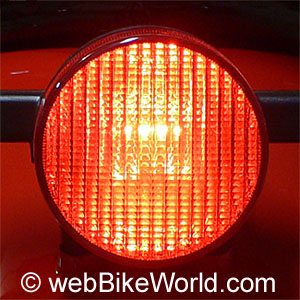
1157 and 1156 Motorcycle Light Bulbs
There are several motorcycle tail light and brake light bulb types which are interchangeable.
Note that these are bulbs that have a low/high filament; i.e., one filament is “on” all the time as the running light, and the other filament comes on as the brake light.
If your motorcycle takes a 21/5W bulb for the brake/taillight combination, you will see that there are alternative bulbs that offer different — and possible better — levels of lighting.
The most interesting aspect of this is that some of these alternative bulbs are available in “long life” versions, which are designed to last longer for “heavy duty” use where vibration is anticipated, such as can be experienced on motorcycles.
Why should you use a different bulb?
Note that the “Diff (%)” column in the table below shows the difference in Watts between the low (running light) bulb power (as an indicator of brightness) and the brake light power. This is important because a greater difference between the running light and the brake light to following vehicles will help increase their awareness that you are coming to a stop.
| Bulb | Filament | Volts | Watts | Diff (%) | Amps | CP | Lumens | Life (hrs) | |
|---|---|---|---|---|---|---|---|---|---|
| Dimmest | 2057 | Low | 14.0 | 6.86 | 74.5 | 0.49 | 2 | 25 | 5000 |
| High | 12.8 | 26.88 | 2.10 | 32 | 402 | 1200 | |||
| 1034 | Low | 14.0 | 8.26 | 64.2 | 0.59 | 3 | N/A | 5000 | |
| High | 12.8 | 23.04 | 1.80 | 32 | N/A | 200 | |||
| 1157 | Low | 14.0 | 8.26 | 69.3 | 0.59 | 3 | 38 | 5000 | |
| High | 12.8 | 26.88 | 2.10 | 32 | 402 | 1200 | |||
| 2397 | Low | 14.0 | 6.72 | 76.5 | 0.48 | 2 | 38 | 5000 | |
| High | 12.8 | 28.54 | 2.23 | 40 | 503 | 400 | |||
| Brightest | 2357 | Low | 14.0 | 8.26 | 71.1 | 0.59 | 3 | N/A | 5000 |
| High | 12.8 | 28.54 | 2.23 | 40 | N/A | 400 | |||
| For reference, here are the specifications for a 21/5W bulb: | |||||||||
| 21/5W | Low | 13.5 | 5.9 | 76.5 | 0.44 | 2.8 | 35 | 1000 | |
| High | 13.5 | 25.1 | 1.86 | 35 | 440 | 250 | |||
| CP = Candle Power. Lumens are a more accurate way of describing “brightness”. This data is from one manufacturer’s bulb specification guide; other bulbs may differ slightly, but they should be very close. The bulbs are listed in order from dimmest to brightest. | |||||||||
For example, if a motorcycle’s running light is 21 Watts (typical 1156), and the brake light is 25 Watts, the difference would be so minimal that following drivers might not notice when the brake lights engage.
This is why I’m a big believer in the rule “one task, one bulb”. The difference between zero output and, say, 25 Watts, using a single filament bulb, is much greater and will be more noticeable than that of a dual-filament. But, I supposed to save space (and money), motorcycle manufacturers seem stuck on the idea of having one bulb perform multiple tasks.
My feeling is that you should find a bulb that is a compromise between three things: brightness, greatest difference in brightness between the running light and the brake light, and longevity.
The 2397 does it for me as a replacement bulb for my Triumph Thunderbird Sport’s 21/5W for one reason: it offers the same differential as the 21/5W, but has at least 5 times the life expectancy. Also, the 2397’s are noticeably brighter than the 21/5W’s when the brake light filaments are lighted (the T-Bird takes two 2397 bulbs).
Note: Since this article was first published, there have been advances in LED lighting technology. See the wBW articles on LED light replacement and LED brake lights – tail lights.
Owner Comments and Feedback
See details on submitting comments.
Other WebBikeWorld Motorcycle Lighting Reviews