

Airbag Technology for Motorcycle Racers
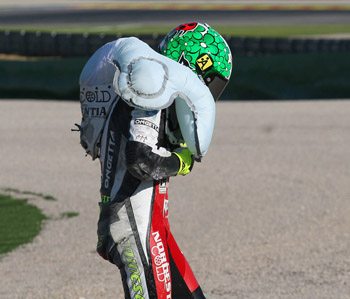
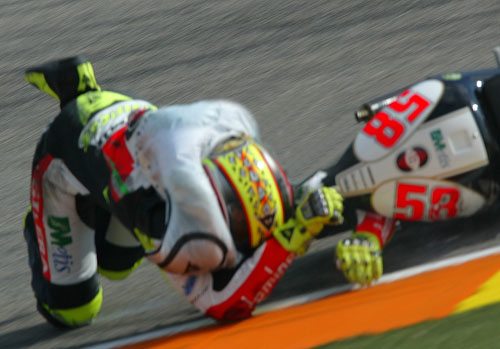
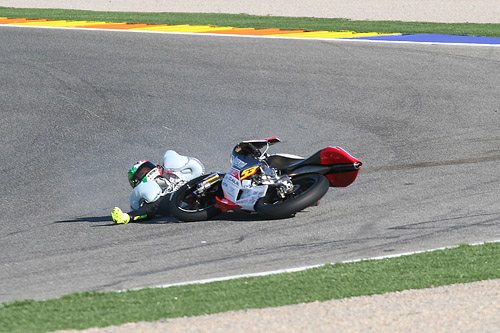
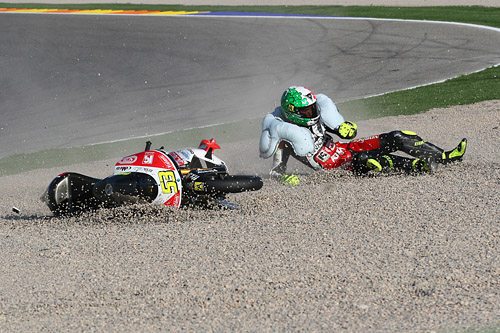
The technology piloted for the Dainese D-Air air bag system was used for the first time ever during the Grand Prix race in Valencia when it was inadvertently tested by by Marco Simoncelli in 250 cc class.
The D-Air air bag system was designed by Dainese (the racing version is called the D-Air Racing System).
It was also worn by motorcycle racers Simone Grotzky and Michi Ranseder in the 125 cc class competition.
A tested and reliable motorcycle air bag system is a welcome addition to the safety accessories that are available to motorcycle riders.
And it probably won’t be long before this type of system is available in many different motorcycle apparel items and even on motorcycles.
Examples: See the wBW report on the Honda airbag system for motorcycles and wBW Armor and Protective Clothing Reviews.
Dainese D-Air System
The Dainese D-Air Racing System is a revolutionary air bag for the protection of competitive motorcycle racers.
After 10 years of study and testing by D-Tec, the Dainese Technology Center, the company’s research and development department presented the innovative new D-air Racing system during a Grand Prix race time in entirely operative mode.
This provides new rider protection technology in the world of racing.
It is a system capable of protecting areas of the rider’s body that traditional protections always failed to reach before: the shoulders, the collarbone, and the neck, thanks to the unprecedented use of an airbag.
The tests conducted in the D-Tec laboratories document shock absorption values decidedly superior to those offered by traditional composite protections.
Those protectors work in synergy with the D-air system to create a complete head-to-toe protection system.
The most revolutionary aspect of the D-air Racing system lies in the fact that the entire system is housed inside a special new appendage mounted on the rider’s shoulders and back instead of the classic aerodynamic hump.
The D-air Racing system works without requiring any type of connection to the motorcycle.
It intervenes whenever the rider makes any of the following types of falls: front low-side, back low-side, and, of course, the dreaded high-side.
The system does not use wires attached to the motorcycle, but is managed by a sophisticated system of accelerometers and gyroscopes housed inside the rider’s aerodynamic hump on the leathers.
The signals are managed by a data interpretation algorithm that triggers inflation.
The trigger signal goes directly to a gas generator that inflates the airbag in 40 milliseconds.
You can see from the photos below that the air bag was inflated as Simoncelli hit the ground.
The system is also designed to be replaced in seconds, and Simoncelli was able to continue practice without problems.
Dainese has been developing this project since 1996.
Perfecting the decision-making hardware and software alone required three years of hard work.
This was also distinguished by the compilation of an impressive quantity of data on racing motorcycle dynamics during both normal riding and falls.
Their interpretation of these data permitted the modification of the trigger signal algorithm, the D-air Racing system’s real ”brain”.
For the development of the D-air Racing system, Dainese formed a special “Task Force” composed of the best experts in the fields of motor vehicle dynamics and airbag system creation.
Also, the motorcycle constructors, who are particularly aware of the importance of safety.
D-Tec also relied on the close collaboration of 2D and the Department of Mechanical Engineering of the University of Padova, while also availing of consultation provided from FIAT Quality Control, TRW, and KTM Racing Team.
The complete absence of fixed connections to the bike, the trigger system, the rapid intervention times, and the areas of the body protected all contribute to making a big difference.
This is compared to similar protection systems and signal a “technological leap forward” in providing people with dynamic sports protection.
The D-air Racing system has been developed exclusively for on-track use by professional racers or expert amateurs.
D-Tec continues in the development of its D-air Strada Project for the protection of motorcycle riders in intense road traffic.
Publication Date: November 2007
Where to Buy Dainese D-Air Motorcycle Air Bag
Check Reviews & Prices on AmazonSee More: Motorcycle Accessories, Motorcycle Tire, Motorcycle Helmets
Owner Comments and Feedback
See details on submitting comments.
Other WebBikeWorld Racers Posts